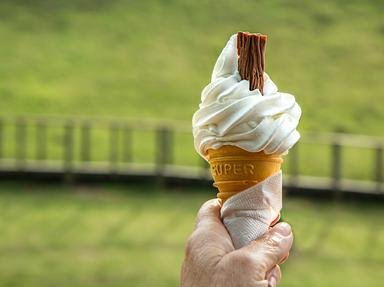
Tiger tail is most popular in Canada, particularly in southern Ontario and Atlantic Canada, and not often found elsewhere in the world. Tiger tail is considered a retro ice cream flavour, owing to its popularity from the 1950s to 1970s, and it has seen a nostalgia-related resurgence since the 2010s.
2. Chunky Monkey
Answer: Banana ice cream, fudge chunks & walnuts
According to Ben Cohen, the name was chosen because it was "fun and silly," and it "made people smile." The "Chunky" part of the name refers to the walnuts and chocolate chunks that give the ice cream its texture, while "Monkey" is a playful reference to the banana flavor. The name is also a nod to the idea that monkeys love bananas, adding to the whimsical and lighthearted nature of the brand.
Chunky Monkey has been referenced in several movies and TV shows, including the sitcom "Friends," in which the character Joey Tribbiani is a huge fan of Chunky Monkey.
3. Butter Brickle
Answer: Chocolate & Buttery Toffee
Although Butter Brickle was first sold as a chocolate-coated toffee on November 20, 1924, by candy manufacturer John G. Woodward Co. of Council Bluffs, Iowa, the credit for creating Butter Brickle ice cream has gone to Omaha, Nebraska's Blackstone Hotel's Orleans Room restaurant, in the late 1920s.
There are two ice cream makers who claim to have been the first to create and market Rocky Road as we know it today, both of them based out of Oakland, California. One ice cream maker is the Bay Area mini-chain Fenton's Creamery, while the other is the national maker Dreyer's (aka Edy's on the East Coast). Dreyer was the ice cream maker and Edy the candymaker, and they created their version of Rocky Road in 1929.
5. Spumoni
Answer: Pistachio, cherry & chocolate ice cream with candied fruit
Spumoni ice cream originates from Southern Italy, specifically Naples, where it began as a molded frozen dessert known as "spumone." The name comes from the Italian word spuma, meaning "foam," describing its light and airy texture.
6. Moose Tracks
Answer: Vanilla ice cream & peanut butter cups
In 1988 in the Upper Peninsula of Michigan, a land known for its moose population, Moose Tracks ice cream was born. The inspiration for the name came from a nearby mini golf course named Moose Tracks.
7. Hokey Pokey
Answer: Vanilla Ice Cream & Honeycomb Toffee
A favorite in New Zealand! The exact origin of Hokey Pokey ice cream is a bit fuzzy, but it's widely agreed that it was popularised by Tip Top, a New Zealand ice cream company founded in 1936. In the 1950s, Tip Top began experimenting with adding toffee pieces to their vanilla ice cream.
While this was a big hit, it wasn't until the 1980's that Tip Top decided to use small balls of honeycomb, or Hokey Pokey instead. The combination of crunchy toffee and smooth ice cream struck a nostalgic chord with locals and quickly became a best-seller.
8. Moon Mist
Answer: Grape, Banana & Blue raspberry
A favorite in Atlantic Canada! After joining his family's creamery business, Bruce Hart travelled from Nova Scotia to the U.S. sometime before or after he served during the Second World War where he attended, most likely, the University of Massachusetts.
It was there, legend has it, that a young Bruce Hart had the audacity to swirl three ice cream flavours together: banana, grape and blue raspberry. He called it Moon Mist, a lush ice cream flavour with colourful ripples of yellow, purple and blue.
In subsequent years some creameries have replaced blue raspberry with bubblegum -flavoured ice cream.
Bear Claw ice cream is a flavor that originated in the United States, specifically in the Midwest, where bear claw pastries are a staple in many bakeries. The ice cream flavor is designed to mimic the taste and texture of these pastries, which typically consist of a flaky, buttery crust filled with nuts and sometimes chocolate.
The story goes that a baker in California accidentally dropped a batch of dough into a vat of oil, resulting in the distinctive claw-like shape of the pastry.
Heavenly Hash dates back to at least 1887 when it was a fruit dessert. It became a chocolate bar containing nougat, marshmallows and chopped walnuts in 1918. Shortly thereafter, the ice cream developed with pecans frequently substituted for walnuts.
12. Cherry Garcia
Answer: Cherry ice cream with cherries & fudge flakes
First introduced in 1987, it was created as a tribute to Jerry Garcia, the legendary lead guitarist of the Grateful Dead. Jerry Garcia was not just a musician but also a cultural icon, deeply associated with the counterculture movement of the 1960s. His fans, known as "Deadheads," were known for their loyalty, and Ben & Jerry's wanted to honor him in a unique way.
A fan-favorite of COWS ice cream, from Cavendish, Prince Edward Island, Canada. COWS is known for its innovative approach to flavor development. Each year, the ice cream production manager invites staff to submit their flavor ideas, which are then sampled and rated.
This collaborative process ensures that new flavors are both creative and delicious. Some flavors are even named through public input, like the popular Moonicorn.
Baskin-Robbins introduced Baseball Nut ice cream in 1986 to honor the World Series. The flavor was inspired by the classic ballpark experience, combining creamy vanilla with crunchy cashews. A black raspberry swirl added a tart, fruity twist.
15. Devil's Footprints
Answer: Newfoundland Partridge Berries
Named after a nearby rock formation, this bright red scoop starts with a creamy custard base and gets packed with hand-picked partridgeberries-they're like cranberries, but even more tart. Created by Sweet Rock Ice Cream, Bonavista, Newfoundland, Canada.
This quiz was reviewed by FunTrivia editor Bruyere before going online.
Any errors found in FunTrivia content are routinely corrected through our feedback system.