FREE! Click here to Join FunTrivia. Thousands of games, quizzes, and lots more!
Quiz about Hajj and its Restrictions

Hajj and its Restrictions Trivia Quiz


This is my adopted quiz on Hajj. Good Luck!
This is a renovated/adopted version of an old quiz by author giantcomet4

A multiple-choice quiz by cavalier87. Estimated time: 4 mins.
  1. Home
  2. »
  3. Quizzes
  4. »
  5. Religion Trivia
  6. »
  7. Islam
  8. »
  9. Events

Author
cavalier87
Time
4 mins
Type
Multiple Choice
Quiz #
186,114
Updated
Jun 05 26
# Qns
10
Difficulty
New Game
Avg Score
9 / 10
Plays
16
Last 3 plays: Reamar42 (9/10), Dizart (8/10), Strike121 (5/10).
- -
Question 1 of 10
1. Prophet Muhammad once said:

"Whoever performs Hajj for the sake of _____ and does not utter any obscene speech or do any evil deed, will go back free of sin as his mother bore him."

What correctly fills in the blank?

Answer: (One Word; Major figure in Muslim faith, starts with an A)
Question 2 of 10
2. Hajj is a rigorous, strict process with multiple layers. Which of the following is strictly forbidden during Hajj? Hint


Question 3 of 10
3. One aspect of Hajj is known as "Sa'i" or, walking and running between the two hills of Safa and Marwa. Participants are asked to travel between these two points multiple times. How many? Hint


Question 4 of 10
4. Hajj has its restrictions as does every event in Islam. After you've done Ihram and started Hajj, which of the following should NOT be done? Hint


Question 5 of 10
5. During Hajj, is hunting allowed or not?


Question 6 of 10
6. Humans in general, across all cultures, place great emphasis on social and financial status, among many other things. When on Hajj, how does your income bracket impact you? Hint


Question 7 of 10
7. On the 10th, 11th, and 12th day of Dhul Hijjah (the month in the Islamic calendar during which Hajj is undertaken), participants will perform Rami, or the stoning of the devil. They must collect 49 pebbles in preparation for doing this. But, of course, 49 divided by 3 does not come out to a whole number. On which day are the LEAST amount of pebbles used? Hint


Question 8 of 10
8. If, for any particular reason, you wanted to, but could not, directly attend a Hajj, the festival of Eid al-Adha, or the Feast of Sacrifice, would still be a way to stay connected to the faith. On what date in Dhul Hijjah does this take place? Hint


Question 9 of 10
9. In order to accommodate and facilitate the Hajj, a particular city is set up with hundreds of thousands of air conditioned tents. It has been nicknamed "The City of Tents". Where do those practicing Hajj spend a majority of their time?

Answer: (Four letters, starts with an M)
Question 10 of 10
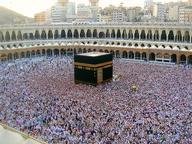
10. The very final aspect of Hajj is known as Tawaf al-Wida. It is the last thing participants do before they depart Makkah. During this step, participants must walk anticlockwise around the Kaaba seven times. Each time, they must "make dua." What is an example of making dua? Hint


(Optional) Create a Free FunTrivia ID to save the points you are about to earn:

arrow Select a User ID:
arrow Choose a Password:
arrow Your Email:


Most Recent Scores
Today : Reamar42: 9/10
Today : Dizart: 8/10
Today : Strike121: 5/10
Today : Nhoj_too: 10/10
Today : Guest 37: 0/10
Today : cardsfan_027: 9/10
Today : marianjoy: 10/10
Today : NASAGreg: 6/10
Today : xchasbox: 9/10

Quiz Answer Key and Fun Facts
1. Prophet Muhammad once said: "Whoever performs Hajj for the sake of _____ and does not utter any obscene speech or do any evil deed, will go back free of sin as his mother bore him." What correctly fills in the blank?

Answer: Allah

This is said in numerous texts, most prominently Bukari Volume 2, Book 26, Hadith 596. It has been reinterpreted with slight changes to very specific words or phrases, which mostly stem around briefly specifying 'obscene speech' or 'evil deeds'. One such example is adding that having sexual relations with one's wife is forbidden, as one such 'evil deed'.
2. Hajj is a rigorous, strict process with multiple layers. Which of the following is strictly forbidden during Hajj?

Answer: Speaking disrespectfully to others

Specifically, participants may not "hurt anybody with their words."

The Quran says: "The pilgrimage is in the appointed months. Whoever intends to perform it during them must abstain from indecent speech, from all wicked conduct, and from quarrelling while on the pilgrimage." (2:197)

There are the three ways stated in the Quran in which people hurt each other with words: a person says indecent things, uses bad language about others, or argues and fights. During Hajj, these are forbidden. The purpose is to make it so that when someone returns from the Hajj, which is a deeply spiritual venture, their tongue remains clean from such words forever.
3. One aspect of Hajj is known as "Sa'i" or, walking and running between the two hills of Safa and Marwa. Participants are asked to travel between these two points multiple times. How many?

Answer: Seven

The intended way for this to go is that participants will begin the Sa'i on the hill of Safa and walk towards the hill of Marwa. Along the way, green-colored markers are meant to help people determine when they should run and when they should walk; upon spotting one, they should run until they reach it, then walk until spotting the next one. The Sa'i is complete once a total of seven trips have been finished between the hills of Safa and Marwa - a total distance of about three kilometres.

This is meant to represent Hajar, and her struggle in the desert in search of water for her son, Prophet Isma'il.
4. Hajj has its restrictions as does every event in Islam. After you've done Ihram and started Hajj, which of the following should NOT be done?

Answer: Cutting your nails

Ihram is a spiritual state of mind, achieving which marks the start of Hajj as a whole. In addition to refraining from nail cutting, men in Ihram must also wear two white seamless cloths and they may not cover their heads. For women, they must wear hijabs, where the hands and face are uncovered.

For both genders, they are forbidden from shaving any part of the body, having sexual relations, using perfumes, damaging plants, killing animals, getting married, or carrying weapons.
5. During Hajj, is hunting allowed or not?

Answer: No

Hunting and killing anything that is alive is forbidden during Hajj - even an ant or a fly. However, if done accidentally, it essentially does not count, so you don't need to micromanage your footsteps while you're outside in fear of stepping on an ant.
6. Humans in general, across all cultures, place great emphasis on social and financial status, among many other things. When on Hajj, how does your income bracket impact you?

Answer: It doesn't

The Ihram is very explicitly meant to show the equality of all participants in front of Allah, with no regard for financial or social status. While one's financial status could determine if they can plausibly even afford to participate, once engaged with Hajj, the meaning of this status becomes irrelevant.
7. On the 10th, 11th, and 12th day of Dhul Hijjah (the month in the Islamic calendar during which Hajj is undertaken), participants will perform Rami, or the stoning of the devil. They must collect 49 pebbles in preparation for doing this. But, of course, 49 divided by 3 does not come out to a whole number. On which day are the LEAST amount of pebbles used?

Answer: 10th

On the 10th of Dhuj Hijjah, seven pebbles are used. On the following two days, 21 apiece are used. The reason is that there are simply more targets for stoning on the latter two days than on the first. On the 10th, participants must strike the Big Jamarah with seven pebbles. During the next two days, they must turn their attention to all three walls of the structure, hitting each wall seven times apiece in the process.
8. If, for any particular reason, you wanted to, but could not, directly attend a Hajj, the festival of Eid al-Adha, or the Feast of Sacrifice, would still be a way to stay connected to the faith. On what date in Dhul Hijjah does this take place?

Answer: 10th

Dhul Hijjah is the twelfth and final month of the Islamic lunar calendar. Its name literally means "The Month of Pilgrimage", which is intended to reflect that it is the month in which Hajj itself takes place.

Incidentally, Eid al-Adha and the start of Rami both occur/begin on the 10th of Dhul-Hijjah. This, in effect, makes it an especially iconic day for the Hajj pilgrimage, known as Yawm al-Hajj al-Akbar.

To begin, Muslims recite the takbir, or a prayer of "Allahu Akbar" roughly translating to English into "God is greater". Like on Eid al-Fitr, the Eid prayer is performed on Eid al-Adha any time after sunrise and before the Zuhr prayer. This is followed up by a sermon, and is finalized by the exchanging of gifts. For those living in the US or in a Europeanized setting, you may view this similarly to how a family may exchange gifts during Christmas.
9. In order to accommodate and facilitate the Hajj, a particular city is set up with hundreds of thousands of air conditioned tents. It has been nicknamed "The City of Tents". Where do those practicing Hajj spend a majority of their time?

Answer: Mina

Mina is where, according to the Qur'an, Ibrahim was ordered by the archangel Ibrayil to throw stones at Shaitan to demonstrate rejection of sin. Three specific commands corresponded to three instances of temptation to disobey Allah's instruction to sacrifice his son Ismail: his own desire to disobey, that of his wife Hagar, and Isma'il's own reluctance to be sacrificed. It was only because all three temptations were resisted that Allah provided the miraculous substitution of a ram for the boy.

As such, the Rami al-Jamarat, undertaken at Mina, reenacts Ibrahim's obedience to the commands of Ibrayil. Mina, because of the way it accommodates Hajj with tents, is largely considered to be the biggest tent city in the world.
10. The very final aspect of Hajj is known as Tawaf al-Wida. It is the last thing participants do before they depart Makkah. During this step, participants must walk anticlockwise around the Kaaba seven times. Each time, they must "make dua." What is an example of making dua?

Answer: Reciting a verse from the Qur'an

Qur'anic verses, dhikr, or any supplications from the Sunnah will suffice for making dua. Once seven rounds have been completed, participants are then expected to perform two rak'ahs of prayer near Maqam Ibrahim, if possible.
Source: Author cavalier87

This quiz was reviewed by FunTrivia editor looney_tunes before going online.
Any errors found in FunTrivia content are routinely corrected through our feedback system.
6/6/2026, Copyright 2026 FunTrivia, Inc. - Report an Error / Contact Us