FREE! Click here to Join FunTrivia. Thousands of games, quizzes, and lots more!
Quiz about Creating the Perfect Storm

Creating the Perfect Storm Trivia Quiz

From Heat to Hail

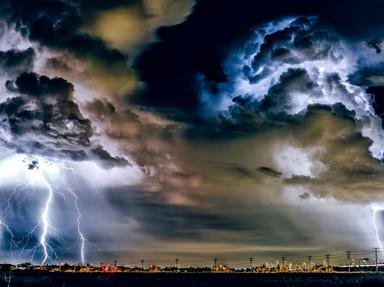
From heat to hail, here are ten steps to follow if you want to create your very own single-cell thunderstorm... or a least understand how they're formed naturally. Place the steps in order, and as always, have fun!

An ordering quiz by NeuralSpicy. Estimated time: 3 mins.
  1. Home
  2. »
  3. Quizzes
  4. »
  5. Science Trivia
  6. »
  7. Environment
  8. »
  9. Weather

Author
NeuralSpicy
Time
3 mins
Type
Order Quiz
Quiz #
425,790
Updated
Oct 05 26
# Qns
10
Difficulty
Tough
Avg Score
6 / 10
Plays
17
Last 3 plays: stevroll (6/10), MargW (8/10), Radain (7/10).
Mobile instructions: Press on an answer on the right. Then, press on the question it matches on the left.
(a) Drag-and-drop from the right to the left, or (b) click on a right side answer, and then click on its destination box to move it.
Generally, single-cell thunderstorms form pretty predictably. I've broken the process down into ten steps. All you have to do is place them in order!
What's the Correct Order?Choices
1.   
The air reaches the dew point
2.   
(Evaporation)
Moisture builds near the surface
3.   
(Trapped!)
Ice particles form and collide
4.   
(Lift-off)
The Sun heats the ground
5.   
(Still going...)
Rising air cools as it climbs
6.   
(That's cold enough)
The storm fully develops
7.   
(Cooling causes heating?)
The air becomes unstable
8.   
Condensation releases heat
9.   
(Chaos in the clouds)
Cumulus clouds grow taller
10.   
Air gets pushed upward


Most Recent Scores
Today : stevroll: 6/10
Today : MargW: 8/10
Today : Radain: 7/10
Today : mjgrimsey: 5/10
Today : Guest 195: 6/10
Today : cardsfan_027: 10/10
Today : Guest 76: 6/10
Today : Guest 86: 8/10
Today : Emma-Jane: 10/10

Quiz Answer Key and Fun Facts
1. The Sun heats the ground

The Sun warms the surface of the Earth. That's its job. The Earth in turn warms the air just above it. It happens all the time and makes for great small talk. The ground heats up surprisingly quickly, especially on sunny days. This creates pockets of warm air near the ground. That sets the whole process in motion by helping moisture build near the surface.
2. Moisture builds near the surface

As the ground and nearby water warm up, water evaporates and adds moisture to the air. So in this case, it's both the heat AND humidity. Warm air can hold a lot more water vapor, so a hot, humid day can load the lower atmosphere with plenty of moisture. Now there's both heat and moisture just waiting for a nudge: rising air.
3. The air becomes unstable

Warm, moist air is less dense than the cooler, drier air around it, so it wants to rise and be free. This creates an unstable atmosphere, where rising air can keep rising instead of quickly sinking back down. However, it still needs that little push to get moving. It's a little like a helium balloon under a blanket, as we'll see.
4. Air gets pushed upward

I know. Hot air should rise all by itself, right? It's more buoyant, and it WANTS to rise (hence the instability). The problem is that above this unstable layer, there is often a stable layer of warm air that acts like a lid. This "lidding" effect is called a capping inversion.

So, something needs to lift the warm, moist air. This lift can come in the form of a cold front, a mountain slope, or winds coming together near the surface. Once that air starts climbing, it encounters lower air pressure and begins to expand. That expansion causes the rising air to cool, which takes us right to the next step.
5. Rising air cools as it climbs

Higher in the atmosphere, the air expands because the pressure is lower, and that expansion cools it. The farther the air rises, the cooler it becomes. It started out warm at the surface, it got pushed up into the atmosphere, and now the air is thin and cold. Eventually, it reaches a temperature where the water vapor doesn't like being water vapor anymore.
6. The air reaches the dew point

The rising air reaches its dew point. That's where water vapor begins turning into tiny liquid droplets. Those droplets form around microscopic particles such as dust or salt (called condensation nuclei) floating in the air. This is when the rising invisible water vapor starts becoming a visible cloud made of water droplets, and the cloud has a very unintuitive way to get an extra boost.
7. Condensation releases heat

When water vapor condenses into droplets, it releases stored heat into the surrounding air. That may sound like a paradox, but the heat was already stored in the water vapor and gets released during condensation. Remember that evaporation causes cooling; that's why we sweat.

It's the reverse here. The extra warmth created by the condensation makes the rising air more buoyant, helping it rise faster and giving the growing cloud even more energy.
8. Cumulus clouds grow taller

With rising air getting another boost from condensation, the cloud can grow, reaching higher and higher, often developing into a monstrous tower of a cumulus cloud. Strong upward currents can carry warm, moist air to humbling heights while the cloud continues to grow. Deep inside that cloud, temperatures eventually become cold enough for frozen particles to form. Which takes us to the next step.
9. Ice particles form and collide

High inside our growing cloud, temperatures are cold enough for ice crystals (particles similar to snow) and supercooled water droplets to live together, but not in happy harmony. They bounce and collide and exchange electrical charges as they move through strong updrafts and downdrafts.

It's chaos! The electrical separation grows, and this will eventually give us the lightning, thunder, heavy rain, and strong winds of a fully mature storm.
10. The storm fully develops

Congratulations. Your single-cell thunderstorm is now complete. The cloud is mature, with strong updrafts and downdrafts, heavy rain, and often lightning, thunder, hail, and high winds. The storm's strong updrafts can keep feeding warm, moist air into our cloud while precipitation falls through the downdrafts. What began with rays of sunshine warming the ground under our toes has now become a huge, energetic system in the atmosphere that brings us the water life needs to survive.
Source: Author NeuralSpicy

This quiz was reviewed by FunTrivia editor rossian before going online.
Any errors found in FunTrivia content are routinely corrected through our feedback system.
Related Quizzes
1. My Head in the Clouds Average
2. The Foggiest Ideas Average
3. A History of Weather Easier
4. A Question of Weather Easier
5. Quite a Cloudy Day Average
6. Hazard a Guess? Average
7. Dust In the Wind Average
8. Let It Rain Average
9. Riders on the Storm Average
10. Weird Weather Average
11. Sometimes It Snows In April Average
12. Seasonal Weather in the USA Average

10/5/2026, Copyright 2026 FunTrivia, Inc. - Report an Error / Contact Us