FREE! Click here to Join FunTrivia. Thousands of games, quizzes, and lots more!
Quiz about Equations Your Physics Teacher Swears Are Fun

Equations Your Physics Teacher Swears Are Fun Quiz

Physics Formulas

I'll show you ten important formulas from the world of physics. Match the description or name of the formula to the formula itself. It's not unkind to those who know little or nothing about the subject. Just don't get overwhelmed by the symbols. Enjoy!

by JJHorner. Estimated time: 3 mins.
  1. Home
  2. »
  3. Quizzes
  4. »
  5. Science Trivia
  6. »
  7. Physics

Author
JJHorner
Time
3 mins
Type
Quiz #
423,227
Updated
Feb 27 26
# Qns
10
Difficulty
Easy
Avg Score
8 / 10
Plays
19
Last 3 plays: MaziFax (10/10), xchasbox (2/10), paper_aero (8/10).
Drag-Drop or Click from Right
Options
Mechanical Advantage Ohm's Law Parallel Component of Weight (Inclined Plane) Kinetic Displacement (Constant Acceleration) Centripetal Force Work Performed (Constant Force) Kinetic Velocity (Constant Acceleration) Newton's Second Law of Motion Time Dilation (Special Relativity) Universal Gravitation


 View Image Attributions for This Quiz

Most Recent Scores
Today : MaziFax: 10/10
Today : xchasbox: 2/10
Today : paper_aero: 8/10
Today : Guest 143: 0/10
Today : GoodwinPD: 10/10
Today : cdecrj: 3/10
Today : bernie73: 1/10
Today : james1947: 10/10
Today : sally0malley: 10/10

Quiz Answer Key and Fun Facts
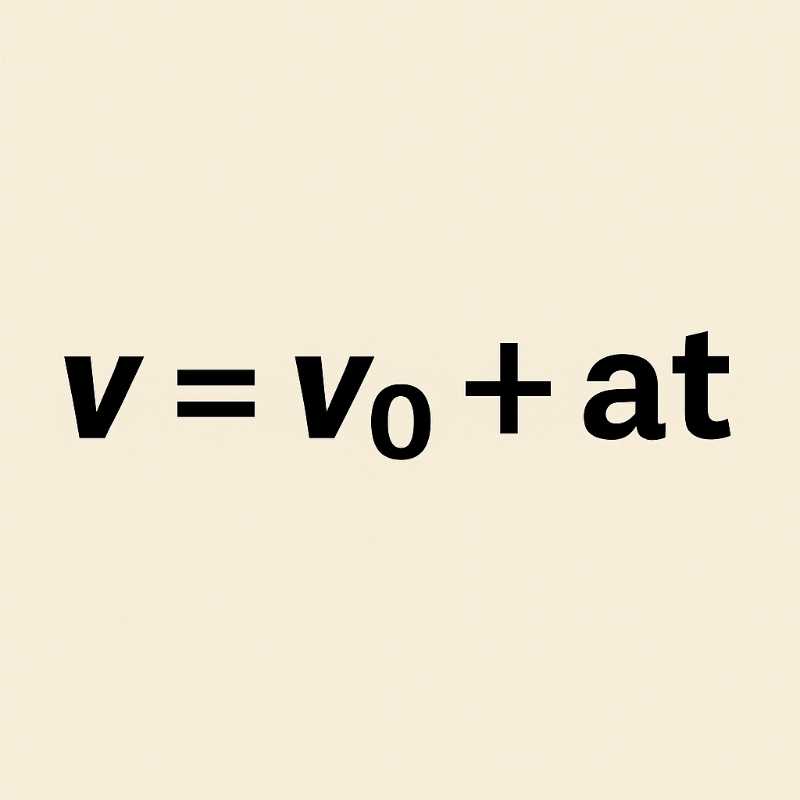
1. Kinetic Velocity (Constant Acceleration)

"Kinematic Velocity at Constant Acceleration" sounds like a very cruel way to describe something quite simple. If you start traveling at a given speed, accelerating (or decelerating) at a constant rate, you're going to have a different velocity after a given amount of time. If that still doesn't make sense, I've got an example. Trust me. There's a squirrel. Kind of.

First things first. The formula:

v = v₀ + at

That's not too scary.

v is the value we're looking for. Your final velocity in meters per second (m/s).
v₀ is your initial velocity at t = 0 in meters per second
a is your acceleration in meters per second squared (m/s²)

Wait, what? Meters per second squared? What's that all about? It's hideous, but it makes sense.

Your velocity is how much distance (meter) you travel per unit of time (second): meters per second (m/s). Easy, right?

Well, your acceleration is how fast your velocity (meters per second) changes every second (second): meters per second per second (m/s/s), but we simplify the units just like we can simplify any fraction: m/s².

Acceleration is positive if you're speeding up or negative if you're slowing down. It's also a vector, which means it has implied direction. We're going to avoid getting too much into vector math in this quiz, so you can relax.

So how about that example?

Imagine you're driving at 20 m/s (about 72 km/h or 45 mph). A plastic bag that you mistake for a squirrel is in your path and you hit the brakes, producing an average deceleration of -5 m/s². How long until the car stops?

We know the initial velocity (20 m/s), we know the end velocity (0 m/s), and we know the acceleration (-5 m / s²). We need to find the time.

0 m/s = 20 m/s + (-5 m/s²) * t

What an unkind quiz author. Let's rearrange that:

t = (-20 m/s) / (-5 m/s²) = 4 s

So, it'll take you 4 seconds to stop.

There's another formula in this quiz that will tell you how far you travelled in that four seconds (see Kinematic Displacement). Long story short, you travelled a total of 40 m (131 ft) while trying to brake. I'm thinking if that was a real squirrel, it might not have a happily ever after.
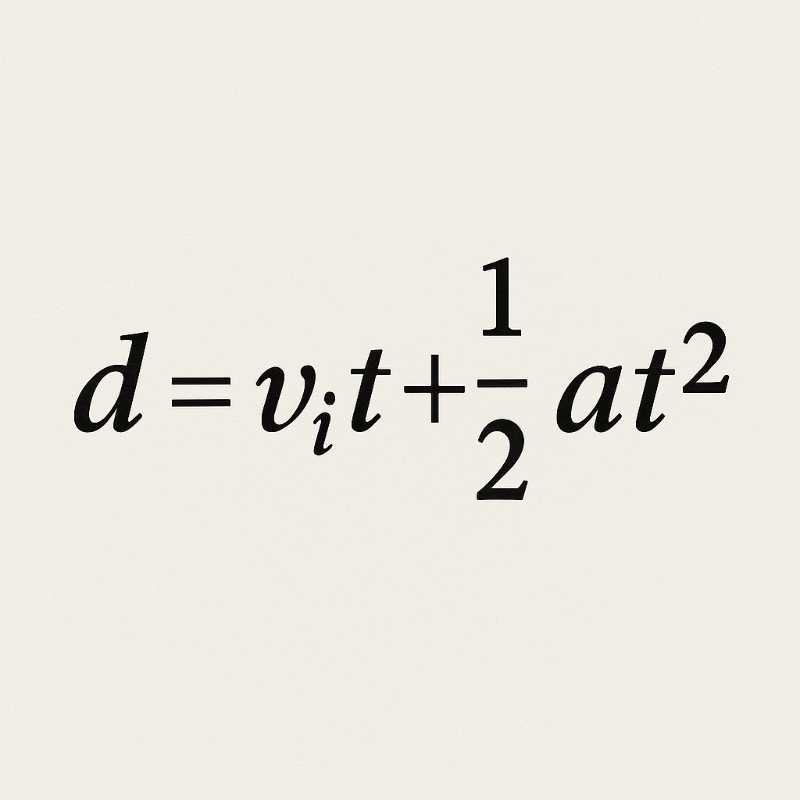
2. Kinetic Displacement (Constant Acceleration)

Kinematic displacement at a constant acceleration is defined as:

d = vᵢt + ½ at²

This looks ugly because I decided to take into account acceleration, forgetting that I was the one who would have to type all these difficult characters into a text editor.

What do all these variables mean? Well, take my hand:

d is the displacement in meters (also sometimes written as 's' to distinguish it from distance, which is a scalar value)
vᵢ is the initial velocity in meters per second
t is the elapsed time in seconds
a is the CONSTANT acceleration, in meters per second per second (m/s²)

If you're wondering if there's a difference between displacement and distance, the answer is a big ten-four. When you drive from your house to the banjo repair shop, the car's odometer tells you the distance you drove. If you look at a map, and draw a direct line between the car and the banjo repair shop, the length of that line is proportional to the displacement.

If you start at home, drive around the block, and end up back at home, you've traveled some distance. But your displacement is zero, because you didn't actually change locations despite all the driving and turning.

Consider this. You're leaning out over a hotel balcony rail texting your friend on your new iPhone about how the banjo repair shop totally ripped you off. Just as you're getting to the part about how they cracked the resonators from improper clamping, you accidentally drop the iPhone. No initial downward push. You just drop it.

So, your phone's initial velocity is zero and its acceleration is the acceleration due to gravity on Earth (9.8 m/s²). Ignoring air resistance, because I'm a nice guy, how far from you has your phone fallen in two seconds, which is about the time you realize you're gonna need a new phone?

d = vᵢt + ½ at²
d = (0)(2 s) + ½ (9.8 m/s²)(2 s)²
d = ½ (9.8 m/s²)(4 s²)
d = 19.6 m

And you just bought that phone.
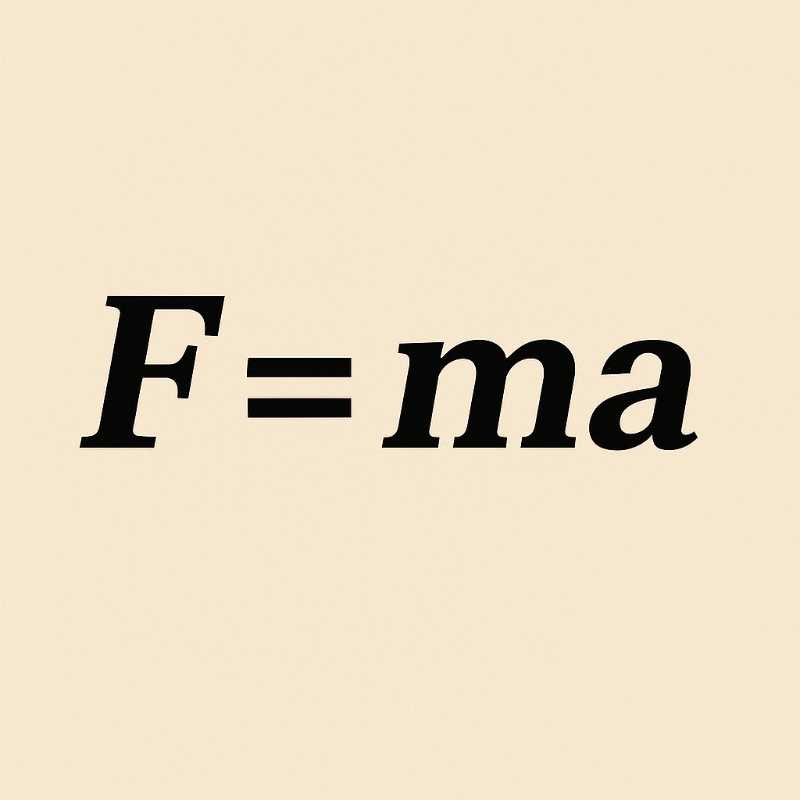
3. Newton's Second Law of Motion

F = ma is Newton's Second Law of Motion, and oh boy, is it fundamental. It's all about how to change the inertial state defined in Newton's First Law. When you grunt, getting up off the couch, you can thank the Second Law.

It's all about how force, mass, and acceleration conspire to change motion. Apply a net force to an object and it accelerates. How much? Depends on how heavy it is and how hard you push. Hence the grunting.

No force, no change. More force, more acceleration. More mass, more stubbornness.

Interestingly, this law is why it's still hard to pick up, move, and stop massy objects in microgravity. If you're on the ISS, you can't just move a 2-ton mass at rest. Weightless is NOT the same as massless, and this formula doesn't care about weight. It cares about mass.

First, the variables:

F is the net force acting on the object, in newtons (N). That's all forces acting on the object combined.
m is the mass of the object, and because this is physics, that's in kilograms (kg).
a is the acceleration of the object in meters per second squared.

This formula is very much vector-aware. That just means force and acceleration have magnitude AND direction, and it's important.

The formula is used everywhere when calculating motion. It's used for designing vehicles, bridges, rockets, and even explaining why grocery carts have such fun personalities.

Picture this. You're sitting on a rolling office chair, feet off the floor. In your hands: a 10 kg backpack. Are you picturing it? Good. Now, because you're weird, you suddenly throw it forward with great enthusiasm if somewhat questionable judgment.

The backpack ends up accelerating at 4 m/s² during the shove.

The force you applied to the backpack was:

F = (10 kg) (4 m / s²) = 40 N

And yes, if you've ever wondered, a Newton is shorthand for the nasty-looking unit kg · m / s².

Well, that was fun and pointless, wasn't it? Oh, but have you heard of Newton's THIRD Law of Motion? For every action there is an equal and opposite reaction. You're on a swivel chair, fool! That backpack exerts 40 N of force right back at... YOU!

If your mass plus the chair is 80 kg-and ignoring friction-we can use the same law to figure out your acceleration BACKWARDS.

a = F / m = 40 N / 80 kg = 0.5 m/s²

So, you roll backwards. Slowly, but it's enough to compromise your dignity and satisfy the laws of physics.
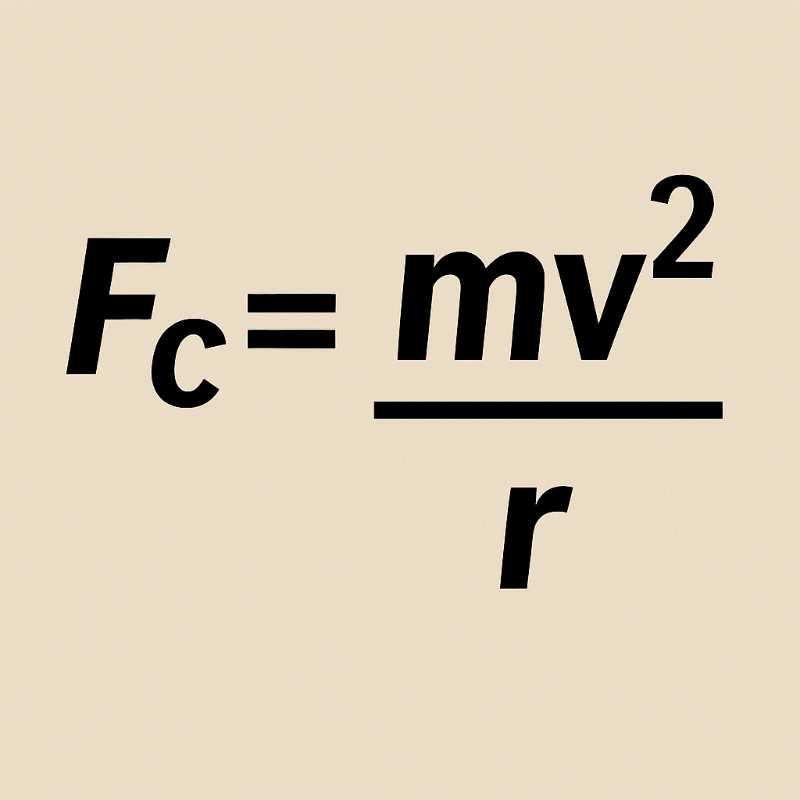
4. Centripetal Force

Ever wonder why you don't go whizzing into the sky as the Earth rotates? That's centripetal force, and the formula is:

F = mv² / r

Behold the glory of centripetal force! It describes the net force required to keep an object moving in a circular path. Not speeding up. Not slowing down. Just constantly going around and around.

Centripetal force is kind of important, because going around in a circle is hard. Without some kind of force counteracting your forward momentum, you can't do it. If you've done donuts in your car, you probably have noticed that you leave a lot of rubber on the road. That's from the friction that exerts a force counteracting your forward momentum.

The terms are all pretty simple here:

F is the centripetal force, in newtons. It always points to the center of the circle.
m is the mass of the object in kilograms
v is the speed of the object in meters per second.
r is the radius of the circular path.

The formula shows up whenever something moves in a circle (or arc), such as cars going around curves, planets orbiting stars, satellites staying in orbit instead of whizzing away into space, and even laundry stuck to the walls of a spinning washing machine.

Gravity, friction, tension, and normal forces can all be the centripetal force. This equation doesn't really care who steps up. It just demands that some force exists.

Let's suppose a 1200 kg (about 2645 lb) car goes around a circular curve with a radius of 50 m at a speed of 20 m/s (about 72 km/h or about 44 mph). Let's get physical and find the centripetal force needed to keep our car on the road.

F = (1200 kg · (20 m/s)²) / 50

If you trust me-and I hope you do-this works out to:

480000 N / 50

Which becomes:

9600 N

That's about 2158 pounds-force (lbf) that the friction between the road and your tires needs to match. What if your tires can't handle that friction? Well, you're going in a straight line. (Good luck!)

Interestingly, if you double the speed, the force required to keep you on the road goes up by four. Cut the radius in half, the force doubles. This is why sharp turns at high speeds can be... problematic, at least for those wishing to remain among the living. While you're ignoring the "Slow" sign and pounding the steering wheel to the beat of your favorite song, the value of this equation is quietly escalating.
5. Universal Gravitation

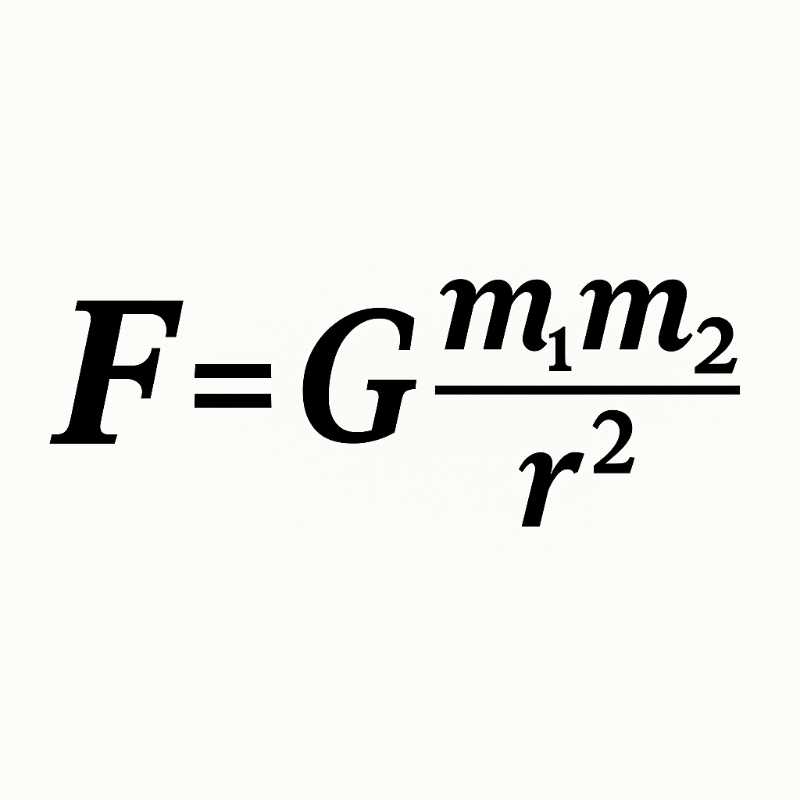
Universal Gravitation is defined as:

F = G · (m₁ · m₂ / r²)

Ugly to look at, a horror to type, this one has enormous consequences. This is Newton's law of universal gravitation. It says that every mass attracts every other mass. No exceptions. Across rooms, across planets, across galaxies. The force might be tiny, but it's always there, politely tugging.

This single equation explains falling apples, planetary orbits, tides, and why a big cloud of hydrogen molecules decided to coalesce one day and create the Sun.

As scary as it looks, the terms aren't too far out.

F is the force of attraction in newtons between two objects

G is a constant called the universal gravitational constant or more commonly "Big G". It's an extremely tiny number, but very important. This site does not support scientific notation or mathematical formats, so here it is, raw and uncut: 0.000000000066743 N · m² / kg². Yes, that's right. Newton-square meter per kilogram squared. That's why we just call it Big G.

m₁ and m₂ are the masses in kilograms of the two objects

r is the distance between the two objects in meters

That r² in the denominator is doing some heavy lifting, so to speak. Gravity fades fast with distance. Double the separation, and the force drops to one quarter.

Alright. How strongly are you attracted to your girlfriend? Forget romance. Let's see what Newton says.

You have a mass of 68 kg (weight = 150 lbs), your girlfriend's mass is a hair over 52 kg (weight = 115 lbs), and you're standing a meter away from her, trying to flex your biceps without LOOKING like you're trying to flex your biceps.

How much physical attraction do you two have? No, not THAT kind of physical attraction. Gravity!

F = G · (m₁ · m₂ / r²)

If we start filling in some numbers:

F = 0.000000000066743 N · m² / kg² · ((68 kg · 52 kg) / 1²)
F = 0.000000236 N

Which is... well, nothing. A mosquito landing on your arm generates more force. A strong exhale is overwhelming in comparison. The Earth's pull on you is 667 N. I'm not saying the two of you are not meant for each other, but according to Newton, you're definitely attracted to larger women. (No judgements.)
6. Work Performed (Constant Force)

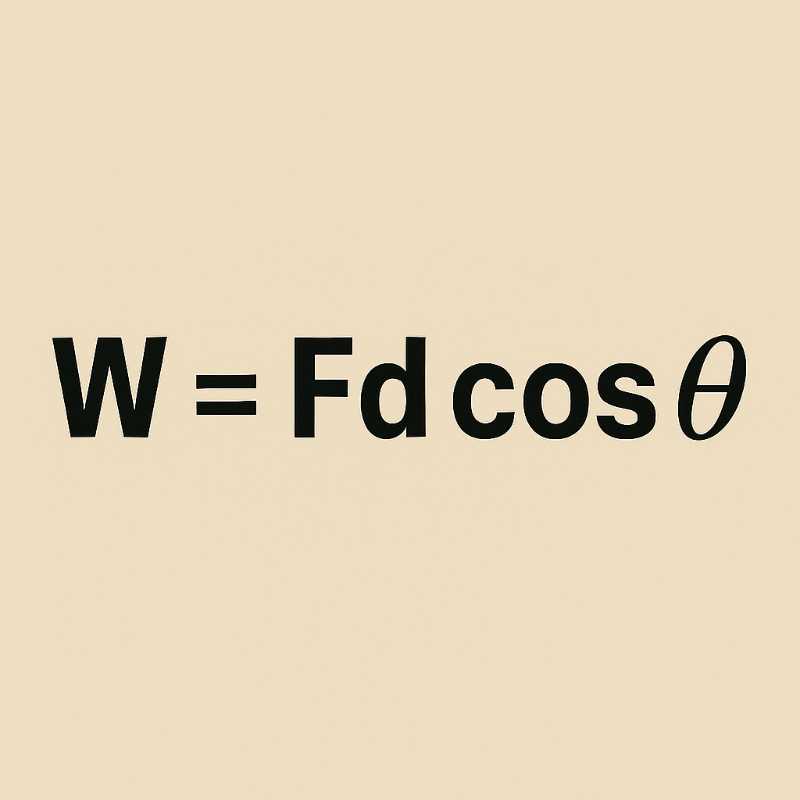
W = F · d · cos(?) looks pretty harmless in itself, but make no mistake. This formula is judging you. Work, in the physics world, is energy transferred by a force acting over a distance. Not all effort counts. You can push as hard as you want, but if nothing moves, physics doesn't call it 'work', which means my entire career has been built on not working... except when walking to meetings or the restroom.

Here's your handy guide to the variables in our formula:

W is the work, of course, measured in joules (J).
F is the force (magnitude only) applied, in newtons (N).
d is the displacement of the object, in meters (m).
θ is the angle between the direction of the force applied and the direction of actual motion.

As you know if you've been playing along at home, displacement is not the same as distance. Distance is the actual amount you've moved. It's what your odometer says. Displacement is the actual change in position. It doesn't care if you took the long way home. It's the straight line measured from the starting point to the ending point.

Theta. You know it's serious business when physicists break out the Greek letters. You can push with all your might, but the object you're pushing may not be moving in the same direction as your push. This makes a difference. If the force is perfectly aligned with motion, well, then θ = 0, and we know cos(0°) = 1. Nice! Full credit!

If the force is perpendicular, θ = 90°, then cos(90°) = 0. Zero work. Sorry, buddy. Nobody's impressed, and physics doesn't care.

If it's somewhere between 0° and 90°, well, you're going to need a calculator.

So let's say you just unpacked and assembled your brand new semi-translucent giant Gummy Bear made of high-density industrial silicone on a brass base. You push it across the floor with a constant force of 200 N, and for your efforts, it slides a total of 5 meters. Your push is angled slightly downward at 30° relative to the direction of motion, and since there's no friction involved in this quiz, we'll just pretend that's not a factor.

When your wife asks how much work you did today, you can tell her:

W = 200 · 5 · cos(30°)

Get out your calculator:
cos(30°) · 0.8666

Now let's answer the wife:
W = 1000 · 0.8666 = 867 J

Women can do math and physics, too. She'll notice that it wasn't 1000 J and ask you about the angle you chose. But first, she'll likely have a question about why there's now a brand new giant semi-translucent high-density industrial silicone Gummy Bear on a brass base standing in the living room.
7. Parallel Component of Weight (Inclined Plane)

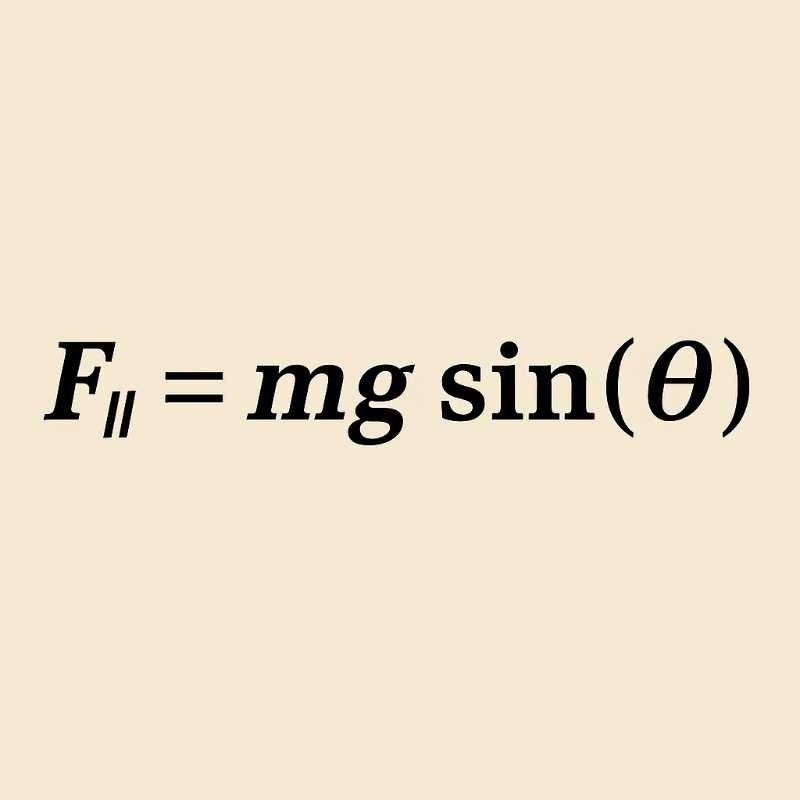
F= mg · sin(θ). This equation gives the component of gravitational force pulling an object along an inclined surface. Eww. Let's try that again. It tells you how hard gravity is trying to make something slide down a ramp.

F is the force we're looking for in Newtons (N)
m is the mass of the object on the ramp in kilograms (kg)
g is the acceleration due to gravity (9.8 m/s²)
θ is the angle of the incline in relation to the horizontal

Gravity always pulls straight down, but ramps mess everything up. They redirect that pull into two parts. One part is pressing the object into the surface, and another part is dragging it down the surface. This formula isolates that second part. The downhill urge. If the parallel force is greater than the force pushing it into the surface, you've just invented a playground slide. (Friction has something to say about all this, too, but that's another equation.)

Now, let's practice. Imagine you're helping a friend load a 50 kg (~ 110 lbs) crate of motion-activated singing rubber chickens into a van using a ramp angled at 30°. The crate looks sweet and innocent. It's not.

So, because you're a total nerd, you want to know how hard gravity is pulling it down the ramp presumably so you can decide whether you need help, better shoes, or a miracle.

If you plug in the values, the parallel force is:

50 kg · 9.8 m/s² · sin(30°)

I picked an easy angle to calculate the sine for, and if you do the work, hopefully you also come up with 245 Newtons (about 55 lbf).

So gravity is tugging the crate downhill with 245 N of force. Pause and think. That's not exactly subtle. If friction and your muscles can't beat 245 N, the crate wins, and your friend is posting images of you on your back covered with rubber chickens on his Instagram account.
8. Mechanical Advantage

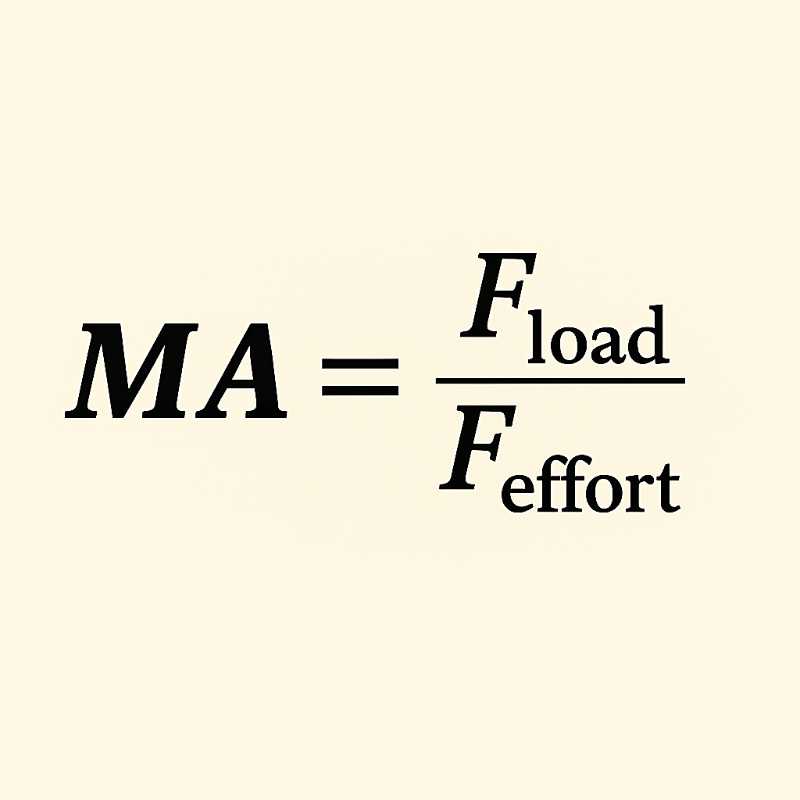
Welcome to the formula for mechanical advantage, MA = F(load) / F(effort). It's my favorite of all physics formulas, because it's about doing less work while still getting things done through the use of machines.

The terms are pretty easy to figure out:

MA is the mechanical advantage. It has no unit.

F(load) is the force exerted on the load in newtons (N). Basically, that's what you're trying to lift, push, or move.

F(effort) is the force you apply to the machine you're using to (hopefully) make life easier.

The formula is used for all kinds of machines: levers, pulleys, inclined planes (ramps), hydraulics, gears, etc.

Well, since I'm going to set your house on fire in the next example, we'll cut you some slack in this example. You're lifting a 600 N crate onto a platform, which is about 135 pounds (61 kg), at least on earth. Because you're middle-aged and falling fast (anyone else?), you use a pulley system to lift it up onto a platform.

You pull down on the rope with a force of 150 N (33 lbf). The crate moves. Slowly.

Let's do the math:

MA = 600 N / 150 N = 4

Well, that was easy. The system has a mechanical advantage of 4.

Um...

Oh, what does that mean? It means, you're lifting 4 times what your tired arms think you're lifting. That's awesome! You may even feel really strong for a minute.

There is a trade-off though. You're trading force for distance; you need to pull more rope. In fact, you'll have to pull that rope 4 times as much to get it to the desired height. Nothing is free in physics.

Well worth it, in my opinion.
9. Ohm's Law

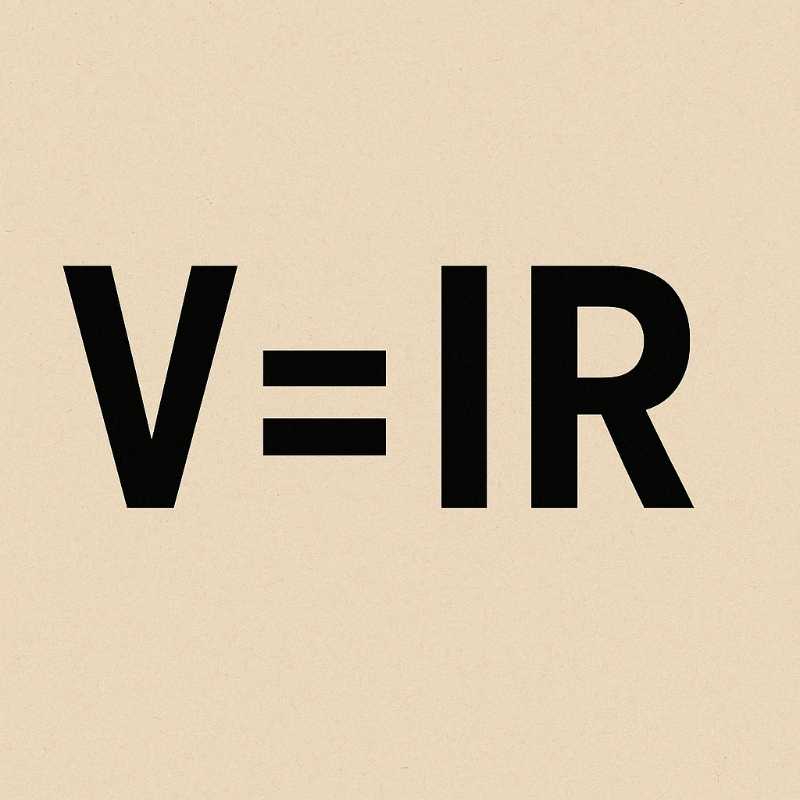
Ah, a friendly one. V = IR. This tiny equation runs half the modern world. It's called Ohm's Law, and it's the simple rule that connects voltage, current, and resistance in an electrical circuit. If you want to think of electricity as your household water supply, this equation explains the relationship between the pressure in your pipes, how fast the water actually flows, and how narrow the pipes are.

The symbols are not quite completely self-evident.

V is the voltage, measured in volts (V). You can think of it as electrical 'pressure' if you want to impress your friends. It's how badly the charges want to move.

I is the current, measured in amperes (A). This is the flow rate of electric charge.

R is the resistance, measured in ohms. This is how much the circuit resists the flow of current. This includes many devices powered by the current.

Okay, let's get physical. Most examples are pretty boring, so let's set your house on fire.

We'll pretend you're wiring a 12 V car battery to a device that has a 2-ohm resistance, because that's the kind of person you are. Live fast, die young, leave a good-looking corpse. Let's see how much current will flow.

Well, if we plug in the values, we get:

12 V = I ·2 ohm

You can probably figure that out, but if we divide both sides by 4, we get:

I = 6 A

This number matters. In fact, it can matter quite a bit if you're the kind of person hooking up devices to your car battery. You'll want to make sure that the wires you're using aren't rated for less than 6 A, or you're going to have a bad time. Insulation softens. Smells fill the air. Your wife yells, "Is something burning?!" The wire turns into a heating element. Flames break out. The neighbors come outside and point at your house. Sirens in the distance.

This author, FunTrivia, its advertisers, staff, and editors in no way endorse attaching wires to your car battery to power a device.
10. Time Dilation (Special Relativity)

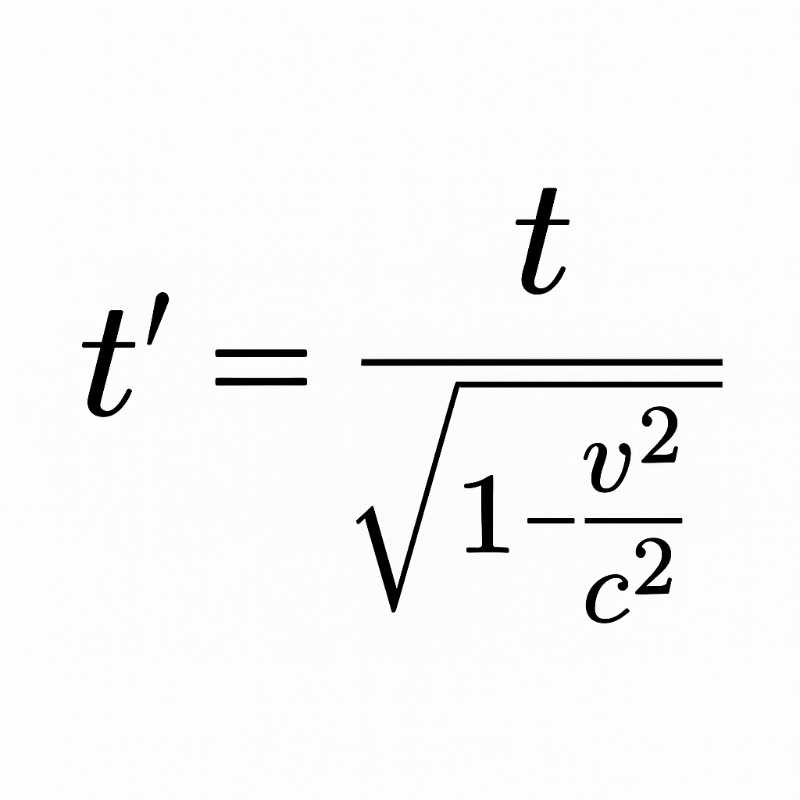
t' = t/√(1 - v² / c²) is the time dilation formula from special relativity. It tells you how time measured by a moving observer compares to time measured by a stationary observer.

The short version is that moving clocks run slow. At least when compared to your clock.

The longer version is that if someone is moving really fast relative to you, time for that person stretches out compared to your time. Not metaphorically. Literally. Physics has the receipts, and it's survived many audits unscathed.

The thing people get wrong all the time about time dilation is that the length of a second (or minute or hour) does not change for the person experiencing them. Nobody notices anything different. Both experience time normally.

The difference only shows up when the two people compare clocks. They're different. Welcome to the weird world of special relativity!

t' is the time experienced by the stationary observer.
t is the time experienced by the person in motion.
v is the relative velocity between the two people.
c is the speed of light in a vacuum, which is about 3 ·10⁸ m/s (670,616,629 mph).

1 / √(1 - v² / c²) by itself is called the Lorentz factor and goes by the symbol 𝛾 (gamma). As a result, the formula can also be written as:

t' = 𝛾t

Note: If you're a math nerd, you can probably tell immediately that if the relative velocity is NOT absurdly fast, there's very little difference in t and t′.

Maximilian and Buttercup are twins, both 20 years old today. Well, Buttercup hops on a spaceship, while Maximilian stays put on Earth wondering why he never gets to do anything cool in my examples.

Buttercup travels at 80% the speed of light (that's fast, folks) for what to her feels like ten years. Her watch ticks once every second, the calendar day changes every 24 hours. Nothing weird.

Maximilian becomes a professional dog food taster and lives his life. Time passes normally for him as well.

After ten years, Buttercup arrives back on Earth. So what's up?

Well, we know Buttercup has aged ten years. If we do the math the Lorentz factor becomes:

1/ √(1 - (0.8 c)² / c²) = 1.66.

t = 10 years, so let's plug that in:

t′ = 1.66 · 10 y = 16.6 y

And that's your time dilation. What does it mean? It means that's how much time poor Maximilian the dog food taster has experienced on Earth tasting dog food.

Buttercup is a young and vital 30 years old, while Max is an over-the-hill nearly geriatric 36 (and two-thirds) years old with bad breath.

This strange phenomenon that Einstein discovered has been confirmed by experiments. In fact, GPS satellites have to take into account the differences in speed and gravity in space to keep your phones showing the right time.
Source: Author JJHorner

This quiz was reviewed by FunTrivia editor rossian before going online.
Any errors found in FunTrivia content are routinely corrected through our feedback system.
2/27/2026, Copyright 2026 FunTrivia, Inc. - Report an Error / Contact Us