FREE! Click here to Join FunTrivia. Thousands of games, quizzes, and lots more!
Elements of the Lightning Fast War Quiz
The Blitzkrieg
The Treaty of Versailles (1919) greatly limited Germany's ability to rebuild its army or manufacture weapons of war at the conclusion of WWI. So how on earth did German leaders pull off the Blitzkrieg?
A collection quiz
by ponycargirl.
Estimated time: 3 mins.
Last 3 plays: deenaingram (8/10), dmaxst (10/10), Guest 174 (10/10).
Find the important elements that, when working in unison, enabled German leaders to launch a successful Blitzkrieg from 1939-1940.
There are 10 correct entries. Get 3 incorrect and the game ends.
First of all, it must be noted that the Germans did not call their plan of attack the Blitzkrieg. In fact, some sources state that Hitler thought Blitzkrieg, the term used by Allied journalists, was stupid. What he did do was take tried and true Prussian military concepts, test them out during the Spanish Civil War, and allow his generals to establish the "Bewegungskrieg", or Maneuver Warfare, which was the term that was used to describe a quick strategic attack.
Many of the units of the military were combined to make a concentrated force. On the ground, Panzer tanks were used to focus on a single, narrow point on the front line in order to quickly break it. After breaking the line, instead of stopping, the tanks would race to the back of the enemy in order to cause as much of a disruption in communication and command centers as possible. And, of course, the tanks were an integral part of the Kessel, which trapped troops in the cauldron. How did the Germans manage this with the restrictions set forth by the Treaty of Versailles? Local companies like the famous Krupp firm had been in existence for a long time. They were able to crank out enough tanks, trucks, and aircraft to support short campaigns. Also, in 1922 with the Treaty of Rapallo, Germans trained Russian soldiers and helped build Russian industry in exchange for allowing secret German installations - like the Kama tank school - to be built on Russian soil.
With the Panzer tanks, a German strategy called the Kessel, or the cauldron, was used. German forces would rapidly encircle enemy troops during a direct attack, sweeping around the sides of the opposing army and enclosing them in a trap. This created panic and hopelessness, as there was little chance of escaping. During the invasion of Poland at the Battle of Bzura, German forces successfully trapped two Polish forces this way, making it impossible for them to launch a counteroffensive. The maneuver was also used at the Battle of France, which led to the Allied evacuation at Dunkirk on the Western Front and during the invasion of Russia in 1941 on the Eastern Front. In fact, at the Battle of Kiev in 1941, the largest encirclement battle in history, over 600,000 Soviet troops were trapped east of the Dnieper River.
Of course, tanks alone couldn't complete the Kessel. It might be thought at this point that Germany probably didn't have the military might needed to carry out such an attack, as their army had been limited to 100,000 men by the treaty and the German General Staff was to be disbanded. The German General Staff was rebranded as the Troop Office, and was able to carry out their planning without interference. Recruits for the army were carefully selected and trained so that when Germany began to rearm in the 1930s there was a well-trained group of leaders who were ready to induct new conscripts. Assisting the tanks were motorized infantrymen. Special units of soldiers were quickly brought in using motorized transport like trucks and armored personnel carriers. This was the only way to keep up with the fast moving Panzers. The vast majority of the infantry divisions, however, did consist of soldiers on foot or bicycle; it was their responsibility to catch up with the tanks - sometimes marching 20-30 miles a day - in order to secure the flanks of the opposing army and make sure that they were not able to close the gap. They were important for clearing out areas of resistance, as well as holding the ground that had been conquered by the tanks.
And just why were the German infantrymen able to march 20-30 miles a day? They were given the drug Pervitin, which was a brand name for methamphetamine. It was sold by the German company Temmler in 1938, and marketed to the people as a miracle pill that was better than coffee as a pick me up. The sense of invincibility and euphoria it induced helped students to do better on their exams, workers increase productivity, and even housewives work harder. Chocolates laced with the drug were even sold. During the Blitzkrieg soldiers were given Pervitin, which they called tank chocolate or flyer's chocolate, to eliminate the need for sleep and food. That way they could march and fight for sometimes up to 72 hours without sleeping. One source has estimated that 35 million pills were given to the troops just between April-July 1940. Of course, at some point the side effects and their consequences had to be addressed. By late 1940 Pervitin was a prescription-only drug in Germany.
Heavy artillery weapons, as well as supply wagons, were typically pulled by horses. The machine gun was the most important artillery weapon in Germany's arsenal. Although they were armed with bolt-action rifles, German infantrymen also carried ammunition for the machine gun and protected the gunner. They were told to draw the enemy into the gunner's line of fire, not shoot individually at the enemy like Allied soldiers did. If there was a pocket of resistance that infantrymen were unable to clear, they would use their radio to call in support.
Wireless radio communication was the key to ensure the coordinated effort required to make the Blitzkrieg a success. Tank drivers could speak with Luftwaffe pilots and gunners to immediately adjust their strategies. Rapid orders could be followed, and the enemy could easily be kept off balance. But ground support wasn't enough.
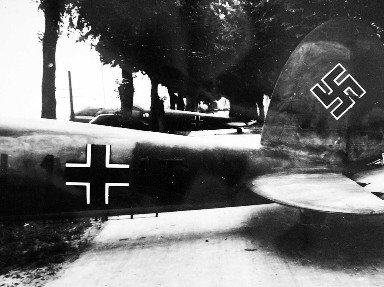
The Treaty of Rapallo also had provided for a secret aviator school - the Lipetsk fighter pilot school-in Russia. In addition, countless training sites, disguised as flying clubs or pilot programs for Lufthansa Airlines, existed inside Germany long before WWII began. Luftwaffe pilots flew dive bombers, medium bombers, and fast fighters during the Blitzkrieg operation. Fast fighters, like the Messerschmitt Bf 109 and 110, were used to destroy enemy air both on the ground and in the sky, which prevented any interference with the ground invasion. Medium bombers, like the Heinkel He 111, were used to attack possible lines of communication like railroads, bridges, and command posts. Dive bombers, like the dreaded Stuka with the terrifying sirens, were used to target pockets of resistance and enemy bunkers.
Quickness was an important element of the Blitzkrieg. The operation was so lightning fast that many times the enemy army was completely surrounded before they knew what hit them. They were trapped before they could even call for a retreat. German forces did not stop to fight in places that were strongholds; instead they pushed past them toward the enemy's rear. Again, consider the fact that it only took the Blitzkrieg five days to travel 120 miles through the Ardennes Forest during the invasion of France. Allied military planners, who were trying to act, really didn't believe such a feat was physically possible. They estimated that it would take at least nine to fifteen days, and acted so slowly that the bottleneck through narrow passes that was caused by so much equipment - 41,000 vehicles and 1,200 tanks - was cleared before they took a chance to do anything about it. Likewise, speed played a huge role in enabling the Blitzkrieg to trap the British Expeditionary Force and French army at Dunkirk in May 1940. German quickness made it next to impossible for the Allies to understand the circumstances and decide what to do. Many times orders were given that were already obsolete and worthless.
While all of the elements of the Blitzkrieg were important, secrecy was perhaps one of the most important aspects of planning such an undertaking. The point was to not only shock the enemy, but to also use the unexpected attack to create so much confusion that it wasn't possible to even launch a counter-offensive. People were totally caught off guard, which caused chaos, and gave no time for planning. Germany unleashed the Blitzkrieg on Poland at dawn (around 4:40-4:45 a.m.) on September 1, 1939. On that morning, the Gleiwitz Incident was staged, where Germans dressed in Polish uniforms attacked a German radio station. Hitler transmitted a speech in which he claimed that Poland had actually tried to attack Germany, and stated that German forces returned their fire at 5:45 a.m. By the time Hitler gave his speech as a justification for the invasion, the Blitzkrieg had already begun. And - don't forget that a week prior Germany and Russia had signed the Molotov-Ribbentrop Pact, where they had agreed to divide Poland between them; both countries kept that a secret as well. A huge part of the element of surprise was also attacking in unexpected places. For example, when Germany invaded France in 1940, the Maginot Line was totally ignored. Instead, German forces advanced through the Ardennes Forest, a region that most thought was totally impassable.
And so country after country fell quickly under the Blitzkrieg. Poland fell within a few weeks in 1939, and Denmark and Norway were attacked in April of 1940; while Denmark surrendered in a matter of hours, Norway took a few weeks to capitulate. The Low Countries - Belgium, the Netherlands, and Luxembourg were invaded and conquered in May 1940. Luxembourg surrendered in a day, the Netherlands resisted for five days, and Belgium lasted for 18 days. France was defeated in just six weeks, with Paris falling in June, 1940. After that the Axis powers combined in 1941 to overrun Yugoslavia and Greece with a combined Blitzkrieg.
Even though France spent a lot of time and money building the Maginot Line after WWI, trench warfare was totally obsolete and a thing of the past. So were horse soldiers, even though the Blitzkrieg used horses to pull artillery wagons and the like. While there is some evidence that Japan used germ warfare against China during WWII, the Blitzkrieg did not use it. Nor did they use the atomic bomb, which only became available at the end of the war. While the Germany navy may have been used at select sites, it was not an integrated part of the fast moving Blitzkrieg.
This quiz was reviewed by FunTrivia editor trident before going online.
Any errors found in FunTrivia content are routinely corrected through our feedback system.