Last 3 plays: Midget40 (9/10), ceetee (10/10), Guest 194 (6/10).
There are ten methods of gliding over the snow in this collection. Pick them out and leave behind the means of transport that don't belong.
There are 10 correct entries. Get 3 incorrect and the game ends.
TobogganSkis Brougham Flexible Flyer Holzschlitten Hang Glider Pung Pulk SnowboardCabriolet Cutter Boston Booby Snowcat Saucer sailfish
Left click to select the correct answers. Right click if using a keyboard to cross out things you know are incorrect to help you narrow things down.
Skis
Humans have been using skis, or something very like them, to glide over snow for roughly eight thousand years. It is thought that the idea developed independently in northern Europe, namely what is now Scandinavia and Russia, and in northern Asia, namely what is now China and Korea. It makes sense that peoples living in places with snowy winters would find much the same way to facilitate travel and hunting, by strapping long, flat runners on their feet. Nowadays, both cross country and downhill skiing are considered sports, though some people still use skis simply as a practical way to get around in the winter.
Snowboard
Used to glide downhill, a snowboard is, in very broad terms, snow's answer to skateboarding, on which a skilled rider can perform jumps, twists and other elaborate maneuvers. A polyethylene board some fifteen to thirty centimeters wide and one hundred twenty-eight to one hundred sixty-six centimeters long on which the rider stands with feet parallel and steers and stops by shifting her/his weight, the modern snowboard is the culmination of work starting in the 1960s by inventors and enthusiasts in the United States, France and the Soviet Union.
Toboggan
A runnerless sled whose name comes from terms like tobakun (Mi'kmaq) or utabaan (Cree ), the latter of which today is also used for 'pickup truck', the toboggan was developed by Algonquian peoples of what is now northern Canada around five thousand years ago to transport loads across snow-covered terrain.. It is traditionally made from thin, flexible boards of birch, larch or ash, steamed or worked while green to make them pliable, fastened parallel to each other using battens and lashed together with rawhide thongs or deer-skin, allowing the frame to remain strong yet flexible. The front end curls upward to create a "hood" that rides over deep snow rather than plowing through it. Today, many recreational toboggans are mass-produced using aluminum or plastic.
The toboggan was Adopted by European settlers in Canada starting in the Sixteenth Century. By the Nineteenth it had also become a recreational and sporting vehicle, popular throughout both Canada and the U.S. . Precursor of the Olympic events Luge, Bobsled and skeleton, the recreational toboggan is a one or at most two rider vehicle ridden sitting up, shifting your weight to steer and dragging your heels in the snow to brake.
Saucer
As its name suggests, the saucer sled is a small, round, single-person, concave sled designed for sliding, spinning, and speeding down snow-covered hills. Made of durable steal, aluminum or plastic, this type of sled often has molded or rope handles for the seated rider to grip. It was invented in the early 1950s by manufacturer Georg Gillmert at the JH factory in Sävsjö, Sweden. Observing that youngsters used metal trays and similar objects to slide downhill, Gillmert converted a disused trash can lid machine to produce round metal sleds that were dubbed 'flying saucers'. Soon, due to the tendency of the original sheet metal to rust, Gillmert Changed the material to aluminum. The popularity of the saucer sled rapidly spread beyond Scandinavia despite, or maybe because of, its resistance to steering. The passenger on a saucer sled is pretty much just along for the ride.
Holzschlitten
A holzschlitten (German for 'wooden sled') or Davos sled is a traditional wooden sled with slatted seat and metal runners, ridden sitting up and steered and braked with the feet. Usually constructed to carry one adult or two children, it is similar to the horned sled. Indeed, nowadays one can find a highbred called a horned Davos.
Strictly speaking, a horned sled has runners that curve upwards in front, forming horns or handles. This type of sled may also have woven textile seats rather than bare slats, and may be rather longer to accommodate three or four riders.
Flexible Flyer
Invented by Samuel Leeds Allen to give his New Jersey farm equipment manufacturing company year-round employment, and patented in 1889, the Flexible Flyer is so called because it is, well, flexible and built for speed. With a body of birch wood slats mounted on pivoting steel runners (often red and powder-coated), it is steered with the steering bar. It can be ridden either sitting up or lying on the stomach. Though typically intended for one rider, the Flexible Flyer is also available in a longer, multi-rider design.
Pulk
A pulk is a low-slung boat-like Nordic cargo or passenger sled, with or without runners, pulled by a person afoot or on skis, or by light draft animals such as dogs or reindeer. In Norway, Finland and Sweden, parents often pull small children on pulks during skiing trips. They are also used as downhill sleds for one or two children. Traditionally made of wood and other natural materials, nowadays they are most often made of plastic.
A larger pulk, designed for transporting heavier loads, is called an akja.
Cutter
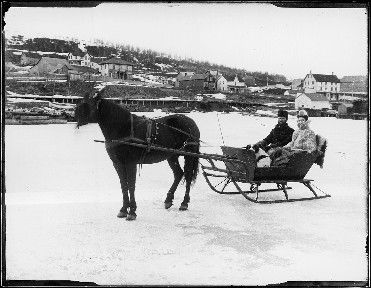
"Cutter", an American term that came into use around 1800, applies to a light sleigh with one seat (accommodating two passengers), pulled by one horse. The general term cutter includes two categories - Portlands and Albanys. The Portland have rather straight angular lines, while the Albany has a slightly swelling body and curved, rounded lines.
Pung
The terms pung (derived from the same Algonquian source as toboggan)and box sleigh refer to similar practical, box-shaped horse drawn vehicles used throughout the Eighteenth and Nineteenth Centuries to transport families and/or cargo in North America. In the early 1820s, like its sporty cousin the Albany cutter, the box sleigh acquired a somewhat softer, more rounded profile, .
In New England, 'pung" was also applied to a lightweight, single-horse sleigh, elsewhere called a jumper. This sleigh often used for racing or short trips due to its speed, was characterized by a box-shaped seat on runners.
Boston Booby
A Boston booby is an enclosed sleigh made with a coach or chariot body suspended, not on wheels, but on sleigh runners by thoroughbraces, leather straps that supported the body and served as springs.
As for the incorrect answers:
A brougham is a light, four-wheeled carriage drawn by a single horse.
'Cabriolet' can refer to a light, two-wheeled, one-horse vehicle with a folding hood or to an automobile similar to a convertible.
The sailfish is a small, hollow body, board-boat style sailing dinghy with a lateen rigged sail mounted to an un-stayed mast. It was popularized in the mid 1940s by Alcort, Inc of Waterbury, Connecticut.
A hang glider is a one person, light, non-motorised, fixed-wing heavier-than-air aircraft. Typically made of an aluminum alloy or composite frame covered with synthetic sailcloth to form a wing, it is flown by a pilot in a harness suspended from the airframe, who controls the aircraft by shifting body weight in opposition to a control frame.
A snowcat is a truck-like snow-going vehicle that runs on treads.
This quiz was reviewed by FunTrivia editor trident before going online.
Any errors found in FunTrivia content are routinely corrected through our feedback system.