FREE! Click here to Join FunTrivia. Thousands of games, quizzes, and lots more!
Quiz about All About Crabs

Animals Quiz: All About Crabs!: 10 Questions | Invertebrates


Biologically speaking, many animals that we call crabs are not "true" crabs, but crabs and their relatives play an important role in supporting healthy marine and coastal ecosystems. Original quiz by boundlessearth - adopted by MotherGoose.
This is a renovated/adopted version of an old quiz by author boundlessearth

A multiple-choice quiz by MotherGoose. Estimated time: 2 mins.
  1. Home
  2. »
  3. Quizzes
  4. »
  5. Animal Trivia
  6. »
  7. Invertebrates
  8. »
  9. Crustaceans

Author
MotherGoose
Time
2 mins
Type
Multiple Choice
Quiz #
369,486
Updated
Oct 04 26
# Qns
10
Difficulty
New Game
Avg Score
7 / 10
Plays
19
Last 3 plays: sarryman (7/10), skatersarehott (5/10), mjgrimsey (2/10).
- -
Question 1 of 10
1. Which hairy-looking crab lives on hydrothermal vents at a depth of up to 2,200 metres (7,200 feet)? Hint


Question 2 of 10
2. What is the largest crab on earth? Hint


Question 3 of 10
3. Which island in the Indian Ocean is famous for its annual red crab spawning and migration? Hint


Question 4 of 10
4. What is the largest land living arthropod in the world? Hint


Question 5 of 10
5. Which of the following is *NOT* a component of the crab's exoskeleton? Hint


Question 6 of 10
6. Which type of crab takes part in an orderly shell-swapping queue when it outgrows the shell it lives in? Hint


Question 7 of 10
7. Which type of crab carries sea anemones in its claws to protect itself from predators? Hint


Question 8 of 10
8. Which antioxidant is responsible for the red colouring of crabs and shrimp? Hint


Question 9 of 10
9. What colour is crab blood? Hint


Question 10 of 10
10. What is the name for a group of crabs? Hint


(Optional) Create a Free FunTrivia ID to save the points you are about to earn:

arrow Select a User ID:
arrow Choose a Password:
arrow Your Email:


Most Recent Scores
Today : sarryman: 7/10
Today : skatersarehott: 5/10
Today : mjgrimsey: 2/10
Today : Guest 107: 7/10
Today : Guest 174: 9/10
Today : andymuenz: 3/10
Today : Guest 104: 9/10
Today : Guest 90: 6/10
Today : Guest 86: 7/10

Quiz Answer Key and Fun Facts
1. Which hairy-looking crab lives on hydrothermal vents at a depth of up to 2,200 metres (7,200 feet)?

Answer: Yeti crab

The yeti crab is so-called because its appendages are covered with fine bristles called setae, giving it a hairy appearance which reminded biologists of the legendary Yeti (the Abominable Snowman). The setae are actually extensions of the exoskeleton. Scientists first discovered these animals in 2005 at the bottom of the Pacific Ocean. There are several other species that have been discovered since then.

As the question indicates, they live on hydrothermal vents at a depth of up to 2,200 metres (7,200 feet). Hydrothermal vents are geysers or hot springs on the ocean floor. Because they live where no light penetrates, they do not need to see. Their eyes are extremely small, do not work and lack pigmentation. Some species have no eyes at all. Instead of seeing, they use touch and special chemical sensors located in their setae to feel their way around and find food.
2. What is the largest crab on earth?

Answer: Japanese spider crab

As the name implies, the Japanese spider crab is only found in the waters around Japan. It has a relatively small body compared to its extremely long legs, giving it a spider-like appearance. The main body, or carapace, can grow up to 40 centimetres (16 inches) wide and its legs can span up to 3.8 metres (12 feet) - longer than a small car. It can weigh up to 19 kilograms (42 lb).

The carapace is covered with short, stubby spikes called tubercles. They stick pieces of algae, sponges, and anemones onto the spikes to camouflage themselves against the ocean floor. Japanese spider crabs can live up to 100 years, potentially giving them the longest lifespan of any crab species.
3. Which island in the Indian Ocean is famous for its annual red crab spawning and migration?

Answer: Christmas Island

There are two Christmas Islands. One is located in the Indian Ocean, between Australia and Indonesia, and is an Australian territory, usually designated IOT (Indian Ocean Territory). It was named by an English sea captain who sighted it on Christmas Day, 1643. The other Christmas Island is located in the Pacific Ocean. It is also called Kiritimati and is part of the Republic of Kiribati. It too was named by an English sea captain (James Cook) because he sighted it on Christmas Eve 1777.

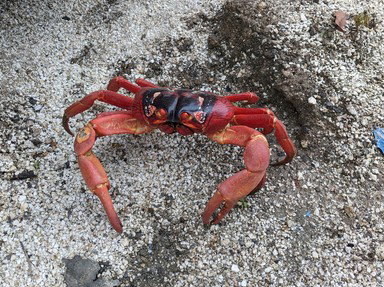
Christmas Island IOT is famous for its red crabs, which are endemic to the island as well as the nearby Cocos Islands. Although they are land animals, they return to the sea to spawn (release their eggs), usually between November and January. The actual timing depends on a number of factors, mostly the lunar cycle and the amount of rainfall, and can be hard to predict. Approximately a month later, the young migrate from the sea back to the land, heading for the rainforest in the centre of the island. At this time, the island is covered in millions of red crabs. To avoid running them over, a number of the roads on the island are temporarily closed and the locals and volunteers go out and sweep them off the main roads with rakes. There are also specially constructed over- and under-passes to encourage the crabs to travel off-road.

I have been fortunate enough to visit Christmas Island and witness the migration. The photo that is the cover image for this quiz was one that I took in January 2025.
4. What is the largest land living arthropod in the world?

Answer: Coconut crab

Coconut crabs are found on islands across the Indian and Pacific Oceans, including Christmas Island (mentioned in the previous question) which is home to the largest protected population of these crabs. They are also called robber crabs because of their habit of stealing unattended items belonging to humans - such as shoes, bags, cameras, small items of camping equipment like pots and pans and, particularly, anything shiny.

On average, adults have a body length of up to 40 centimetres (16 in) and a weight of 4 kilograms (9 lb). The males are generally larger than the females. Their massive front claws can exert a force of up to 3,300 Newtons. This pinch strength is comparable to the bite force of a lion and is the strongest of any crustacean. They have been recorded snapping tough objects like golf clubs in two and crushing heavy metal pans with their claws. With the ability to climb and their strong claws, they can scale palm trees, snap off coconuts and crack them open, although coconuts are not actually their preferred food. They are omnivores that prefer soft fallen fruits and they also eat nuts, seeds, carrion, and small baby animals such as birds, turtles and rodents. They are also "cannibals" that eat other crab species, including their own.

When we stayed on Christmas Island, I enjoyed sitting on my verandah with a coffee and watching the coconut crabs wander through the garden. They move slowly and are generally timid and not aggressive toward humans, but they will defend themselves fiercely if they feel cornered, threatened, or handled incorrectly.
5. Which of the following is *NOT* a component of the crab's exoskeleton?

Answer: Bone

A crab's exoskeleton is a tough, hard outer covering composed of chitin, proteins and calcium carbonate. The base layer of the exoskeleton is made of chitin, which forms a flexible mesh that holds all the components together. Chitin is a tough, natural polysaccharide (a complex sugar polymer). The chitin fibers are bound together with specialized proteins which act as a glue to create a tight matrix. The chitin and the proteins are secreted by the crab's epidermis.

Calcium carbonate, a mineral, is deposited into this matrix which causes it to become hard and rigid. The crab makes calcium carbonate by extracting calcium and carbonate ions directly from their environment (from the surrounding seawater or fresh water), combining them by a process known as biomineralization.
6. Which type of crab takes part in an orderly shell-swapping queue when it outgrows the shell it lives in?

Answer: Hermit crab

Hermit crabs have soft spiral-shaped abdomens which need protection. Instead of growing their own exoskeleton, they protect themselves by moving into empty seashells. Shells, of course, do not allow for growth so, when they outgrow their current shell, they need to find a bigger one. A bizarre aspect of their behaviour is that, when a larger shell washes up on the beach, hermit crabs will line up in order of size, from largest to smallest, and perform a rapid, coordinated chain-reaction of shell-swapping where the largest crab that fits the shell moves in.

This leaves its old shell vacant for the next crab in line, creating a domino effect where everyone gets an "upgrade". Moving from one shell to another happens in a split second because being completely out of their shell is dangerous. Not finding an appropriately-sized shell is usually fatal for a hermit crab.
7. Which type of crab carries sea anemones in its claws to protect itself from predators?

Answer: Boxer crab

The boxer crab is a tiny crab, about 2.5 centimetres (1 inch) across its carapace, that carries venomous sea anemones in its front claws like tiny boxing gloves or cheering pom-poms. For this reason, it is also known as the pom-pom or cheer-leader crab. This represents the biological relationship, called "mutualism", where both organisms benefit from their association.

The crab benefits because the stinging tentacles of the anemones protect the crab from predators such as fish. The anemones benefit because the crab provides transport to take the anemones to new places where they can source food. If the crab loses one of its anemones, it can split the remaining anemone in half. The half regenerates (grows back), turning into two identical anemones. Nature is amazing!
8. Which antioxidant is responsible for the red colouring of crabs and shrimp?

Answer: Astaxanthin

Astaxanthin is a natural red-orange pigment and potent antioxidant found in microscopic algae. It gives the pinkish-red colour to animals that eat the algae, or those that feed on animals that eat it, such as salmon, trout and flamingos. In the case of crustaceans, like crabs, shrimp, and lobsters, the pigment binds to their exoskeletons, often appearing blue-grey or dark until they are cooked. Cooking breaks down the protein bonds and reveals the pinkish-red astaxanthin.
9. What colour is crab blood?

Answer: blue or colourless

Animal blood comes in a variety of colours. The colour is dependent upon the chemical composition of the substance in their blood which carries oxygen. Human blood gets its red colour from a protein in the blood cell called haemoglobin, which contains iron. Crabs have blood which ranges from colourless to a dull bluish-grey to bright blue, depending on species, because it contains a similar protein called haemocyanin. Haemocyanin contains copper instead of iron.
10. What is the name for a group of crabs?

Answer: Cast

Some crabs are solitary animals but others work together collectively as a "cast". Another collective noun for crabs is a consortium. Unofficially, a group of crabs may sometimes be referred to as a swarm, cluster, colony, or army.

A group of crabs is called a cast because when they scurry across the sand together, it looks like a single tossed entity, like a net that has been cast. The word "cast" also relates to how crabs molt, meaning they cast off (shed) their old hard exoskeletons in order to grow bigger.
Source: Author MotherGoose

This quiz was reviewed by FunTrivia editor rossian before going online.
Any errors found in FunTrivia content are routinely corrected through our feedback system.
10/4/2026, Copyright 2026 FunTrivia, Inc. - Report an Error / Contact Us