FREE! Click here to Join FunTrivia. Thousands of games, quizzes, and lots more!
Captivating Costa Ricans Trivia Quiz
Can you recognize these animals, some of the half million different species you can see while visiting Costa Rica? Don't worry, they won't all be examples of the 300,000 types of insect or the 183 different terrestrial gastropods!
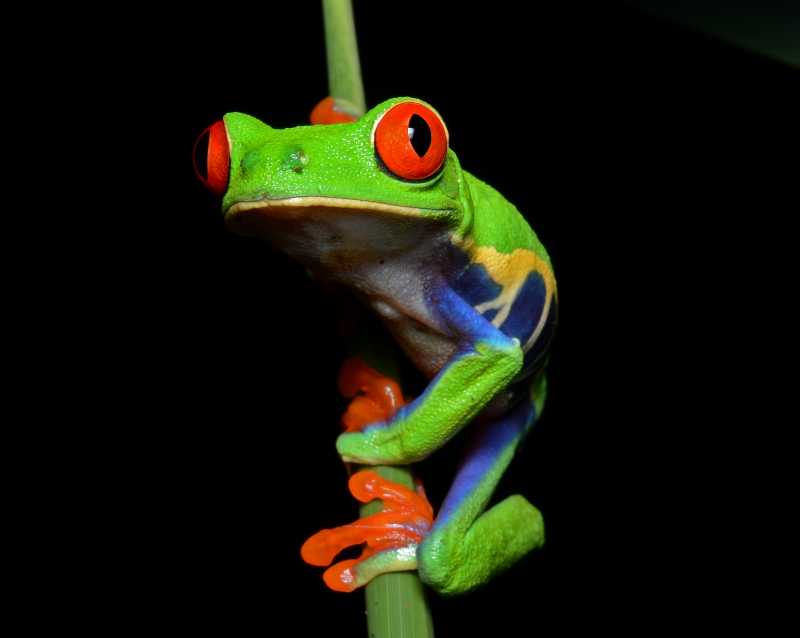
Costa Rica has around a hundred different types of amphibian, including the aptly-named red-eyed tree frog (Agalychnis callidryas), also sometimes called the red-eyed leaf frog. In addition to the red eyes, it has a body which is mostly green (providing camouflage as it sits among green foliage), a white belly, blue and yellow stripes on its side, and orange feet. Most amphibians with such bright coloring are poisonous - the coloration it intended to deter predators by warning them that the meal is not a good idea. A. callidryas is not poisonous, but uses the predator's reflexive movement back as cover for an escape.
If you are looking to spot one of these little gems (adult males are about 5 cm, just under 2 inches long, females 7.5 cm, or 3 inches), you need to go out at night (they are nocturnal) and look for trees (they are arboreal) or dense bushes near a body of water (essential for their reproductive cycle, ad also a good place to find the insects that form their diet).
2. amber daggerwing
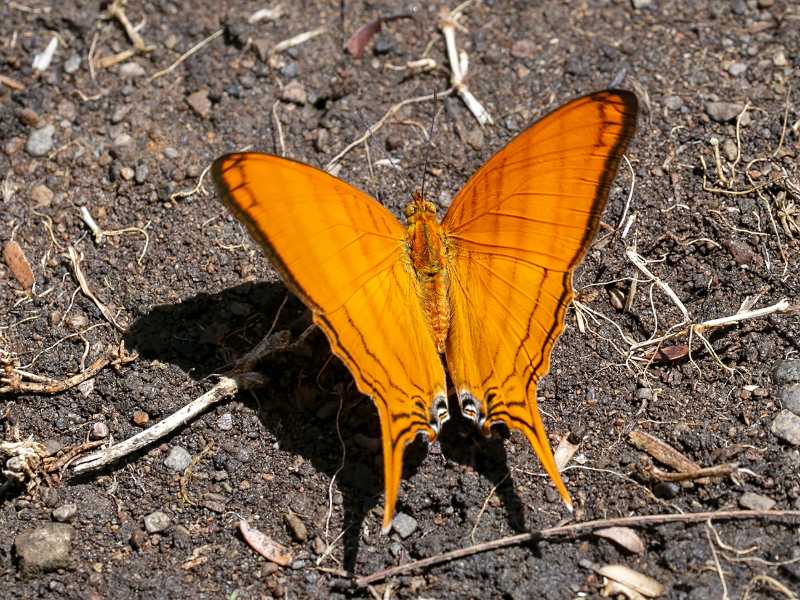
As its common name suggests, Marpesia berania is a butterfly with an orangish colour and an unusual shape to its wings - those two little pointy bits at the back end. Females are generally more of a brown color, while males are bright orange with dark brown stripes - as seen in the image used for this question.
Like most butterflies, they are diurnal, so can be seen during the day - primarily during the wet season, as they like to be near water. At night they form group roosts on the underside of leaves in the rainforest vegetation, with up to 60 of them in a cluster that has females near the centre (because they leave the water and head for the forest earlier than the males) and the males around the outside. They are relatively long-lived in the adult form, which lasts for months rather than days.
3. mantled howler
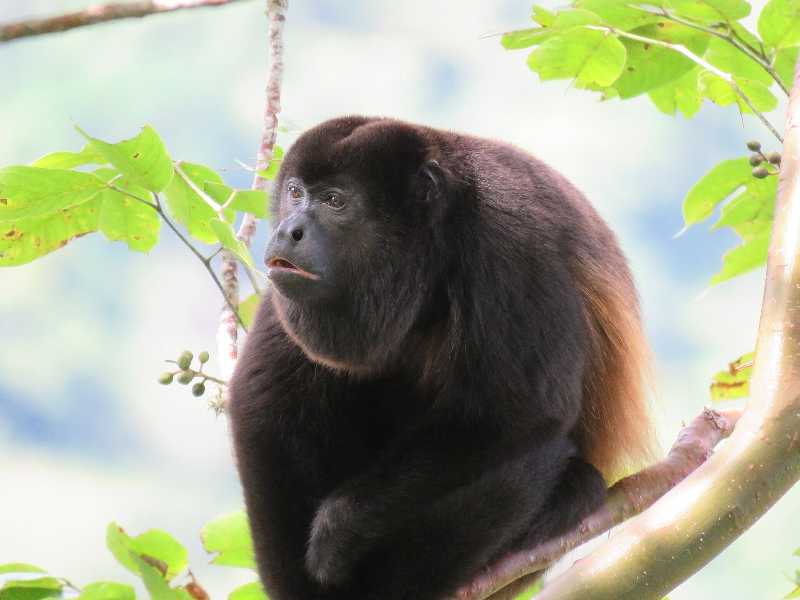
The mantled howler (Alouatta palliata) is one of the four species of monkey native to Costa Rica. the others are the Central American squirrel monkey (Saimiri oerstedii), the Panamanian white-faced capuchin (Cebus imitator), and Geoffroy's spider monkey (Ateles geoffroyi). It is called mantled because of the long hairs protruding along its sides, which can be seen in the image as orange whisps. You can probably guess that they are very loud, having an enlarged hyoid bone like other members of their genus, and are more often heard than seen!
This is one of the largest types of howler monkey, weighing up to about 10 kg (22 lbs), and is the only Central American monkey whose diet is almost completely leaves, with some fruit thrown in for variety. This means they need a lot of digesting time, to extract as much value as possible from a low-energy food, and spend all night and well over half the day resting in trees.
4. Yigüirro
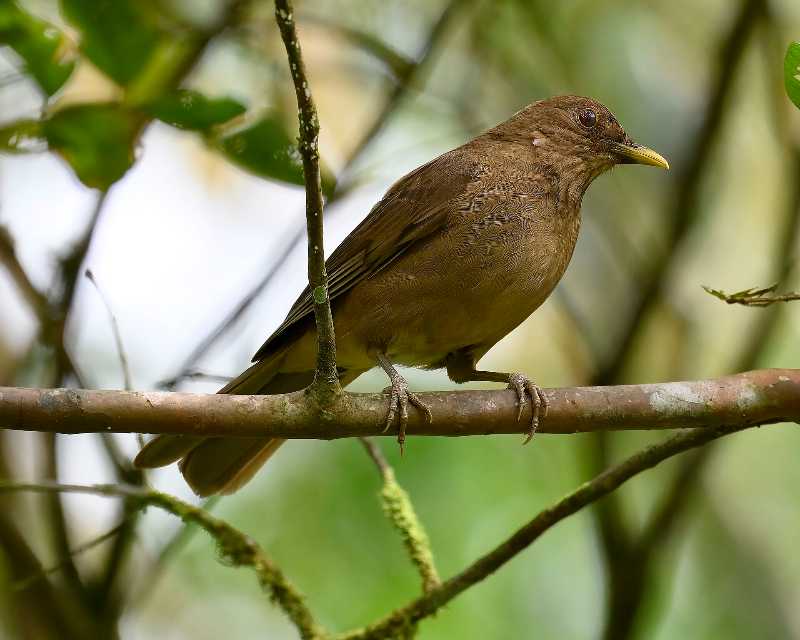
Yigüirro is the Spanish name for the Costa Rican national bird, Turdus grayi, also known as the clay-colored thrush (because it is a brown thrush). Its general appearance and behavior is similar to the American robin (Turdus migratorius), but obviously lacking the red-orange breast feathers. Their range is from southern Texas south aong the Caribbean coast of Mexico and through Central America to northern Colombia.
The yigüirro is a familiar sight around settled areas, part of the reason it was chosen as the national bird instead of one of the many more colorful birds of the rainforest. The other reason was the way its highly recognisable song is associated with the onset of the rainy season.
5. banded peacock
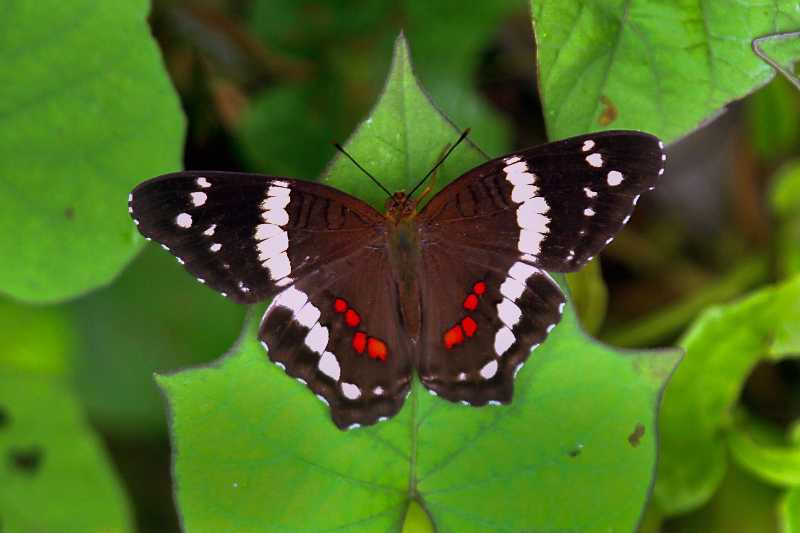
I know, the name sounds like a bird, but the fact that it is so clearly a butterfly means that the common name for Anartia fatima is usually just given as the banded peacock. The banded part of the name is obvious, the dark brown wings with stripes that may be white or yellow. The fact that there are also some red and some white spots is apparently reminiscent of the tail feathers of a peacock, with their eye-shaped spots.
Banded peacocks are a favorite food of many predators, leading to their use as a control food in experiments about lepidoptera predation - to see how effective mimicry is in protecting a species from its predators. They seem to gain little advantage from having stripes that look more poisonous than they are but, because the species is so numerous, the losses from predation do not impact the population as a whole. They also compete for nectar with other butterflies, and with hummingbirds but, again, while individuals may suffer, the population is resilient to these losses.
6. striped basilisk
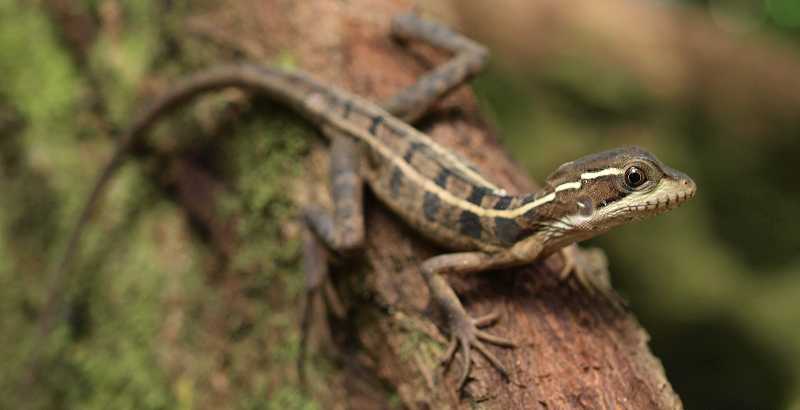
The striped basilisk (Basiliscus vittatus) gets its generic name from a Greek word meaning little king, and its specific name is Latin for striped. Pretty straightforward, really, although the word basilisk also refers to a mythological Greek monster (part rooster, part snake, part lion) that could turn people and animals to stone with its gaze. These fellows aren't deadly, but they do exhibit some interesting behavior. Like the other three members of the genus, they have large hind feet with flaps of skin between their toes, which lets them run quickly across the surface of water without sinking - hence their common designation as 'Jesus lizards'. They can often cover more than 20 metres (65 feet) without sinking, allowing them to escape heavier predators.
Given that this is their primary defense mechanism, it is not surprising to find that striped basilisks like to live near the water. They are a semi-arboreal species, spending time both in trees and on the ground looking for the insects that form the bulk of their diet, so look for them in areas with riparian vegetation. Their coloring makes them hard to find, though!
7. northern tamandua
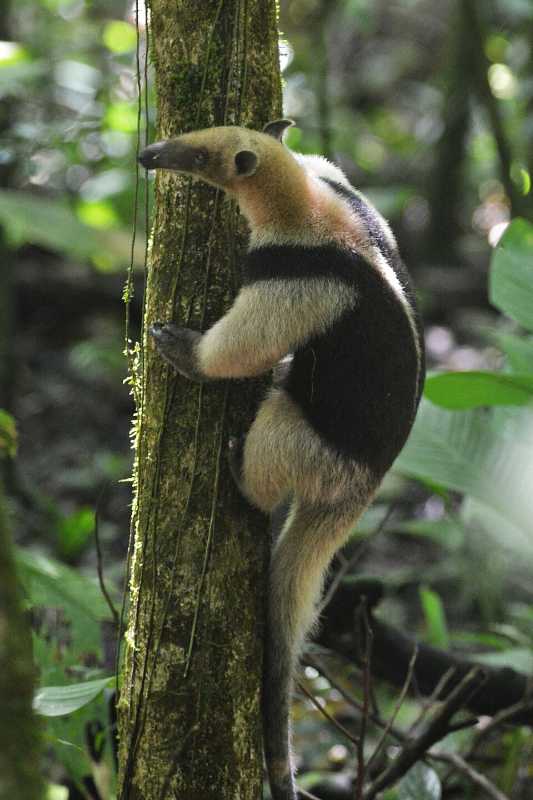
Tamandua mexicana is a kind of anteater, as you might guess from its long snout, a feature shared with the other members of the suborder Vermilingua (worm tongue): the giant anteater, the silky anteater and the southern tamandua (also called the collared anteater).
The northern tamandua can be found in forests and grasslands as they are semiarboreal. The black vest coat pattern is a major way of distinguishing the northern from the southern tamandua. That long tail in the picture is partially prehensile, meaning they can use it to help hold on to things. Their front feet are fully prehensile, allowing them to climb trees by gripping projections on the way. The forefeet also have middle toes with very large claws, which they use to tear open wood to expose the ants and/or termites within - their preferred food - which they scoop up with their elongated sticky tongue.
8. scarlet macaw
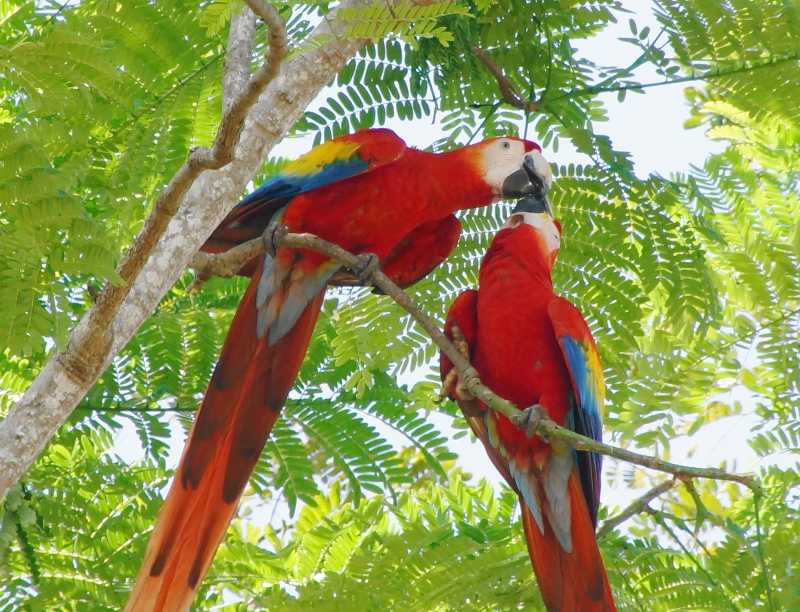
The scarlet macaw (Ara macao) is a large parrot found in evergreen forests from southeastern Mexico south to Brazil (and Honduras, where it it the national bird) as well as some Caribbean islands. The name refers to the predominant color of its feathers, but the wings also sport yellow, green and blue feathers - hence it is sometimes called the red-breasted macaw, the red-and-blue macaw, or the red-and-yellow macaw. But not the red-and-green macaw, another species entirely, which is also mostly red. The scarlet macaw is slightly smaller than the red-and-green macaw, but has a longer tail. The three most popular macaws kept in captivity as pets are the scarlet macaw, the red-and-green macaw, and their cousin, the blue-and-yellow macaw.
Scarlet macaws form monogamous breeding pairs, and can be highly aggressive in defending their nests during breeding season. Juveniles reach maturity and look for a partner at about five years of age, and typically live for around 50 years, but in captivity that may be more like 75 years. This is definitely a gift that is not just for Christmas.
Possibly surprisingly, the pet trade has actually had a positive impact on the wild population. Without intervention, adult macaws will often kill some of their chicks to prevent competition for scarce resources. Conservationists now monitor nests, so that they can remove and raise vulnerable chicks, using the methods developed by aviculturalists over the centuries, then release them into the wild again in a spot where the population is thinner.
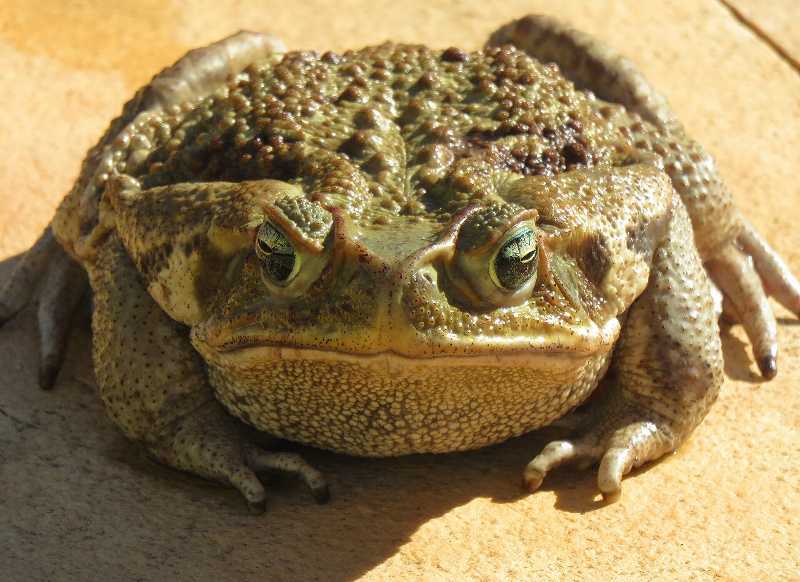
9. cane toad
Australians know the cane toad as a fierce invasive species - imported in a misguided attempt at biological control of a beetle that was damaging the sugar cane crops. It turns out that Rhinella marina is highly toxic - the glands on its skin will kill most animals that eat it - or even just make the attempt. Native species such as the northern quoll have had their numbers drastically reduced because of this. Others, such as monitor lizards, have suffered from the competition for prey, as the cane toad is voracious - it doesn't just confine itself to the desired target insects, it feasts on all kinds of invertebrates, and on vertebrates smaller than itself (up to 25 cm or 10 in head-to-vent, which is why it is also known as the giant toad), even vegetable matter when push comes to shove. But that is another quiz - in its native location, it fits in the balance of things much more smoothly.
Predators of the cane toad in the Costa Rica area include the snouted caiman, the banded-eyed snake, several different types of eel and killifish, and bullet ants. Humans have used the toxic chemicals that can be released by squeezing the toad's glands to produce a poison for the tips of arrows (similar to the use of the poison-dart frog), and also as a mild hallucinogen, in small doses. They can also be eaten, if properly prepared by removal of the skin and the parotid glands. Or maybe you would like to have one stuffed and carefully posed as a memento of your trip?
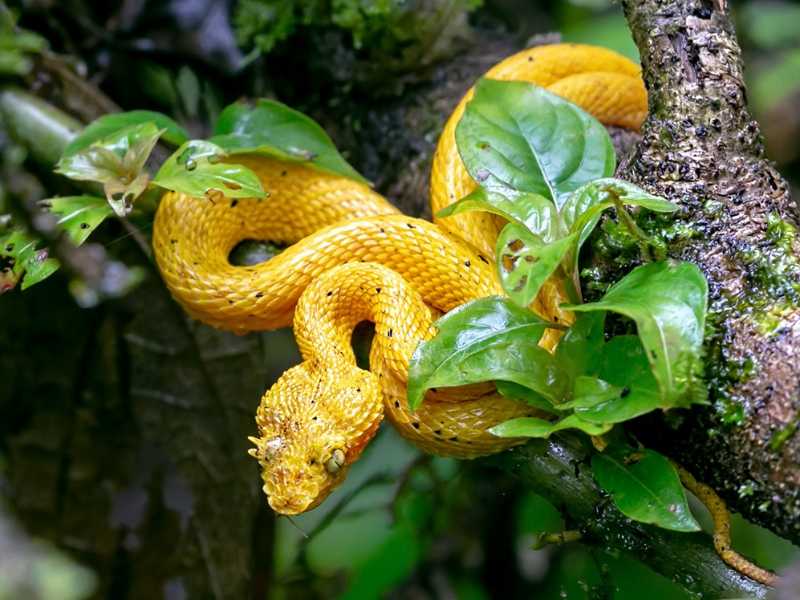
10. eyelash viper
If you look closely at its head, the superciliary (above the eye) scales that are responsible for the common name of Bothriechis schlegelii (named in honor of the herpetologist Hermann Schlegel) will be obvious. They come in all sorts of colors, not just the bright yellow in the photo. This variety of colors and also of shape has led to reclassification in recent years, which is still in flux as of the time this quiz is being written. Taxonomists now consider that B. schlegelii is only found in Colombia. The eyelash vipers found from Mexico down to Colombia are now considered to be a monophyletic clade, which means they are closely related species distinct from the rest of their genus. Things could change, as DNA analysis continues.
Like all pit vipers, eyelash vipers have a heat-sensing organ located in a pit between each eye and the adjacent nostril. They have needle-like fangs which are usually folded back against the roof of the mouth. When attacking, the jaws open to an angle of nearly 180 degrees, and the fangs swing into position allowing them to penetrate deeply into their prey and inject their venom efficiently. they are usually nocturnal ambush predators, waiting until a suitable prey comes close before launching their attack. They spend the day sleeping in trees, with their prehensile tail wrapped around a branch to keep them firmly in place.
This quiz was reviewed by FunTrivia editor rossian before going online.
Any errors found in FunTrivia content are routinely corrected through our feedback system.