
FREE! Click here to Join FunTrivia. Thousands of games, quizzes, and lots more!
Quiz about Mapping Animals 2

Mapping Animals (2) Trivia Quiz


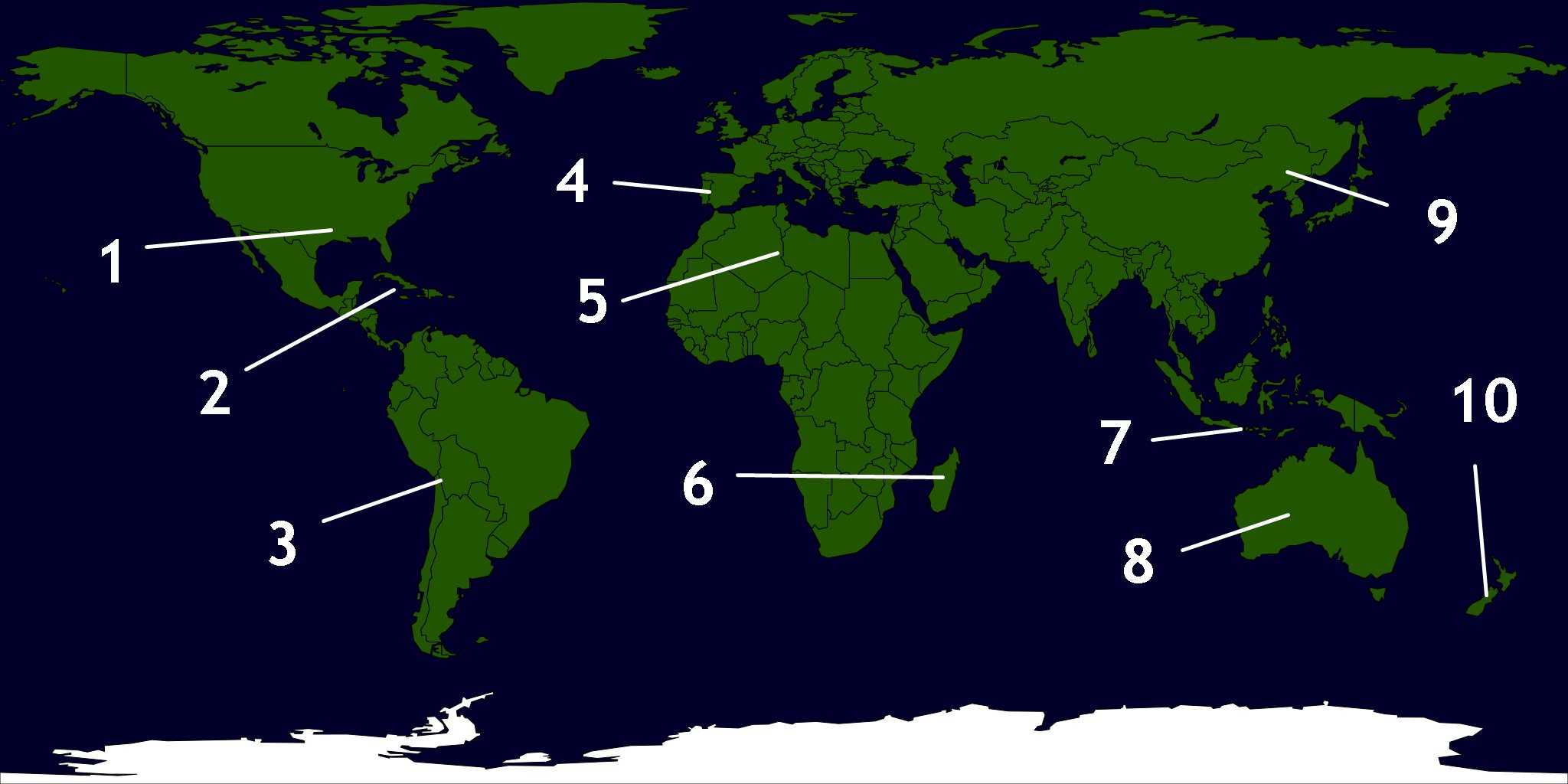
The listed animals are endemic to certain regions of the world. Place them against the correct labelled region on the map. Bear in mind some of these animals may be found in more than one region.

A label quiz by suomy. Estimated time: 3 mins.
  1. Home
  2. »
  3. Quizzes
  4. »
  5. Animal Trivia
  6. »
  7. Animals by Region

Author
suomy
Time
3 mins
Type
Label Quiz
Quiz #
423,253
Updated
Mar 01 26
# Qns
10
Difficulty
Easy
Avg Score
9 / 10
Plays
56
Last 3 plays: Guest 113 (10/10), dmaxst (10/10), Guest 124 (8/10).
Click on image to zoom
aye-aye Barbary macaque Amur leopard Komodo dragon red wolf Iberian lynx blue iguana emu guanaco kea
* Drag / drop or click on the choices above to move them to the answer list.
View Image Attributions for This Quiz
1.   
2.   
3.   
4.   
5.   
6.   
7.   
8.   
9.   
10.   

Most Recent Scores
Today : Guest 113: 10/10
Today : dmaxst: 10/10
Today : Guest 124: 8/10
Today : pixiecat: 10/10
Today : Guest 93: 4/10
Today : cbushman: 8/10
Today : Mistigris: 10/10
Today : Guest 108: 10/10
Today : mulder100: 10/10

Quiz Answer Key and Fun Facts
1. red wolf

There is debate over whether the red wolf is a separate species, a sub-species of the grey wolf or a hybrid of a coyote and a grey wolf. Found in the south-east USA, it is endangered with critically low numbers. Its numbers suffered severely during last century from predator control programmes, habitat loss and through hybridisation with coyotes.

Despite reintroductions from captive breeding programmes, most of the remaining population is in captivity.
2. blue iguana

The blue iguana (Cyclura lewisi) is endemic to the island of Grand Cayman in the Caribbean. The largest native animal on the island, it is an example of island gigantism which is where an isolated population grows in physical size when compared to the mainland population.

This may have been due to a lack of mammalian predators. European colonisation changed that and the blue iguana now seems dependent on a captive breeding programme for re-booting the wild population.
3. guanaco

Closely related to the domesticated llama and alpaca, the guanaco (Lama guanicoe) is one of two wild camelids in South America. The other is the vicuņa (Lama vicugna) which prefers to live at higher altitudes. Even so, the guanaco can be found living at altitudes around 4,000 m (13,000 ft) and has altitude adaptations such as high red blood cell counts.

It also is noted for its thick neck skin, which serves as a protection against predators but has also made it desirable for making shoes. The guanaco is amongst the largest native terrestrial mammals in South America.
4. Iberian lynx

The Iberian lynx (Lynx pardinus) is found mainly in Spain with smaller numbers in Portugal. The European rabbit makes up three-quarters of its diet although it will also prey on other animals including rabbit predators such as the red fox, Egyptian mongoose and European wildcat. Rabbit population crashes caused by the myxomatosis virus (introduced in France to control the wild rabbit population) and also the rabbit haemorraghagic disease (RHD) virus (which spread from China) have had a knock-on impact on predator populations, including the Iberian lynx.
5. Barbary macaque

Native to the mountains of Algeria, Tunisia and Morocco, this is the only primate occurring north of the Sahara Desert in Africa. The best known group is probably the introduced population in Gibraltar, Europe's only wild monkeys. Fossil records indicate that macaques were at one time widespread in Europe before becoming extinct.

They are believed to have been re-introduced by the Moors during the Middle Ages. They have boneless vestigial tails and, like all Old World monkeys, well-developed sitting pads.
6. aye-aye

A member of the lemur family, the aye-aye is the world's largest nocturnal primate. It finds its preferred food (grubs and larvae) by tapping on a tree trunk, gnawing a hole with its continually-growing teeth and inserting its thin middle finger into the hole to hook out the grubs and larvae. In ecological terms, it could be described as the Madagascan equivalent of a woodpecker.
7. Komodo dragon

Surprisingly, perhaps, the main source of food for the Komodo dragon is the Javan rusa, a type of deer native to Indonesia. They also eat lots of carrion. The largest lizard in the world, it is an apex predator growing to 3 metres (10 ft) in length and weighing as much as 150 kg (330 lb). It is endemic to five Indonesian islands, including Komodo after which it is named.
8. emu

The emu is a large ostrich-like bird endemic to Australia. A member of the ratite group of keelless and flightless birds, the emu is now confined to Australia's mainland with outlying island-based subspecies now extinct. It is common for the females to fight amongst themselves for a mate and it is the male who incubates the eggs, barely eating or drinking during the eight weeks it takes for them to hatch.

He also raises the young.
9. Amur leopard

The Amur leopard (Panthera pardus orientalis) is a subspecies that once occurred throughout eastern Siberia, Manchuria and the Korean Peninsula. It is now mostly found within the Primorye region of far eastern areas of Russia and into NE China, mainly where there are wild sika deer populations.

It is well-adapted to snowy, mountainous conditions and is noted for its winter coat. Poaching is a significant problem and numbers are now so low that inbreeding is an issue.
10. kea

Keas (Nestor notabilis) are a familiar sight for tourists visiting alpine regions of New Zealand's South Island. A species of large parrot, these mostly olive-green birds are noted for their intelligence and curiosity. It is a social animal and normally hangs out in groups of up to a dozen or so.

Its common name is onomatopoeic, sounding like the bird's call. It is one of nine surviving parrot species endemic to New Zealand.
Source: Author suomy

This quiz was reviewed by FunTrivia editor rossian before going online.
Any errors found in FunTrivia content are routinely corrected through our feedback system.
3/1/2026, Copyright 2026 FunTrivia, Inc. - Report an Error / Contact Us