FREE! Click here to Join FunTrivia. Thousands of games, quizzes, and lots more!
Quiz about The American Black Bear

The American Black Bear Trivia Quiz

Ursus americanus

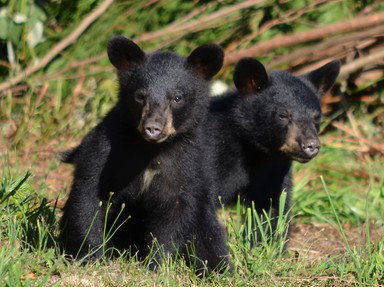
Test your knowledge of the American black bear with this 10-question photo quiz that covers coloring, diet, behavior, and romance.

A photo quiz by EggyTheHead. Estimated time: 3 mins.
  1. Home
  2. »
  3. Quizzes
  4. »
  5. Animal Trivia
  6. »
  7. Carnivores
  8. »
  9. Ursidae-Bear Family

Author
EggyTheHead
Time
3 mins
Type
Photo Quiz
Quiz #
424,310
Updated
May 26 26
# Qns
10
Difficulty
New Game
Avg Score
9 / 10
Plays
21
Last 3 plays: Reamar42 (9/10), GoodwinPD (10/10), kvanhoy (8/10).
-
Question 1 of 10
1. Despite the name, American black bears can naturally appear in several colors besides black. Which of these is a real color variation of "black" bears? Hint


Question 2 of 10
2. What is the primary diet of the American black bear? Hint


Question 3 of 10
3. Which sense is especially strong in the American black bear? Hint


Question 4 of 10
4. During what season do American black bears usually mate? Hint


Question 5 of 10
5. What do many American black bears do during winter in colder regions? Hint


Question 6 of 10
6. Compared with grizzly bears, American black bears are usually what? Hint


Question 7 of 10
7. What is the typical number of cubs born in a black bear litter? Hint


Question 8 of 10
8. How developed are black bear cubs when they are first born? Hint


Question 9 of 10
9. What is a common defensive behavior of black bears when threatened? Hint


Question 10 of 10
10. Which statement about American black bears and humans is accurate? Hint


(Optional) Create a Free FunTrivia ID to save the points you are about to earn:

arrow Select a User ID:
arrow Choose a Password:
arrow Your Email:


View Image Attributions for This Quiz

Most Recent Scores
Today : Reamar42: 9/10
Today : GoodwinPD: 10/10
Today : kvanhoy: 8/10
Today : FlicksBuff: 8/10
Today : LancYorkYank: 10/10
Today : Guest 136: 10/10
Today : Guest 137: 7/10
Today : Dizart: 9/10
Today : woodstockwanda: 9/10

Quiz Answer Key and Fun Facts
1. Despite the name, American black bears can naturally appear in several colors besides black. Which of these is a real color variation of "black" bears?

Answer: Cinnamon

American black bear. The name seems simple enough. Self-explanatory, even. Not so. They can and do show up with glossy black fur of course. But they can also don deep brown coats, wow the boys as blonds, and yes... others have that famous cinnamon fur. You'll find them in parts of the western United States and Canada, where people often mistake them for grizzly bears from a distance.

Then there are the real oddballs. Some black bears in coastal British Columbia carry a rare gene that makes them creamy white. They're called Kermode bears, or more dramatically, "spirit bears." Despite the cute names, they're still American black bears underneath all that creamy white fluff.
2. What is the primary diet of the American black bear?

Answer: Plants

American black bears are omnivores classified as carnivores, but most of what they eat comes from plants. Confused? Don't be. Taxonomists do this stuff all the time. Berries, nuts, acorns, grasses, roots, and other leafy greens make up the bulk of their diet through much of North America. Their eating habits change with the seasons. The spring menu has tender shoots and insects. Late summer is a nonstop berry-fest as they prepare for winter.

All that said, black bears are definitely opportunists. They'll definitely eat fish if they're around, especially during salmon runs in certain regions. They won't say no to carrion or small mammals either if given the chance. But mostly these carnivores opt for the salad bar.
3. Which sense is especially strong in the American black bear?

Answer: Smell

The black bear's sense of smell is so powerful that people who research this kind of thing estimate it may be several times stronger than that of a bloodhound. They're also more dangerous to put on a leash. Bears can sniff out food from miles away if the conditions are right. Long snouts and giant nasal cavities are carrying the load here.

Bears in general use scent to locate food, identify other bears, detect danger, and even track mates during the season of romance. They've been known to smell carcasses buried under snow. They'll even pick up odors drifting across valleys. Their hearing is pretty good too, and black bears can see color better than many people assume, but smell is definitely their thing.
4. During what season do American black bears usually mate?

Answer: Summer

American black bears typically find romance during the summer months, most often from June into July. However, it can vary by region. Male bears can and do travel long distances searching for Ms. Right, and temporary pairs sometimes stay together for several days before drifting apart again, like ships passing in the night...

One of the odder parts of black bear biology comes afterward. Fertilized eggs do not immediately begin developing. Instead, black bears use a process called "delayed implantation", where the embryo takes a pause before actually attaching to the uterus. If the mother has gained enough body fat by autumn, the pregnancy continues during torpor and cubs are born in the den during winter. If not the embryo gets reabsorbed by the would-be mother.
5. What do many American black bears do during winter in colder regions?

Answer: Enter a long period of dormancy

When winter chills the air and the snow has turned your car into a big white lump, you'll find our forest-dwelling friends sleeping it off. It's an enviable way to make it through the winter. So, yes, most American black bears retreat into their dens and enter a long period of dormancy often referred to by us mere mortals as hibernation. The zoology crowd scoffs at us, however, telling us that it's actually "torpor".

The bears' heart rate slows dramatically, their breathing drops, and they can go for months without eating, drinking, or even wandering out for a midnight snack. A bear turns itself into a giant fuzzy battery, living off stored body fat until spring starts thawing the place out.

The den can be surprisingly austere. Bears might hide themselves into hollow trees, rock crevices, brush piles, dug-out spaces beneath roots, etc. Pregnant females usually give birth during the wintertime, somehow caring for tiny cubs while barely eating themselves.
6. Compared with grizzly bears, American black bears are usually what?

Answer: Smaller

Grizzly bears are large. I mean, very large. Huge is not too strong a word. Meanwhile, American black bears are generally smaller and lighter. They have a slimmer build, shorter claws, and a more angular face. Adult black bears often weigh a few hundred pounds (80-135 kg on average). Nothing you want to wrestle with, but grizzlies can be more than twice that weight.
7. What is the typical number of cubs born in a black bear litter?

Answer: Two or three

Black bear mothers usually give birth to litters of two or three cubs during the winter while denned up during hibernation (technically torpor). The cubs arrive tiny and blind, often weighing less than a pound (less than half a kilogram). Inside the den, the cubs nurse and grow rapidly while their mother survives off stored body fat.

The cubs have a strong bond. They grow up together, they play together, they learn together (Mom's a great teacher), and they all snuggle up for warmth. After about 18 months, Mom decides they've learned enough. She chases them away, sometimes aggressively so. While the siblings might stick together for a little while longer for comfort, they eventually separate to stake out their own territories.
8. How developed are black bear cubs when they are first born?

Answer: They are tiny, blind, and nearly hairless

If you think bears are scary, you should see them with their clothes off. Squeaky little beanbags with claws. They are very small, blind, mostly hairless, and completely dependent on Mom. A cub usually weighs less than a pound at birth (a little less than half a kilogram). It's about the size of a chipmunk... with a lot of growing to do. Mom dozes through the winter, while the cubs feed constantly.

They grow fast. By spring, those tiny beanbags are fuzzy, hyperactive cubs, stumbling and tumbling after their mother through the woods. They learn quickly, especially when it comes to climbing trees, but they absolutely cannot do that at birth. Their eyes remain closed for a month or more, and they rely heavily on Mom's warmth and milk early on.
9. What is a common defensive behavior of black bears when threatened?

Answer: Climbing trees

Black bears are amazing climbers, and climbing a tree is their classic escape maneuver when danger rears its ugly head. Cubs scamper upward almost automatically. Adult black bears can certainly climb too, though the chubbier ones may rely more on running away or bluffing an attack ("bluff-charging"). Their curved claws are perfect for gripping tree bark.

You know that old advice about playing dead? That can sometimes work with grizzly attacks that are purely defensive. Good luck! However, it's not recommended for black bears. They don't want the fight and are more likely to be deterred by fighting back and making lots of noise.

Personally, I've had two very up-close and unwanted experiences with black bears. In one case, the bear cub fell out of a tree right next to me. We looked at each other for just a moment, and I think we each broke land-speed records that day... in opposite directions. (After the second encounter, I ran, while the monster behind me just kept moseying along, apparently deciding the out-of-shape human trying to run away was not really a threat.)
10. Which statement about American black bears and humans is accurate?

Answer: They usually avoid people when possible

Most American black bears want absolutely nothing to do with you. If they see a person nearby, they usually slip away quietly long before anyone has time to shout "RUN!" They're all about caution and avoidance, which is great for us. In heavily forested areas, hikers often walk right through black bear territory without ever spotting one because the bears have already melted back into the trees like ninjas.

Problems usually start when bears connect humans with easy food. Bird feeders, garbage cans, pet food, and campground snacks will tempt even cautious bears into risking it. A "fed bear" can become a dangerous bear because it loses its fear of humans. My father loved having bears around and would create massive mounds of birdseed... and then send me out into the woods to do chores. This explains the two close-up and personal encounters I mentioned earlier in the quiz.
Source: Author EggyTheHead

This quiz was reviewed by FunTrivia editor rossian before going online.
Any errors found in FunTrivia content are routinely corrected through our feedback system.
5/26/2026, Copyright 2026 FunTrivia, Inc. - Report an Error / Contact Us