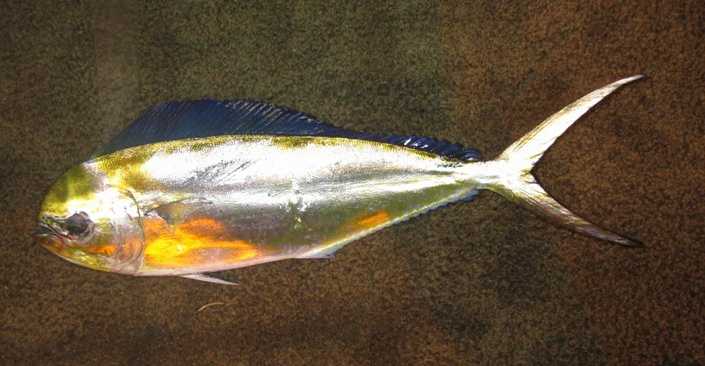
This fish has a distinctive round head and fin, and green and yellow colouring. Mahi-mahi are also known as dolphinfish or dorado. The name mahi-mahi means "very strong" in Hawaiian. Dorado is Spanish for gold, and refers to their bright colouration. These fish are popular with sports fishermen for their size, fight and impressive appearance.
They spawn three times a year, and females can produce up to 1,000,000 eggs each spawning event, meaning up to 3 million eggs in a year.
2. Sailfish
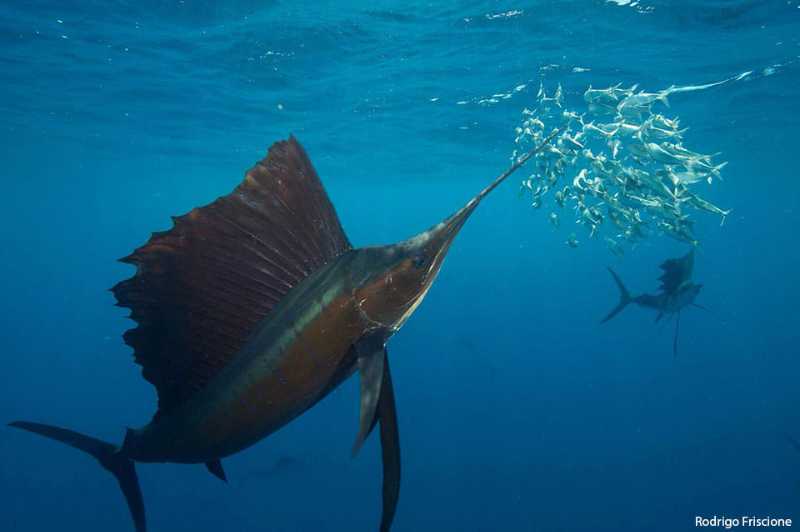
This fish's large, sail-like fin gives it its name. There are two species of sailfish; the Atlantic and the Indo-Pacific. They are considered the fastest fish in the ocean, reaching up to 55 km/h (35 mph). They may have a limited ability to change colour, possibly to display emotion, communicate with other sailfish or confuse prey.
Their distinctive sails are usually folded back for hydrodynamics, but they are raised when sailfish begin to attack their prey. They are highly prized for sport fishing, and are part of a group colloquially known as billfish, which includes sailfish, swordfish and marlin.
3. Marlin
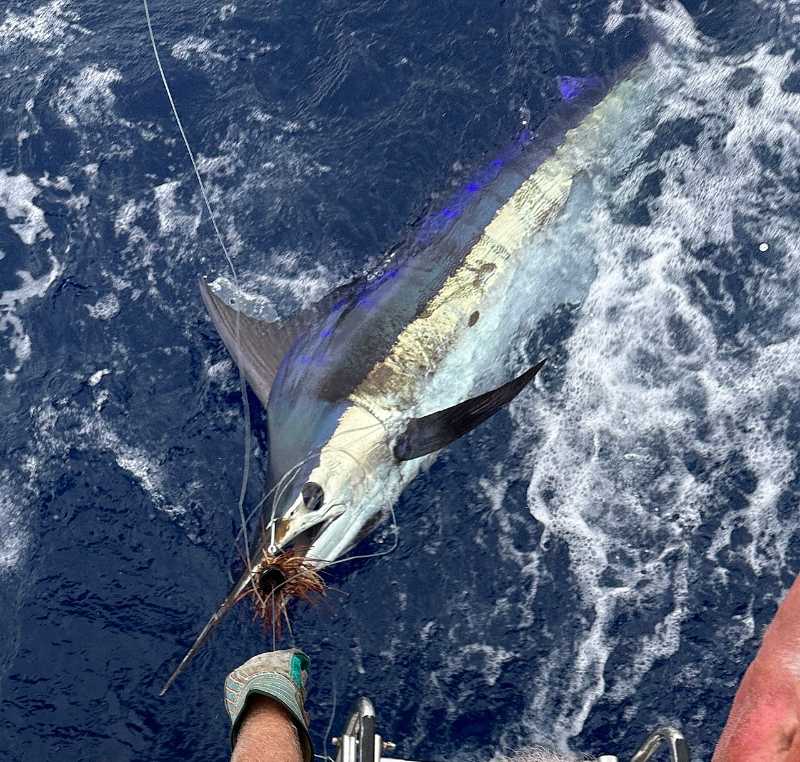
These fish look similar to the sailfish and almost identical to the swordfish. There are between 9 and 11 species depending on the authority. The largest species is the black marlin, reaching in excess of 5 metres (16 feet) and 670 kg (1480 lbs). They are among the billfish, a highly prized group of fish among sport fishermen.
They can swim pretty fast, but not as fast as the sailfish. Also, like sailfish, they can change the colour of their stripes, often done before attacking prey.
4. Anglerfish
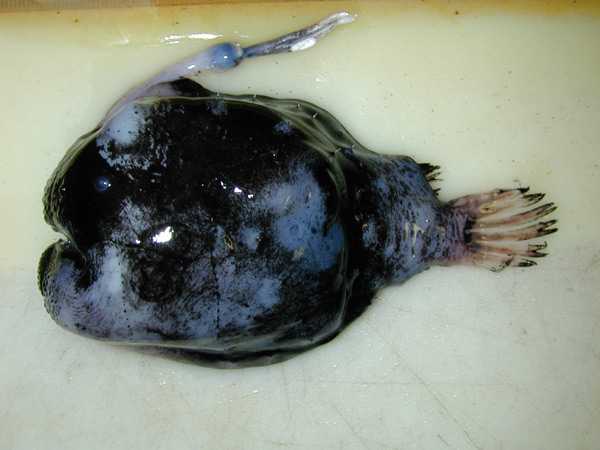
This fish's dark colour, lure on its head and round shape clearly distinguish it as a deep-sea anglerfish. There are many species of deep-sea anglerfish. These fish use the bioluminescent bacteria in their lure to attract prey, flashing it enticingly in front of their sharp teeth.
The males are much smaller than females, which is linked to their interesting mating process. The small males seek out a female with their sense of smell. When they find one, they bite onto her, sucking her blood as a source of nutrients.
The male will slowly grow together with the female, becoming a lump with eyes permanently on her body. The females can then choose to use his sperm whenever she feels like laying eggs. Females can have multiple males on their body.
5. Giant oarfish
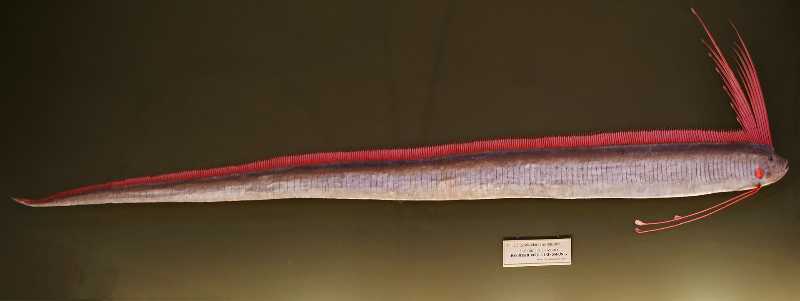
The long silvery body and distinctive red fins are characteristic of this fish. They are among the longest fish, and are the longest ray-finned fish, reaching lengths of at least 8 metres (26 feet) but possibly up to 11 metres (36 feet). These fish are believed to be one of the many inspirations for descriptions of sea serpents, with large eyes, a long shiny body and an undulating way of movement.
At the deepest, they live at around 500 m (1614 feet) and these fish are oceanodromous, meaning they migrate around the ocean.
They are found nearly everywhere except in polar oceans.
6. Ocean sunfish
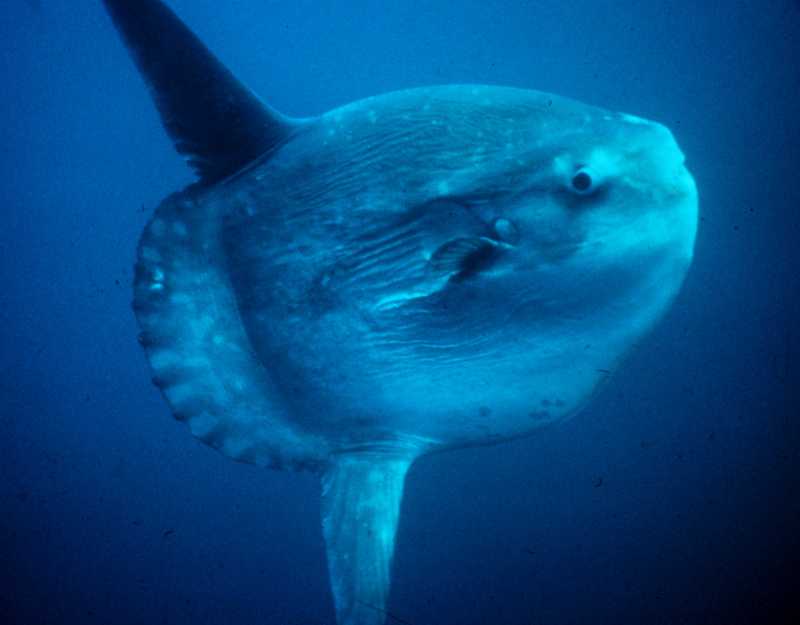
These large fish cannot be mistaken. Their large bodies, distinctive fins and shape, and the "half-fish" appearance are unique to them. There are five species of sunfish, but the most well known is the oceanic sunfish (Mola mola). The other species are the giant sunfish (Mola alexandrini), hoodwinker sunfish (Mola tecta), sharptail mola (Masturus lanceolatus) and slender sunfish (Ranzania laevis).
These fish are often sighted lying on their sides at the surface. This is so seagulls can land on them and remove parasites, and possibly also to refill their oxygen stores and warm up. These fish are known to be preyed on by seals and orcas, and there is recent footage (2026) of orcas ramming a sunfish so hard it explodes.
7. Parrotfish
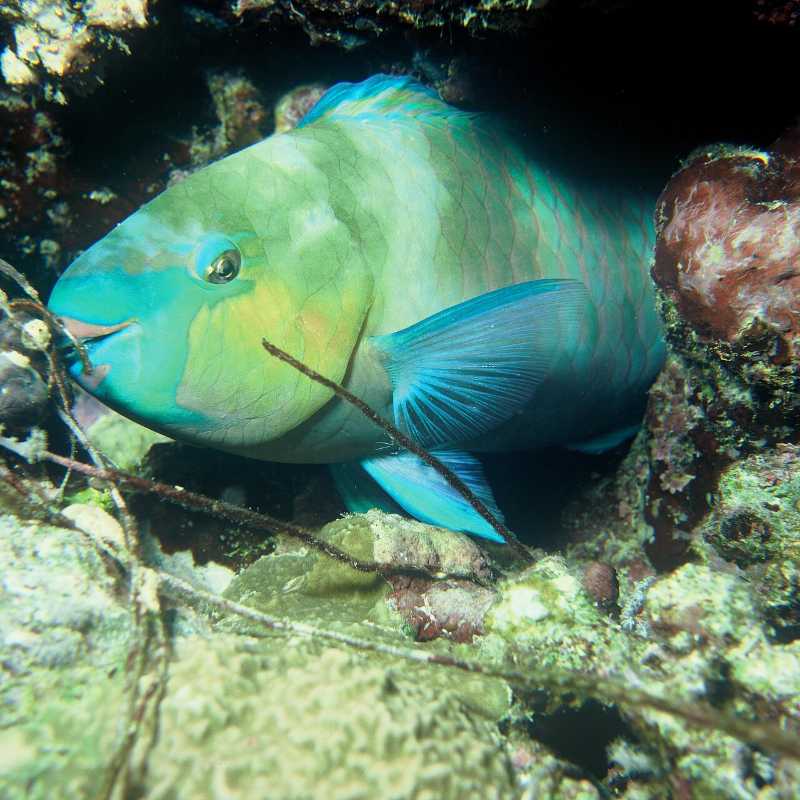
These fish have eye catching bright colouration and live in reefs. They are named for their distinctive beak, which resembles that of a parrot. They are a type of wrasse and there are close to 100 different species of parrotfish.
Some species use their beaks to eat away at coral and occasionally rock, possibly in an attempt to eat the algae that has formed on the solid surface. They eat algae, seagrass and, sometimes, plankton.
8. Coelacanth
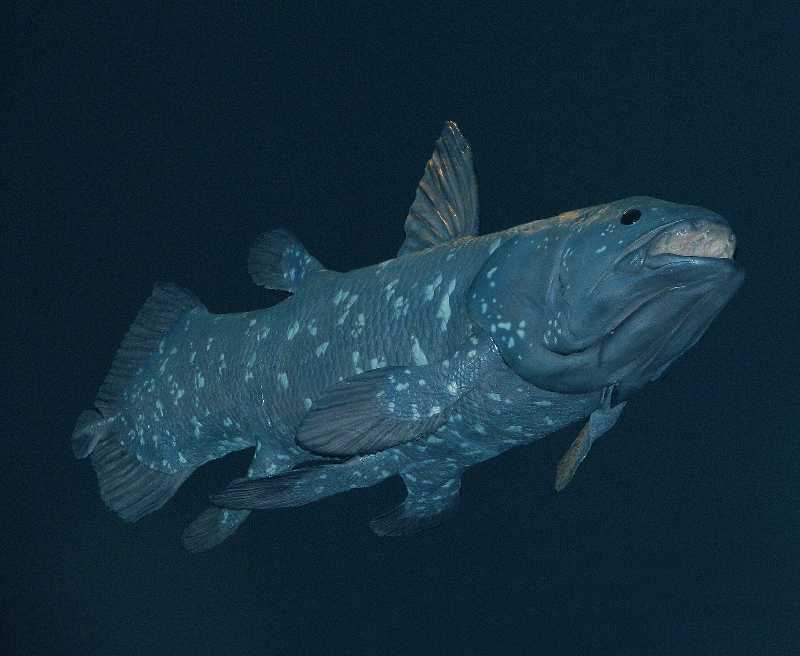
This fish's mottled blue pattern, interspersed with patches of white scales and distinctive lobed tail, reveal it to be one of the two living coelacanth species, specifically the West Indian Ocean coelacanth. The other species is the Indonesian or Sulawesi coelacanth, which is very similar but, instead of blue and white, it is brown and white.
It was revealed to be a separate species in 1997 after a specimen was found at a fish market in Sulawesi.
9. Batfish
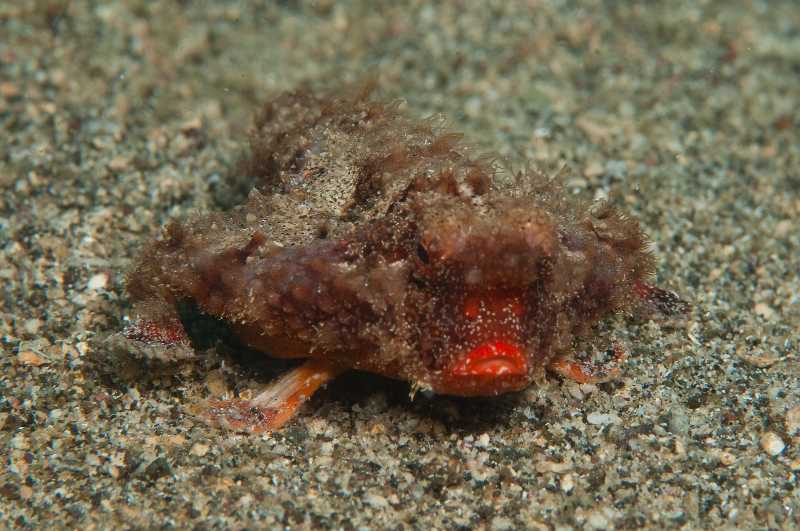
This fish is the rather uncreatively named red-lipped batfish, obviously named for the prominent red lips. Technically, these are a species of anglerfish, though they are morphologically unique. They use their pectoral, anal and pelvic fins almost like hands to walk along the floor.
When they become adults, they develop a spine on their dorsal fin that acts as an anglerfish's lure to attract prey. They reach 40 cm (16 inches) in length and live in the deep ocean. They look very odd from a top-down view.
10. Frogfish
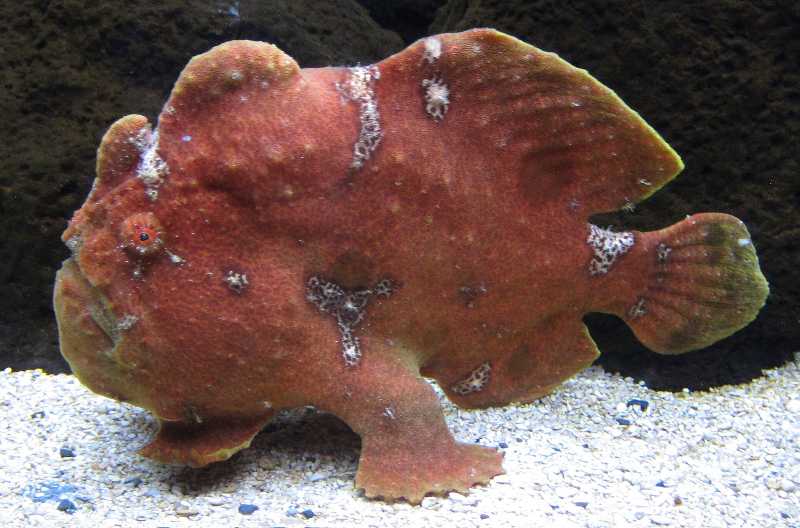
The distinctive walking fins and lumpy head are fairly consistent across the many frogfish species. They are also known as handfish for the appearance and use of their fins to move across the seafloor. These are part of the anglerfish order. Their appearance depends on their habitat and camouflage needs. Colourful and lumpy fish are often found in coral reefs, but a fish covered in filaments and coloured a greenish yellow likely lives among seaweed.
11. Hagfish
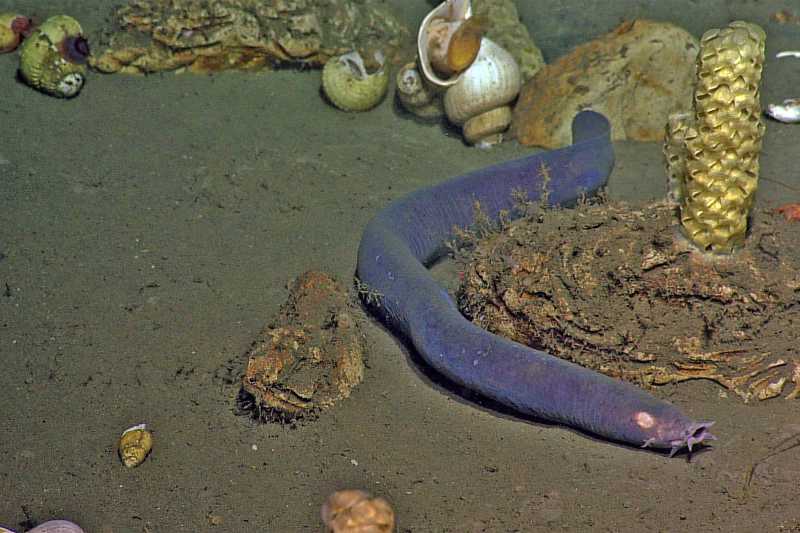
The distinctive purple and eel-like body of the hagfish is impossible to confuse when combined with the barbels ("whiskers") on the face. These deep-sea fish are common sights at whalefalls, where a whale carcass has sunk to the ocean floor and created a mini ecosystem.
These fish are known for tying themselves into knots, which may help them to get a better purchase on their prey of dead animals. They also produce copious amounts of slime from their skin, so much so that if a hagfish is placed in a bucket, within an hour or two the bucket will be full of slime.
12. Electric eel
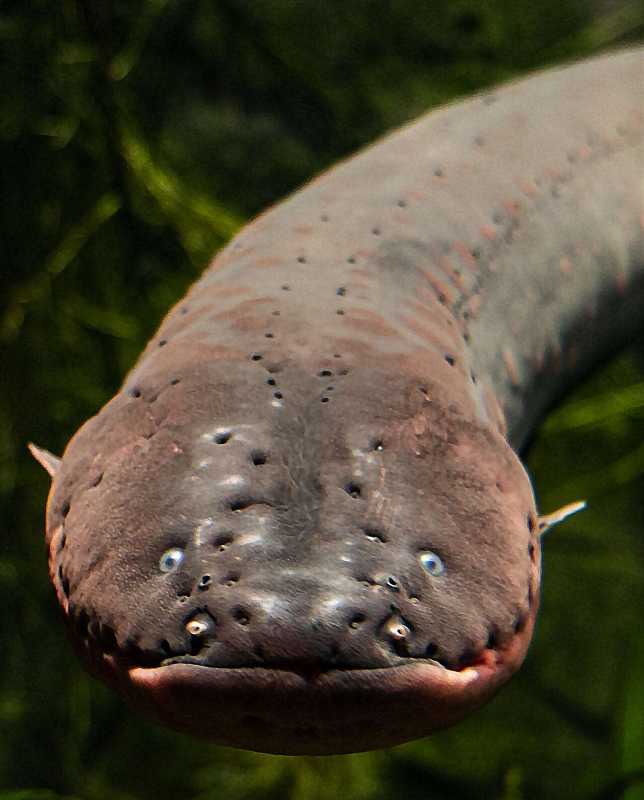
The prominent pits on the face and body, along with small, upwards facing eyes, are characteristic of the electric eels. These are not true eels, but a group of electroreceptive knifefish, meaning that, not only can they put out electricity, they are also especially adept at sensing it. Around four fifths of their body is muscle dedicated to producing electricity.
They can deliver shocks of up to 860 volts, and can kill humans, though this is rare as they are shy fish. There are three species of electric eel.
13. Lamprey
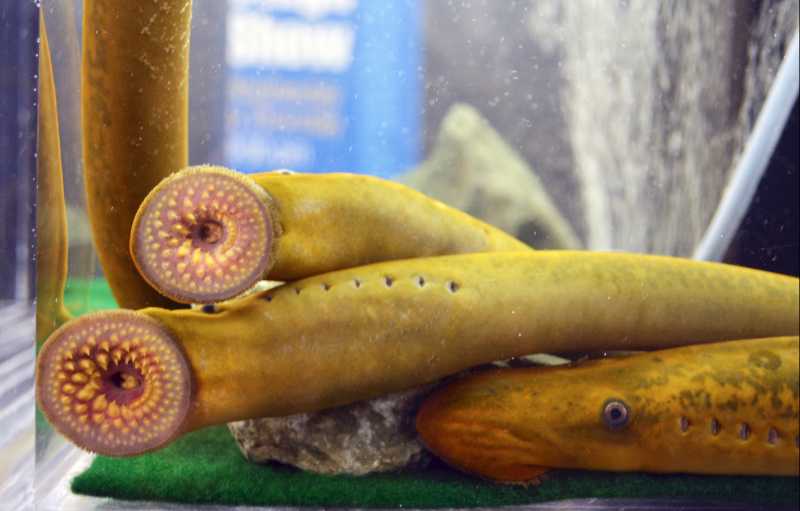
The unique mouth of this fish is all that is needed for identification here. These parasitic jawless fish use their gripping teeth and sharp tongue to bore a hole into fish and occasionally humans (if they are truly starved) to take some flesh. They are closely related to hagfish.
They spend most of their life as juveniles, filter feeding and burrowing into river and ocean beds. They have long been eaten, in both medieval and modern times, for their meaty taste.
14. Remora
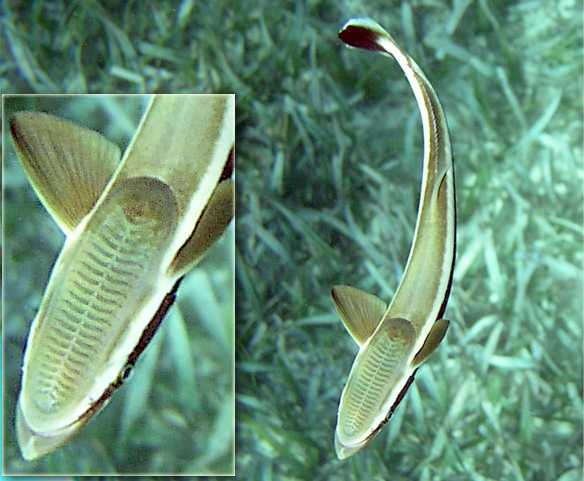
This fish, also known as the suckerfish, has a very unusual head with a unique purpose. They will either directly attach to (via suction), or swim just below, a range of animals, such as sharks, whales, turtles, rays, small boats, and even divers. They benefit from this by getting the leftovers of their host's meals, and possibly supplement this by picking the parasites off the host's skin, though this is unconfirmed.
This is a mutualistic relationship, as the host benefits from parasite removal, and the remora benefits by getting food, protection and a rush of water over their gills to help it breathe better.
15. Lungfish
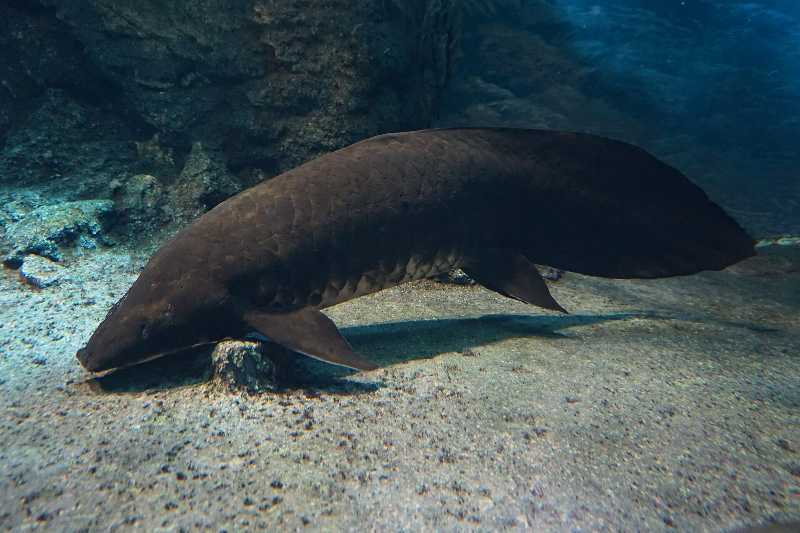
Lungfish have distinctive fins, tails and brown colouration that allow easy identification. There are six separate species, and they tend to eat hard-shelled animals, like crustaceans, using their crushing tooth plates. The are named for their interesting respiratory system. Five species of lungfish have two well structured lungs that are so dominant that their gills have atrophied beyond use.
The other species, known as the Australian or Queensland lungfish, has only one lung, and can also use its gills in tandem with its lung.
This quiz was reviewed by FunTrivia editor rossian before going online.
Any errors found in FunTrivia content are routinely corrected through our feedback system.