FREE! Click here to Join FunTrivia. Thousands of games, quizzes, and lots more!
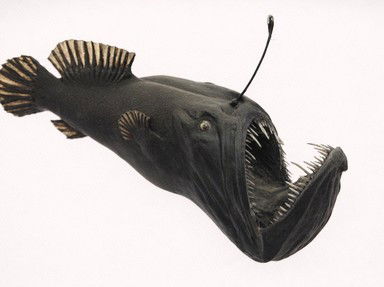
Quiz about The Anglerfish

The Anglerfish Trivia Quiz


Welcome to the world of the strange aquatic anglers of the deep, those fish with their own built-in fishing rods and glowing lures. Here you'll learn everything you ever wanted to know about them... and more than a few things you didn't. Enjoy!

A photo quiz by JJHorner. Estimated time: 3 mins.
  1. Home
  2. »
  3. Quizzes
  4. »
  5. Animal Trivia
  6. »
  7. Fish

Author
JJHorner
Time
3 mins
Type
Photo Quiz
Quiz #
423,447
Updated
Mar 16 26
# Qns
10
Difficulty
Average
Avg Score
8 / 10
Plays
23
Last 3 plays: PurpleComet (10/10), Guest 64 (6/10), Steelflower75 (6/10).
-
Question 1 of 10
1. Anglerfish are so named for the glowing lure that extends from the head. What causes the anglerfish's lure to glow? Hint


Question 2 of 10
2. Which anglerfish species (Himantolophus groenlandicus) is commonly found in the Atlantic Ocean and is known for its strangely shaped body, its fondness for warmer climes, and their shorter 'fishing rods' (illicia)? Hint


Question 3 of 10
3. Where do most anglerfish species live? Hint


Question 4 of 10
4. What species of anglerfish (Lophius americanus) has a distinctive flattened body and belongs to the goosefish group often found along the Atlantic coast of North America? Hint


Question 5 of 10
5. What purpose does the anglerfish's gigantic mouth serve? Hint


Question 6 of 10
6. Which family of anglerfish, lacking pelvic fins, has a particularly fearsome appearance with sharp teeth and extremely dark coloration, contributing to the name? Hint


Question 7 of 10
7. What unusual reproductive strategy do we see in many deep-sea anglerfish species? Hint


Question 8 of 10
8. Which type of anglerfish, found mostly on tropical reefs, is famous for its incredible camouflage and its ability to "walk" along the seafloor using modified pectoral fins? Hint


Question 9 of 10
9. Anglerfish are strong, acrobatic swimmers.


Question 10 of 10
10. What is the largest and most diverse family of anglerfish, known for their stowable lures, non-parasitic males, and often very dark skin? Hint


(Optional) Create a Free FunTrivia ID to save the points you are about to earn:

arrow Select a User ID:
arrow Choose a Password:
arrow Your Email:


View Image Attributions for This Quiz

Most Recent Scores
Today : PurpleComet: 10/10
Today : Guest 64: 6/10
Today : Steelflower75: 6/10
Today : shaniatrivia: 9/10
Today : Guest 65: 5/10
Today : aandp1955: 8/10
Today : parrarobbie: 6/10
Today : Bowler413: 5/10
Today : GoodwinPD: 10/10

Quiz Answer Key and Fun Facts
1. Anglerfish are so named for the glowing lure that extends from the head. What causes the anglerfish's lure to glow?

Answer: Bioluminescent bacteria

That weird little fishing rod on an anglerfish's head is called an 'illicium' and the luminescent lure is the 'esca'. It glows thanks to colonies of bioluminescent bacteria living inside it. If you're like me, you might say that the fish runs a tiny underwater condo for glowing microbes.

So, you probably won't want to say that.

These bacteria produce light through a chemical process involving molecules like luciferin and the enzyme luciferase, which is probably something you could have gone your whole life without knowing (and honestly will probably forget in 3... 2... 1...).

In return for the free housing and tasty nutrients, the bacteria provide a steady blue-green glow that works like a deep-sea porch light for very hungry predators. When a curious fish swims over to investigate the neat shiny thing, the anglerfish snaps it up. Efficient. A little rude, maybe, but efficient nonetheless.

The deep sea is so dark that sunlight never reaches it, so bioluminescence is everywhere down there. Creatures flash, blink, pulse, and glow for all sorts of reasons. Some use light to hunt like anglerfish do. Others use it to communicate, confuse predators, or even camouflage themselves by matching the faint light from above.
2. Which anglerfish species (Himantolophus groenlandicus) is commonly found in the Atlantic Ocean and is known for its strangely shaped body, its fondness for warmer climes, and their shorter 'fishing rods' (illicia)?

Answer: Atlantic footballfish

The Atlantic footballfish (or Himantolophus groenlandicus, if you like dirty talk) is said to look like a football. I mean... I guess. Its body is bulbous, which is fine and all. Then there's the frighteningly huge mouth, needlelike teeth, and that classic anglerfish lure poking out over its face like a tiny fishing rod. All of that is a solid no for me.

It lives in the deep Atlantic Ocean, often hundreds to thousands of meters down where sunlight is more of a rumor than anything else. The lure helps it hunt in that permanent darkness, attracting smaller fish and crustaceans that drift a little too close to investigate.
3. Where do most anglerfish species live?

Answer: In the depths of the ocean

Most anglerfish species live deep in the ocean, usually hundreds or even thousands of meters below the surface. So, really deep ocean. Down there the environment is cold. The pressure will crush you and me like a bug. Sunlight doesn't exist.

It's a permanent midnight zone.

But that's us. The anglerfish just love it. Their often-dark bodies blend into the gloom, and their ridiculously sinister (and huge) mouths let them swallow prey nearly their own size.

Then of course there's that famous glowing lure dangling in front of their faces like a cat toy. In a place where food is scarce and visibility is basically zero, a built-in fishing pole with a light on the end is a pretty solid hunting strategy, I guess.

Anglerfish fit right in with the weirdos down in the deep-ocean waters. There are plenty to choose from. Some species drift slowly through the water waiting for prey, while others hover near the seafloor like ambush predators. Scientists are still discovering new species because exploring the deep ocean is... challenging. (Remember that bit about the pressure crushing you and me like a bug?)

We actually know more about the surface of the Moon than we do about parts of the deep sea. I hear James Cameron is on the case, though.
4. What species of anglerfish (Lophius americanus) has a distinctive flattened body and belongs to the goosefish group often found along the Atlantic coast of North America?

Answer: American angler

The American angler is part of a group of anglerfish often called goosefish, and if you're picturing a goose, just stop. It doesn't look like your average anglerfish either. It's not nearly ugly enough.

Nope, instead of floating around in the dark depths, this one hangs out on the seafloor along the Atlantic coast of North America, from the Gulf of St. Lawrence down to the Gulf of Mexico. Its body is wide and flattened, like a grumpy-looking rug with fins. It's designed for blending into sandy or muddy bottoms, and I'm just immature enough to be merrily entertained by the term 'muddy bottoms'.

When prey wanders too close, we see the American angler do its angling thing. The fish flicks a small lure near its mouth and then opens a jaw that is, as usual, absurdly oversized. The mouth expands so fast that nearby water and the unlucky victim get sucked right in. Now, if it only did carpets.

Commercial fishermen call the American angler 'monkfish'. Like 'goosefish' and 'footballfish', I just don't see it.

The tail meat is considered excellent eating and is sometimes nicknamed 'poor man's lobster'.
5. What purpose does the anglerfish's gigantic mouth serve?

Answer: It allows the fish to swallow prey nearly as large as itself

It's not for its stimulating conversation, that's for sure. Nope, that giant mouth is a biological bear trap, if bears were deep-sea marine animals.

Most species live in the deep ocean where food can be painfully scarce for a predator. When something edible drifts by, the anglerfish strikes. Its jaws open extremely wide, and its stomach can stretch to accommodate surprisingly large meals... just like my friend Dave. That means a fish that wanders a little too close can suddenly find itself swallowed by a predator that looks smaller than it does.

But the teeth? The teeth are something from a nightmare. They're long, thin, and often angled inward like little spikes on a one-way door. Once prey slides inside, backing out quickly stops being an option. Some anglerfish (and my friend Dave) even use suction-feeding, rapidly opening their mouths so water and prey rush inward together. The whole event can happen in a fraction of a second. It's not pleasant to watch.
6. Which family of anglerfish, lacking pelvic fins, has a particularly fearsome appearance with sharp teeth and extremely dark coloration, contributing to the name?

Answer: Black seadevil

Black seadevils belong to the family Melanocetidae, with the best known species being the humpback anglerfish, Melanocetus johnsonii. It's another creepy deep-sea nightmare. 'Melanocetus' literally means 'black sea monster', which isn't what I'd call subtle. But the name fits. (The 'johnsonii' part is named after its discoverer, James Yate Johnson.)

This anglerfish is small, often only a few inches long, but it has a huge mouth lined with long needlelike teeth that again curve inward like fishhooks. Its skin is jet black, helping it vanish in the lightless depths of the open ocean. I suppose everything vanishes without light, but this one REALLY vanishes. It looks freakishly like a bad drawing of a human head with a tail growing out of the skull. The famous glowing lure sticks out over its mouth, just a-bobbing gently in the dark like a little neon snack sign.
7. What unusual reproductive strategy do we see in many deep-sea anglerfish species?

Answer: Males permanently attach to females

It's a love story as old as time. Boy meets girl. Boy bites girl and hangs on for dear life. Boy becomes biologically fused to girl. C'est l'amour, oui?

So, yeah, in these species, the males are very tiny compared to the females, just a fraction of the size. In the vast darkness of the deeps, finding a mate isn't easy for a bloke, so evolution got... I wanna say 'creative'. When a male in search of a mate finally locates a female, he bites onto her body and... well, stays there. You know the type.

Over time his tissues fuse with hers, their circulatory systems connect, and the male basically becomes a living um... appendage that provides sperm whenever the female needs it. And yeah, there has to be a better way to phrase that. The point is that she looks very silly, to say the least.

Once attached, the male loses many of his organs because he no longer lives independently. The female supplies nutrients through their shared bloodstream, while the male's only remaining job is reproduction. Psychologists call it codependence.

A female can even carry multiple fused males at once, and you just know what the other females say about HER.
8. Which type of anglerfish, found mostly on tropical reefs, is famous for its incredible camouflage and its ability to "walk" along the seafloor using modified pectoral fins?

Answer: Frogfish

Frogfish are the oddballs of the anglerfish world, as you might guess from the hairy frogfish pictured here. Unlike their deep-sea relatives that haunt the dark ocean depths, frogfish usually live in warmer, shallow tropical waters, especially around coral reefs and sponges.

Their bodies are chunky and lumpy, often covered with little skin flaps and bumps that help them blend perfectly into their surroundings. Some look like bits of coral. Others look like algae-covered rocks. The hairy frogfish looks like a Woodstock attendee singing along with Country Joe McDonald. (See what I did there? His band is Country Joe and the Fish. Anyone?)

A frogfish sitting still is so good at camouflage that divers often swim right past one without realizing a predator the size of a golf ball with teeth is smiling at them.

Instead of swimming, frogfish prefer to 'walk' across the seafloor using their modified pectoral fins, which act almost like little legs. It's a slow, deliberate shuffle that makes them seem more like a grumpy emo kid walking to school than someone out for a jog.

They still have the classic anglerfish lure, though (not the emo kids). A small rod called the 'illicium' sticks out from the head with a fleshy bait on the end, and the frogfish wiggles it like a worm to attract prey, which it then inhales in about six milliseconds, making it one of the fastest feeders in the animal kingdom.
9. Anglerfish are strong, acrobatic swimmers.

Answer: False

See that guy sitting on a rock at the side of a lake with a fishing pole? If you come back in an hour, you know what you'll see? The same guy sitting on a rock at the side of a lake with a fishing pole. Maybe there'll be an empty beer can next to him.

Fishing is not how humans get their cardio in.

And it's similar for anglerfish, which are among the least athletic swimmers in the entire fish world. Many species just drift slowly through the water or sit motionless on the seafloor waiting for prey to come to them. Like me, they're soft and kind of floppy, not exactly built for speed or graceful maneuvering. They just stay still, wave their glowing lure like a tiny fishing rod, and let curiosity do the rest of the work.
10. What is the largest and most diverse family of anglerfish, known for their stowable lures, non-parasitic males, and often very dark skin?

Answer: Oneirodidae (Dreamers)

The family Oneirodidae is charmingly, delightfully nicknamed the 'dreamers', and it is the largest and most diverse family of deep-sea anglerfish. Don't let the name fool you, though. The dreams they give you are hideous and terrifying nightmares.

They are anglerfish after all.

Many species have extremely dark, almost velvety skin that helps them disappear into the blackness of the deep ocean. Any of you remember the Pocket Fisherman? That's their signature move. That little glowing fishing rod over the mouth of dreamers can actually be folded down and tucked away when it's not in use. (And it's yours for just $19.99 if you act now.)

Most dreamers also stand out among deep sea anglerfish for their reproductive habits. They DON'T do the trick with the tiny parasitic males permanently fusing themselves onto females like tiny biological barnacles. Oneirodidae skip that arrangement entirely.

The males remain free living dreamers and do not become the parasitic partners of their cousin fish. Scientists think chemical signals (pheromones) in the water help them locate females when the time comes to reproduce, which is quite an accomplishment considering the deep ocean is enormous, pitch black, and sparsely populated... kind of like a singles bar at 2:00am.
Source: Author JJHorner

This quiz was reviewed by FunTrivia editor rossian before going online.
Any errors found in FunTrivia content are routinely corrected through our feedback system.
3/16/2026, Copyright 2026 FunTrivia, Inc. - Report an Error / Contact Us