FREE! Click here to Join FunTrivia. Thousands of games, quizzes, and lots more!
Quiz about Thinkin About The World As It Is

Thinkin' About The World As It Is Quiz


Attention Students! This is a quick exercise about large continuous land masses called continents and vast bodies of saltwater called oceans. Listen up!

A label quiz by ponycargirl. Estimated time: 3 mins.
  1. Home
  2. »
  3. Quizzes
  4. »
  5. For Children Trivia
  6. »
  7. Our World for Kids

Author
ponycargirl
Time
3 mins
Type
Label Quiz
Quiz #
424,847
Updated
Jul 10 26
# Qns
12
Difficulty
Very Easy
Avg Score
12 / 12
Plays
22
Last 3 plays: Sandpiper18 (12/12), mcpoorboy (12/12), briandoc5 (12/12).
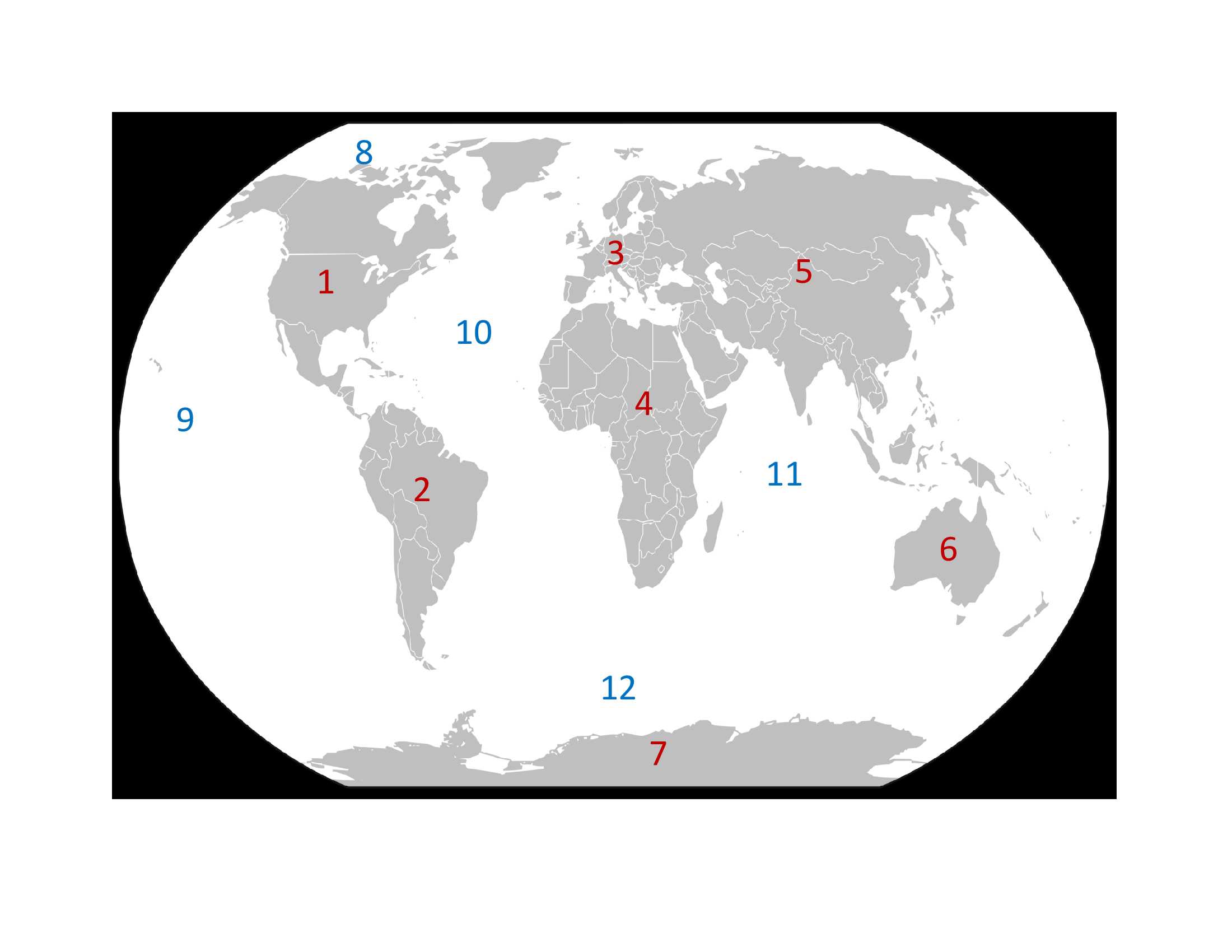
Match the continent or ocean with its number on the map.
Click on image to zoom
Pacific Ocean Africa Arctic Ocean Atlantic Ocean Antarctica Asia South America Southern Ocean Indian Ocean Australia North America Europe
* Drag / drop or click on the choices above to move them to the answer list.
View Image Attributions for This Quiz
1.   
2.   
3.   
4.   
5.   
6.   
7.   
8.   
9.   
10.   
11.   
12.   

Most Recent Scores
Today : Sandpiper18: 12/12
Today : mcpoorboy: 12/12
Today : briandoc5: 12/12
Today : zorba_scank: 12/12
Today : briarwoodrose: 12/12
Today : em1958: 12/12
Today : Guest 174: 12/12
Today : Guest 198: 12/12
Today : dinipie: 12/12

Quiz Answer Key and Fun Facts
1. North America

The continent of North America contains the largest fresh water lake (by surface area) in the world, Lake Superior, which is one of the Great Lakes and is shared with Canada. Canada and the United States also share the longest continuous land border in the world at 5,526 miles (8,893 km) in length. Although it is part of the European country of Denmark, North America is home to the world's largest island, which is Greenland.

Fun fact: Did you know that North America is the only continent that has every type of climate? This includes tropical, dry, temperate, continental, and polar climate regions.
2. South America

The world's largest tropical rain forest, the Amazon Rain Forest, is found in South America and covers approximately 2,123,562 square miles (5.5 million square km). Angel Falls, the world's highest waterfall, is located nearby in the country of Venezuela. Spanning an area of 41,000 square miles (105,000 square km), the Atacama Desert in Chile is the driest non-polar desert in the world. Some places there haven't seen even a drop of rain in more than 500 years!

Fun Fact: Did you know that the Andes Mountains are the longest mountain range in the world? It is over 4300 miles (6200 km) long.
3. Europe

The landmass of Europe and Asia is actually attached and forms a feature called Eurasia. On its own, Eurasia is technically a continent, with Europe being known as its subcontinent, which is a large section of a continent. Ancient Greek geographers not only named the two continents, but also set the precedent for the belief that they should each be considered a separate continent. The Ural Mountains in Russia have long been the recognized boundary between the two land masses. There are fifty countries located on the continent of Europe; this includes the smallest country in the world, Vatican City.

Fun Fact: Istanbul, Turkey, is the only city in the world located on two continents - Europe and Asia.
4. Africa

Africa is the second largest continent, and has the most countries. It is home to the Nile River, the longest in the world at 4130 miles (6650 km), and the Sahara, which is the world's largest hot desert at 3.6 million square miles (9.2 million square km); it is approximately the same size as the continental United States!

Fun Fact: Did you know that Africa is called the Cradle of Humankind? The ancient human fossils and tools found there indicate the beginning of humanity, which dates to over 200,000 years ago.
5. Asia

Asia is the largest continent. It contains about 33% of Earth's land, and is the home of approximately 60% of the world's population. The largest country by size in the world, Russia, is located there, and so is China, the most populous. Mt. Everest, the world's highest mountain, is found in Asia, along with the world's lowest point on land, the Dead Sea.

Fun Fact: Did you know that Russia actually spans two continents, Asia and Europe?
6. Australia

Australia is not only the smallest continent, it is also the only continent that has just one country. It is the second smallest continent by population; more people live in the U.S. state of Texas than in the country of Australia! In fact, when some authors include the island nations of Oceania, like New Zealand and Papua New Guinea, as part of the Australian continent, there are still more sheep in the area than people!

Fun Fact: Did you know that kangaroos in the wild are only found in Australia and New Guinea today because their ancestors migrated to the areas via land bridges before they became geographically isolated as islands?
7. Antarctica

Approximately 98% of Antarctica is covered with a huge ice sheet. It is both the driest and coldest continent on Earth, with the lowest historic temperature of -128° F (-89° C) being recorded there. It is considered to be the world's largest desert because it never rains in Antarctica. Even so, an astonishing seventy per cent of the Earth's fresh water is found there.

Fun Fact: Did you know that Antarctica has an official population of 0? While there are some scientists who live there for short periods of time, it is not owned by any country.
8. Arctic Ocean

The Arctic Ocean, located around the North Pole, is the smallest ocean on earth and the most shallow. It is covered in ice for much of the year; however, when the ice does melt it deposits fresh water into the ocean. Because water retains heat better than glaciers, the North Pole is warmer than the South Pole.

Fun Fact: Did you know that during the summer the sun doesn't set for over thirty days in the area around the Arctic Ocean? Likewise, during the winter polar nights there are places that go weeks without seeing the sun.
9. Pacific Ocean

The Pacific Ocean, named by Ferdinand Magellan because it was so peaceful, is the world's largest ocean. Evidently Magellan didn't witness any activity in the Ring of Fire there, which houses over 75,000 volcanoes in the Pacific Ocean! The ocean covers approximately 33% of the Earth's surface. At 35,797 feet (11,000 m) under the ocean, the Mariana Trench is the deepest place in the world.

Fun Fact: Did you know that the Great Barrier Reef, the largest living structure in the world at 1400 miles (2253 km) long, is located in the Pacific Ocean off the northeast coast of Australia?
10. Atlantic Ocean

The Atlantic, named the Sea of Atlas by the ancient Greeks, is the second largest ocean, covering about 20% of the surface of the Earth. It contains the longest underwater mountain range, which is called the Mid-Atlantic Range, which covers approximately 10,000 miles (16,000 km).

Fun Fact: Iceland is the only place on Earth where a large section of the Mid-Atlantic Range can be seen above sea level. There are a few spots, however, where peaks can be seen. The Azores, owned by Portugal, are one of those spots.
11. Indian Ocean

The Indian Ocean, third largest in the world, is the warmest ocean in the world at 71° F (22° C) because the continent of Asia blocks it from Arctic waters. Covering about 20% of the Earth's surface, it is also the youngest ocean. It is the only ocean with surface currents that reverse direction every year; the change is caused by the seasonal monsoon winds.

Fun Fact: Did you know that the Indian Ocean gets about eight inches (20 cm) wider every year? This is due to the melting of the polar ice caps.
12. Southern Ocean

Some books do not mention a fifth world ocean, while others say the Southern Ocean, located around the South Pole, is where the waters from all the oceans run together. It is the only ocean that encircles the globe without encountering a landmass, and features the Antarctic Circumpolar Current, which is the longest and strongest current in the world.

Fun Fact: The Antarctic Circumpolar Current moves more water than all the rivers in the world combined. It serves as Earth's refrigerator and absorbs 40% of the carbon dioxide that humans produce.
Source: Author ponycargirl

This quiz was reviewed by FunTrivia editor looney_tunes before going online.
Any errors found in FunTrivia content are routinely corrected through our feedback system.
7/11/2026, Copyright 2026 FunTrivia, Inc. - Report an Error / Contact Us