FREE! Click here to Join FunTrivia. Thousands of games, quizzes, and lots more!
Quiz about A Song for Spain

A Song for Spain Trivia Quiz


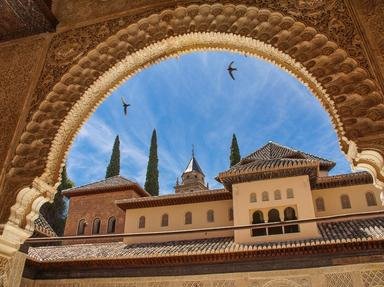
This quiz celebrates the venerable history and culture of Spain, one of the world's most influential countries. Join our fiesta and enjoy!

A photo quiz by LadyNym. Estimated time: 3 mins.
  1. Home
  2. »
  3. Quizzes
  4. »
  5. General Knowledge Trivia
  6. »
  7. Mixed Nations
  8. »
  9. Mixed Spain

Author
LadyNym
Time
3 mins
Type
Photo Quiz
Quiz #
422,570
Updated
Jan 17 26
# Qns
10
Difficulty
New Game
Avg Score
8 / 10
Plays
14
Last 3 plays: Lindaellen (8/10), jmac5cicada (9/10), SisterSeagull (9/10).
-
Question 1 of 10
1. The Spanish coat of arms features the arms of the five kingdoms that united to form Spain in the 15th century. Which of these kingdoms is represented by the pomegranate at the bottom of the shield? Hint


Question 2 of 10
2. Mount Teide, Spain's highest mountain, is an active volcano located on one of the islands that are part of the country's territory. Which one? Hint


Question 3 of 10
3. Charles V, Holy Roman Emperor, became King of Spain in 1516, presiding over the expansion of the Spanish Empire in the Americas. He belonged to what European royal house, known for ruling a large portion of Central Europe in the 19th century? Hint


Question 4 of 10
4. Various languages other than Spanish are spoken in the territory of Spain. Which of these is unrelated to the others, as well as being considerably older? Hint


Question 5 of 10
5. Early 20th-century composer Manuel de Falla is known for his works inspired by Andalusian flamenco. What is the title of his most famous piece, a movement from his ballet "El amor brujo" (Love, the Sorcerer)? Hint


Question 6 of 10
6. In what city in southern Spain, whose historic centre is a UNESCO World Heritage Site, would you be able to visit a Roman Catholic cathedral that was originally a mosque? Hint


Question 7 of 10
7. An extinct subspecies of what wild goat, native to the mountains of Spain and Portugal, was cloned in 2003, but died shortly afterwards - earning the sobriquet of "the species that went extinct twice"?


Question 8 of 10
8. This painting, one of Francisco Goya's most celebrated works, created a scandal when it was discovered by the Spanish Inquisition in 1808. By what name is it known? Hint


Question 9 of 10
9. The bronze statue in the photo is a homage of the city of Madrid to what great Spanish poet and playwright, known for his "Gypsy Ballads", who was assassinated in 1936 during the Spanish Civil War? Hint


Question 10 of 10
10. What is the name of the delectable strips of deep-fried pastry dough commonly enjoyed all over Spain for breakfast or as a snack - often accompanied by a cup of hot chocolate? Hint


(Optional) Create a Free FunTrivia ID to save the points you are about to earn:

arrow Select a User ID:
arrow Choose a Password:
arrow Your Email:


View Image Attributions for This Quiz

Most Recent Scores
Today : Lindaellen: 8/10
Today : jmac5cicada: 9/10
Today : SisterSeagull: 9/10
Today : DeepHistory: 10/10
Today : runaway_drive: 9/10
Today : Guest 24: 9/10
Today : Rizeeve: 10/10
Today : GoodwinPD: 10/10
Today : Guest 35: 4/10

Quiz Answer Key and Fun Facts
1. The Spanish coat of arms features the arms of the five kingdoms that united to form Spain in the 15th century. Which of these kingdoms is represented by the pomegranate at the bottom of the shield?

Answer: Granada

Adopted on 5 October 1981, six years after the country's return to democracy, the coat of arms of Spain represents the nation and its form of government, a constitutional monarchy. The emblem also appears in the middle yellow stripe of the national flag.

The elaborate design consists of a shield divided into four quarters, bearing respectively a triple-towered castle (Kingdom of Castile), a lion rampant (Kingdom of León), four pallets (Kingdom of Aragon), and a cross made of golden chains (Kingdom of Navarre). A seeded pomegranate with green leaves, the arms of the Kingdom of Granada, is placed in the pointed division ("enté en point") at the bottom of the shield. The three fleur-de-lys in the middle of the shield represent the reigning house of Bourbon-Anjou. The shield is topped by the Royal Crown, and flanked by the Pillars of Hercules with a ribbon bearing the motto "Plus Ultra".

The Kingdom of Granada, in the southern region of Andalusia, was created in 1492, after the defeat of the Muslim Emirate of Granada at the hands of the Catholic Monarchs (Isabella I of Castile and Ferdinand II of Aragon). A territorial jurisdiction of the Crown of Castile, the Kingdom lasted until 1833, when it was abolished like the other kingdoms within Spain. The pomegranate ("granada" in Spanish) was originally the personal device of Henry IV of Castile, Isabella I's half-brother.
2. Mount Teide, Spain's highest mountain, is an active volcano located on one of the islands that are part of the country's territory. Which one?

Answer: Tenerife

With an elevation of 3,715 m (12,188 ft) above sea level, Mount Teide dominates the landscape of Tenerife, the largest of the Canary Islands, an autonomous community of Spain located about 100 km off the northwest coast of Morocco, in the Atlantic Ocean. This imposing stratovolcano lies at the centre of a national park that was designated as a UNESCO World Heritage Site in 2007, and is also Spain's most visited national park. The mountain was revered by the islands' indigenous population, the Guanches, who believed it to be the home of a powerful deity.

An active volcano, Teide has a history of destructive eruptions, and is believed to pose a danger of future explosive eruptions with pyroclastic flows. Because of that, it is strictly monitored as one of the sixteen Decade Volcanoes, distinguished by their eruptive history and proximity to densely populated areas. The highest peak in mainland Spain is Mulhacén (3,479 m/11,411 ft), in the Sierra Nevada range.

The Canary Islands are one of the four volcanic archipelagos in the Atlantic Ocean that are collectively known as Macaronesia (Islands of the Blessed) - the others being the Azores, Madeira (both part of Portugal) and Cape Verde (a sovereign nation). Lanzarote is one of the seven main islands in the Canary archipelago, while Mallorca and Ibiza are part of the Balearic Islands, located in the western Mediterranean Sea.
3. Charles V, Holy Roman Emperor, became King of Spain in 1516, presiding over the expansion of the Spanish Empire in the Americas. He belonged to what European royal house, known for ruling a large portion of Central Europe in the 19th century?

Answer: Habsburg

Born in Ghent (in present-day Belgium), Charles V (1500-1558) was the eldest son of Philip of Austria of the House of Habsburg and Joanna of Castile, the daughter of Isabella I of Castile and Ferdinand II of Aragon. Upon his father's death in 1506, Charles became heir-apparent (Prince of Asturias) to the throne of Castile, and in 1516 he was proclaimed King of Castile and Aragon jointly with his mother. As Joanna - who is known by the derogatory nickname of Joanna the Mad - was kept confined because of her precarious mental state, Charles was to all intents and purposes the sole ruler. Having inherited the Habsburg Low Countries from his father, and territories in Spain and Italy from his mother, he eventually succeeded his paternal grandfather, Maximilian II, as Holy Roman Emperor.

Charles V's reign was rife with events of great historical import, such as the Protestant Reformation and the continuation of the Spanish colonization of the Americas, which had begun in the late 15th century following Christopher Columbus' first voyage. In particular, the Spanish conquest of the Aztec Empire (1519-1521) and the Inca Empire (begun in the 1530s), as well as Ferdinand Magellan's expedition (1522), the territories of the Spanish crown expanded considerably - so that it was said that on Charles V's empire "the sun never set". The expansion of the Spanish Empire continued under his son, Philip II, who succeeded his father in 1556. Habsburg rule in Spain lasted until 1700, when the death of Charles II led to the War of the Spanish Succession and the ascension of the House of Bourbon to the Spanish throne.

The House of Habsburg was founded in the 11th century in present-day Switzerland. It ruled the Holy Roman Empire from 1440 to 1806, and then the Austrian and Austria-Hungary Empires until the end of WWI.

The portrait of Charles V in the photo is attributed to 16th-century Venetian painter Titian.
4. Various languages other than Spanish are spoken in the territory of Spain. Which of these is unrelated to the others, as well as being considerably older?

Answer: Basque

Spain's only official language is Spanish (Castilian). However, according to the Spanish Constitution of 1978, other languages can become official in the autonomous communities (first-level administrative divisions) where they are spoken. Most of the languages spoken on the territory of Spain (including the three listed as wrong answers) belong to the Romance group of the Indo-European family. The exceptions are the Afro-Asiatic (Semitic) languages spoken in the autonomous cities of Ceuta and Melilla, located on the northern coast of Morocco, the Romani Caló language spoken by Spanish "gitanos" (which, however, is heavily influenced by Iberian Romance), and Basque.

Unrelated to any other living language, Basque (Euskara) - spoken in a region on the Atlantic coast of northern Spain and southwestern France that straddles the Pyrenees - is widely believed to have pre-Indo-European origins, and to have been present in the area for thousands of years. A language that may have been related to Basque was known as Aquitanian in Roman times. Basque is currently spoken by around 800,000 people, most of whom live in the Basque Autonomous Community (Euskadi) of Spain. Suppressed during the Francoist dictatorship (1936-1975), the language has undergone a revitalization process in the years that have followed, though still facing pressure from Spanish and other local languages. Written in the Latin alphabet, Basque is known for its very complex grammar structure, which differs from that of most European languages.

The photo depicts a stele bearing the "lauburu" ("four heads"), an ancient, traditional symbol of Basque culture and identity consisting of four comma-shaped heads.
5. Early 20th-century composer Manuel de Falla is known for his works inspired by Andalusian flamenco. What is the title of his most famous piece, a movement from his ballet "El amor brujo" (Love, the Sorcerer)?

Answer: Ritual Fire Dance

Born in Cádiz, Manuel de Falla y Matheu (1876-1946) is widely regarded as one of Spain's greatest composers. His music was strongly influenced by the musical traditions of his native Andalusia, in particular the vocal style of flamenco known as "cante jondo" ("deep song"). He was also an accomplished pianist who composed a number of piano works. Among his most significant works there are the puppet opera "El retablo de maese Pedro" (Master Peter's Puppet Show, premiered in 1923), the orchestral piece "Noches en los jardinos de España" (Nights in the Gardens of Spain, 1909-1919), and the ballets "El sombrero de tres picos" (The Three-Cornered Hat, 1919), and "El amor brujo" ("Love, the Sorcerer", 1915-1916).

Based on an Andalusian Romani legend, "El amor brujo" was originally composed in 1915 as a "gitanería" (danced gypsy entertainment) dedicated to famed flamenco dancer and singer ("cantaora") Pastora Imperio. It was then revised in 1916 and 1924, when it was turned into a one-act "ballet pantomímico". It is the story of the gitana Candela and her haunting by the ghost of her deceased husband, who prevents her from establishing a relationship with her first love, Carmelo. The impetuous "Danza ritual del fuego" (Ritual Fire Dance) - De Falla's signature piece - is one of the ballet's key moments, in which Candela dances around a campfire in an attempt to banish her husband's ghost.

The painting of a flamenco dancer ("bailaora") in the photo is by Impressionist Spanish painter Joaquín Sorolla.

"Sabre Dance" is by Soviet-Armenian composer Aram Kachaturian, while "Dance of the Sugar Plum Fairy" is by Pyotr Tchaikovsky, and "Dance of the Hours" by Italian composer Amilcare Ponchielli.
6. In what city in southern Spain, whose historic centre is a UNESCO World Heritage Site, would you be able to visit a Roman Catholic cathedral that was originally a mosque?

Answer: Córdoba

Officially called Cathedral of Our Lady of the Assumption, but frequently referred to as Mezquita ("mosque" in Spanish), the massive complex of the Mosque-Cathedral of Córdoba reflects the city's past as the capital of a powerful Islamic state whose territory included most of present-day Spain and Portugal. The magnificent Great Mosque was built in the late 8th century AD during the reign of Abd el-Rahman I, the founder of the Umayyad Emirate (later Caliphate) of Córdoba - according to some accounts, on the site of an older Christian church. The mosque's most innovative and influential feature were its rows of two-tiered arches, which can be seen in the photo. In the following two centuries the building was expanded and decorated with stunning mosaics and marble carvings.

In 1236, Córdoba was conquered by King Ferdinand III of Castile, and the Great Mosque was converted into a Christian cathedral. Many additions and alterations were made during the following centuries - such as the iconic late 16th-century bell tower, which incorporates the remains of the mosque's original minaret. The Mezquita complex, which overlooks the Guadalquivir, was designated as a UNESCO World Heritage Site in 1984; the designation was extended to the historic centre of Córdoba in 1994. At the time of writing, Spain is one of the top ten nations in terms of sites inscribed in the World Heritage List.

Located on the right bank of the river Guadalquivir, Córdoba is the capital of the province of the same name, in the autonomous community of Andalusia. It was the birthplace of Roman philosopher and dramatist Seneca and Islamic polymath Averroes. The three cities listed as wrong answers, though home to famous medieval cathedrals, are all located much further north than Córdoba.
7. An extinct subspecies of what wild goat, native to the mountains of Spain and Portugal, was cloned in 2003, but died shortly afterwards - earning the sobriquet of "the species that went extinct twice"?

Answer: Iberian ibex

The Iberian, or Spanish ibex (Capra pyrenaica) is one of several species of wild goat characterized by the huge, curved horns of the males. The name ibex given to these ungulates comes from one of the indigenous languages of the Iberian Peninsula. The Iberian ibex is closely related to the Alpine ibex, to which it is very similar in build and general appearance. Endemic to the mountain regions of the Iberian Peninsula, it is mainly found in eastern and southeastern Spain, as well as northern Portugal.

This wild goat originally had four subspecies, but only two of them - the western Iberian ibex and the southeastern Iberian ibex - are left. The species is classified by IUCN as Least Concern (2020) though threatened by disease, poaching and habitat loss. While the Portuguese ibex died out in 1890, the Pyrenean ibex (known in Spanish as bucardo) survived until January 2000, when the last surviving specimen, a female named Celia, was found dead. Some of Celia's tissue samples were preserved, and in July 2003, after many failed experiments, a living specimen (also a female) cloned from these tissues was born. However, due to lung defects, this first animal to become "unextinct" died just a few minutes after birth.

The Pyrenean chamois (Rupicapra pyrenaica) is also a caprine (goat-antelope), though it belongs to a different genus than the ibexes; it is also smaller, with much shorter and straighter horns. Besides the Pyrenees and the Cantabrian Mountains of northern Spain, the Pyrenean chamois is found in the Italian Apennines.
8. This painting, one of Francisco Goya's most celebrated works, created a scandal when it was discovered by the Spanish Inquisition in 1808. By what name is it known?

Answer: The Nude Maja

Francisco Goya painted "La maja desnuda" (The Nude Maja) around 1797-1800. This painting of a young, nude woman reclining on a bed of pillows and looking directly at the viewer with a frank, unashamed gaze was probably commissioned by Manuel de Godoy, a powerful nobleman and politician whose private art collection included a number of nude paintings kept in a separate cabinet. The model is widely believed to have been Godoy's mistress (and later wife) Pepita Tudó, here identified with a "maja", a lower-class woman with a distinctive sense of fashion - as seen in the pendant that Goya created a few years later, known as "La maja vestida" (The Clothed Maja).

Groundbreaking in its realistic depiction of full-frontal female nudity (including pubic hair), "La maja desnuda" was kept hidden by Godoy for a number of years, but was eventually discovered and confiscated by the notorious Spanish Inquisition along with other "questionable" artworks. Both Godoy and Goya ended up before a tribunal, the artist being charged with moral depravity, but eventually escaping prosecution by citing the "Rokeby Venus" by Diego Velázquez, a greatly admired nude that had never caused any scandal.

The Nude Maja and its companion painting have been part of the collection of Madrid's Prado Museum since 1901. The "Grande Odalisque" by Jean-Auguste-Dominique Ingres and "Olympia" by Édouard Manet (very likely influenced by Goya's work) are also among the most famous depictions of naked women in art history.
9. The bronze statue in the photo is a homage of the city of Madrid to what great Spanish poet and playwright, known for his "Gypsy Ballads", who was assassinated in 1936 during the Spanish Civil War?

Answer: Federico García Lorca

Federico García Lorca was born in 1896 near Granada from a well-to-do family. Through his passion for music and his friendship with composer Manuel de Falla, he found enduring inspiration in the folklore of his native Andalusia. During his stay in Madrid as a student, he also befriended painter Salvador Dalí and filmmaker Luis Buñuel, who introduced him to Surrealism. Lorca began his literary career as a playwright in 1920, publishing his first book of poems the following year. His most significant work of poetry, "Romancero gitano" (Gypsy Ballads), came in 1928, bringing him fame throughout the Spanish-speaking world with its strikingly vivid imagery based on the rich tradition of the "gitanos", the Spanish Romani.

In the early 1930, after a trip to the US, Lorca produced his best-known plays, known as the "Rural trilogy" "Bodas de Sangre" (Blood Wedding), "Yerma" and "La casa de Bernarda Alba" (The House of Bernarda Alba). Targeted by the rising right-wing for his socialist beliefs and homosexuality, Lorca was arrested and assassinated on 19 August 1936, at the very beginning of the Spanish Civil War. His remains have never been found. After the end of the Francoist regime, a number of memorials to him have been created, both in Spain and elsewhere. The bronze statue in the photo stands before the Teatro Español in central Madrid. The poet is depicted holding a lark - a bird often mentioned in his poems - in his hands.

Antonio Machado and Miguel de Unamuno belong to an earlier generation of Spanish writers than Lorca, while Rafael Alberti was also a member of the "generation of 1927".
10. What is the name of the delectable strips of deep-fried pastry dough commonly enjoyed all over Spain for breakfast or as a snack - often accompanied by a cup of hot chocolate?

Answer: churros

Churros (a word believed to be an imitation of the sound of frying) are made with various kinds of dough, some containing eggs and butter as well as flour, water and salt. The dough is piped into strips with a closed star nozzle - which lends them a characteristic ridged surface - and fried in hot oil. There are many theories about their origin: some believe they were originally made by Spanish shepherds to replace bread when roaming in the mountains, while others posit Roman or even Greek roots. In any case, these fried pastries are popular not only in Spain and Portugal, but also in Latin America and the Philippines.

In the Iberian Peninsula, churros are often sprinkled with sugar immediately after frying, and served with hot chocolate - a beloved breakfast combination. They can be bought from cafés or street stalls (especially during fairs and other celebrations), or easily made at home. In many Latin American countries, churros are often filled with jam, chocolate or "dulce de leche" (caramelized milk), while in the US they are often served as a dessert in Mexican or other Latin American restaurants.

The three wrong answers are also names of fried foods, though none of them from Spain: tostones are twice-fried plantain slices (from Puerto Rico), taquitos are small, rolled-up corn tortillas with various fillings (from Mexico), and samosas are fried pastries with a savoury filling (from South Asia).
Source: Author LadyNym

This quiz was reviewed by FunTrivia editor agony before going online.
Any errors found in FunTrivia content are routinely corrected through our feedback system.
1/17/2026, Copyright 2026 FunTrivia, Inc. - Report an Error / Contact Us