FREE! Click here to Join FunTrivia. Thousands of games, quizzes, and lots more!
By the Rivers of Europe Trivia Quiz
Though rather small as continents go, Europe is rich in historically and economically significant rivers. How many of these venerable watercourses can you pick out from this list?
A collection quiz
by LadyNym.
Estimated time: 3 mins.
Because of Europe's relatively small size, its rivers do not compare in terms of either length or discharge with rivers found in other parts of the world. The continent's longest river, the Volga (which flows entirely within European Russia) ranks as the 18th-longest in the world, and the 30th by discharge. However, whatever European rivers may lack in size, they definitely score highly in terms of cultural (as well as economic) importance.
We begin our journey in the British Isles with the Severn, the longest river in Great Britain (354 km/220 mi). Known in ancient times by the Proto-Celtic name of Sabrina, the Severn (Hafren in Welsh) rises in the Cambrian Mountains of Wales, flowing eastward through the counties of Shropshire, Worcestershire and Gloucestershire and their historic county towns of Shrewsbury, Worcester and Gloucester. Crossed by a number of bridges, including the late 18th-century Iron Bridge, the river discharges into the Bristol Channel on the border between England and Wales.
Known for its role in WW2, the Scheldt rises in northern France, and flows for about 360 km (223 mi) through western Belgium and the southwestern Netherlands. Its name is related to the English word "shallow". The river flows through the historic cities of Cambrai and Valenciennes in France and Ghent and Antwerp in Belgium before emptying into the North Sea. Connected to the Rhine and other major rivers by a network of canals, the Scheldt is one of the most important waterways in Western Europe: the port of Antwerp, the continent's second-largest, is located on its banks.
With a length of about 452 km (281 mi), the Weser is the second-longest river that flows wholly within Germany. It starts at the confluence of the Fulda and the Werra in the northwestern state of Lower Saxony, then flows north through the Westphalian Gap until it reaches the city of Bremen. The Weser empties into the North Sea at the port of Bremerhaven, which together with Bremen forms the German state of the Free Hanseatic City of Bremen. Another notable town on the river's course is Hamelin in Lower Saxony, known for the folk tale of the Pied Piper - in which the Weser features prominently.
About 1,112 km (691 mi) long, the Elbe, like the Weser, is almost fully navigable. It rises in the Giant Mountains, near the border between the Czech Republic and Poland, then turns west until its confluence with the Vltava, Prague's river, which doubles the volume of its waters. The Elbe then flows in a northwesterly direction through the historic cities of Dresden, the capital of the German state of Saxony, and Magdeburg, the capital of Saxony-Anhalt - finally reaching Hamburg, Germany's second-largest city, before emptying into the North Sea.
A very short river at only 74 km (46 mi), the Neva packs a punch in terms of average discharge - ranking fourth in Europe after the much longer Volga, Danube and Rhine. Originating from Lake Ladoga, Europe's largest lake, it flows westward through the western part of Leningrad Oblast before draining into the Gulf of Finland. The Neva's main claim to fame is being the river on whose banks the city of Saint Petersburg was built in 1703. In the Middle Ages, the river had a major role in facilitating trade between Scandinavia and the Byzantine Empire.
Known to the Greeks by the name of Borysthenes, the Dnieper (Dnipro in Ukrainian) is by far the longest of the rivers featured in this quiz. With a length of about 2,201 km (1,368 mi) - which makes it the continent's fourth-longest river - it rises in the Valdai Hills of central European Russia (where the Volga also originates), and flows south through Belarus and Ukraine, forming a large delta on the Black Sea near the city of Kherson. Navigable for the most part, the Dnieper passes through a number of major cities, such as Smolensk in Russia, Mogilev in Belarus, and the Ukrainian capital of Kyiv.
One of the largest tributaries of the Danube, the Sava flows for 990 km (615 mi) through Central and Eastern Europe. Rising in the nature reserve of Zelenci Springs in northwestern Slovenia, near the border with Italy, the river flows in a southeasterly direction through Slovenia and Croatia, along the latter country's border with Bosnia and Herzegovina, finally reaching central Serbia. Before its confluence with the Danube at Belgrade, the Sava passes through two other capitals - Ljubljana (Slovenia) and Zagreb (Croatia).
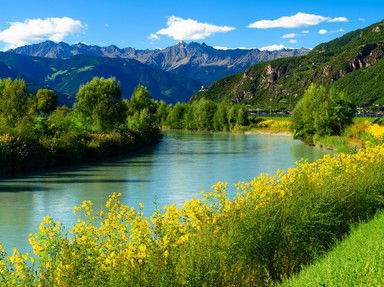
The Adige (Etsch in German) is Italy's second-largest river after the Po, with a length of about 410 km (250 mi). Its headwaters lie near the Reschen Pass, on the border with Switzerland and Austria: from there the river flows through the Bolzano province (known in Italian as Alto Adige, and Südtirol in German). South of Bolzano, the Adige turns south, reaching the cities of Trento and Verona before turning east towards the Adriatic Sea. The mouth of the Adige is located near the town of Chioggia, north of the Po Delta. The cover photo shows a detail of the Adige Valley between Merano and Bolzano.
Called Rhodanus in Latin, the Rhône is one of France's five major rivers, though only part of its 814-km (505 mi) course runs through the country. Beginning as the meltwater of the Rhône Glacier in the Swiss Alps, the river flows southwest towards Lake Geneva. After exiting the lake, the Rhône continues westward until it reaches Lyon, one of France's largest cities, where it receives the Saône. From there, it flows south, passing through the historic city of Avignon, then draining into the Mediterranean Sea south of Arles. The river's vast delta, a unique wetland environment, is known as the Camargue.
The name of the Guadalquivir reflects the influence of centuries of Moorish rule in the Iberian Peninsula, as it comes from the Arabic "wādī l-kabīr", meaning "great river". This 657-km (408 mi) waterway - the second-longest entirely located in Spain - rises in the Sierra de Cazorla range of southern Spain, and flows in a southwesterly direction through the autonomous community of Andalusia, finally emptying into the Gulf of Cádiz. The historic cities of Córdoba and Seville - which is also the main port on the river - lie on the banks of the Guadalquivir.
The six rivers listed as wrong options are found in Asia (Amur and Tigris), North America (Columbia), South America (Madeira), Africa (Orange) and Australia (Murray). All of them are considerably longer than any of the European rivers mentioned here.
This quiz was reviewed by FunTrivia editor agony before going online.
Any errors found in FunTrivia content are routinely corrected through our feedback system.