FREE! Click here to Join FunTrivia. Thousands of games, quizzes, and lots more!
Quiz about Get Going to Greece

Get Going to Greece Trivia Quiz


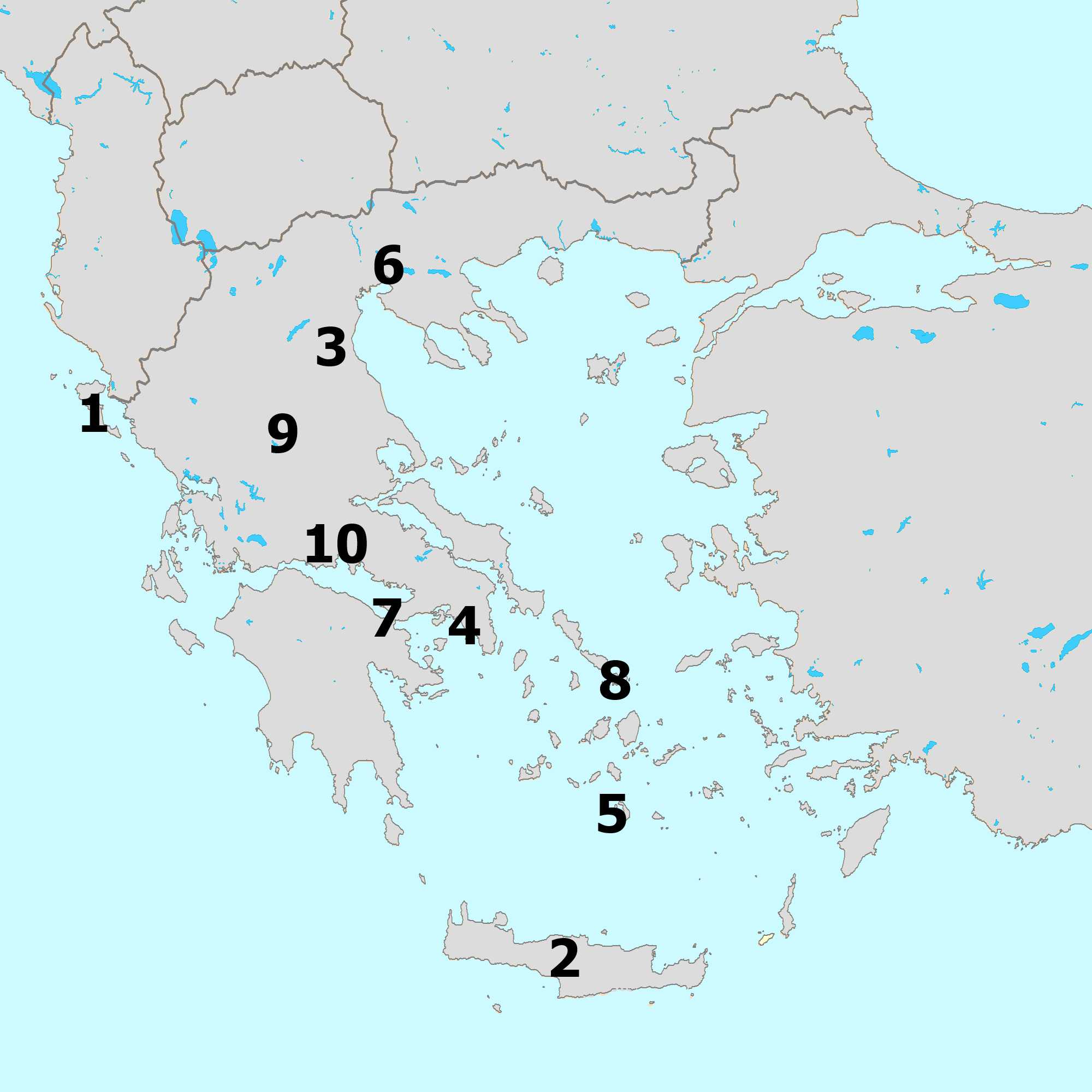
In every corner of Greece, there's something to see and do. In this quiz, see if you can locate ten different Greek locations on the map. Good luck!

A label quiz by kyleisalive. Estimated time: 3 mins.
  1. Home
  2. »
  3. Quizzes
  4. »
  5. Geography Trivia
  6. »
  7. Europe
  8. »
  9. Greece

Author
kyleisalive
Time
3 mins
Type
Label Quiz
Quiz #
422,562
Updated
Jan 10 26
# Qns
10
Difficulty
Average
Avg Score
8 / 10
Plays
49
Last 3 plays: Guest 86 (2/10), Guest 1 (6/10), elgecko44 (8/10).
Click on image to zoom
Santorini Corfu Mount Olympus The Apollonion (or the Temple of Apollo) Thessaloniki Crete Corinth Canal Mykonos The Acropolis Meteora
* Drag / drop or click on the choices above to move them to the answer list.
View Image Attributions for This Quiz
1.   
2.   
3.   
4.   
5.   
6.   
7.   
8.   
9.   
10.   

Most Recent Scores
Today : Guest 86: 2/10
Jan 10 2026 : Guest 1: 6/10
Jan 10 2026 : elgecko44: 8/10
Jan 10 2026 : Triviaballer: 10/10
Jan 10 2026 : Guest 99: 5/10
Jan 10 2026 : Guest 24: 10/10
Jan 10 2026 : Guest 75: 10/10
Jan 10 2026 : Guest 174: 3/10
Jan 10 2026 : Guest 37: 4/10

Quiz Answer Key and Fun Facts
1. Corfu

One of the northernmost and westernmost islands on Greece's western coast, Corfu has been, like much of the rest of Greece, settled for thousands of years and, as such, is a major site for archaeological discovery. From a geographical point of view, it marks the point at which the Adriatic Sea, which stretches along the coastline to the north, and the Ionian Sea, which makes up much of the area around Greece in the Mediterranean, split apart. Today, Corfu holds a landscape of dramatic cliffsides along the coast while the city of Corfu itself sits on a harbour facing the mainland where Greece meets the Albanian border.
2. Crete

The largest Greek island, Crete sits south of the mainland in the middle of the Mediterranean Sea. Crete has an extensive history having been occupied and overseen by the Minoans, the Mycenaeans, the Romans, the Byzantines, and the Ottomans, amongst others, and it makes it a particularly notable spot for ancient landmarks and historical ruins.

Much of this narrow island is spined by mountain ranges, but at the edges, you can visit the cities of Heraklion, Chania, and Rethymno. Heraklion happens to be the home of the Palace of Knossos, one of the most-visited destinations in Greece.
3. Mount Olympus

The tallest peak in Greece, Mount Olympus rises to a height of just over 2,900 ft, and because of the fact that it's been long-known as the highest mountain in this part of the world, Ancient Greeks believed it to be the home of the gods. Today, Mount Olympus is part of a larger protected park and is a popular destination for mountaineers and hikers. Visitors often make the trip from Thessaloniki, to the north, and start the hike from the edge of Olympus National Park in the town of Litochoro, which sits on the Thermaic Gulf.
4. The Acropolis

An ancient citadel occupied in some manner or another over the past six thousand years, the Acropolis is the most-recognizable landmark in Greece and is one of a handful of ancient structures, worldwide, that one would be likely to know (akin to the Pyramids and the Colosseum). Found at the highest point in the Greek capital of Athens, the Acropolis is topped by several ruins, but most notable amongst them would be the Parthenon.

There are constantly ongoing efforts to restore this feat of ancient architecture from the damage brought on by centuries of decay and tourist presence.
5. Santorini

An island in the south reaches of the Cyclades, Santorini (also known as Thira) is a major vacation destination for tourists headed to Greece, partly because of its beautiful, whitewashed buildings and windmills, which provide an Instagram-ready backdrop for Mediterranean visitors.

The island itself rises from a central caldera formed by volcanic activity over the past tens of millions of years, and as such it's in a spot that's prone to earthquakes, even in the modern day. But for anyone eager to venture out, it's a warm and sunny destination flush with castles, forts, beaches, wineries, and great seafood.
6. Thessaloniki

The second-largest city of Greece, Thessaloniki sits on the Thermaic Gulf Coast as part of Central Macedonia and, like much of the rest of Greece's major destinations, it has a particularly noteworthy history punctuated by the rules of many different empires. Founded in the third century BCE, Thessaloniki takes many of its influences from past Byzantine, Ottoman, and Roman oversight, and because of its location, both in time and place, it's consistently held a significant Jewish population. Nearly five hundred kilometres from Athens to the south, its position on the edge of the Aegean Sea is quite fortunate; on a clear day you can even see Mount Olympus from its better vantage points.
7. Corinth Canal

Finished at the end of the 19th century, this feat of engineering allowed boats to travel between the Ionian Sea and the Aegean Sea without the need to sail all the way around the Peloponnese, turning a trip of hundreds of kilometres into a six kilometre pass-through.

When the canal was created, its 80 foot width allowed for clearance of most watercraft, but in the modern era, the widening of most transport craft has rendered the Corinth Canal virtually obsolete for the sake of shipping. Today it's used more for tourist purposes than anything else, and that's when it's not being repaired after common landslides.
8. Mykonos

Found amongst the Cyclades, the island of Mykonos is a vibrant tourist destination known for its wind-swept coastal towns, its popular beaches, and its association with Greek myth, having been a site of battle between Zeus, Hercules, and the Giants, the consequences of which allowed for the gods to reign. Mykonos is generally warm year-round (hot during some months), but almost always windy, and it's because of this that its characteristic windmills are common symbols of the destination.
9. Meteora

Located in the middle of the northwestern region of Greece, Meteora is a unique location in the way of religions significance as it is there that two dozen Eastern Orthodox monasteries were constructed in the 14th century, some of which can only be reached by ascending to the top of the locale's precarious rock formations.

In the 21st century, only six of the original monasteries would see continual use, with most of the rest having fallen into ruin over the ages. Protected by UNESCO as a World Heritage Site, the remainder are still occupied by monks and nuns and considered among the most important religious sites in Greece.
10. The Apollonion (or the Temple of Apollo)

Although there are a number of locations around Greece that serve as a Temple of Apollo (and others outside of Greece!), The Apollonion indicated on the map here is located in the city of Delphi, having been built there in the 4th century BC. Found on Mount Parnassus, the Apollonion is said to have been a place of worship for Apollo and Dionysus both, and at one point, it was the home of the Pythia, better known as the Oracle of Delphi, who served as a consult to the citizens of the Mediterranean region for hundreds of years. Today, much of the temple is in ruins, but is part of an ongoing archaeological excavation.
Source: Author kyleisalive

This quiz was reviewed by FunTrivia editor agony before going online.
Any errors found in FunTrivia content are routinely corrected through our feedback system.
1/11/2026, Copyright 2026 FunTrivia, Inc. - Report an Error / Contact Us