FREE! Click here to Join FunTrivia. Thousands of games, quizzes, and lots more!
Quiz about Scrambled Travelogues Somalia

Scrambled Travelogues: Somalia Quiz


I'm a journalist, working on a story about Somalia. The country has deep history and deeper conflicts, and... well, I'd love to tell you more than that, but all the labels have fallen off my bulletin board. You'll have to help me fill in the blanks!

A label quiz by etymonlego. Estimated time: 3 mins.
  1. Home
  2. »
  3. Quizzes
  4. »
  5. Geography Trivia
  6. »
  7. Africa
  8. »
  9. Somalia

Author
etymonlego
Time
3 mins
Type
Label Quiz
Quiz #
421,344
Updated
Dec 07 25
# Qns
10
Difficulty
Average
Avg Score
6 / 10
Plays
19
Last 3 plays: Strike121 (3/10), GoodVibe (3/10), Kalibre (0/10).
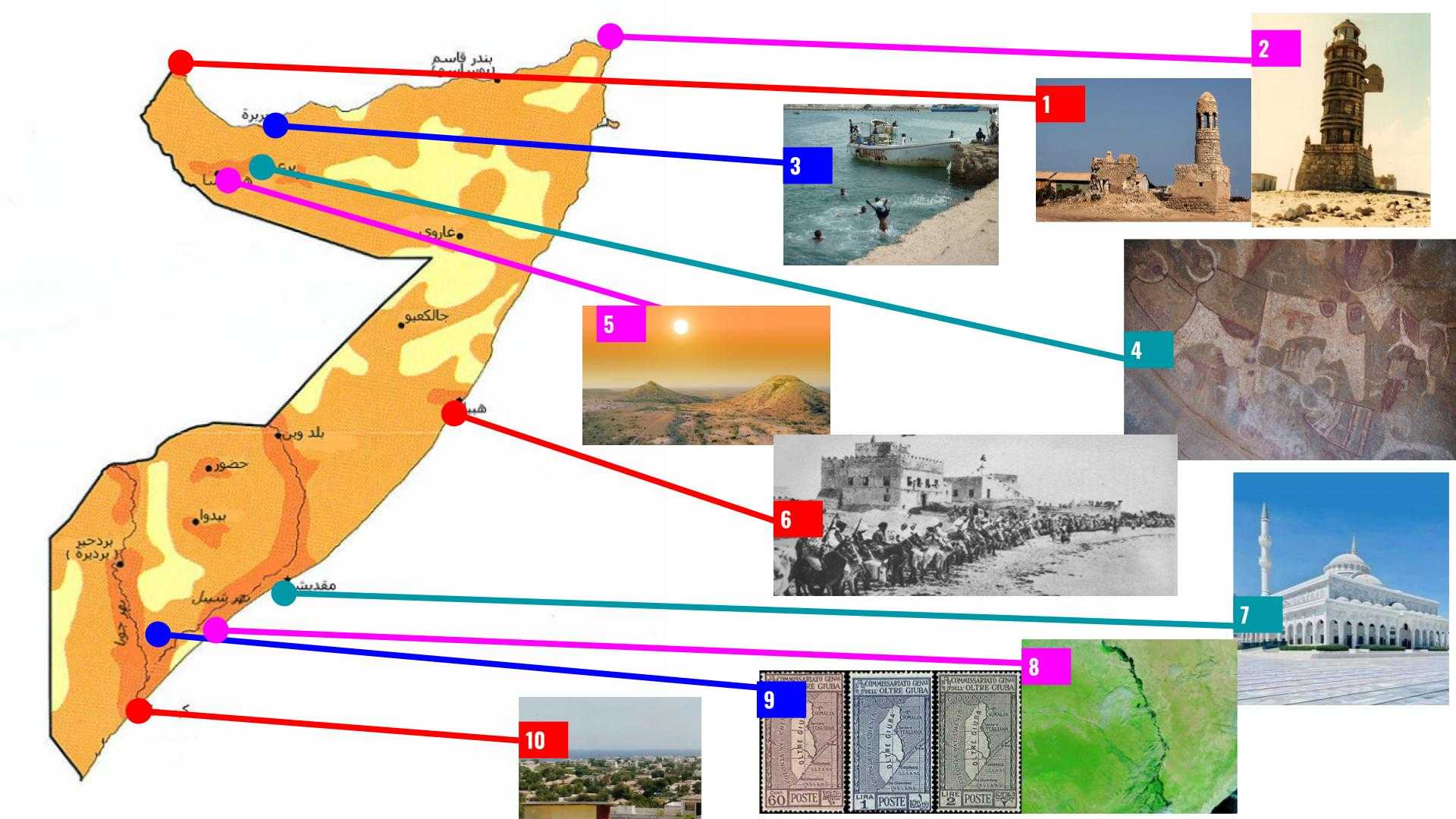
Match each place name to the photo and the map pin. The colors of the lines are only for visual clarity.
Click on image to zoom
Hargeisa Mogadishu Cape Guardafui Zeila (a.k.a. Seylac) Berbera Kismayo Hobyo Shebelle River Jilib Laas Geel
* Drag / drop or click on the choices above to move them to the answer list.
View Image Attributions for This Quiz
1. Northern port; possible site of Biblical land of Havilah  
2. Hotly contested geographic point; just 68 miles away from Yemen  
3. Somaliland's major port on the Red Sea  
4. Site of rock paintings depicting pastoral life  
5. Mountainous "summer" capital of Somaliland  
6. Heavily fortified ancient city, once a sultanate's prize  
7. "White Pearl of the Indian Ocean." Somalia's major port  
8. Major irrigation system for most of southern Somalia  
9. City on the Jubba river, occupied by the Islamic Emirate of Somalia  
10. Port on the Jubba River delta  

Most Recent Scores
Today : Strike121: 3/10
Today : GoodVibe: 3/10
Dec 07 2025 : Kalibre: 0/10
Dec 07 2025 : xchasbox: 2/10
Dec 07 2025 : lethisen250582: 10/10
Dec 07 2025 : griller: 8/10
Dec 07 2025 : Guest 174: 10/10
Dec 07 2025 : bernie73: 2/10
Dec 07 2025 : Rizeeve: 10/10

Quiz Answer Key and Fun Facts
1. Zeila (a.k.a. Seylac)

Not surprising for the country with (mainland) Africa's longest coastline, the history of Somalia has largely been that of tribes settling along the coast - and fighting over those settlements. To the sea are coral reefs and mangrove forests; inland are vast swathes of desert. Zeila, also spelled Zalya, is a small port city just over the border with Djibouti. Situated on the Gulf of Aden, its location has made it a crossroads - a port of entry for Ethiopian and Somalian trade with Phoenicia, Greece, Persia and Rome, as well as the start of trade routes to Berbera (further down the coast) and to the Ethiopian interior.

The ethnography of Somalia is defined by its clans, whose genealogies are carefully recorded: Zeila is considered the ancestral homeland of the Issa and Gadabuursi, both sub-clans of the Dir. Dir clan is far-ranging, its influence extending to the Ethiopian city of Dire Dawa and even down into northeast Kenya.
2. Cape Guardafui

Cape Guardafui is the easternmost point of mainland Africa, at the tip of Cape Horn. Socotra, a Yemeni island chain, is due north of the Cape. During Italian occupation of Somalia in the 1900s, several attempts were made to erect a lighthouse on Guardafui's wreck-laden coast. For decades, failed negotiations with locals and attacks by insurgents stalled the project. The stone lighthouse was finally completed in 1930. To the side of the right side of the pictured lighthouse is a large axe-head, a "fasces" - the root word and primary symbol of Italian fascism.

It's said that "Guardafui" means "look and run away," although there are alternative explanations for the name too, and this is the kind of etymology that is almost always disappointingly false.
3. Berbera

Berbera remains one of the most important cities in the region of Somaliland. Closely connected to Zeila, both belonged to the Adal Sultanate, a powerhouse in East African Islam during the 15th and 16th centuries. In his 1894 travelogue "First Footsteps in East Africa," Richard Burton said that Berbera was "the true key to the Red Sea" and "the only safe place for shipping on the entire Erythrean shore." Britain had made Somaliland a protectorate in 1884, but ceded it in portions to the French and Italians by 1920.

When it was not being fought over, Berbera made an excellent port for the trade of ivory, ambergris, frankincense and myrrh. Until the 20th century, it was also central in the trade of Bantu, Amhara, Tigray and Oromo slaves into rural Somalia and into the rest of the world.

Today, Berbera pales in importance to other Red Sea ports. Just over the border, the city of Djibouti processes over five million tonnes of cargo every year, but Berbera handles less than half a million.
4. Laas Geel

By the oldest estimates, the rock paintings at Laas Geel are 10,000 years old - possibly older than those found at Lascaux, France. The rock formations in this scrub desert feature many natural overhangs, sheltering the paintings from the elements. The paintings, almost all of them depictions of cattle, are older than Aksum and Egypt - making them some of the oldest depictions of livestock-tending in Africa.

Government leaders in Somaliland have used the Laas Geel paintings to express the region's unique heritage, part of its plea for international recognition. "With independence, a world of funding and tourism would open up to us," one official told the Washington Post.
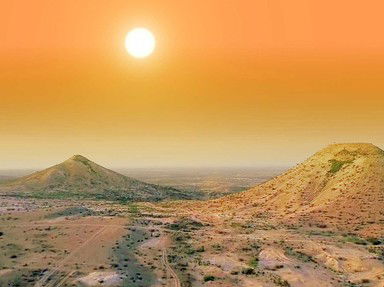
5. Hargeisa

At over 4,000 feet (1,200 meters) in elevation, Hargeisa is situated in a remote valley of the Ogo Mountains. Somalia's second-largest city after Mogadishu, Hargeisa currently functions as Somaliland's capital, being over 500 miles (800 km) away from Mogadishu - if you cut through Ethiopia. (If you ask the Somalian government, it's formally the capital of Maroodi Jeex.) The long way, staying within Somalia, is almost 900 miles (over 1400 km). Historically a stop along trade routes, today Hargeisa intersects with many roads carved through the Ogos.

The Somalian civil war totally razed Hargeisa, as it did many cities through the Somaliland region, but the rebuild has come. The name of the port of Berbera comes from the Somali phrase "beri-beri," meaning "occasionally" - and even today, residents leave Berbera during the hottest months to summer in the highlands of Hargeisa.
6. Hobyo

Crossing Ethiopia's Ogaden region from Hargeisa, we arrive at Hobyo, a 13th century port on Somalia's long Indian Ocean coast. With the obvious exception of Mogadishu, the southeast coast of Somalia is brutal for trade, littered as it is with sandbars, shoals, and coral reefs.

However, that didn't stop the Ajuuran Empire from trying. Upstream of the jewel of their empire, Mogadishu, Hobyo represented the northernmost port run by the seafaring Ajuuran. Later (in the 1880s, while Somaliland was under British rule, until the Italian takeover in 1927) Hobyo operated as an independent sultanate in its own right.

From the 1990s until around 2010, Hobyo had the unfortunate distinction of being a hub for Somali piracy. The Maersk Alabama, featured in the 2013 movie "Captain Philips," was hijacked off of Hobyo.
7. Mogadishu

In modern times, due to the civil war in the 1980s and 1990s, and exacerbated due to movie depictions like "Black Hawk Down," Mogadishu has become a byword for violence and civil unrest. The factions of the ongoing, decades-long Somali Civil War continue to make the city volatile.

With that said, valiant efforts have been undertaken to restore the city to its former glory. Looking backwards, Mogadishu is one of the oldest settlements on Africa's Indian Ocean coastline. The port is blessed with a perfect location - deep-water access combined with nearby access to the Shebelle River - in a region otherwise cursed, commercially speaking, by geographical setbacks.

The Arabs settled Mogadishu in the 10th century. The first Europeans to trade in Somalia, the Portuguese, were in awe of the wealth that passed through here: luxuries like ivory and gold as well as commodities and, of course, livestock (Somalia is home to the world's largest population of camels!). During Italian rule in the 1900s, it acquired the nickname "White Pearl of the Indian Ocean," after the striking white of many of its beautiful mosques that mix classic Moorish and modernistic elements, like the Ali Jimale Mosque (pictured), the Arba'a Rukun, and the Isbahaygisa Mosque.

As with Kismayo, a limiting factor is storage. Mogadishu lies close to the equator, and destruction of its facilities during the War hasn't helped. Much of what it processes are dry goods that can sit forever - sand, fuel, and cement.
8. Shebelle River

The significance of the Shebelle and Jubba rivers for southern Somalia can't be overstated. At over 1,250 miles (2,000 km), the Shebelle runs towards Mogadishu, getting as close as 30 km (18 mi) to the Indian Ocean - part of why Mogadishu's geography feels almost miraculous is that it is a usable natural harbor that happens to have access to fresh water, both rarities in the region.

Then, the river makes a sharp turn to the southwest - where it runs in tandem with the coastline for several hundred kilometers. Unfortunately, the river is shallow enough as to be unusable as a trade route. To this day, there is no continuous route by water or land that runs from Hobyo to Kismayo.

What the Shebelle lacks in navigability, it makes up for as a source of irrigation. Somalia depends on the Shebelle to grow its cash crops - sesame today, bananas before the Somalian Civil War. The Shebelle is also a source of water for cattle, goats, and camels. Livestock has always been the cornerstone of Somalia's economy, and make up about a third of its exports today.
9. Jilib

One of the largest towns along Somalia's other major riverway, the Jubba, Jilib is in a fortuitously eastern position. This makes it a pit-stop for travelers from Mogadishu to Kismayo. It's a central location and trading-post for the entirety of southern Somalia.

Today, that fortuitous position has unfortunately backfired. A mirror of the Somaliland insurgency to the north, the lands east of Jubba also assert their independence as the state of Jubaland. Given its eastern position, Jilib has remained a strategic foothold for the Islamic Emirate of Somalia, an al-Qaeda-affiliated group.
10. Kismayo

Kismayo is a sheltered bay near the Jubba delta and to this day serves as a major port of anchorage. Mogadishu is 700 km (430 mi) to the north; the next port down the coast is Mombasa in Kenya, 500 km (300 mi) down. It is historically the largest and most important city south Somalia, and like Hobyo and Mogadishu, its value has made it a prize for every sultanate, colonial power, and modern rebel group that's caught its attention in its thousand-year history.

Somalia exports around five million head of livestock annually, with Kismayo and Mogadishu accounting for about one-sixth of that total export. Alas, it will take even more change to increase southern Somalia's share of that pie chart. A report by Marine Insight has found that 80% of Kismayo's intake facilities are not operational, and the port lacks basics, like a cold storage warehouse.
Source: Author etymonlego

This quiz was reviewed by FunTrivia editor agony before going online.
Any errors found in FunTrivia content are routinely corrected through our feedback system.
12/8/2025, Copyright 2025 FunTrivia, Inc. - Report an Error / Contact Us