Select the world's fourteen mountains over 8000m / 26,247 feet, while ignoring the other iconic but lower elevation peaks!
There are 14 correct entries. Get 3 incorrect and the game ends.
Lhotse K2 Cho Oyu Gasherbrum II Kangchenjunga Denali Gasherbrum I Broad PeakEverest Kosciuszko Gyachung Kang Manaslu Makalu Annapurna I Nanga ParbatAconcagua Machapuchare Shishapangma Ama Dablam Dhaulagiri I
Left click to select the correct answers. Right click if using a keyboard to cross out things you know are incorrect to help you narrow things down.
Mountains that rise to over 8000m of elevation (26,246 feet) are a rare feature on Earth. They cluster in just two mountain ranges: the Himalayas and the Karakoram. Nepal is home to eight of the Himalayan fourteen eight-thousanders. Three of these are entirely within Nepal, four lie on the border with Tibet, while one lies on the border with India. Tibet also has a standalone peak. The remaining five 8000m peaks lie within the disputed region of Kashmir, with varying claims from Pakistan, India and China.
Annapurna I (8091m / 26,545 feet - 10th highest) lies entirely within Nepal, within the expansive Annapurna Massif. It was the first eight-thousander to be summited, in 1950 by Maurice Herzog and Louis Lachenal on a French expedition. This, as it turns out, was rather ironic, as it proved to be the deadliest of the fourteen for a long time. For every three people that successfully summited, one person would die in the attempt. More recently, this ratio has improved to one death per five successful summits. Much of this risk is due to its technical difficulty, unavoidable high avalanche risk, and unpredictable weather. Non-mountaineers can still enjoy the mountain, visible from the Annapurna Base Camp and Annapurna Circuit treks. These range from a few days to a few weeks, with elevations up to 5416m / 17,769 feet, and are some of the best experiences I have had in my outdoor adventures.
Dhaulagiri (8167m / 26,795 feet - 7th highest) also lies entirely with Nepal, and is also visible from the Annapurna Circuit. It is separated from Annapurna I by the Kali Gandaki Gorge, which is often claimed to be the deepest gorge in the world (the elevation change from the summit of Dhaulagiri to the river basin is quoted at 5571m, which would indeed clinch the title if that is how you choose to define the depth of a gorge. However when standing at the bottom it feels like a valley rather than a true gorge with the all-encompasing feel of something like the Grand Canyon of the USA). Dhaulagiri was first summited in 1960 by a Swiss-Austrian-Nepali expedition.
Manaslu (8163m / 26,781 feet - 8th highest) is the final mountain situated entirely within Nepal. It was first summited by a Japanese expedition in 1956. It is about 64km east of Annapurna I, and can be viewed from the Manaslu Circuit, a less popular trekking route that branches off from the Annapurna Circuit along old Tibetan salt-trading routes.
Cho Oyu (8188m / 26,864 feet - 6th highest) is the west-most of the four eight-thousanders on the Nepal-Tibet border. It was first summited by an Austrian expedition in 1954. It is considered the easiest eight-thousander to summit, with the most successful summits after Everest, and lowest death rate at about 1%. For trekkers, it can be viewed from the summit of Gokyo Ri in the Khumbu (Everest) region of Nepal, which is commonly reached as part of the Three Passes trek or as a side trek from the Everest Base Camp trek.
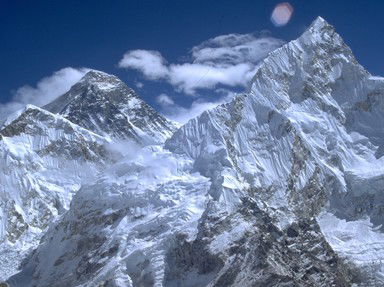
Everest (8849m / 29,032 feet - highest in the world) is the next eight-thousander on the Nepal-Tibet border, and needs little introduction. It was first summited in 1953 by New Zealander Sir Edmund Hillary and Sherpa Tenzing Norgay on a British expedition, making it the second eight-thousander to be summited. It is the most popular eight-thousander to climb, with hundreds attempting the feat each year. The main climbing season is centered around a few weeks in April/May where the weather is generally the most stable, and parties will still wait around for rare weather windows during this period to make a summit attempt. This means most of the climbers will attempt the summit on just a couple of days each year, leading to long line ups and delays across the fixed routes. Compounding this is the commercialisation of the mountain, with dozens of commercial expeditions bringing relatively inexperienced mountaineers to this dangerous climb. Trekkers also flood the region on the popular Everest Base Camp and Three Passes treks. The summit of Everest cannot actually be seen from Everest Base Camp, thus trekkers typically ascend nearby Kala Patthar (5545m / 18,192 feet) at sunrise to witness the golden glow striking the summit of Everest, well before the sun breaks over the horizon of lower elevations.
Lhotse (8516m / 27,940 feet - 4th highest), also on the Nepal-Tibet border, is Everest's smaller sibling, with summits just 3km / 1.86 miles apart as the crow flies. It is connected to Everest by the South Col at 7906m / 25,938 feet elevation, which means one only needs to ascend 610m / 2,000 feet to reach the summit of Lhotse from the summit of Everest. Thus many climbers will ascend both summits within a day or two, with Mingme Dorchi Sherpa achieving the feat with just 6 hours and 1 minute separating him standing on both summits. Lhotse does indeed look very prominent when observed from the South and Northeast Faces, making it a stunning part of the panoramic Everest Massif for trekkers to observe.
Makalu (8485m / 27,838 feet - 5th highest) is the final eight-thousander on the Nepal-Tibet border. It is isolated from other peaks, with an iconic four-sided pyramid shape. It can be seen from afar from the popular trekking peak Chukhung Ri in the Khumbu (Everest) region. The region around the mountain itself is much less travelled, though it does attract some adventurers with landscapes ranging from subtropical monsoon forests to alpine.
Kangchenjunga (8586m / 28,169 feet - 3rd highest) is India's only eight-thousander, also straddling the border with Nepal. It was thought to be the world's highest peak from 1847-1852 until further measurements and calculations proved Everest to be higher. The first ascent came with a British expedition in 1955, after over 100 years of exploration and attempts. They came just short of the true summit to keep a promise to the monarch of the Kingdom of Sikkim to keep the top of the mountain 'inviolate'. It has since been summitted on many occasions from both countries, however India has again banned expeditions on the Indian side since 2000.
Shishapangma (8027m / 26,335 feet - 14th highest), located in Tibet 5km from the border with Nepal, is the lowest of our eight-thousanders, scraping into the list with 27m / 89 feet to spare. It lies further north than the main Himalayan peaks, in the Tibetan Plateau. This region is more dry, leading to less dramatic and steep terrain compared to other Himalayan peaks, compounded by the high plateau around it giving it less vertical prominence. Yet it still remains a significant challenge to climb, with the main summit in particular requiring dangerous ridge-climbing to reach.
Nanga Parbat (8125m / 26,657 feet - 9th highest) is also known as Diamer locally. It lies within Pakistan-administered Kashmir, though India also claims this region. It rises high above the surrounding terrain in all directions, making it appear very tall and prominent compared to other eight-thousanders. It is the fastest growing eight-thousander, growing at 7mm / 0.27 inches per year. It is considered the western-most major peak of the Himalayas, despite being far closer to the four Karakoram eight-thousanders than the other nine Himalayan eight-thousanders. It is considered one of the more difficult and fatal climbs of the eight-thousanders.
K2 (8611m / 28,251 feet - 2nd highest) is the first of the four 8000m Karakoram peaks we will look at. It is located on the border of Pakistan-administered Kashmir and the China-administered Trans-Karakoram Tract in the Taxkorgan Tajik Autonomous County of Xinjiang. The first thing that stands out is the unique name. It arose during the Great Trigonometrical survey, with 'K' representing Karakoram and 2 being the number designated to the peak. Local names were given to mountains by this survey, however they weren't able to identify any local name for this remote peak that was not visible from any permanent habitation nearby and would have only rarely or never been seen by locals. In lieu of a local name, "Mount Godwin-Austen" was suggested in honour of an early explorer of the area but this name was rejected. Thus K2 retained its impersonal and harsh name, which nicely reflects its reputation as a remote, difficult and deadly peak.
Broad Peak (8051m / 26,414 feet - 12th highest) lies about 8km / 5 miles east from K2, also on the border of Pakistan-administered Kashmir and the China-administered Trans-Karakoram Tract. It is aptly named, with a "broad peak" about 1.5km / 0.9 miles in length compared to other peaks no more than a few dozen metres wide. It has five summits, of which three reach above 8000m, though they are all considered subpeaks of Broad Peak rather than distinct peaks or mountains of their own.
Gasherbrum II (8034m, 26,358 feet - 13th highest) is yet another 8000 peak on the border of Pakistan-administered Kashmir and the China-administered Trans-Karakoram Tract, also only a few kilometres from Broad Peak and K2. It was named K4 initially as part of the Great Trigonometrical survey, but managed to pick up a local name in contrast to K2. It derives from the local Balti words "rgasha" (beautiful) and "brum" (mountain). It is considered part of the Gasherbrum Massif, and attracts the designation 'II' as it is the second highest peak in this massif.
Gasherbrum I (8080m / 26,510 feet - 11th highest) is the easternmost and final 8000 peak on the border of Pakistan-administered Kashmir and the China-administered Trans-Karakoram Tract, and indeed the final eight-thousander we are exploring. Originally surveyed as K5, it was found to be the highest of the peaks in the Gasherbrum Massif. It is also known as "Hidden Peak" as it mostly remains hidden behind other peaks when trekking in the area.
This quiz was reviewed by FunTrivia editor agony before going online.
Any errors found in FunTrivia content are routinely corrected through our feedback system.