FREE! Click here to Join FunTrivia. Thousands of games, quizzes, and lots more!
Quiz about Ohio From Competing Claims to Statehood

Ohio: From Competing Claims to Statehood Quiz

1748-1803

This quiz tackles the early history of Ohio: from the first British and French claims, to the way that rivalry started a global conflict, and finally to statehood. Enjoy!

A photo quiz by JJHorner. Estimated time: 3 mins.
  1. Home
  2. »
  3. Quizzes
  4. »
  5. History Trivia
  6. »
  7. U.S. States & Cities
  8. »
  9. Ohio

Author
JJHorner
Time
3 mins
Type
Photo Quiz
Quiz #
424,050
Updated
May 07 26
# Qns
10
Difficulty
New Game
Avg Score
7 / 10
Plays
18
Last 3 plays: lethisen250582 (10/10), stephgm67 (4/10), Guest 4 (1/10).
-
Question 1 of 10
1. What British-backed land company, led by this handsome devil, began promoting settlement and trade in the Ohio region in 1748? Hint


Question 2 of 10
2. Which French officer led the 1749 expedition that buried lead plates to claim the Ohio Valley for France? Hint


Question 3 of 10
3. What English-aligned trading village near the Great Miami River was destroyed in 1752? Hint


Question 4 of 10
4. What French outpost did George Washington visit in 1753 to deliver Virginia's demand that the French leave the Ohio Country? Hint


Question 5 of 10
5. What 1763 peace agreement ended the Seven Years War and transferred the Ohio Country to British Control? Hint


Question 6 of 10
6. What land speculation group, organized in Boston in 1786 contracted for a huge tract of land in the Muskingum and Hocking valleys in what is now southeastern Ohio? Hint


Question 7 of 10
7. Which 1787 congressional act created a territorial government and a path to statehood for the federal lands north and west of the Ohio River? Hint


Question 8 of 10
8. What Ohio settlement, founded in 1788, became the first permanent U.S. settlement in the Northwest Territory? Hint


Question 9 of 10
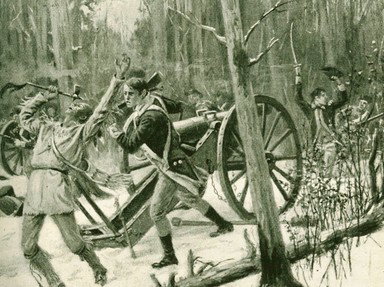
9. What 1791 battlefield disaster near present-day Fort Recovery became the worst defeat ever suffered by U.S. troops at the hands of Native Americans? Hint


Question 10 of 10
10. In what year did Ohio enter the Union as the 17th state? Hint


(Optional) Create a Free FunTrivia ID to save the points you are about to earn:

arrow Select a User ID:
arrow Choose a Password:
arrow Your Email:


View Image Attributions for This Quiz

Most Recent Scores
Today : lethisen250582: 10/10
Today : stephgm67: 4/10
Today : Guest 4: 1/10
Today : Guest 76: 7/10
Today : xchasbox: 9/10
Today : Reamar42: 9/10
Today : mac4293: 7/10
Today : harley74: 4/10
Today : klotzplate: 10/10

Quiz Answer Key and Fun Facts
1. What British-backed land company, led by this handsome devil, began promoting settlement and trade in the Ohio region in 1748?

Answer: Ohio Company of Virginia

What started as a bold land speculation scheme quickly turned into something much... bigger. The Ohio Company of Virginia was formed by a group of influential Virginians, including members of the Fairfax family and a young surveyor named George Washington, who would later get tangled up in its various... pursuits. The company was granted a large tract of land west of the Appalachian Mountains, and its goal was simple, at least on paper: encourage settlement, build trading posts, and profit from westward expansion. Meanwhile, the French had some different ideas. When real estate deals go sour, they usually don't change borders across multiple continents. This one would be different.

(The handsome devil's name was Thomas Lee.)
2. Which French officer led the 1749 expedition that buried lead plates to claim the Ohio Valley for France?

Answer: Pierre Joseph Céloron de Blainville

In 1749, Pierre Joseph Céloron de Blainville was sent by New France to claim control over the Ohio Valley. He did so in a curious way. He quite literally buried stamped lead plates at key river junctions. Each one declared French sovereignty over the land and warned off British traders who were already poking around. It was France's way of saying, in no uncertain terms, 'Dibs!'

Pete and his men traveled thousands of miles along rivers like the Allegheny and Ohio. They encountered Native American communities, where his little lead-plate scheme was met with some mixed emotions. Many of those communities had strong trading ties with the British and saw the French effort as a bit of a faux pas at the very least. The British didn't take it very well either.
3. What English-aligned trading village near the Great Miami River was destroyed in 1752?

Answer: Pickawillany

So things were getting tense. Meet Pickawillany, a happy and thriving little trade hub hanging out along the Great Miami River near the present-day city of Piqua, Ohio. It was where the Miami people did business with British traders to the benefit of both. The French were trying to lock down the Ohio Valley. They had lead plates and everything. Well, you can't exactly have thriving British trading posts in the middle of New France. Trade was power, and Pickawillany was tilting that balance in a direction the French did not like.

In 1752, a force of French soldiers and Native American allies descended on the settlement and destroyed it. The attack was brutal and definitely meant to send a message. The message was received.
4. What French outpost did George Washington visit in 1753 to deliver Virginia's demand that the French leave the Ohio Country?

Answer: Fort LeBoeuf

George Washington was all of 21 years old when he made the long, cold journey into contested territory. Virginia Governor Robert Dinwiddie--if you think his name is funny, you need to look up his picture--sent him, and Washington traveled deep into the Ohio Country to deliver a formal message to the French telling them to hit the road. He reached Fort LeBoeuf, near present-day Waterford, Pennsylvania. This is a long stone's throw from the present-day border with Ohio. There he met with the commanding officer.

The French response was polite but firm: non.

Within a year, Washington would be back on the frontier, this time with troops, and things would spiral into open conflict. But that first visit marked one of the opening moves in what became the French and Indian War in North America, and more broadly the Seven Years' War.
5. What 1763 peace agreement ended the Seven Years War and transferred the Ohio Country to British Control?

Answer: Treaty of Paris

By 1763, everyone involved in the Seven Years' War was tired, broke, or both. The Treaty of Paris finally brought it to a close. The treaty completely changed the map of North America. France gave up vast territories east of the Mississippi River to Britain, including the Ohio Country. This effectively ended French colonial ambitions there.

Spain, which had sided with France late in the war, handed Florida over to the British as well. On paper, Britain came out looking like the big winner. However, they were left with crippling war debt. It would later attempt to tax its American colonies to pay for the war. What could go wrong?

The ripple effects in Europe were pretty dramatic as well. France lost territory and prestige points, Austria was dissatisfied, Prussia was flexing its muscles, and Russia was a mess. In other words, while the Treaty of Paris ended one global conflict, it definitely set the stage for quite a few more.
6. What land speculation group, organized in Boston in 1786 contracted for a huge tract of land in the Muskingum and Hocking valleys in what is now southeastern Ohio?

Answer: Ohio Company of Associates

Fresh out of the Revolution, the new United States had land, and lots of it. Just one problem: no cash. Enter the Ohio Company of Associates, a group of Revolutionary War veterans, investors, and bigwigs who saw opportunity out west. It was organized in Boston in 1786.

They negotiated with Congress to purchase a massive tract in the Northwest Territory. Their plan was not just to flip land for profit though... well, that was certainly part of it. They wanted to build actual communities, orderly ones, with schools, churches, and a sense of stability.
7. Which 1787 congressional act created a territorial government and a path to statehood for the federal lands north and west of the Ohio River?

Answer: Northwest Ordinance

The Northwest Ordinance was passed in 1787 under the Articles of Confederation and laid out a clear system for how new territories would be governed and eventually admitted as states. The idea was that once a territory hit certain population milestones, it could move step by step toward full statehood, equal to the original thirteen. That alone was kind of a revolutionary idea. It set a precedent that the United States would grow by adding equal states, instead of colonies and territories. At least for a little while.

But it wasn't all fun and games. Slavery was banned in the Northwest Territory, which created an early dividing line between free and slave regions. The ordinance also encouraged public education and outlined basic civil liberties. The framework held up, too. States like Ohio, Indiana, and Illinois followed that path into the Union.
8. What Ohio settlement, founded in 1788, became the first permanent U.S. settlement in the Northwest Territory?

Answer: Marietta

Marietta was born in 1788 right where the Ohio and Muskingum Rivers meet. This was no rough scattering of cabins tossed together in a hurry. It was a planned settlement, organized by the Ohio Company of Associates. Revolutionary War veterans were among the first settlers. They traded in their military lives for axes, survey lines, and the long, slow work of building something permanent out of wilderness. Marietta became a model for what westward expansion could look like under the Northwest Ordinance. Streets were planned, institutions followed, and there was an effort to keep order from the very beginning.

One little catch: the land was already home to Native American nations, and conflict was inevitable. Nevertheless, Marietta holds its place in history as the first real foothold of the United States in the Northwest Territory. It's still there if you don't believe me.
9. What 1791 battlefield disaster near present-day Fort Recovery became the worst defeat ever suffered by U.S. troops at the hands of Native Americans?

Answer: St. Clair's Defeat

In November 1791, a force led by General Arthur St. Clair marched into the Northwest Territory to assert control. Instead, they walked straight into a coordinated attack by Native American forces led by Little Turtle, Blue Jacket, and others. The U.S. troops were poorly trained and badly supplied. Nothing good ever comes next when I write a sentence like that. The Americans were overwhelmed in a matter of hours near what is now Fort Recovery, Ohio. It was bad. More than 600 soldiers were killed, along with many camp followers. This made it the deadliest defeat ever suffered by the U.S. military in any conflict with Native Americans.

In response, President George Washington pushed for the creation of a more professional standing army. This eventually led to the formation of the Legion of the United States under General Anthony Wayne. That force would later face the same Native confederacy at the Battle of Fallen Timbers in 1794. That fight would have a very different outcome.
10. In what year did Ohio enter the Union as the 17th state?

Answer: 1803

Ohio became a state on March 1, 1803, but the process had already been underway for a while. Settlers had poured into the region after the Northwest Ordinance set the rules for statehood. By the early 1800s, the population had grown enough to qualify. Congress approved Ohio's constitution, and just like that, the former frontier that sparked a war across oceans officially joined the Union as the 17th state.

For years there was a bit of bureaucratic weirdness around it, though. Congress never passed a formal resolution explicitly declaring Ohio a state at the time. It was just kind of assumed. Everything functioned normally, representatives were seated, and no one really thought much about it. Then in 1953, during Ohio's 150th anniversary, Congress went back and officially confirmed statehood retroactively. So long story short, it took Ohio 150 years to finally finish the paperwork.
Source: Author JJHorner

This quiz was reviewed by FunTrivia editor trident before going online.
Any errors found in FunTrivia content are routinely corrected through our feedback system.
5/7/2026, Copyright 2026 FunTrivia, Inc. - Report an Error / Contact Us