Last 3 plays: LauraMcC (2/12), GoodVibe (0/12), ehjuhkaytid (3/12).
The names used here are transliterations of their Asian names. Some are commonly identified in English by a translation, but others are not. For consistency, I have left them all in the original language, and provided relevant translations in the information.
Drag-Drop or Click from Right
Options
Thapthim kropMochiHalo-haloBanh bo nuongKhao niao mamuangKulfi and falooda Gulab jamunKuih lapisPulut intiKulfiBingsuGinataan bilo bilo
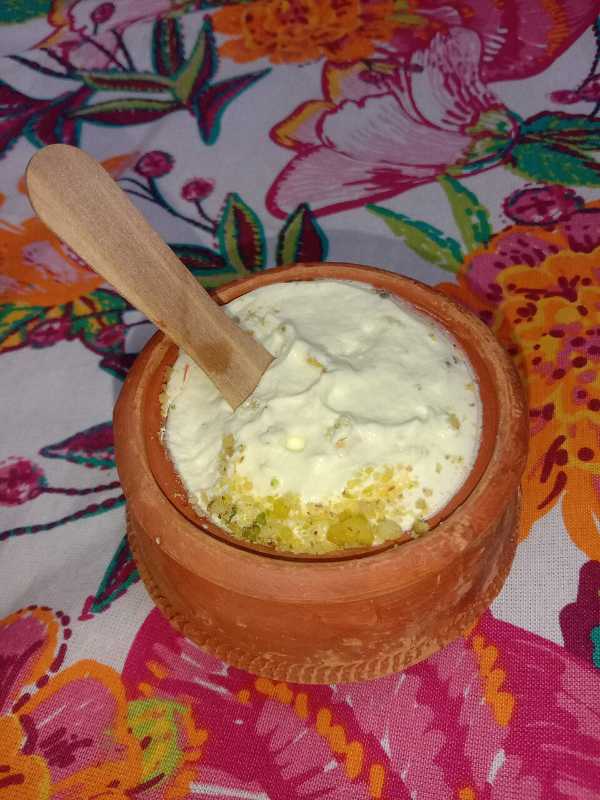
Kulfi is often referred to as Indian ice cream, but that is not quite accurate. Its origin is in India (during the Mughal era), and it is a frozen dairy dessert. However, it is denser than ice cream, as it is not churned while freezing. The sweetened milk is heated and condensed, during which the sugar caramelizes, then poured into sealed moulds (the origin of the name of the dish, which means covered cup) and quickly frozen. The traditional method involves a bath of ice and salt, but modern freezers can also be used. If the mixture sets quickly enough, the formation of ice crystals is avoided, and the mixture remains smooth. To serve, it is warmed a bit so it can be removed from the mould, or it can be served in the pot used to set it.
The flavour of kulfi can be modified by adding flavoring ingredients such as mango, rosewater, saffron, almond, cardamom or pistachio. Alternatively (or additionally), the kulfi can be topped with ground nuts and/or diced or sliced or pureed fruit as it is being served.
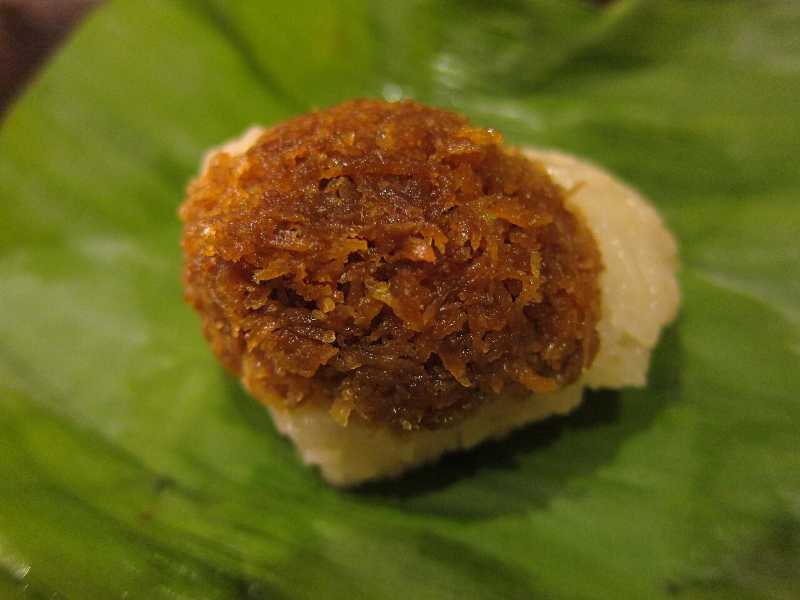
2. Pulut inti
It is a shame I couldn't find an image that displays the usual presentation of this dish - the banana leaf on which the stack of glutinous rice cooked in coconut milk (pulut), topped with a pile of grated coconut that has been caramelized with palm sugar (inti) is shown sitting is about to be folded to form a green tetrahedron which is held in the hand for consumption. They are usually small enough to be eaten in a few bites.
This is a Malaysian treat; traditionally Malays leave their rice white, while Nyonya (descended from Chinese immigrants) often colour it blue, using bunga telang (juice from the butterfly pea flower). Pandan may be added to the rice or the coconut, or both. Pandan, the leaves of the screwpine, are a common flavouring additive in Southeast Asian cooking, imparting a taste that some compare to vanilla, while others find it more earthy and grass-like.
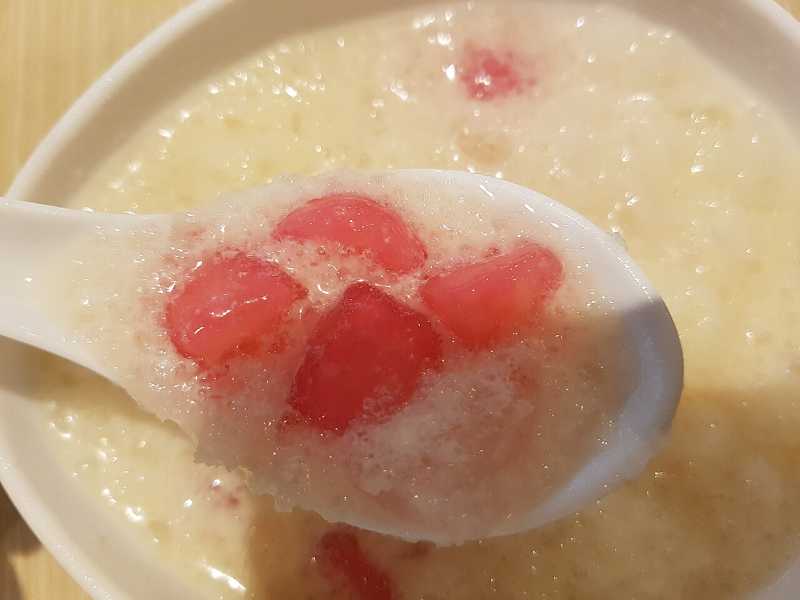
3. Thapthim krop
The Thai name for this dish literally means 'crispy rubies', which describes the red balls seen in the image. The word translated as rubies can also be translated as pomegranate seeds. These cubes or balls are made from water chestnuts soaked in grenadine (or, less traditionally, red food dye) then coated in tapioca flour before being boiled.
They are served in a bowl of sweetened coconut milk, often flavoured with pandan, on which ice cubes are floated.
4. Banh bo nuong
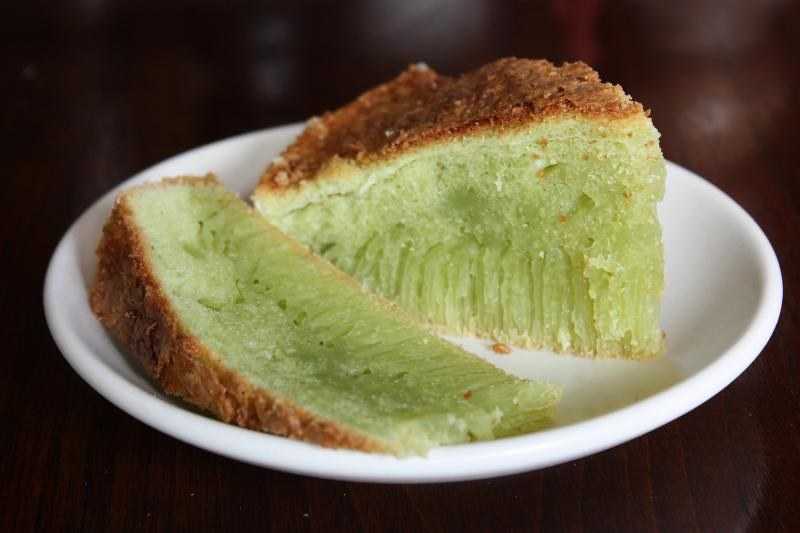
The English name for this dish is Vietnamese honeycomb cake, describing the texture of the cake. 'Bánh bò' literally means cow cake, because the cake (before slicing) is said to resemble a cow's udder. 'Nuong' means baked. The batter is made from rice flour, water, sugar and yeast - which produce the numerous bubbles that lead to its English name. Coconut milk is usually added for flavour.
If the cake mixture does not have anything else added, it will have a creamy colour inside, and a brown exterior due to caramelization during cooking. The cake in the image is bright green because it has had pandan added to the mixture.
5. Gulab jamun
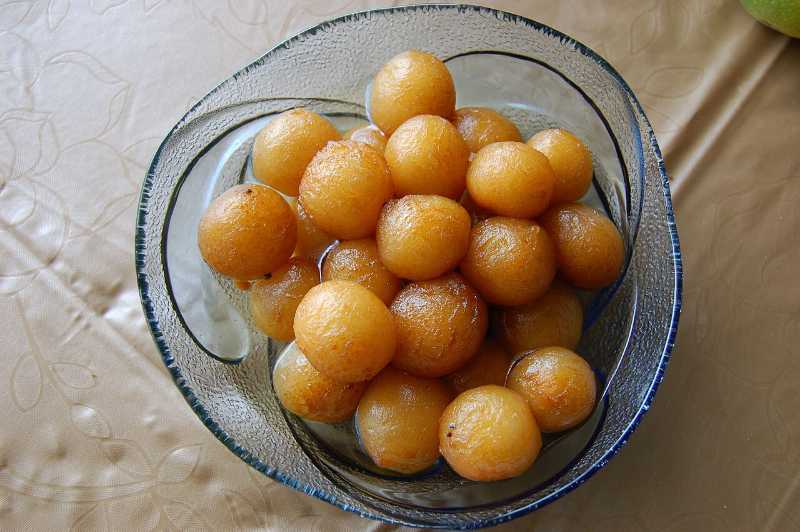
Gulab jamun are small balls of evaporated milk (reduced to form the soft cheese known as khoa) mixed with flour. They are deep fried in oil or ghee and soaked in sugar syrup. The syrup may be plain, or it can be flavoured with rosewater, cardamom, saffron or kewra (screwpine oil, similar to but stronger than pandan). Gulab jamun are often served over kulfi (or ice cream).
Gulab jamun were developed during the Mughal Era, and shows the way the Mughals integrated influences from the various parts of their empire. Gulab comes from Persian words for flower and water - suggesting the original dish was the version using rosewater in the syrup. Jamun is the Hindustani name for an Indian fruit that the balls resemble.
6. Kuih lapis
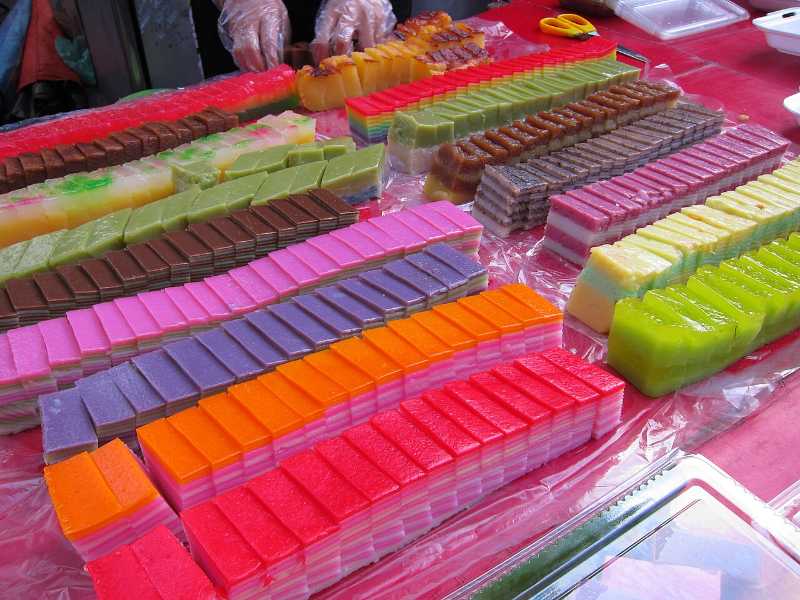
Kuih or kueh, pronounced kway, are small, sweet treats - one or two bites - that are found in a number of Southeast Asian countries. Pulut inti (q2) are a type of kuih, and the multi-coloured treats in the image are another. 'Lapis' means layered, and these steamed treats are common in Malaysia, Indonesia and Singapore, associated with the Peranakans (descendants of Chinese settlers whose culture has been influenced by colonial rulers in the area where they settled).
Kuih lapis is made from a rice flour and sago batter, flavoured with coconut milk (and sometimes other additives). Usually there are at least two colours used (or sometimes a light and dark version of the same colour), so the batter is divided up and coloured before cooking. A thin layer is placed in the pan, and steamed until set. The next layer (of another colour) is then added and cooked; repeat until the desired height is reached. The fun way to eat these is to peal off the layers one by one. They have a bouncy texture, almost like a jelly.
Pandan is traditionally used to produce green layers, but artificial colours can also be used - as seen in the image! The image also shows some of the kuih lapis that have had multiple adjacent layers of the same colour used, producing thick layers of colour, although the actual cake is still in thin (about 1 mm) layers.
7. Halo-halo
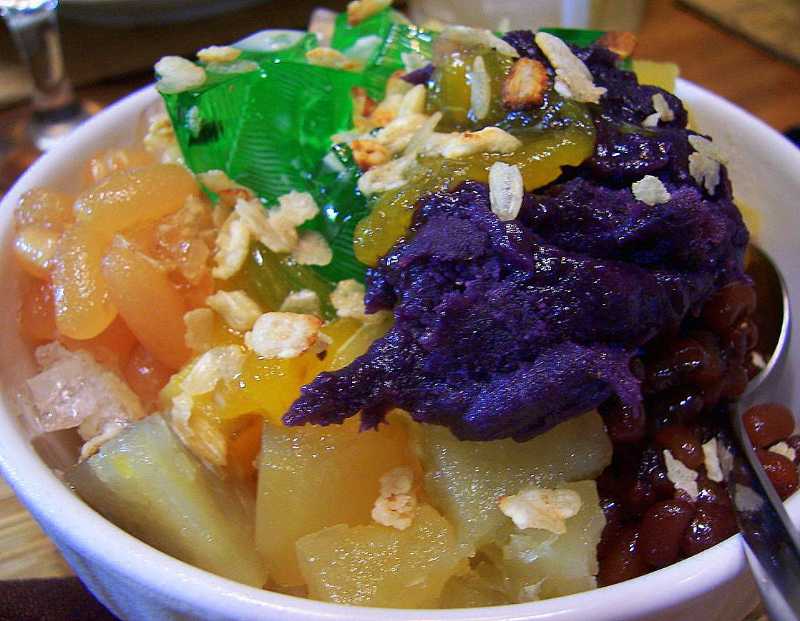
Halo-halo translates into English as mix-mix, indicating that this Filipino dish has a serious mixture of ingredients. The exact ingredients are up to the individual cook, although the purple yam shown here is a frequent inclusion. Shaved ice, not visible in the photo, is a central part of the dish, which is often considered a symbol of Filipino culture.
The bottom layers consist of a selection of sweet ingredients: jackfruit, plantains and other fruit (either fresh or cooked in syrup for extra sweetness) may be mixed with flavoured agar jelly, tapioca pearls, macapuno (gelatinous flesh of a kind of coconut), sweet potato or beans of various sorts cooked in syrup, and more. This is covered with shaved ice, then the top layer is added: this could be custard, mashed yam, ice cream, or all of the above. Coconut milk may be poured over it all just before serving.
The halo-halo in the photo seems to have had some crispy puffed rice sprinkled over for texture. While this is in a bowl, it is common to see halo-halo presented in a tall glass, so that the various layers can be seen - even if one then attempts to eat multiple layers in each bite, to get the mix of flavours.
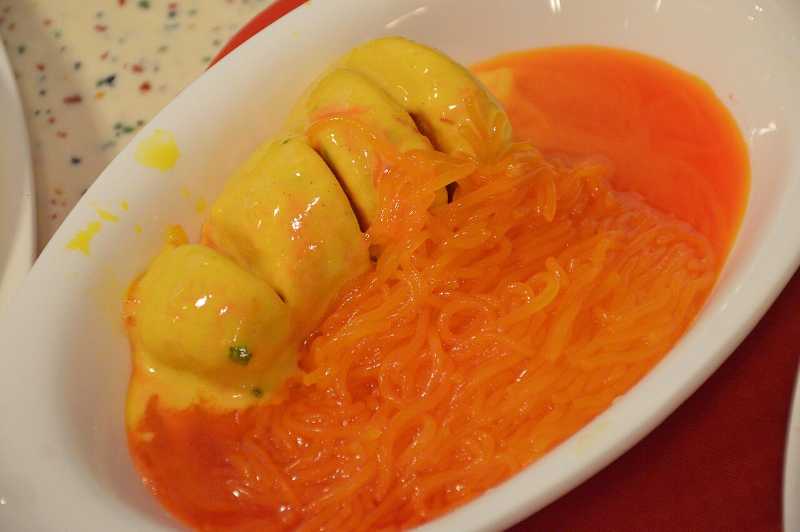
8. Kulfi and falooda
The photo shows a serving of kulfi (see q1) served with vermicelli noodles that have been cooked in rose syrup that has been flavoured with basil seeds. That's the falooda. Falooda has its roots in Persian cuisine, where the noodles and syrup are presented as a frozen dish similar to a sorbet. The Mughals brought it to India, then spread it around.
Falooda can be served as a sweet noodly dish, as in the photo. It can also be included in multi-ingredient dishes - it is often one of the layers in a parfait-like dish of fruits and frozen treats. In this case, the noodles can be mixed with milk and frozen, or they may be just flavoured noodles.
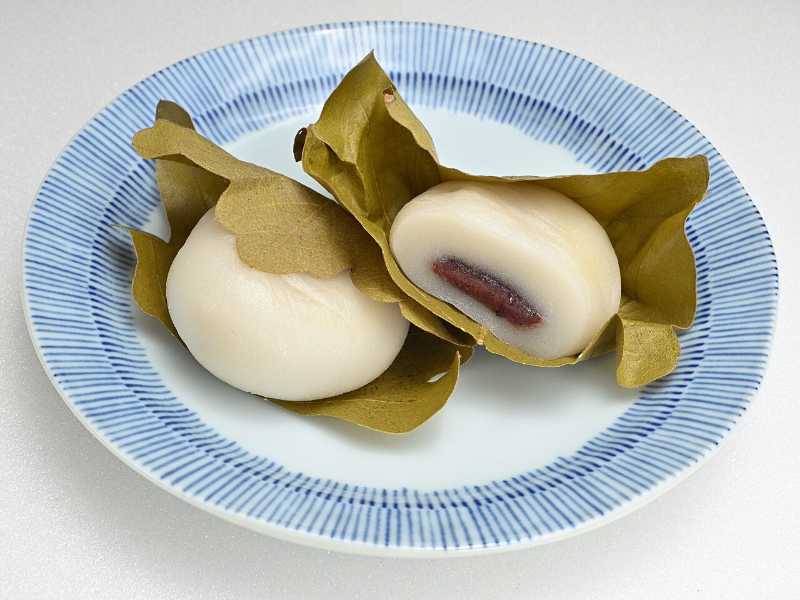
9. Mochi
Mochi are traditional Japanese sweets made of glutinous rice that has been cooked in a mold, and may have a filling. different kinds of mochi are associated with various times of the year (although they can all be eaten year-round). The image here is of kashiwa-mochi, filled with anko (sweet red bean paste) and wrapped in an oak leaf (kashiwa). It is associated with Children's Day, May 5.
Other special mochi include Sakuramochi (using pink rice and wrapped in a salted cherry blossom leaf), eaten in the spring, and kagami mochi, a New Year's special. This is a bit more complicated to prepare, as you need to construct it using two mochi (a larger one on the bottom, a smaller one on top) and then adding a small bitter orange on top. This vaguely humanoid figure is then dressed and decorated with symbols of good luck.
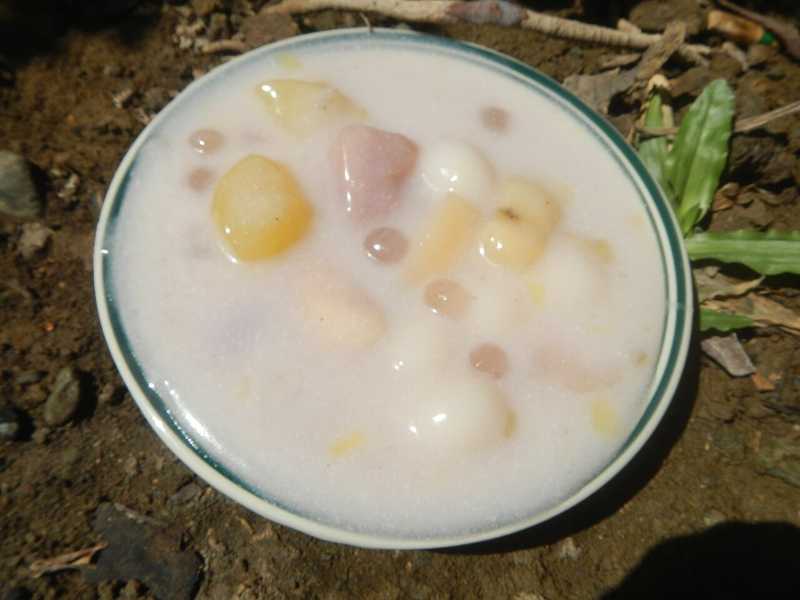
10. Ginataan bilo bilo
Ginataan bilo bilo is a dessert in the Philippines that resembles a sweet soup. The name 'ginataan' means cooked in coconut milk, and bilo bilo are colorful mochi balls made from tapioca starch, water, and flavoring (like pandan). Along with the bilo bilo, the sweetened coconut milk has pieces of other ingredients such as jackfruit, banana, sweet potato, tapioca pearls and taro floating in it. It may be served hot or cold, depending on the region.
Other names for essentially the same dish in various parts of the Philippines include bilu-bilo, pinaltok, binignit, paradusdos, pinindot and tambo-tambong.
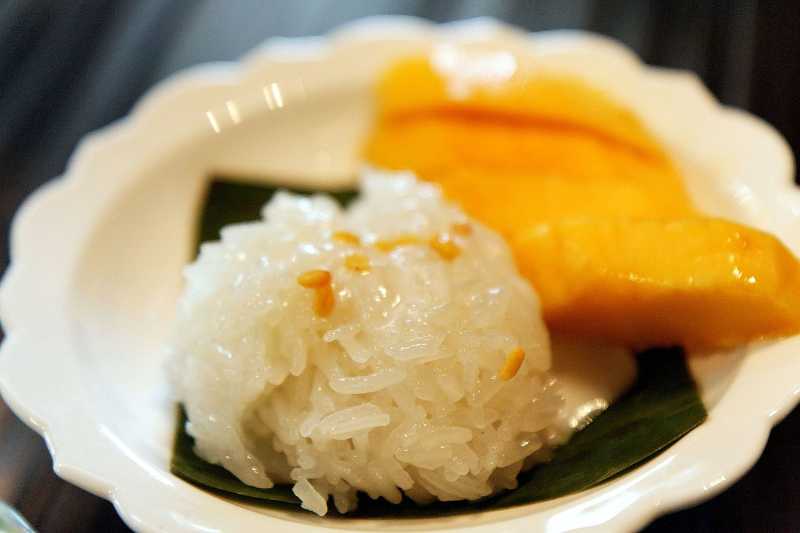
11. Khao niao mamuang
The English name, mango sticky rice, is pretty self-explanatory. There is a scoop of sticky rice (glutinous rice cooked in coconut milk that has been sweetened with jaggery) and some slices of mango. The banana leaf in which the rice was cooked can be seen in the photo, and is sometimes included in the presentation.
This is often considered the quintessential Thai dessert, but it is found in other countries in the region. When mangoes are not in season, other fruits may be served - or substitute frozen mango to keep the flavour even if the texture is a bit soft. If you want to add some crunch, sprinkle some toasted sesame seeds or mung beans over the top.
12. Bingsu
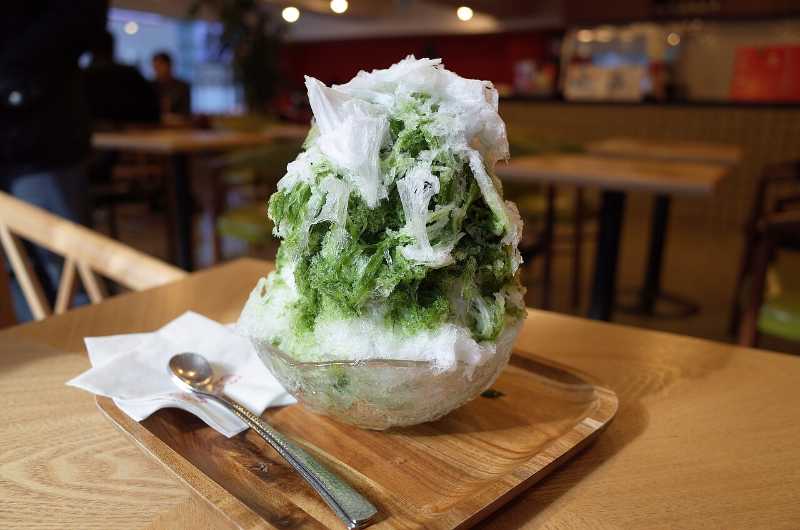
Bingsu, which means ice water, is a Korean shaved ice dessert with sweet toppings. These may include chopped fruit, fruit-flavoured syrup and/or condensed milk. If you include sweet red beans, you will have pat-bingsu. The image shows nokcha-bingsu, made with green tea. Adding strawberries (not traditional!) produces ttalgi-bingsu. Etc.
Traditionally the dish is made of shaved ice - originally using natural ice, which then evolved into using artificially frozen ice. In more recent times it has become common to use ice cream as a quick substitute, but that is not authentic.
This quiz was reviewed by FunTrivia editor Bruyere before going online.
Any errors found in FunTrivia content are routinely corrected through our feedback system.