FREE! Click here to Join FunTrivia. Thousands of games, quizzes, and lots more!
Quiz about Solar Opposites

Solar Opposites Trivia Quiz

Deities and Creatures of the Sun

A life-giving force for everything on Earth, the Sun has been worshipped as a deity by most human civilizations. This quiz will deal with gods, goddesses and associated creatures featured in the myths of some major ancient cultures.

A multiple-choice quiz by LadyNym. Estimated time: 3 mins.
  1. Home
  2. »
  3. Quizzes
  4. »
  5. Humanities Trivia
  6. »
  7. Mythology Mixture
  8. »
  9. Something in Common

Author
LadyNym
Time
3 mins
Type
Multiple Choice
Quiz #
425,584
Updated
Sep 19 26
# Qns
10
Difficulty
New Game
Avg Score
7 / 10
Plays
17
Last 3 plays: debbitts (4/10), Guest 86 (4/10), quizzer74 (7/10).
- -
Question 1 of 10
1. In Ancient Egyptian mythology, various deities embodied different aspects of the Sun. What was the name of the lioness-headed goddess, also associated with war and destruction, who embodied the burning desert sun? Hint


Question 2 of 10
2. Shamash, the Sun god of ancient Mesopotamia, had also another major role, which inspired Babylonian king Hammurabi's greatest achievement. What role was this?


Question 3 of 10
3. In Chinese mythology, the goddess Xihe was the mother of ten suns that took the shape of what animal (which in the West would rather be associated with darkness)? Hint


Question 4 of 10
4. A child of Titans, Helios was the Greek god of the Sun. What Greek island, known for erecting a massive statue of the god, was a major centre of his cult? Hint


Question 5 of 10
5. What ancient Iranian god of sun and light (whose name might remind you of a bishop's headgear) inspired a syncretic cult widely practiced by soldiers in the Roman Empire? Hint


Question 6 of 10
6. In Norse mythology the Sun was a goddess named Sól or Sunna, who was pursued across the sky by what kind of fierce creature? Hint


Question 7 of 10
7. The Sun god Inti was the patron deity of the Inca Empire. What majestic animal, a national symbol in much of South America, was associated with him?

Answer: (six letters - large bird)
Question 8 of 10
8. What ancient civilization, based in present-day Turkey, worshipped three different solar deities - including a Sun goddess of the Earth who presided over the underworld? Hint


Question 9 of 10
9. The powerful sun goddess Saule, responsible for all life on Earth, is still a pervasive presence in the folklore of which two countries in northeastern Europe?


Question 10 of 10
10. The Aztecs believed in five cosmic eras, known as "Five Suns", each of them ruled by a different deity. What Sun god, with a heavy-sounding name, ruled the fifth sun, corresponding to the present era? Hint


(Optional) Create a Free FunTrivia ID to save the points you are about to earn:

arrow Select a User ID:
arrow Choose a Password:
arrow Your Email:


Most Recent Scores
Today : debbitts: 4/10
Today : Guest 86: 4/10
Sep 19 2026 : quizzer74: 7/10
Sep 19 2026 : cardsfan_027: 10/10
Sep 19 2026 : Guest 75: 8/10
Sep 19 2026 : Jdoerr: 5/10
Sep 19 2026 : HBSpud: 3/10
Sep 19 2026 : reedy: 10/10
Sep 19 2026 : Guest 72: 5/10

Quiz Answer Key and Fun Facts
1. In Ancient Egyptian mythology, various deities embodied different aspects of the Sun. What was the name of the lioness-headed goddess, also associated with war and destruction, who embodied the burning desert sun?

Answer: Sekhmet

The goddess Sekhmet ("She Who Is Powerful") had a complex nature that combined negative and positive attributes. As the Eye of Ra, the vengeful manifestation of her father, the supreme Sun god, she was a violent force that subdued his enemies. She was depicted as a woman with the head of a lioness, bearing a sun disk with an uraeus (a stylized cobra, symbol of royalty) on her head. Her consort was the creator god Ptah.

In her role as a solar deity, Sekhmet was identified with the hot winds of the desert, which were said to be her flaming breath. Like the sun, she could burn and kill but also encourage growth and renewal: in fact, she also had a dual nature as bringer of plagues and healer of the sick. In a well-known myth, Sekhmet, sent by Ra to wreak vengeance on mortals who had conspired against him, almost destroyed the whole of humankind. To stop her, the gods poured a lake of beer tinted red with ochre, which the goddess mistook for blood and drank avidly - eventually getting drunk and ending her violent rampage. Some scholars have compared Sekhmet to the Hindu goddess Kali, who also has destructive and nurturing aspects.

The cat-headed goddess Bastet was considered a gentler aspect of Sekhmet. Hathor, often represented as a cow, was a mother-goddess figure associated with the sky and femininity. Ma'at, on the other hand, was the goddess of truth and justice and harmony: Sekhmet was regarded as her protector.
2. Shamash, the Sun god of ancient Mesopotamia, had also another major role, which inspired Babylonian king Hammurabi's greatest achievement. What role was this?

Answer: he was the judge of the underworld

Known to the Sumerians as Utu, the Sun god Shamash was also venerated as a dispenser of divine justice. His name is related to the Akkadian word for "sun" and words with the same meaning in other Semitic languages (such as Arabic "sams"). He was the son of the Moon god Sin (Nanna) and his consort Ningal, and the brother of Inanna (Ishtar), the goddess of love and war. Shamash's wife, the dawn goddess Aya (Sherida), was worshipped alongside him at their shrine in Sippar. He was often depicted with rays emanating from his shoulders and a saw in his hand, or holding the rod-and-ring symbol associated with major Mesopotamian deities.

In his role as god of the Sun, Shamash was able to see everything that happened in the world every day - hence his connection to justice, divination and the protection of travellers. Shamash travelled across the sky in a chariot pulled by four horses, each of them representing an aspect of the light of heaven. During the night he journeyed through the underworld, where he judged the dead. Because of Shamash's role as a divine judge, Babylonian king Hammurabi claimed that his famous law code - one of the oldest in the world - was revealed to him by the god, as shown in the carving at the top of the basalt stele on which the code is inscribed.

In the "Epic of Gilgamesh" and related myths, Shamash is the titular hero's protector, helping him to defeat the monstrous Humbaba.
3. In Chinese mythology, the goddess Xihe was the mother of ten suns that took the shape of what animal (which in the West would rather be associated with darkness)?

Answer: crow

The ancient Chinese solar goddess Xihe was one of the two consorts of Di Jun (Emperor Jun), the God of the Eastern Sky, along with the lunar goddess Changxi. Xihe gave birth to ten suns in the form of three-legged crows that perched on a red mulberry tree known as Fusang. Changxi, on the other hand, gave birth to twelve moon daughters. Every day, each of the sun crows was taken by Xihe on her chariot to travel around the world. Xihe's sun chariot was pulled by a dragon - as depicted by a famous statue in the historic city of Hangzhou. The goddess' daily journey is described in the ancient text "Huainanzi" (2nd century BC).

According to Chinese folklore, one day the ten golden sun crows decided to come out all on the same day to play with each other - eventually setting fire to the world. The Jade Emperor (the supreme god of the ancient Chinese pantheon) tasked the celestial archer Hou Yi with trying to reason with them. As they would pay no heed, Hou Yi started shooting them one by one. Xihe then begged him to spare one of her sons to ensure that the Earth had a sun. The three-legged crow ("sanzuwu") is an ancient symbol in Chinese art; it also appears in the mythologies of Korea and Japan.

The toad, the rabbit and the turtle are all three-legged creatures that appear in traditional Chinese mythology.
4. A child of Titans, Helios was the Greek god of the Sun. What Greek island, known for erecting a massive statue of the god, was a major centre of his cult?

Answer: Rhodes

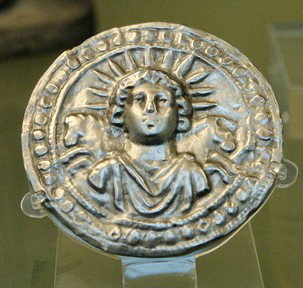
The personification of the Sun, Helios was the son of the Titans Hyperion and Theia; Selene, goddess of the moon, and Eos, goddess of the dawn, were his sisters. His father's name, Hyperion ("The One Above"), was also one of his attributes, as was Phaethon ("The Shining One"), the name of his son by the Oceanid nymph Clymene. Helios was usually depicted as a young, beardless man wearing the sun's rays as a crown around his head and driving a chariot pulled by four horses - the latter a common motif in the depiction of solar deities. Though in classical Greek mythology his role as sun god was not as prominent as that of Apollo, in late antiquity his worship was revived by several Roman emperors as Sol Invictus ("Unconquered Sun", shown in the cover photo).

Helios appears in various ancient sources, notably "The Odyssey", where the Sun god's sacred cattle are killed and eaten by Odysseus' men. Helios begs Zeus to punish them for their actions, and the king of the gods strikes the ship with a thunderbolt - causing the death of everybody but Odysseus. In another well-known myth, Helios' son Phaethon drove the Sun's chariot too close to the Earth and was killed by Zeus' lightning to prevent him from burning the planet. Among Helios' other children, the most famous were those he had with the Oceanid Perse: Aeëtes, king of Colchis and Medea's father, the sorceress Circe, and Pasiphaë, queen of Crete and mother of the Minotaur.

The island of Rhodes in the Dodecanese, named after Rhode, one of the god's lovers, was a major centre for the cult of Helios, who was its patron deity. A huge statue of the god, known as the Colossus of Rhodes, stood at the entrance of the island's port. Counted among the Seven Wonders of the World, the Colossus was destroyed by an earthquake in 226 BC, 54 years after its completion.
5. What ancient Iranian god of sun and light (whose name might remind you of a bishop's headgear) inspired a syncretic cult widely practiced by soldiers in the Roman Empire?

Answer: Mithra

In the ancient Iranian religion, Mithra was one of three major deities - the others being Ahura Mazda and the goddess Anahita. Though a solar deity often depicted with rays of light emanating from his head, he was also the god of justice, oaths and covenants - the latter implied by the meaning of his name in Proto-Indo-Iranian, "that which causes to bind". The Hindu Vedic deity Mitra was also associated with the morning sun and was venerated as the patron god of friendship.

Mithra's connection with the Sun is evidenced by the myth of his birth from the heart of a rock during the night of the winter solstice - symbolizing the light of the Sun that overcomes the darkness of the shortest night of the year, leading to longer hours of daylight. His connection with truth and justice also stems from his role of Sun god: as in the case of the Mesopotamian god Shamash, he could see everything that happened on Earth, presiding over social and cosmic order. The rulers of ancient Iranian kingdoms and empires also claimed an association with the god: the name Mithridates, borne by several Parthian kings, means "given by Mithra".

Though the cult of Mithras that developed in Ancient Rome around the 1st century AD was inspired by the figure of the Iranian Mithra, this mystery religion had its own unique characteristics.
The bishop's headgear is a mitre, a word of Greek origin that some scholars believe to be related to the name Mithra. Varuna, Rudra and Indra are ancient Hindu deities mentioned in the Rigveda.
6. In Norse mythology the Sun was a goddess named Sól or Sunna, who was pursued across the sky by what kind of fierce creature?

Answer: wolf

In the Eddas, the main sources for Norse mythology, Sól and her brother Máni (the Moon) are said to be the children of Mundilfari, an obscure character who has been interpreted as the personification of time. She is counted among the Ćsir, the gods and goddesses of the Norse pantheon; in Snorri Sturluson's Prose Edda, however, both Mundilfari and his children are described as human: the siblings were taken away from their father and set in the sky by the gods to punish Mundilfari for boasting about their beauty and calling them Sun and Moon.

Like other solar deities, Sól was believed to ride across the sky in a chariot named Álfröđull ("elf-beam") drawn by two horses, Árvakr ("early awake") and Alsviđr ("very quick"). These horses were protected from the heat of the Sun by bellows fixed underneath their shoulders. In the Prose Edda, the Sun moves across the sky at great speed because she is being chased by a wolf named Sköll ("treachery"); another wolf, Háti ("enemy"), gives chase to her brother Máni. In the prophecy about Ragnarök, the end of the world, both wolves will eventually catch and devour their prey. Sköll and Háti are children of the monstrous wolf Fenrir, son of Loki, and an unnamed giantess.

Several artifacts from the Nordic Bronze Age depict the solar chariot - most notably the Trundholm Sun Chariot, found in 1902 in Denmark, a statue of a bronze horse on four wheels connected to a gold-plated bronze disk.
7. The Sun god Inti was the patron deity of the Inca Empire. What majestic animal, a national symbol in much of South America, was associated with him?

Answer: condor

In Inca mythology, Inti ("sun" in Quechua) was the son of the creator god Viracocha, who created him out of Lake Titicaca. He was married to his sister, the Moon goddess Mama Quilla - just like the emperor (Sapa Inca) often married his sister to keep the royal line pure. In fact, according to a legend, Inti was the ancestor of the ruling dynasty through his son Manco Capac and daughter Mama Ocllo. The Sapa inca was considered the living representative of the Sun god; the second-most powerful person in the Inca Empire, the High Priest of the Sun (Willaq Umu) was often the emperor's brother.

Inti represented the three diurnal stages of the sun. He was a benevolent deity, regarded as a source of life that brought the warmth and light necessary for human life to thrive. His usual depiction was a golden disk surrounded by rays. This solar symbol appears on the coats of arms of Ecuador and Bolivia along with the condor (from Quechua "kuntur"), one of the largest flying birds in the world. For the people of the Inca Empire, the condor was a mediator between the earthly realm and the upper world inhabited by Inti and other deities. The bird's association with Inti was due to its ability to soar to great heights with its huge wings.

The main centre of Inti's worship, which was also the Inca Empire's state religion, was the Qurikancha ("golden temple") in the empire's capital of Cuzco, whose remains have survived to this day as part of a Catholic church. The festival of Inti Raymi was celebrated during the winter solstice (the month of June in the Southern Hemisphere), at the beginning of a new planting season. It is still celebrated in Cuzco on 24 June of each year, attracting tourists from all over the world.
8. What ancient civilization, based in present-day Turkey, worshipped three different solar deities - including a Sun goddess of the Earth who presided over the underworld?

Answer: Hittites

The Hittite civilization flourished in Anatolia (the Asian portion of Turkey) in the 2nd millennium BC. Their religion shared many features with those of other influential civilizations of the Ancient Near East, such as those based in Mesopotamia. However, some prominent elements are also reminiscent of reconstructed Proto-Indo-European mythology. A particular aspect of Hittite mythology is the presence of three distinct solar deities, two female and one male: the Sun goddess of Arinna (also known as Istanu or Wurusemu), the Sun god of Heaven, and the Sun goddess of the Earth.

The Sun goddess of the sacred city of Arinna was the most important deity in the Hittite pantheon and the protector of the kingdom. Her consort was Tarḫunna, the Weather god of Heaven; the vegetation god Telipinu was one of their children. The Sun god of Heaven, like its Mesopotamian counterpart Shamash, was also regarded as the god of law, truth and oaths. The Sun goddess of the Earth personified the sun in its chthonic aspects. Every night she opened the doors of the underworld after the sun vanished from the sky. She was also associated with purification rituals, as she had the power to cleanse every sickness and impurity from Earth. In her role as Queen of the Underworld, the Sun goddess of the Earth was influenced by other similar deities of the Ancient Near East, particularly the Sumerian goddess Ereshkigal.

The Etruscan, Minoan and Phoenician civilizations were based respectively in Italy, Crete and Lebanon.
9. The powerful sun goddess Saule, responsible for all life on Earth, is still a pervasive presence in the folklore of which two countries in northeastern Europe?

Answer: Lithuania and Latvia

The part of northeastern Europe corresponding to the Baltic countries of Lithuania and Latvia was one of the last European regions to embrace Christianity between the 13th and the 15th centuries - which explains the survival of many pagan beliefs in the countries' folklore. As no original texts have survived, much of what is known about Baltic mythology comes from Late Medieval chronicles and reconstructions of comparative mythology, which have emphasized the presence of elements of Proto-Indo-European religion.

Saule - whose name simply means "sun" and is related to Latin "Sol" - was one of the most important deities in the Baltic pantheon. Associated with growth and fertility, like other solar deities she was said to ride through the sky in a chariot with copper wheels, drawn by horses that never got tired. When evening fell, Saule washed her horses in the sea before retiring in her silver-gated castle until morning. Her husband was Maness, the moon god, with whom she had several daughters ("Saules meitas"). He was, however, unfaithful to her with Ausrine, the goddess of the morning star, which caused him to be severely punished by the thunder god Perkūnas.

Saule's sacred animal was a household spirit in the guise of a harmless grass snake, named "zaltys", regarded as a bringer of fertility and good luck. Saule's festival was celebrated at Midsummer, which, as it still does today, involved dancing around a bonfire and greeting the Sun the next morning. After Christianization, the celebration of Saule's return on the winter solstice was absorbed into Christmas.
10. The Aztecs believed in five cosmic eras, known as "Five Suns", each of them ruled by a different deity. What Sun god, with a heavy-sounding name, ruled the fifth sun, corresponding to the present era?

Answer: Tonatiuh

Aztec religion's elaborate cosmology revolved around five distinct eras of creation and destruction - each of them identified with a solar deity. Each of these deities was in turn associated with an animal or element, which was also responsible for ending its respective era. In this belief system, shared by other ancient Mesoamerican cultures, the present world was referred to as Fifth Sun or Fifth World.

In various original sources the ruler of the Fifth Sun was Tonatiuh ("Movement of the Sun" in Nahuatl), who every day journeyed through the sky from east to west. Depicted as a fierce god with red skin, crowned with a tall headdress of eagle feathers, Tonatiuh was born from the sacrifice of other deities. He also had a strong association with human sacrifice, which was needed to sustain him in his daily journey. Like the other Aztec deities, Tonatiuh was not considered immortal: his death would signal the end of humans and the descent of the world into permanent darkness. Spanish conquistador Pedro de Alvarado, who subdued most of Central America, was given the name Tonatiuh by the Aztecs because of his handsome appearance, red hair and beard, and fiery temper.

Tezcatlipoca, god of the night sky and hurricanes, ruled the first Sun, the Jaguar Sun. Quetzalcoatl, the Feathered Serpent, was associated with Venus, the morning star, while Coatlicue was the Aztec goddess of fertility and the Earth.
Source: Author LadyNym

This quiz was reviewed by FunTrivia editor looney_tunes before going online.
Any errors found in FunTrivia content are routinely corrected through our feedback system.
9/20/2026, Copyright 2026 FunTrivia, Inc. - Report an Error / Contact Us