FREE! Click here to Join FunTrivia. Thousands of games, quizzes, and lots more!
Quiz about Shakespeares Settings

Shakespeare's Settings Trivia Quiz


While Shakespeare didn't travel extensively, he was apparently an avid reader of all sorts of materials. Classical authors like Plutarch, English folk songs and tales, and accounts of voyages and foreign lands helped to set the tone of his plays.

A label quiz by ponycargirl. Estimated time: 3 mins.
  1. Home
  2. »
  3. Quizzes
  4. »
  5. Literature Trivia
  6. »
  7. Shakespeare

Author
ponycargirl
Time
3 mins
Type
Label Quiz
Quiz #
422,380
Updated
Dec 26 25
# Qns
10
Difficulty
Average
Avg Score
8 / 10
Plays
45
Last 3 plays: Guest 143 (3/10), Guest 35 (5/10), RedHook13 (5/10).
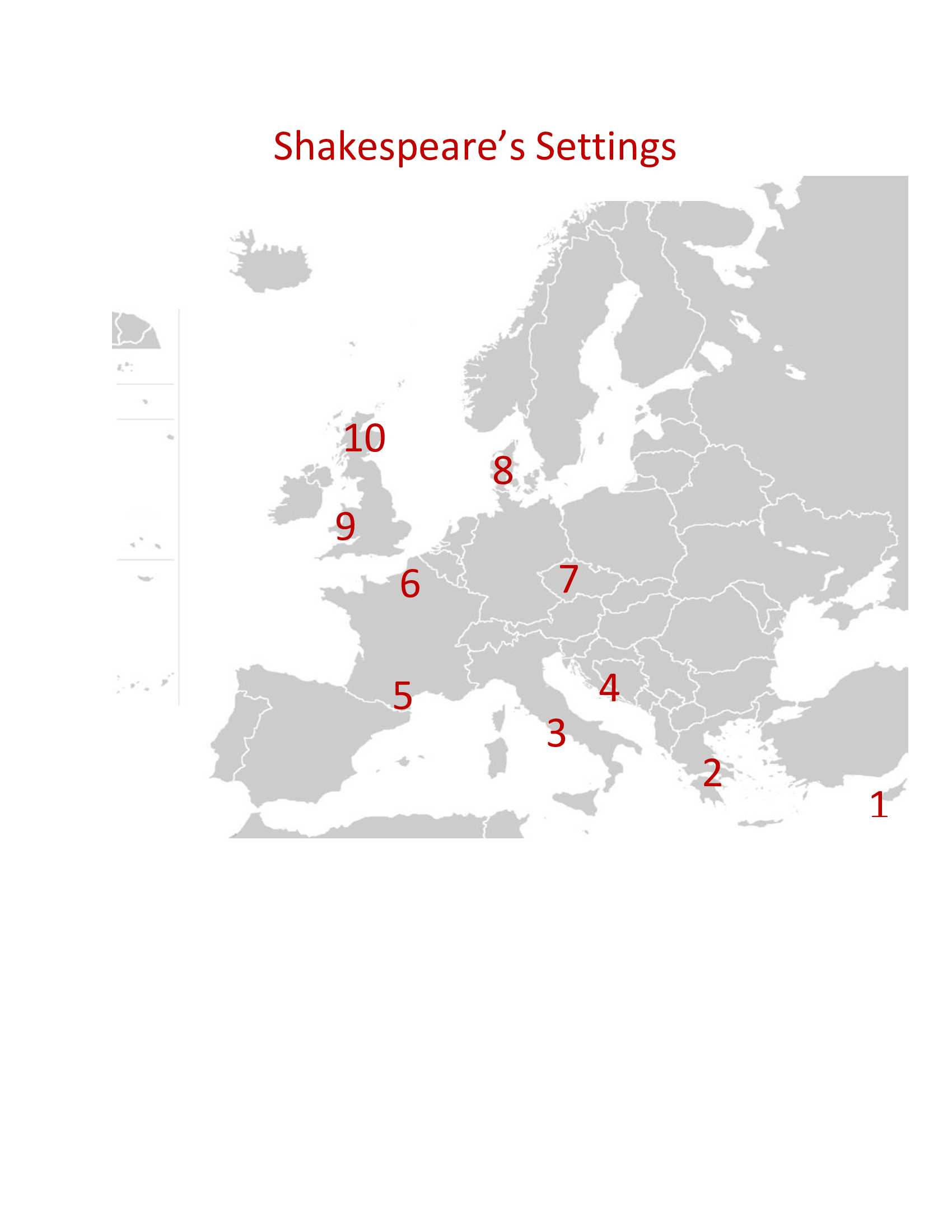
Shakespeare obviously spent a lot of time and effort in choosing settings for his plays, and they provided important symbolism. Some of Shakespeare's settings featured imaginary places, while others were real. See if you can match the number on the map with the settings of the Shakespeare plays that are listed.
Click on image to zoom
All's Well That Ends Well Othello Cymbeline Julius Caesar Henry V Macbeth Twelfth Night Timon of Athens The Winter's Tale Hamlet
* Drag / drop or click on the choices above to move them to the answer list.
View Image Attributions for This Quiz
1.   
2.   
3.   
4.   
5.   
6.   
7.   
8.   
9.   
10.   

Most Recent Scores
Today : Guest 143: 3/10
Today : Guest 35: 5/10
Today : RedHook13: 5/10
Today : sarryman: 5/10
Today : maryhouse: 2/10
Today : Guest 86: 5/10
Today : mulligas: 5/10
Today : Guest 216: 7/10
Today : Guest 67: 4/10

Quiz Answer Key and Fun Facts
1. Othello

The first act of "Othello" takes place in Venice, where Othello, a Moor, is the victim of an intolerant society in spite of the fact that he is married to Desdemona, a senator's daughter. While he is a respected general, Othello is still an outsider.

Acts II-V take place on the island of Cyprus, which is an important trading and heavily fortified military outpost that is threatened by the Turks. Cyprus was, at the time, a Venetian colony; Venice had been at odds with the Ottoman Turks for years, as they both were interested in the same trading routes and territories. In the play, Cyprus is believed to be on the very edge of civilization.

Luckily, the Turkish fleet was destroyed in a storm, and did not reach Cyprus. Instead, Othello must deal with his ensign, Iago, who is set on revenge after Othello promoted Cassio rather than himself.
2. Timon of Athens

"Timon of Athens", as its name suggests, takes place in the polis and a cave in the surrounding area of Athens. Believed to have been adapted from a story about an ancient historical person who knew the likes of Socrates and Pericles, the play tells about Timon, a wealthy Athenian, who lives in a fine house and throws luxurious parties.

Like the real Timon, the man in the play famously grows to despise mankind.
While he appears to have a lot of friends, they really only like Timon for his money. Finally, after carelessly spending and giving his money away, he finds that he is deeply in debt; none of his "friends" will help him. Timon retreats to a cave, where he finds a vein of gold. Will he repeat his past mistakes? Does money corrupt? You will have to read to find out!
3. Julius Caesar

The first four acts of "Julius Caesar" take place in the city of Rome, while the last act is set in Greece, where the famous Battle of Philippi takes place. Shakespeare's play is perhaps more widely read that the real story of Caesar's final days, and many believe that he said, "Et tu, Brute?", after being fatally stabbed by Brutus. His contemporaries, however, said that he groaned, was silent, or said, "Kai su, teknon?", the Greek for "You too, child?", which exacerbated the rumors that Brutus was actually Caesar's illegitimate son.

Anyway, Shakespeare takes readers all around Rome to tell his story of the final days of Caesar's life - to the Forum, Caesar's home, and the streets of Rome, in addition to other locations. Of course, Caesar's life ends on the floor of the Roman Senate in the play. In reality, the Senate building was being renovated, and Caesar was murdered at the Curia of Pompey, the temporary meeting place.

The Battle of Philippi was fought in Greece in 42 BC. The forces of Marc Anthony and Octavian, finally defeated Brutus and Cassius, who are portrayed as being the main conspirators against Caesar.
4. Twelfth Night

Shakespeare's Illyria was located off the coast of the Adriatic Sea, in approximately the region where Croatia is located today. While there was an area the ancient Romans called Illyrium that was conquered in the second century BC, in Shakespeare's day there was no real place called Illyria. He was able to use the location as a way to make the setting of the play seem more mysterious.

The plot of the movie has many twists and turns, as well as instances of mistaken identity after Viola is shipwrecked in Illyria and dresses as a man to hide her true identity. Her brother, Sebastian, who was presumed dead, also shows up to create even more confusion and a strange type of love triangle forms. Considered to be one of Shakespeare's best comedies, "Twelfth Night" remains a popular play today.
5. All's Well That Ends Well

"All's Well That Ends Well" begins and ends in Roussillon, France, with some of the action taking place in between in Paris and Italy during the Middle Ages. Roussillon is the home of the Countess and Bertram, who have adopted Helena and taken her into their home in after the death of her father, the court physician.

When Bertram travels to Paris to take his father's place as the king's attendant, Helena follows him there. She offers to cure the sick king in exchange for being allowed to choose a husband from one of the members of his court. She chooses Bertram, who marries her, but does not return her feelings. Following him as he fights in Italy, Helena is given certain conditions to meet in order to gain his love. When the two finally return to Roussillon, will all end well?
6. Henry V

One of Shakespeare's histories, Henry V partially tells the story of England's attempt to take over France during the Hundred Years War, which lasted from 1337-1453. Focusing on the famous Battle of Agincourt, Henry rallies his much smaller army with his famous St Crispin's Day speech on the morning of October 25, 1415, which Shakespeare greatly embellishes. The speech is inspiring, but Shakespeare added the "band of brothers" line! It is true, however, that in the end Henry married the French princess, Katharine, and that he ruled both France and England for fourteen years before the Maid of Orleans appeared.

The play begins in the royal palace in London, England, but most of the action takes place in various locations in France, including Le Havre, where the English staged a successful siege, Agincourt, where the battle took place, and the French royal palace, where Henry negotiates for his bride.
7. The Winter's Tale

"The Winter's Tale" begins in Sicily, where King Leontes becomes irrationally jealous of what he thinks is a relationship between his wife, Hermione, and friend, Polixenes. Leontes orders that his newborn daughter, Perdita, be abandoned, and Hermione is put in prison, in spite of the fact that the Oracle of Apollo tells of her innocence.

Perdita is abandoned on the coast of Bohemia, in spite of the fact that it is a landlocked country! (If there wasn't a coast, where would a baby be abandoned and eventually escape homeward?) It is a pastoral land, where sheep are raised and nature rules; the infant Perdita is adopted and raised by a shepherd there. After sixteen years Perdita has fallen in love with Florizel, Polixenes' son, who pretends to be a shepherd. Can the two marry? Will Leontes ever receive forgiveness for his past mistakes?
8. Hamlet

"Something is rotten in the state of Denmark", where Elsinore Castle is located! The setting for "Hamlet" is almost exclusively inside the castle grounds, except for a scene at a nearby graveyard and one set at the Danish coast. In this case the castle represents Hamlet's isolation; inside he feels like he is constantly watched, almost like it is a prison. It also symbolizes moral and physical decay, what the entire country is experiencing under King Claudius' reign.

The ghost of Hamlet's father, the King of Denmark, has told Hamlet to investigate his murder. It turns out that it was committed by Claudius, Hamlet's uncle, who has already married his mother. What will Hamlet do? What will happen to everyone in the end? Hint - It's one of Shakespeare's greatest tragedies!
9. Cymbeline

"Cymbeline" takes place in Britain, Rome, and the countryside around Milford-Haven in Wales. Cymbeline is the King of Britain, but is a Roman vassal. Because his two sons were kidnapped as infants, it is the responsibility of his daughter, Imogen, to birth a royal heir; she cannot do that if she marries her husband of choice, a commoner named Posthumus, who is promptly exiled to fight in Italy.

While in Italy, Posthumus is tricked into thinking that Imogen has been unfaithful. He sends two letters - one asking her to meet him at Milford-Haven in Wales, and the other to a servant, asking him to kill her. The servant warns Imogen, and she disguises herself as a boy, finding refuge in a cave where she also finds her long-lost brothers! Can Posthumus regain Imogen's love and trust? Can the family be restored? And what about the kingdom? Jupiter knows!
10. Macbeth

Scotland is a good choice of a setting for Shakespeare's play. It honors his patron, King James I, who is also King of Scotland. With Scotland's reputation at the time for witchcraft (James was especially interested) and folklore, it is easy to throw in the Three Witches who would foretell major events in the story. And - Scotland's wild terrain and foggy terrain can be used to symbolize the disorder and moral decay that was the result of Macbeth's actions.

There was a historical King of Scotland named Macbeth who reigned from 1040-1057. Unlike the king in the play, he kills a young King Duncan in battle in order to take his place, rather than an old King Duncan in his sleep. Historic Macbeth was known as a strong leader, unlike Shakespeare's character who is simply driven by the witches' prophecies, his own ambition, and his wife's plotting. In both, Duncan's son ultimately defeats Macbeth.
Source: Author ponycargirl

This quiz was reviewed by FunTrivia editor MotherGoose before going online.
Any errors found in FunTrivia content are routinely corrected through our feedback system.
12/26/2025, Copyright 2025 FunTrivia, Inc. - Report an Error / Contact Us