FREE! Click here to Join FunTrivia. Thousands of games, quizzes, and lots more!
Quiz about Herbivorous vs Carnivorous Dinosaurs

Herbivorous vs Carnivorous Dinosaurs Quiz

Eat or Be Eaten

Eat only the herbivores and avoid the carnivores. If you attack too many carnivores you, yourself, will be eaten.

A collection quiz by misdiaslocos. Estimated time: 3 mins.
  1. Home
  2. »
  3. Quizzes
  4. »
  5. Science Trivia
  6. »
  7. Paleontology
  8. »
  9. Dinosaurs

Author
misdiaslocos
Time
3 mins
Type
Quiz #
426,221
Updated
Nov 04 26
# Qns
15
Difficulty
Average
Avg Score
11 / 15
Plays
75
Last 3 plays: Guest 99 (6/15), Guest 90 (12/15), Guest 68 (6/15).
You are a weak compsognathus hunting for your meal. You need to eat only the herbivores and avoid the carnivores. If you attack too many carnivores you will be eaten. Note - The classification into herbivore and carnivore is done using the best current knowledge, mostly based on teeth shape, wear, and histology. Also, I do realize that some of these dinosaurs could never have met as they are separated by tens of millions of years...but we are in FunTrivia Land...play along.
There are 15 correct entries. Get 2 incorrect and the game ends.
Protoceratops Diplodocus Pachycephalosaurus Brachiosaurus Giganotosaurus Ankylosaurus Spinosaurus Brontosaurus Triceratops Utahraptor Stegosaurus Parasaurolophus Tyrannosaurus Rex Iguanodon Carcharodontosaurus Corythosaurus Styracosaurus Argentinosaurus Edmontosaurus Apatosaurus

Left click to select the correct answers.
Right click if using a keyboard to cross out things you know are incorrect to help you narrow things down.

Most Recent Scores
Today : Guest 99: 6/15
Today : Guest 90: 12/15
Today : Guest 68: 6/15
Today : marianjoy: 15/15
Today : Guest 99: 14/15
Today : Guest 209: 14/15
Today : Guest 72: 5/15
Today : mjgrimsey: 3/15
Today : Guest 209: 3/15

Quiz Answer Key and Fun Facts
Answer:

Your Food

Ankylosaurus - This living tank motored around North America, reaching lengths of 8 to 9 meters (25 to 30 feet) and weighing around 4 to 8 metric tons (4.4 to 8.8 short tons). It was so heavily fortified that even its eyes were armoured with bone plates to shield its eye sockets during predator attacks. And it didn't just have armour, its club-like tail was devastating to its foes.

Apatosaurus - A Jurassic herbivore that lived in North America, it reached lengths of 21 to 23 meters (70 to 75 feet) and weights of up to 23 metric tons (25 short tons). Its name means "deceptive lizard" because its fossilized bones looked like a Mosasaur and fooled the first person who tried to name it.

Argentinosaurus - They make things bigger down south! This absolute colossus lived in South America (can you guess which country?), stretching up to 30 to 35 meters (100 to 115 feet) long and weighing a staggering 73 to 91 metric tons (80 to 100 short tons). It was so massive that a single backbone vertebra from its skeleton stood over 1.5 meters (5 feet) tall...yep, big.

Brachiosaurus - Towering over North America but having nothing on South America, Brachiosaurus stood over 12 meters (40 feet) tall and reached 23 meters (75 feet) in length. Unlike most sauropods, its front legs were longer than its hind legs presumably for reaching high tree canopies. Oh, it was thought that these guys lived in Africa, but they have been reclassified as Giraffatitan...Cool name!

Brontosaurus - He is back BABY!! Measuring roughly 22 meters (72 feet) long and weighing 15 metric tons (17 short tons), this famous dino grazed on the open plains of North America. For over a century, scientists thought it was just an Apatosaurus, but it was officially reinstated as its own unique dinosaur genus in 2015. Now, let's go get Pluto back!

Corythosaurus - It lived in North America and was 9 meters (30 feet) long and weighed around 3.6 metric tons (4 short tons). Its name means "Corinthian helmet lizard" because its prominent head crest looked exactly like the headgear worn by ancient Greek soldiers.

Diplodocus - Living mostly in North America it was 27 to 30 meters (90 to 100 feet) long and weighed around 13.6 metric tons (15 short tons), this was one of the longer dinosaurs to ever live. Its tail was unusually long and consisted of about 80 vertebrae that it could crack like a supersonic whip to scare away predators.

Edmontosaurus - This massive Canadian duck-billed dino lived in the Alberta region and could reach 12 to 13 meters (39 to 43 feet) in length and weigh over 3.6 metric tons (4 short tons). Exceptionally preserved "mummified" fossils revealed that it had a fleshy, rooster-like comb on top of its head. It has some of the better preserved skin casts in the dino world.

Iguanodon ("The Fonz") - This dino lived in Europe, North America, and Asia. It was a very successful herbivore that grew to 10 meters (33 feet) long and weighed up to 4.5 metric tons (5 short tons). Early paleontologists mistook its sharp thumb spike for a horn and accidentally reconstructed it on top of the dinosaur's nose. You can still find some pretty funny photos online.

Pachycephalosaurus - Another North American dino that grew to 4.5 meters (15 feet) long and weighed around 450 kilograms (1,000 pounds). The solid bone dome on top of its skull was an incredible 25 centimeters (10 inches) thick, acting like a built-in football helmet for head-butting - most likely for mating rituals.

Parasaurolophus - This extremely recognizable duck-billed dinosaur lived in North America, stretching 10 meters (33 feet) long and weighing around 4.5 metric tons (5 short tons). The long tube on its head was completely hollow and acted like a trombone to blast out deep, echoing communication calls to its herd. Yours truly has blown through a reconstruction of one of these things and the sound made was amazing.

Protoceratops - This sheep-sized herbivore is probably your best bet for food. It lived in the deserts of Asia, measuring just 1.8 meters (6 feet) long and weighing roughly 180 kilograms (400 pounds). Many historians believe that ancient discoveries of its abundant skeletons by early nomads inspired the mythological legend of the Griffin.

Stegosaurus - Living across North America and Europe, this instantly recognizable dinosaur from any kids' toy set grew up to 9 meters (30 feet) long and weighed about 4.5 to 6.4 metric tons (5 to 7 short tons). Despite its massive body and intimidating spiked tail, its brain was famously tiny-only about the size and shape of a walnut. I grew up being told it had a brain in its tail, but it turns out that like most good stories, it's just bunk.

Styracosaurus - This 5.5 meter (18 feet) long, 2.7 metric tons (3 short tons) dino lived in upper North America. In addition to its beautifully spiky neck frill, it boasted a single, terrifying nose horn that could grow up to 60 centimeters (2 feet) long. This one really DID have a nose horn.

Triceratops: This popular herbivore lived in North America, grew up to 9 meters (30 feet) long, and weighed up to 11 metric tons (12 short tons). Its giant skull made up nearly one-third of its entire body length, giving it an unmistakable profile. This is the one that you always see fighting with the T.Rex in dino paintings. When paleontologist Stephen Jay Gould looked into these depictions he claimed that in over 80% of pictures, triceratops wins.


What You Are Food For

Carcharodontosaurus - A big African brute that grew up to 13.7 meters (45 feet) long and had a reinforced neck. Its massive 20-centimeter (8-inch), razor-sharp teeth resembled those of a shark and could easily slice through thick muscle, causing its victims to rapidly bleed out. Avoid at all costs.

Giganotosaurus - An apex predator from South America that rivaled the T-Rex in size, it could theoretically run up to 50 kilometers per hour (31 miles per hour). It was armed with over 70 thin, blade-like serrated teeth specialized for slicing huge chunks of flesh off giant sauropods. You might be able to dodge this one, but don't take chances.

Spinosaurus - The largest known meat-eating dinosaur in history, this semi-aquatic terror reached lengths of 15 to 18 meters (50 to 60 feet). It was armed with massive, hook-like claws and crocodile-like jaws designed to snatch giant prey from both land and water. Look this thing up, there is no way it is real. This is simply good-ol'-fashioned nightmare fuel.

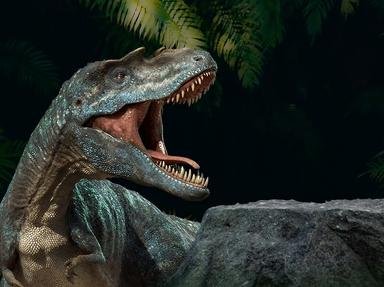
Tyrannosaurus Rex - This is the ultimate land predator - at least in the public imagination. The T. Rex possessed an insane 5.8-metric-ton (6.4-short-ton) bone-crushing bite force, which is the strongest of any terrestrial animal in history, ever...in history...seriously, in all history! Compare that to the current living record holder, the saltwater crocodile, which has a measly 1.6 metric tons (1.8-short-ton) force. Along with banana-sized serrated teeth, it had highly advanced depth perception to track its prey.

Utahraptor - While much smaller than the giants above, this lethal predator weighed nearly 900 kilograms (1 short ton) and combined terrifying speed with agility. It used a devastating 23-to-30-centimeter (9-to-12-inch) sickle claw on each foot to pin down and brutally dispatch its prey. I mean the popular velociraptor gets a lot of press, but pound-for-pound (0.453592 kilo-for- 0.453592 kilo) this one is probably more dangerous.
Source: Author misdiaslocos

This quiz was reviewed by FunTrivia editor rossian before going online.
Any errors found in FunTrivia content are routinely corrected through our feedback system.
11/4/2026, Copyright 2026 FunTrivia, Inc. - Report an Error / Contact Us