FREE! Click here to Join FunTrivia. Thousands of games, quizzes, and lots more!
Quiz about Mars the Bringer of War

Mars, the Bringer of War Trivia Quiz


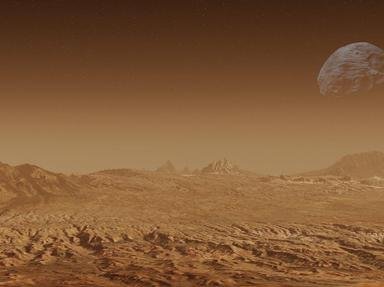
Inspired by Gustav Holst's orchestral suite "The Planets," here is my fifth of seven quizzes on the "other" planets in our Solar System. What do you know of warlike Mars, the fourth planet from the Sun?

A photo quiz by reedy. Estimated time: 3 mins.
  1. Home
  2. »
  3. Quizzes
  4. »
  5. Science Trivia
  6. »
  7. Our Solar System
  8. »
  9. Mars

Author
reedy
Time
3 mins
Type
Photo Quiz
Quiz #
424,140
Updated
May 17 26
# Qns
10
Difficulty
New Game
Avg Score
8 / 10
Plays
13
Last 3 plays: Guest 172 (3/10), Upstart3 (9/10), Guest 209 (0/10).
-
Question 1 of 10
1. Gustav Holst gave Mars the title "The Bringer of War," reflecting the planet's long association with conflict and aggression in mythology and astrology. Which fiery astrological sign, often linked with energy, impulsiveness, and combativeness, is ruled by Mars? Hint


Question 2 of 10
2. Visible to the naked eye as a reddish "wandering star," Mars was observed by many ancient civilizations. Which culture named the planet Huoxing, meaning "fire star"? Hint


Question 3 of 10
3. Mars is often called the "Red Planet" because of its distinctive color in the night sky. What chemical compound on its surface is responsible for giving Mars this reddish appearance? Hint


Question 4 of 10
4. Mars is significantly smaller than Earth. Approximately how many times wider is Earth's diameter compared to Mars?


Question 5 of 10
5. The length of Mars' day (one axial rotation) is nearly identical to Earth's, especially when compared to all the other planets. But just how close is it? Hint


Question 6 of 10
6. Mars has two small, irregularly shaped moons. What are their terrifying names? Hint


Question 7 of 10
7. Mars hosts the tallest volcano in the Solar System. What is the name of this enormous shield volcano? Hint


Question 8 of 10
8. One of Mars' most dramatic features is a vast canyon system stretching thousands of kilometers across its surface, far larger than Earth's Grand Canyon. What is the name of this immense Martian canyon? Hint


Question 9 of 10
9. Mars experiences a variety of dramatic weather due to its thin atmosphere and extreme temperature swings. Which of the following types of violent weather phenomena is capable of growing so large that it can completely cover the entire planet? Hint


Question 10 of 10
10. Mars has been explored by numerous robotic missions. Which inquisitive NASA rover, landing in 2012, discovered strong evidence of ancient habitable conditions in Gale Crater? Hint


(Optional) Create a Free FunTrivia ID to save the points you are about to earn:

arrow Select a User ID:
arrow Choose a Password:
arrow Your Email:


View Image Attributions for This Quiz

Most Recent Scores
Today : Guest 172: 3/10
Today : Upstart3: 9/10
Today : Guest 209: 0/10
Today : hojoger: 7/10
Today : japh: 10/10
Today : HumblePie7: 5/10
Today : Aph1976: 4/10
Today : emodius: 9/10
Today : jonathanw55: 5/10

Quiz Answer Key and Fun Facts
1. Gustav Holst gave Mars the title "The Bringer of War," reflecting the planet's long association with conflict and aggression in mythology and astrology. Which fiery astrological sign, often linked with energy, impulsiveness, and combativeness, is ruled by Mars?

Answer: Aries

Mars is regarded as the planet of energy, aggression, and action, which aligns closely with Aries, the first sign of the zodiac. Aries is deeply associated with themes of:

Courage and initiative
Competition and conflict
Impulsiveness and directness
Leadership and independence
Physical strength and drive

As one of the three fire signs (along with Leo and Sagittarius), it makes sense that Aries would be connected with Mars, a planet named for the Roman god of war. In mythology, Mars embodies battle, conquest, and raw force - qualities that are mirrored in Aries' bold, assertive nature.

Holst's subtitle "The Bringer of War" reflects this connection vividly: Mars does not symbolize war in a purely destructive sense, but rather the primal energy that drives action, struggle, and confrontation. In astrology, Mars governs how we assert ourselves and pursue our desires, and through Aries, this energy is expressed in its purest, most immediate form - decisive, fearless, and often volatile.
2. Visible to the naked eye as a reddish "wandering star," Mars was observed by many ancient civilizations. Which culture named the planet Huoxing, meaning "fire star"?

Answer: Chinese

Huoxing, meaning "fire star," is the name given to Mars in traditional Chinese astronomy, reflecting its striking reddish appearance in the night sky. In the ancient Chinese system of the Five Elements (Wu Xing), fire symbolized heat, intensity and, at times, destruction - qualities that aligned closely with the planet's ominous glow and unpredictable movement among the stars. Unlike many Western traditions that personified Mars directly as a war god, Chinese scholars interpreted Huoxing more as a celestial omen, often associating its presence with upheaval, conflict, or significant change on Earth.

This connection between Mars and fire is echoed in many cultures, but the Chinese designation is particularly literal, grounding the planet's identity in observable physical characteristics rather than solely mythological figures. The name Huoxing highlights how ancient astronomers blended careful observation with symbolic meaning, transforming a wandering red light in the sky into a powerful sign within their cosmological worldview.
3. Mars is often called the "Red Planet" because of its distinctive color in the night sky. What chemical compound on its surface is responsible for giving Mars this reddish appearance?

Answer: Iron oxide

Mars' reddish appearance comes from a fine layer of iron oxide (rust) that coats much of its surface, giving the entire planet its characteristic "Red Planet" glow. Unlike Earth, where iron is often locked away beneath the surface, Mars' thin atmosphere and lack of liquid water have allowed this oxidized dust to remain exposed and widespread, forming a global layer of rust-colored soil.

Observations from orbiters and Mars rovers have revealed that this iron oxide is not just a surface stain, but is mixed into the planet's dust and regolith (loose surface material). Winds regularly lift this fine dust into the atmosphere, sometimes producing enormous dust storms that can envelop the entire planet - further spreading the reddish coating evenly across Mars.
4. Mars is significantly smaller than Earth. Approximately how many times wider is Earth's diameter compared to Mars?

Answer: Two times

Mars is often compared to Earth as a smaller, colder neighbour, but the differences in scale are striking. Earth's diameter is about 12,742 km (7,918 miles), while Mars measures roughly 6,779 km (4,212 miles), making Earth nearly twice as wide. This difference carries over to circumference as well: Earth spans about 40,075 km (24,901 miles) around the equator, compared to Mars' roughly 21,344 km (13,263 miles).

The contrast becomes even more dramatic when looking at mass. Earth is over nine times more massive than Mars, owing to its larger size and denser composition. These disparities help explain why Mars has weaker gravity, a thinner atmosphere, and less ability to retain heat, all of which contribute to its cold, dry environment in contrast to Earth's life-supporting conditions.
5. The length of Mars' day (one axial rotation) is nearly identical to Earth's, especially when compared to all the other planets. But just how close is it?

Answer: About 40 minutes longer

All of the planets in the Solar System have two ways of measuring a "day": a sidereal day (one complete rotation relative to distant stars) and a solar day (one complete rotation relative to the Sun)..

On Earth, the sidereal day is about 23 hours 56 minutes, which is the true time it takes the planet to complete one full rotation. However, because Earth is also orbiting the Sun, it must rotate a little extra for the Sun to return to the same position in the sky. This makes the familiar solar day slightly longer at 24 hours.

Mars follows the same pattern, but with slightly longer values. Its sidereal day is about 24 hours 37 minutes, and its solar day - called a "sol" - is about 24 hours 39 minutes. The difference between the two is similar in principle to Earth's: as Mars moves along its orbit, it must rotate a bit farther for the Sun to appear in the same place again.
6. Mars has two small, irregularly shaped moons. What are their terrifying names?

Answer: Phobos and Deimos

Mars is accompanied by two irregular moons, Phobos and Deimos, whose names come from Greek mythology, where they personify fear and terror - fitting companions to Mars, the god of war.

Discovered in 1877 by astronomer Asaph Hall, these moons are quite unlike Earth's large, spherical Moon. Phobos, the larger of the two, measures about 22 km (14 mi) across and orbits extremely close to Mars, completing a full orbit in just over 7 hours - so quickly that it appears to rise in the west and set in the east. Deimos, smaller and smoother at about 12 km (7.5 mi) across, orbits farther out and moves more slowly. Both moons are heavily cratered and are believed to be composed of carbon-rich rock, possibly formed from debris rather than captured asteroids. Their unusual shapes and rapid motion provide insight into Mars' gravitational environment and the dynamic processes that have shaped its satellite system.
7. Mars hosts the tallest volcano in the Solar System. What is the name of this enormous shield volcano?

Answer: Olympus Mons

Olympus Mons is the largest volcano in the Solar System, rising approximately 22 km (13.6 miles) above the surrounding Martian plains - nearly three times the height of Mount Everest. Its enormous shield-like structure spans about 600 km (370 miles) in diameter, making it so wide that a person standing on its surface would not easily perceive its full scale.

Formed by successive flows of low-viscosity lava, Olympus Mons grew to such immense size partly because Mars lacks the moving tectonic plates found on Earth, allowing volcanic activity to remain fixed over one spot for millions of years. The mountain's gentle slopes and massive caldera complex at its summit highlight a long history of eruptions, offering scientists valuable insight into the geological evolution of Mars and the role volcanism played in shaping its surface.
8. One of Mars' most dramatic features is a vast canyon system stretching thousands of kilometers across its surface, far larger than Earth's Grand Canyon. What is the name of this immense Martian canyon?

Answer: Valles Marineris

Valles Marineris is a vast canyon system that stretches across the Martian surface for about 4,000 km (2,485 miles) - nearly the width of the continental United States. In places, it reaches depths of over 7 km (4.3 miles), making it far deeper and longer than Earth's Grand Canyon. Unlike canyons on Earth that are primarily carved by flowing water, Valles Marineris is believed to have formed from a combination of tectonic stretching, crustal cracking, and collapse, likely linked to the nearby Tharsis volcanic region.

First observed in detail by NASA's Mariner 9 spacecraft in the early 1970s, the canyon system reveals complex layers and features that suggest a varied geological history, including possible past interactions with water. Today, it stands as one of the most dramatic surface features in the Solar System, offering a window into Mars' internal forces and ancient environment.
9. Mars experiences a variety of dramatic weather due to its thin atmosphere and extreme temperature swings. Which of the following types of violent weather phenomena is capable of growing so large that it can completely cover the entire planet?

Answer: Dust storms

Mars is well known for its powerful and far-reaching dust storms, some of the most extreme weather events in the entire Solar System. Despite the planet's thin atmosphere, fine particles of iron-oxide-rich dust are easily lifted from the surface by winds, especially during warmer seasons when sunlight heats the ground unevenly. These storms can begin as small, localized events but sometimes grow into massive regional systems - and, in rare cases, they expand into global dust storms that can envelop the entire planet for weeks or even months.

Because the dust is so fine, it can remain suspended high in the atmosphere, blocking sunlight and significantly reducing temperatures at the surface. Space missions such as the Opportunity rover were directly affected by these storms; in 2018, a planet-wide dust storm cut off sunlight to its solar panels, ultimately ending the mission. Observations from orbiters and rovers have shown that these storms play a key role in redistributing surface material, gradually reshaping the Martian landscape and maintaining its uniform reddish appearance.
10. Mars has been explored by numerous robotic missions. Which inquisitive NASA rover, landing in 2012, discovered strong evidence of ancient habitable conditions in Gale Crater?

Answer: Curiosity

Mars has been explored by a series of rovers that have progressively deepened our understanding of its past. Sojourner (1997) was a small proof-of-concept rover that demonstrated surface mobility. The twin rovers Spirit and Opportunity (2004-2018) followed, uncovering strong evidence that liquid water once existed on Mars, including mineral deposits formed in wet conditions.

A major breakthrough came with Curiosity (which landed 2012 in Gale Crater), a much larger, laboratory-equipped rover. By drilling into ancient lakebed rocks, it discovered clay minerals, organic molecules, and evidence of long-standing freshwater, showing that Mars once had conditions suitable for microbial life - clear evidence of past habitability. More recently, Perseverance (2021) has built on this work by searching for direct signs of ancient life and collecting samples for possible return to Earth, continuing the step-by-step exploration of Mars' potential to support life.
Source: Author reedy

This quiz was reviewed by FunTrivia editor rossian before going online.
Any errors found in FunTrivia content are routinely corrected through our feedback system.
5/17/2026, Copyright 2026 FunTrivia, Inc. - Report an Error / Contact Us