FREE! Click here to Join FunTrivia. Thousands of games, quizzes, and lots more!
Quiz about The Good Stood Where the Bad Had

The Good Stood Where the Bad Had Quiz

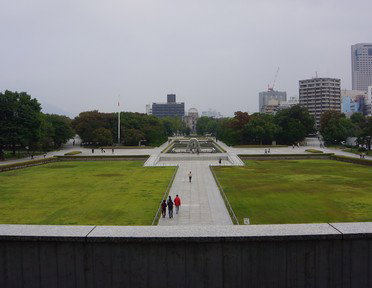
Hiroshima Peace Memorial Park

When an atom bomb demolished the centre of Hiroshima, a large empty space was created, which is now the site of the Hiroshima Peace Park.

A photo quiz by looney_tunes. Estimated time: 3 mins.
  1. Home
  2. »
  3. Quizzes
  4. »
  5. World Trivia
  6. »
  7. World Sites
  8. »
  9. Monuments & Memorials

Author
looney_tunes
Time
3 mins
Type
Photo Quiz
Quiz #
423,814
Updated
Apr 25 26
# Qns
10
Difficulty
New Game
Avg Score
8 / 10
Plays
17
Awards
Editor's Choice
Last 3 plays: lethisen250582 (10/10), Kabdanis (6/10), maos264 (6/10).
-
Question 1 of 10
1. These lanterns, floating on the Motoyasu River, are part of the annual ceremonies commemorating the dropping of an atomic bomb on the city of Hiroshima. On what day of the year was this photo taken? Hint


Question 2 of 10
2. This watch stopped as the impact blast hit it. Which of these activities was its owner most likely doing at the time?


Question 3 of 10
3. The skeletal building shown here is known as the A-Bomb Dome. It is the building closest to the hypocenter of the blast to have at least partially remained standing. What was the name of the building at the time it was destroyed? Hint


Question 4 of 10
4. The Atomic Bomb Memorial Mound contains the remains of about 70,000 unidentified victims of the 1945 destruction of Hiroshima. About what percentage of the city's population died as a result of the bomb? Hint


Question 5 of 10
5. This plaque, located at the entry to a display in the Hiroshima Peace Memorial Museum of personal effects of some of the victims, includes a motto which reflects the theme of the entire Peace Park. which of these is it? Hint


Question 6 of 10
6. This statue is commonly called the Children's Peace Monument. What kind of item is displayed in the glass cabinets that flank it? Hint


Question 7 of 10
7. The inscription on the Memorial Cenotaph is written in Japanese characters which have been translated by the author as "Let all the souls here rest in peace for _____ shall not repeat the evil." What word completes the epitaph? Hint


Question 8 of 10
8. The Eternal Flame in Hiroshima Peace Park is pledged to be kept burning until which of these happens?


Question 9 of 10
9. The Peace Bell has inspirational messages written in three languages. Which of these is NOT one of them? Hint


Question 10 of 10
10. These ten structures, erected on the south side of the Peace Park in 2005, are called by which of these names? Hint


(Optional) Create a Free FunTrivia ID to save the points you are about to earn:

arrow Select a User ID:
arrow Choose a Password:
arrow Your Email:


View Image Attributions for This Quiz

Most Recent Scores
Today : lethisen250582: 10/10
Today : Kabdanis: 6/10
Today : maos264: 6/10
Today : bigjohnsludge: 10/10
Today : jddrsi_raven: 3/10
Today : Guest 69: 6/10
Today : Guest 166: 7/10
Today : FrappMaster: 10/10
Today : 1nn1: 10/10

Quiz Answer Key and Fun Facts
1. These lanterns, floating on the Motoyasu River, are part of the annual ceremonies commemorating the dropping of an atomic bomb on the city of Hiroshima. On what day of the year was this photo taken?

Answer: August 6

While active warfare in Europe had finished with Nazi Germany's unconditional surrender on 8 May 1945, the war in the Pacific was dragging on, with no clear end in sight. The United States government took the decision to deploy their new weapon, an explosive device using nuclear fission (a so-called atomic bomb) which released massively more energy on impact that traditional weapons, hoping to convince their opponents that defeat was inevitable, and continued fighting could only lead to more suffering for everyone. (That is the official motive on the record, although some historians dispute the ostensibly noble motivation.) On July 26, the Potsdam Declaration called on Japan to surrender unconditionally or face "prompt and utter destruction" - an ultimatum which was ignored.

The city of Hiroshima was one of five cities selected as possible sites, which met the criteria of having a strategic military facility that could serve as the target, surrounded by buildings which would suffer effective damage from the blast wave, and which was unlikely to have already been attacked by the start of August. Hiroshima was selected to be the primary target, with the others in reserve for subsequent bombing as necessary. On 6 August, the first atomic bomb was deployed.

November 11 and September 2 are the dates of the official ending of World War I and World War II, respectively.
2. This watch stopped as the impact blast hit it. Which of these activities was its owner most likely doing at the time?

Answer: Travelling to work

The time shown is 8:15, a time which is echoed in multiple places around Hiroshima. There had been an air raid warning earlier in the morning, but an all clear was sounded just after 7:30, and people resumed their usual morning activities. The bomb that flattened the city was released at precisely 8:15 am local time, and took just under 45 seconds to reach its detonation height, approximately 600 m (2,000 ft) above the city. Due to a crosswind, it did not explode over the intended target, the Aioi Bridge, but over a nearby hospital.

The Shima Hospital, which has since been rebuilt, is considered to be ground zero for the blast. It is a few minutes' walk from the Peace Memorial Park.
3. The skeletal building shown here is known as the A-Bomb Dome. It is the building closest to the hypocenter of the blast to have at least partially remained standing. What was the name of the building at the time it was destroyed?

Answer: Hiroshima Prefectural Industrial Promotion Hall

The current name is pretty self-explanatory, given the prominent dome on the surviving structure. The building was constructed in Hiroshima's business district in 1915 as a site for industries to use for exhibiting products to the public, in the worldwide tradition of exhibition buildings. It came to be used for educational displays and art shows.

Like the hospital which was located directly under the atomic blast, about 500 m away, this building had no military significance. Its only mistake was to be situated too close to the Aioi Bridge, which was selected as the target because its distinctive shape made it easy to spot. Because the explosion was nearly overhead, most of the force pushed the structure downwards, rather than horizontally, so its strong stone and steel framework survived relatively intact. Everyone inside, however, died.

The ruined building has been kept in its 1945 condition (including some restoration work to counteract deterioration) as a memorial to the civilians who died in Hiroshima, whether from the immediate blast or from the widespread fires that followed, or from radiation sickness. It is incorporated into the Hiroshima Memorial Peace Park, and was designated as a UNESCO World Heritage Site in 1996. The declaration referred to its cultural significance both as a record of the first use of nuclear weapons on a human population and as a symbol of peace.
4. The Atomic Bomb Memorial Mound contains the remains of about 70,000 unidentified victims of the 1945 destruction of Hiroshima. About what percentage of the city's population died as a result of the bomb?

Answer: 30-45%

The numbers are, of course, difficult to determine with any exactness, and have been revised a number of times over the years. The most recent evaluation placed the city population at the time as being around 350,000. Before the end of the year, between 100,000 and 160,000 people had died as a direct result of the bombing of Hiroshima.

The original estimate, based on the immediate impact of the bombing, was around 65,000 dead and 70,000 injured. Subsequent deaths included both some of those recorded as injured on the day, those who died of malnutrition due to the massive social disruption caused by the bombing, and a number of people who later developed radiation sickness due to their exposure. Of those who died, approximately 90% were civilians, even though Hiroshima had been selected as a target because of the 20,000+ troops stationed there (as well as the munitions factories).
5. This plaque, located at the entry to a display in the Hiroshima Peace Memorial Museum of personal effects of some of the victims, includes a motto which reflects the theme of the entire Peace Park. which of these is it?

Answer: No more Hiroshimas

The museum is the largest building in the park, dedicated to educating visitors about the bombing of Hiroshima. The exhibits cover the background to the war and Hiroshima's role both before and during World War II, as well as detailed information about the bombing of the city and its aftermath. This plaque is at the entry to an exhibit of the personal effects of those who died, along with written memoirs from survivors about their experience and photographs taken before, during and after the bombing.

The museum is a popular place to start a visit to the Peace Memorial Park, as it provides the relevant background to the other sites. From its windows you can look out over the Memorial Cenotaph, the Peace Flame (on the far end of the Peace Pool) and in the distance the A-Bomb dome.
6. This statue is commonly called the Children's Peace Monument. What kind of item is displayed in the glass cabinets that flank it?

Answer: paper cranes

This statue, titled 'Atomic Bomb Children', was built using money raised by Japanese schoolchildren, including the classmates of Sadako Sasaki, who died in 1958 of leukemia resulting from her exposure to radiation during the bombing of Hiroshima when she was two years old. Inspired by a Japanese legend that someone who created a string of 1,000 paper cranes (senbazuru) would be granted one wish, she started folding, with a target of world peace. Sadako is the model for the girl on the top of the monument, who is holding a wire crane above her head. She is also the subject of the story 'Sadako and the Thousand Paper Cranes', a 1977 book often used in primary schools as part of lessons around peace and world history. According to the book she only folded 644 cranes before her death, with her friends completing the task. In reality, she is thought to have reached her target and then some. But you can never have enough origami cranes, and children around the world continue to fold cranes and send them to Hiroshima. There is a plentiful supply to freshen the display at regular intervals!

It is not only children who participate in the idea of the senbazuru project. When US President Barack Obama visited Hiroshima in 2016, he folded two cranes, which are on display in the Peace Memorial Museum.

The base of the monument is a traditional Japanese bell, within which a bronze crane hangs, free to swing in the breeze. The black marble slab at its base has an inscription in Japanese that can be translated as 'This is our cry, this is our prayer: for building peace in the world'.
7. The inscription on the Memorial Cenotaph is written in Japanese characters which have been translated by the author as "Let all the souls here rest in peace for _____ shall not repeat the evil." What word completes the epitaph?

Answer: we

In Japanese, it is polite when making a statement of respect to include lexical ambiguity, so the author, Tadayoshi Saika, Professor of English Literature at Hiroshima University, omitted the subject, which grammatically could have been either we or you. English, however, requires a subject, so he translated it with 'we'. This proved to be somewhat controversial, as it could be taken to mean that the Japanese people were taking responsibility for the events. He later clarified that the intention of the 'we' was all of humankind, and in 1983 an extra plaque with this explanation was added.

The Memorial Cenotaph was one of the first memorial monuments built on open field as part of the process of developing the Peace Memorial Park. It was opened on 6 August 1952 as part of a commemorative ceremony. The word cenotaph means empty tomb, and is usually applied to a monument erected to honor people whose remains are either lost or buried elsewhere. The arch shape of this cenotaph was chosen to represent the concept of providing a shelter for the souls referred to in the inscription.

The image shows a shot through the Cenotaph, over the Peace Pool to the Eternal Flame at its other end, with the A-Bomb Dome in the distance.
8. The Eternal Flame in Hiroshima Peace Park is pledged to be kept burning until which of these happens?

Answer: All nuclear weapons are destroyed

While eternal peace would be a nice goal, it is hardly realistic (in view of humanity's track record) to expect the flame can be kept going until it has been achieved. When the flame was first lit in 1964, the target set was the elimination of all nuclear weapons. In 2025, the International Campaign to Abolish Nuclear Weapons (ICAN) listed nine countries known to have a store of nuclear weapons, with six countries being used to store devices on behalf of other countries, and 28 more which officially endorse the potential use of nuclear weapons (by the good guys, of course).

When the flame was lit, only the USA, USSR and UK had nuclear weapons in their arsenal. China followed later that year, India in 1974, Pakistan in 1998 and North Korea in 2006. Israel is understood to have nuclear weapons, developed sometime between 1960 and 1979, but details have been kept secret. All things considered, it seems likely that the flame will need to burn for quite a while yet.

This shot of the Eternal Flame (which does not photograph all that well in daylight) has the Peace Memorial Museum as a dominant feature, with the Cenotaph appearing to surround the flame.
9. The Peace Bell has inspirational messages written in three languages. Which of these is NOT one of them?

Answer: English

This is one of three Peace Bells, the one that stands near the Children's Memorial, and which visitors are encouraged to ring in support of worldwide peace. The Greek embassy donated the bell in 1964, and selected the Greek text to be a quotation from Socrates which translates as 'Know yourself'. The Japanese text means the same, but the Sanskrit text is a longer passage, taken from the The Amitayus Sutra, which can be translated as 'The lord of vast light, incomparable and infinite, has illuminated all Buddha countries in all the quarters, he has quieted passions, all sins and errors, he has quieted the fire in the walk of hell', a much more poetic expansion on the idea!

The use of three languages is intended to underscore the universal nature of the goals - also reflected by the map of the world with no national borders on the surface of the bell.
10. These ten structures, erected on the south side of the Peace Park in 2005, are called by which of these names?

Answer: Gates of Peace

Technically standing outside the Peace Park, this display standing adjacent to the Peace Memorial Hall, is intended to echo its meaning. There are ten glass gates, each 9 m high, 2.6 m wide and 1.6 m deep, located along a 75-metre stretch of Peace Avenue. The panels are covered with the word 'Peace', written in 49 languages (which involves 18 different alphabets).

The number of ten for the gates was chosen to represent Dante's famous nine circles of Hell, with an additional one to represent Hiroshima. The concept, according to Clara Halter and Jean-Michel Wilmotte, the designers, is that walking through them will be an immersive experience creating a link between memories of the past and hope for the future.
Source: Author looney_tunes

This quiz was reviewed by FunTrivia editor trident before going online.
Any errors found in FunTrivia content are routinely corrected through our feedback system.
4/25/2026, Copyright 2026 FunTrivia, Inc. - Report an Error / Contact Us