Przewalski's horse is believed to be the last truly wild horse on Earth, so it technically isn't a "breed". Known as "takhi" in their native Mongolia, they became extinct there after 1969, but wild populations were successfully rebuilt from captive stock in the 1990s.
2. Altai
Answer: Central Asia
This breed developed in the Altai Mountains of Central Asia, the area where the present-day countries of Russia, China, Mongolia, and Kazakhstan meet. As you might expect of mountain-bred horses, the Altai has a compact and sturdy build and is agile and sure-footed so they can move through terrain with narrow valleys, loose rock, steep gradients and high altitude.
The nomads who bred the Altai also used them for milk, meat, and horsehair.
3. Percheron
Answer: France
The large and powerful Percheron breed originated in western France, in the former province of Perche (present-day provinces of Orne and Eure-et-Loir). The Percheron excels as a draft horse, pulling sleds, carts, carriages, farm and forestry implements, and for parades. In France, the Percheron also provides meat for human consumption.
4. Gotland pony
Answer: Sweden
Also known as Skogsruss or Gotlandruss the breed originated in Sweden. Feral ponies called "russ" (riding horses) were noted on the island of Gotland in the 13th century, and the Gotland pony is now found on the mainland of Sweden and other Nordic countries.
5. Chincoteague pony
Answer: United States
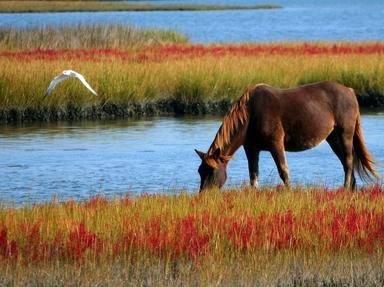
Wild herds of ponies are found on Assateague Island on the Atlantic Coast of Virginia and Maryland. The wild herds are managed by each state, which uses different terms for the same breed: Maryland uses Assateague horse and Virginia uses Chincoteague pony.
6. Batak pony
Answer: Indonesia
The Batak is selectively bred on the Indonesian island of Sumatra. Ancestors of the breed may have been Chinese horses brought to Indonesia in the 7th century, and Mongolian horses brought when Kublai Khan invaded Java in 1293. In recent times, Arabians have been interbred to add more desirable characteristics to the breed.
7. Kerry bog pony
Answer: Ireland
County Kerry in southwest Ireland is known for swampy bogs, and this breed of horse originated there. Peat from the bogs was used as fuel and building material, and these hardy ponies were bred to carry peat to market, either as pack loads or pulled in carts.
8. Miyako pony
Answer: Japan
Miyako is an island of the Okinawa Prefecture, and the pony bred there is considered an ancient native horse of Japan. The Miyako is protected by the Japanese government which strives to maintain a population numbering only in the dozens since the 1970s.
9. Mousseye pony
Answer: West Africa
Also known as the Poney du Logone, this breed originated in the valley of the Logone River that flows through the present-day countries of Cameroon and Chad. The breed shows some resistance to the deadly "sleeping sickness" (trypanosomosis) transmitted by the bite of the tsetse fly.
10. Sable Island pony
Answer: Canada
Explorers released horses on Sable Island, off the coast of Nova Scotia, in the 18th century. These horses became feral and became protected by the Canadian government in the 1960s. These horses live only on Sable Island, and they are the official horse of the Province of Nova Scotia.
This quiz was reviewed by FunTrivia editor rossian before going online.
Any errors found in FunTrivia content are routinely corrected through our feedback system.