FREE! Click here to Join FunTrivia. Thousands of games, quizzes, and lots more!
Quiz about The Power of Ten

The Power of Ten Trivia Quiz


Powers of ten are numbers that can be written as the digit 1, followed or preceded by place-holding zeroes that determine the magnitude of the number. Match the symbols to the words that refer to them in describing numbers.

by looney_tunes. Estimated time: 3 mins.
  1. Home
  2. »
  3. Quizzes
  4. »
  5. General Knowledge Trivia
  6. »
  7. Thematic Fun
  8. »
  9. Advent Calendar

Author
looney_tunes
Time
3 mins
Type
Quiz #
421,988
Updated
Dec 10 25
# Qns
10
Difficulty
New Game
Avg Score
8 / 10
Plays
13
Last 3 plays: flopsymopsy (10/10), Guest 172 (10/10), AxolotlU (8/10).
Some of the words refer to the actual number (in one or more of the systems used around the world), and some are prefixes used when a number is written as some other number multiplied by a power of 10, a way of writing very large and very small numbers without having to actually write out all the zeroes.
Drag-Drop or Click from Right
Options
femto- lakh googol mega- one-tenth root ten hundred nano- myriad thousandth


 View Image Attributions for This Quiz

Most Recent Scores
Today : flopsymopsy: 10/10
Today : Guest 172: 10/10
Today : AxolotlU: 8/10
Today : dellastreet: 10/10
Today : mcdubb: 10/10
Today : Lord_Digby: 5/10
Today : sw11: 10/10
Today : xchasbox: 10/10
Today : spaismunky: 8/10

Quiz Answer Key and Fun Facts
1. femto-

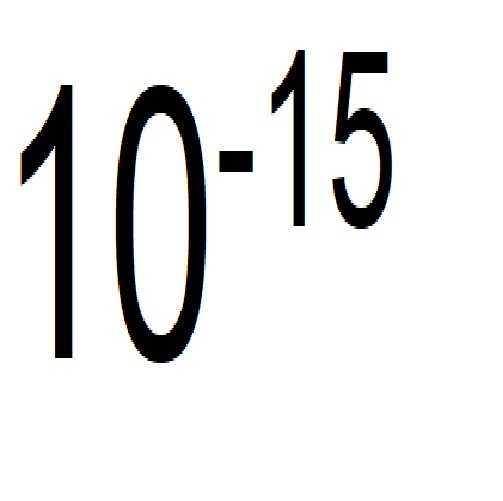
This is the index notation used to show the number read as "10 to the minus 15th power". When a number is written as 10^n, where ^ indicates that the following number should be written in superscript, as was done in the diagram, and n is a number, that number indicates the number of times 10 must be multiplied by itself to produce the desired number. When n is a positive number, you can write it out by adding n zeroes after the digit 1. When n is a negative number, that means you need to divide 1 by the number you would write out for a positive value - since this gives a number less than 1, it can be written out with (n-1) zeroes to the right of a decimal point followed by the digit 1. So this number can be written out in full as 0.00000000000001 - which gives you an idea why people using such small numbers find index notation useful. Not only is it tedious to write so many 0s, it is easy to lose track and not have the correct number of them.

When the power of ten is negative, the number can be named by adding "th" to the word used for the number with that positive value of n. For powers of ten greater than 8, there are two different names depending on whether you are using the Long Scale (UK) or Short Scale (US) naming system. This is discussed further in another question. So 10^-15 is one quadrillionth or one billiardth. To avoid confusion, when the number is being used to describe a measurement, such as a very short time interval, a prefix word is preferred - hence 10^-15 seconds is called a femtosecond.
2. hundred

Here is the familiar way of writing powers of ten for small values of n. One hundred is the same as 10 x 10, or 10^2, read aloud as 10 squared. You can tell this on inspection, because there are two zeroes in the expanded number. However, you need to know the language you are using in order to write the corresponding word.

In French, hundred is 'cent', in Spanish it is 'cien', in Italian 'cento'.
3. thousandth

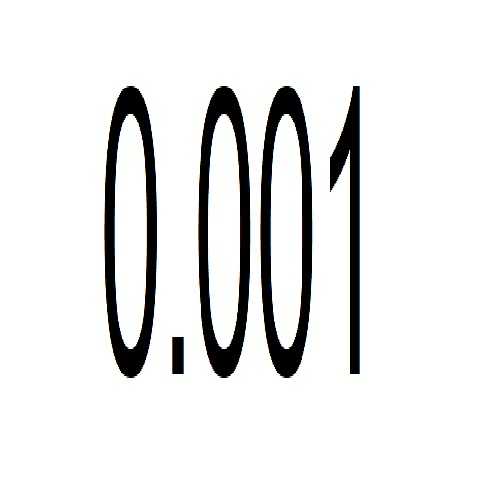
As mentioned earlier, if a number is between 0 and 1 the power of ten describing it ends in "th". This number can also be written as 10^-3, or 1 divided by 10^3, which is 1 divided by 1000, one thousandth. It is common to use expanded notation for numbers as small as 0.001, before switching to index notation for smaller numbers.

If the number is being attached to a measurement, it is usual to use a prefix to indicate the relevant fraction. A thousandth of a metre is usually described as a millimetre (or millimeter, depending on where you live).
4. lakh

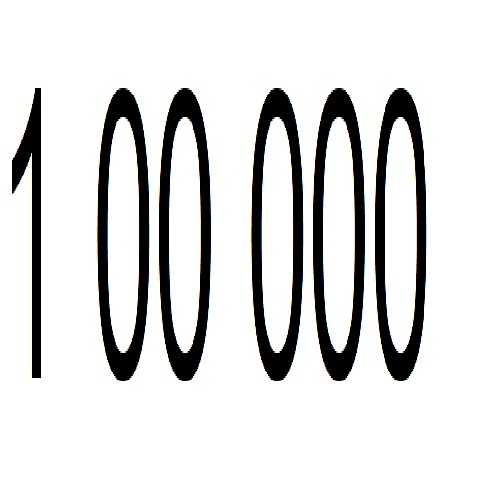
Lakh, or lac, is a unit used in India and thereabouts to indicate the number called a hundred thousand in English. While English nomenclature ascribes a new base name after every third power of 10 (thousand, million, billion, trillion ...), in India the first four powers have the same name as in English, but then there is a new name used for every second power, meaning that there is a special name for 10^5. You will note, in the image, that the spacing is not in batches of three, as is usual in English notation, but (counting from right to left) 3, 2, 2 - and for larger numbers, that grouping continues. One crore, for example, is written 1 00 00 000.
5. nano-

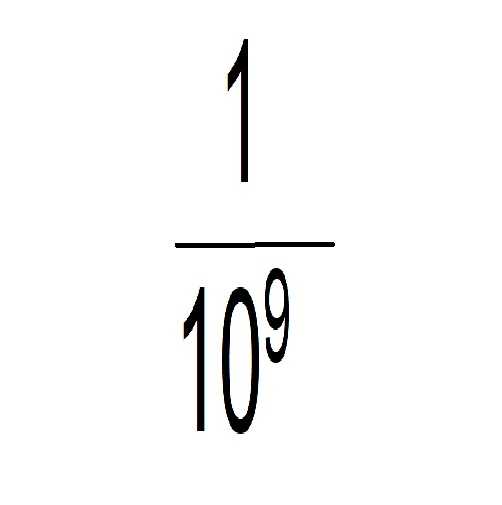
Since the 10^9 is written as the denominator of the fraction, it means 1 divided by 10^9, which is the same as 10^-9, or 0.000 000 001. Depending on which naming system you use, 10^9 is either a thousand million (properly, but not commonly, called a milliard) or a billion.

Hence, 10^-9 is a thousand-millionth, a milliardth, or a billionth. As is the case for other numbers involving large powers of ten, the most common occurrence is in measurements, when it is more likely to see, for example, the wavelength of light described in nanometres than as billionths of a metre.
6. root ten

The power of ten in a number does not always have to be a whole number, and using the appropriate fraction as the index allows us to write all real numbers as 10^n, where the value of n is described as the logarithm to the base 10 of that number. That's a whole new field, for another quiz to explore. This question looks at one relatively simple case of a fractional index.

The index of 1/2 indicates a number that can be multiplied by itself to get 10^1, which is 10. By definition, that number is called the square root of 10, often shortened to root 10. 10^1/3 is the cube root of 10, a number which must be multiplied by itself three times to produce the value of 10. Both of these are examples of irrational numbers - they cannot be represented exactly in expanded form, as they are numbers whose decimal values go on forever. The square root of 10 is approximately equal to 3.16227766, which can be rounded to 3.2, 3.16, 3.162, 3.1623 or however much accuracy is relevant to the situation. (This makes sense if you think about it - the square root of 9 is 3, and 10 is a bit bigger than 9, so its square root should be a bit larger than 3.)
7. myriad

In common use, myriad is a vague term that refers to some large number - a myriad of ants swarmed over the picnic spread. However, it does have a more precise meaning, as it comes from the ancient Greek word for ten thousand, 'myrias'. Interestingly, the etymology of this word is uncertain, but possibly related to 'myrmex', ant - which is also the source of the word myrmidon to refer to someone who unquestioningly carries out the orders of a superior. While everyday naming would call this number ten thousand, it is sometimes useful when translating from classical texts to use the word myriad to fit the metre better.

A number of Asian numeration systems group in ten thousands, not the thousand (million - thousand thousand, etc.) grouping used in European systems. Hence, their number names have equivalents to myriad (which will not display here) for 10^4, as well as specific words for 10^8, 10^12, etc.
8. one-tenth

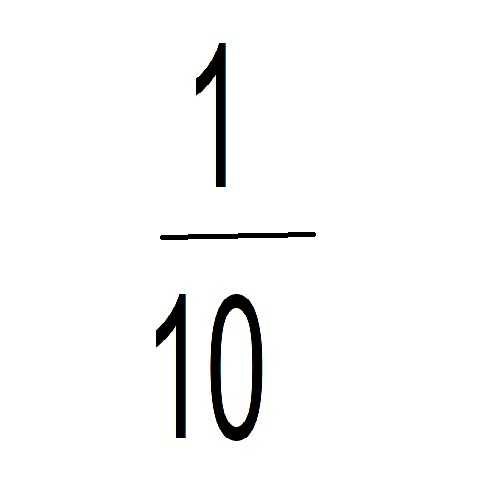
One-tenth indicates a number that can be multiplied by 10 to give 1 as the answer. It can also be written as 10^-1 or 0.1. Prefixes are rarely used when a fraction of something is being described, as tenths are sort of within the visual grasp of most people. However, if it is desired to describe a tenth of a gram with a prefix, it would be decigram. Not that creative, as our numbering system is called the decimal system because it is based on the use of ten (Latin 'decimus, -a, -um') different digits to represent numbers.

One common use of the prefix deci- is in the unit used to measure sound intensity, the decibel. This is used because the bel is awkwardly large for use in describing everyday sounds, so the number ends up as a fraction - 0.5 bels is 5 dB. (Technically, the bel measures the ratio between two different measures of power, but over time it has been appropriated to being used as if it describes a fixed value. Again, that is a story for another quiz.)
9. mega-

What you call this number will depend on where you live, which is why I opted to match it with the prefix used to describe things which are that multiple of a base measurement. You may have heard a digital camera described as having a certain number of megapixels. This measures how many pixels (the smallest element used to compose a picture) are used to produce images. There are so many that megapixel is much more convenient than using zillions (a vague term being used to avoid specifying how large the number is) of pixels. A camera with an array of 2048 pixels x 1536 pixels has a total of 3 145 728 pixels in its image, commonly described as 3.2 megapixels.

So if you want to give a name to 10^6, or 1000000, it depends on what naming system you want to use. In North America is is probably a million; in the UK you are more likely to call it a million million (or a milliard); in India it is 10 lakh; in China, 100 wan.
10. googol

Here we have one of my favourite numbers, a non-metric unit popularised in Edward Kasner's 1940 book 'Mathematics and the Imagination', after his nephew had coined it 20 years earlier. It is defined as 1 followed by 100 zeros, or 10^100. If you want to give it a systematic name, you could call it ten duotrigintillion (Short Scale) or ten sexdecilliard (Long Scale). I prefer googol.

How big is a googol? There are estimated to be about 10^80 elementary particles in oir known universe, so a googol is 10^20 times larger. Clearly, it has no particular practical use (which is part of its charm), but it is a useful tool when discussing the mathematical difference between a very large number and infinity - to which it does not even come close. Nor does the googolplex, which is 10^googol, or 1 followed by a googol of zeroes. Don't even think about trying to write that out in expanded form - if you were to write them on paper, fitting about a million zeroes into a 400-page book, you would need 10^94 books. Ignoring the covers, the mass of these books would be about 5 x 10^40 times the mass of the entire observable universe. And time? Let's say you can write one zero a second (you will be faster at the start, but probably slow down, and need some rest breaks), you can write about 3 x 10^7 in a year, which means you need about 3 x 10^92 years to get the job done. A googol would only take a few minutes.
Source: Author looney_tunes

This quiz was reviewed by FunTrivia editor agony before going online.
Any errors found in FunTrivia content are routinely corrected through our feedback system.
12/10/2025, Copyright 2025 FunTrivia, Inc. - Report an Error / Contact Us