FREE! Click here to Join FunTrivia. Thousands of games, quizzes, and lots more!
Quiz about Great Depressions

Great Depressions Trivia Quiz

Places Below Sea Level

Many quizzes on Fun Trivia are dedicated to the lofty places of the Earth. This one, on the other hand, will take you on a tour of some of the world's lowest-lying sites. Enjoy the journey!

A multiple-choice quiz by LadyNym. Estimated time: 3 mins.
  1. Home
  2. »
  3. Quizzes
  4. »
  5. Geography Trivia
  6. »
  7. Physical Geography
  8. »
  9. Physical Geography Extremes

Author
LadyNym
Time
3 mins
Type
Multiple Choice
Quiz #
423,496
Updated
Mar 24 26
# Qns
10
Difficulty
Easy
Avg Score
8 / 10
Plays
44
Last 3 plays: Guest 81 (3/10), Guest 71 (7/10), Guest 67 (4/10).
- -
Question 1 of 10
1. The lowest land-based elevation on Earth, the Dead Sea was known in ancient times as a source of what organic chemical compound, used by the ancient Egyptians for mummification?


Question 2 of 10
2. What ancient Biblical city, the oldest fortified city in the world, lies in the Jordan Valley at −258 m (−846 ft)? Hint


Question 3 of 10
3. What famous, historic trade route ran through the hot and arid Turfan Depression, China's lowest surface point?

Answer: (two words - the first refers to a luxurious fibre)
Question 4 of 10
4. Located on the western shore of the Caspian Sea, Baku is the world's lowest-lying national capital. What transcontinental country claims it as its capital? Hint


Question 5 of 10
5. At 4 m (13 ft) below sea level, Schiphol is Europe's lowest-lying international airport, as well as one of the continent's busiest hubs. What picturesque, free-spirited capital city does it serve? Hint


Question 6 of 10
6. Badwater Basin is the lowest point in North America at 86 m (282 ft) below sea level. It lies within what national park in eastern California, known for record-high summer temperatures? Hint


Question 7 of 10
7. The lowest point for an island country, Lake Enriquillo is located at 46 m (151 ft) below sea level on what second-largest Caribbean island, visited by Christopher Columbus on his first voyage? Hint


Question 8 of 10
8. What large South American country is home to the continent's lowest point, Laguna del Carbón, as well as its highest mountain peak? Hint


Question 9 of 10
9. Africa's lowest point is a lake that lies in the Afar Depression, in the country of Djibouti. What is this body of water's name? Hint


Question 10 of 10
10. Located in the Far North region of South Australia, Lake Eyre is the lowest natural point in Australia, located immediately south of what desert? Hint


(Optional) Create a Free FunTrivia ID to save the points you are about to earn:

arrow Select a User ID:
arrow Choose a Password:
arrow Your Email:


Most Recent Scores
Today : Guest 81: 3/10
Today : Guest 71: 7/10
Today : Guest 67: 4/10
Today : etymonlego: 10/10
Today : Guest 172: 5/10
Today : Guest 76: 9/10
Today : Guest 129: 4/10
Today : bgjd: 5/10
Today : Lindaellen: 8/10

Quiz Answer Key and Fun Facts
1. The lowest land-based elevation on Earth, the Dead Sea was known in ancient times as a source of what organic chemical compound, used by the ancient Egyptians for mummification?

Answer: bitumen

The Dead Sea lies at the southern end of the Jordan Rift Valley, at 440 m (1,443 ft) below sea level, bordered by Jordan to the east and Israel and Palestine's West Bank to the west. Though known for the extreme salinity of its waters (to which it owes its name, a calque of the Arabic al-Bahr al-Mayyit), nearly ten times as salty as those of the ocean, it is not the world's saltiest body of water. The Dead Sea, however, is not only rich in sodium chloride and other salts. Its depths constantly discharge pebbles and blocks of bitumen (asphalt), a black, extremely viscous hydrocarbon that in Ancient Egypt was used to embalm mummies: in fact, the word "mummy" comes from the Arabic word for bitumen. Because of this peculiarity, the Dead Sea was known to the Greeks and Romans as "Asphalt Lake".

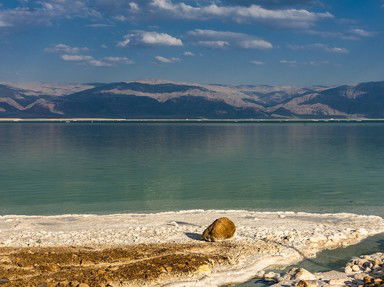
Many hotels and resorts have been built in recent times on the shores of the Dead Sea, which is a popular destination for people interested in the supposed curative and beautifying properties of its mineral-rich waters. The major archaeological sites present in the area around the lake - such as the fortress of Masada (a UNESCO World Heritage Site) and the Qumran Caves, where the Dead Sea Scrolls were discovered in the mid-20th century - also attract many visitors. The cover photo shows a detail of the Dead Sea shore.

Widely used as a preservative and in the manufacturing of gunpowder and fireworks, saltpeter (potassium nitrate) is an inorganic compound.
2. What ancient Biblical city, the oldest fortified city in the world, lies in the Jordan Valley at −258 m (−846 ft)?

Answer: Jericho

Located in Palestine's West Bank, between Jerusalem and the river Jordan, Jericho was founded about 11,000 years ago (9,000 BC); the remains of over 20 settlements dating from different ages have been unearthed by archaeologists at Tell es-Sultan, a hill just outside the city. As well as being one of the world's oldest continuously inhabited cities, Jericho (whose name probably derives from a Canaanite word meaning "fragrant") is widely regarded as the world's oldest fortified city, as its earliest walls were built during the Neolithic. However, the city mentioned in the Book of Joshua of the Old Testament, whose walls fell after the Israelites marched around them for six days, dates from the Late Bronze Age.

Not surprisingly for its location - the Jordan Rift Valley, much of which lies below sea level - Jericho has also earned the distinction of lowest-lying city in the world. Despite its hot desert climate, the city is known for its rich soil and plentiful springs, which have attracted human settlement throughout the ages. Home to about 20,000 people, half of them under the age of 20, Jericho - like most of Palestine - has very high population density. The site of Tell es-Sultan was inscribed in the UNESCO World Heritage List in 2023; the city also boasts a number of major Christian pilgrimage sites.
3. What famous, historic trade route ran through the hot and arid Turfan Depression, China's lowest surface point?

Answer: Silk Road

The Turfan (or Turpan) Depression is located in the eastern part of the Tian Shan range, in the Xinjiang Uygur Autonomous Region of Western China. Covering an area of 50,000 km² (19,000 sq mi), this long trough between high mountains is one of the lowest depressions on Earth. The lowest point in the depression and in the whole of China, the almost completely dry Aydingkok (Lake Ayding), lies at 154 m (505 ft) below sea level. The depression is named for the oasis city of Turpan, which lies on its northern side.

Due to its location and peculiar geographical structure, the Turfan Depression has a harsh, continental desert climate, characterized by very low precipitation, scorchingly hot summers and very cold winters. However, thanks to a sophisticated irrigation system known as Karez System, which employs water coming from the surrounding mountains, the oases of this inhospitable environment are renowned for the cultivation of various fruits. The Turfan Depression contains the ruins of the ancient city of Gaochang (a UNESCO World Heritage Site), a major stop on the Northern Silk Road, which stretched through East and Central Asia from Chang'an (present-day Xi'an) almost to the shores of the Mediterranean Sea.
4. Located on the western shore of the Caspian Sea, Baku is the world's lowest-lying national capital. What transcontinental country claims it as its capital?

Answer: Azerbajian

The world's largest inland body of water, the Caspian Sea lies 28 m (92 ft) below sea level. It is surrounded by a low-lying flatland that also touches the Aral Sea to the east. The northern part of this region, shared by Azerbaijan, Russia and Kazakhstan, is known as the Caspian Depression, and is considered Europe's lowest point.

Azerbaijan's capital and largest city, Baku stands on the southern shore of the Absheron Peninsula, in the bay named for the city. Because of its location, it is nicknamed the City of Winds, and known for harsh winter weather. Probably founded before the 5th century AD, Baku is home to over 2 million people. Its walled Old City, which includes various medieval buildings such as the Maiden Tower and the Palace of the Shirvanshahs, was designated as a UNESCO World Heritage Site in 2000.

Though Azerbaijan is widely regarded as a transcontinental country (a distinction it shares with neighbouring Turkey, Russia and Georgia, as well as Kazakhstan), its European portion is quite small. Iran and Turkmenistan, which also border the Caspian Sea, are located entirely within Asia.
5. At 4 m (13 ft) below sea level, Schiphol is Europe's lowest-lying international airport, as well as one of the continent's busiest hubs. What picturesque, free-spirited capital city does it serve?

Answer: Amsterdam

Schiphol Airport is located 9 km (5.6 mi) southwest of Amsterdam, the capital of the Netherlands, in the province of North Holland. The area where it now stands, the polder of Haarlemmermeer, was a large lake that was reclaimed in 1852. Originally a military airbase opened in 1916 and destroyed by German bombs during WWII, the present airport was built in the late 1940s, then progressively expanded to became the Netherlands' primary airport: a small town named Rijk was demolished to make way for the expansion. Schiphol Airport is the main hub for KLM, the Dutch flag carrier, and the oldest airline still using its original name.

The name Schiphol is usually translated in English as "ship hole", though no shipwrecks were found in the lake when it was dredged. Another theory posits that "hol" refers to a low-lying area of land where the wood to build ship was obtained. In any case, about 26% of the area of the Netherlands lies below sea level - hence the country's name.

The world's lowest-lying international airport (-22 m/-92 ft) is located near Atyrau, in western Kazakhstan. Built on both banks of the river Ural, Atyrau - like Istanbul - straddles Europe and Asia. Interestingly, Kazakhstan's flag carrier Air Astana operates regular flights from Atyrau International Airport to Schiphol Airport.
6. Badwater Basin is the lowest point in North America at 86 m (282 ft) below sea level. It lies within what national park in eastern California, known for record-high summer temperatures?

Answer: Death Valley

Named for a spring-fed pool whose water is rendered undrinkable by accumulated salts, Badwater Basin is located within Death Valley National Park, in California's Inyo County. Most of the basin is a salt pan, formed where Lake Manly used to stand; the lake occasionally reforms after heavy rainstorms, covering the salt crust with a thin layer of standing water. As this makes walking over the salt flats hazardous, the sign marking the basin's lowest point has been placed near the pool. On a rocky cliff overlooking the road, a sign reads "sea level", giving the area's many visitors an idea of how low-lying Badwater Basin is.

Death Valley is known for its extremely hot summers, and Badwater Basin is no exception, often registering high temperatures in excess of 49 ºC (120 ºF) in the shade. Just 29 km (18 mi) south of Badwater Basin lies the aptly-named Furnace Creek, where the alleged highest temperature in the world (56.7 °C/134 °F) was recorded in 1913. Furnace Creek is also located below sea level, at -58 m (-190 ft).
7. The lowest point for an island country, Lake Enriquillo is located at 46 m (151 ft) below sea level on what second-largest Caribbean island, visited by Christopher Columbus on his first voyage?

Answer: Hispaniola

Covering an area of about 380 km² (150 sq m), Lake Enriquillo is located in the southwestern part of the Dominican Republic, not far from the border with Haiti. These two countries share the island of Hispaniola, one of the Greater Antilles in the Caribbean Sea. Like most other lakes situated below sea level, Lake Enriquillo is an endorheic lake with no outlet - which accounts for the high salinity of its waters. The lake lies within a rift valley, known as Hoya de Enriquillo, which stretches from near the Haitian capital of Port-au-Prince to Neiba Bay in the Dominican Republic. Haiti's largest lake, Étang Saumâtre ("Brackish Pond"), is also located in this depression.

The area around Lake Enriquillo has a hot, semi-arid climate with unpredictable levels of precipitation. The lake hosts the largest population of American crocodiles (Crocodylus acutus) in the Caribbean, and its shores are home to various bird species, most prominently American flamingoes (Phoenicopterus ruber). An island, named Isla Cabritos, rises from the waters of the lake, which was designated as a national park in 1974.

Christopher Columbus landed on Hispaniola on 6 December 1492. The largest island in the Caribbean is Cuba, which lies west of Hispaniola. The three islands listed as wrong answers, all considerably smaller, lie southeast of the Greater Antilles.
8. What large South American country is home to the continent's lowest point, Laguna del Carbón, as well as its highest mountain peak?

Answer: Argentina

Laguna del Carbón ("Coal Lagoon") is located in the Santa Cruz province of southern Argentina, in the region of Patagonia. This small salt lake lies within an endorheic basin named Gran Bajo de San Julián (Great St Julian Depression), at 105 m (344 ft) below sea level. As well as being the lowest point of all the Americas, Laguna del Carbón is the seventh-lowest point on Earth. The area around the lake, like much of Patagonia, is also known for the dinosaur and other fossils that have been found there. The second-, third- and fourth-lowest points in South America are also located in Argentinian Patagonia.

The highest mountain in South America and the Western Hemisphere, Aconcagua lies much further north than Laguna del Carbón - in the Mendoza Province of western-central Argentina, near the Chilean border. With an elevation of 6,967 m (22,858 ft) above sea level, it is also the highest peak in the Andes range and the highest mountain not located in Asia.
9. Africa's lowest point is a lake that lies in the Afar Depression, in the country of Djibouti. What is this body of water's name?

Answer: Lake Assal

Part of the Great Rift Valley of East Africa, the Afar Triangle, or Afar Depression, lies at the junction of three plates - the Nubian, the Somali and the Arabian Plate - in the Horn of Africa, bordering the Red Sea and the Gulf of Aden. Regarded by some experts as the cradle of the human race because of the fossil remains of early hominins found there, this region is characterized by extremely inhospitable conditions, including strong tectonic and volcanic activity. A large portion of the Depression is covered by salt deposits, and rainfall is very rare; year-round average temperatures are the highest on Earth.

Lake Assal ("honey" in Arabic) is a crater lake lying 155 m (509 ft) below sea level in central-western Djibouti. In addition to being the lowest point in the African continent, it is also regarded as the third-lowest point on Earth (after the Dead Sea and the Sea of Galilee) and the world's fifth most saline body of water. This high salinity - about ten times higher than the sea - is due to high evaporation. As in the past exploitation of salt deposits was uncontrolled, the lake has been a protected zone since 2000, and in 2015 was added to the UNESCO World Heritage Tentative List.

Lake Volta, the world's largest artificial reservoir, is located in Ghana. Lake Albert lies on the border between Uganda and the Democratic Republic of the Congo, and Lake Chad at the junction of Chad, Nigeria, Niger and Cameroon. They are all freshwater lakes.
10. Located in the Far North region of South Australia, Lake Eyre is the lowest natural point in Australia, located immediately south of what desert?

Answer: Simpson Desert

Lake Eyre is located in the Far North region of South Australia, where it covers an area of 9,000 km² (3,500 sq mi). This shallow saline lake - known as Kati Thanda in the Aboriginal Arabana language - lies within a large endorheic basin, at about 15 m (49 ft) below sea level. Most often empty, it partially fills with water when the rivers that enter the lake receive enough rainwater. This, however, is a rare occurrence: a 1.5 (5 ft) flood occurs every three years, and a fill or near fill only a few times a century. When the lake is flooded almost to capacity, its waters turn blue and are no saltier than normal seawater. However, when the lake is saturated with salt the presence of the alga Dunaliella salina lends its waters a pinkish hue.

One of the most important sites in Australia for waterbirds, in particular pelicans and banded stilts, Lake Eyre is located immediately south of the Simpson Desert, the fourth-largest Australian desert. A smaller desert, known as the Tirari Desert, lies partially within Kati Thanda-Lake Eyre National Park, one of two protected areas (the other being Elliott Price Conservation Park) covering the extent of the lake.

The three deserts listed as wrong answers are located in Asia (Thar), Africa (Namib) and North America (Sonoran).
Source: Author LadyNym

This quiz was reviewed by FunTrivia editor agony before going online.
Any errors found in FunTrivia content are routinely corrected through our feedback system.
3/24/2026, Copyright 2026 FunTrivia, Inc. - Report an Error / Contact Us