FREE! Click here to Join FunTrivia. Thousands of games, quizzes, and lots more!
Quiz about Western Capitals

Western Capitals Trivia Quiz

Of South America

Of the four South American countries that border the Pacific Ocean, three - Ecuador, Peru and Chile - are located entirely or almost entirely south of the Equator. Their respective capitals are fascinating places rich in history and scenic appeal.

A classification quiz by LadyNym. Estimated time: 3 mins.
  1. Home
  2. »
  3. Quizzes
  4. »
  5. Geography Trivia
  6. »
  7. South America
  8. »
  9. South American Cities

Author
LadyNym
Time
3 mins
Type
Classify Quiz
Quiz #
424,749
Updated
Jul 03 26
# Qns
12
Difficulty
New Game
Avg Score
7 / 12
Plays
8
Last 3 plays: Guest 73 (5/12), oslo1999 (4/12), Guest 172 (6/12).
Classify these capital cities according to their descriptions.
Quito
Lima
Santiago

Gateway to the famous Maipo Valley wine region Home to the tallest building in South America The world's highest or second-highest national capital Known as the Gastronomical Capital of the Americas Home to the oldest university in the Americas Oldest South American capital Originally named "City of Kings" by its founder, Francisco Pizarro One of the very first UNESCO World Heritage sites Founded by Pedro de Valdivia in 1541 Second-largest national capital located in a desert Located in a valley in the centre of the country Not its country's largest city

* Drag / drop or click on the choices above to move them to the correct categories.


Most Recent Scores
Today : Guest 73: 5/12
Today : oslo1999: 4/12
Today : Guest 172: 6/12
Today : bernie73: 4/12
Today : cbushman: 5/12
Today : Rizeeve: 12/12
Today : rainbowriver: 10/12
Today : xchasbox: 6/12

Quiz Answer Key and Fun Facts
1. The world's highest or second-highest national capital

Answer: Quito

Home to nearly 1.8 million people, Quito lies on the eastern slopes of Pichincha, an active volcano part of the Andes range, at an elevation of 2,850 m (9,350 ft) above sea level. Its standing as the highest or second-highest national capital depends on which of Bolivia's two capitals - La Paz and Sucre - is considered its national capital. While Sucre (de jure capital) has a slightly lower elevation than Quito, La Paz (seat of government) stands at 3,650 m (11,980 ft) above sea level.

Quito also enjoys other distinctions. It is the national capital closest to the Equator, which runs about 26 km (10 mi) north of the centre of the city. The area known as "Ciudad Mitad del Mundo" (City of the Middle of the World), which contains a monument and an ethnographic museum, is a popular tourist destination. Quito is also the only national capital built very close to an active volcano.
2. Oldest South American capital

Answer: Quito

Archaeologists have found evidence of prehistoric human habitation on the site where Quito now stands. The territory was then ruled by the indigenous Quitu people (after whom the city is named) from around 2000 BC to the Inca invasion in the late 15th century. The pre-Columbian city was destroyed during the Inca Civil War. It was refounded in its present location by a group of 204 Spanish settlers led by conquistador Sebastián de Benalcázar on 6 December 1534.

Quito's official name is San Francisco de Quito, the name it was given by its Spanish founders. It became a city in 1541, part of the Viceroyalty of Peru and subsequently the Viceroyalty of New Granada. In 1822, the battle of Pichincha was fought between royalist and independentist forces, bringing about the independence of Quito and its surroundings from Spain. The city became the capital of Ecuador in 1829.
3. Not its country's largest city

Answer: Quito

Quito is one of a considerable number of national capitals that are not their respective countries' largest cities. In this case, Ecuador's most populous city is the port of Guayaquil, which lies on the Guayas River, about 60 km (40 mi) from the Gulf of Guayaquil on the Pacific Ocean. Home to over 3 million people in its metropolitan area, Guayaquil is Ecuador's economic capital and main port. It was founded in 1538 by Spanish conquistador Francisco de Orellana.

However, Quito is the country's political and cultural centre, as well as its most prosperous city, boasting the highest per capita income and the highest contribution to Ecuador's GDP. Many national and international financial institutions have offices in Quito: in particular, the national oil company, Petroecuador, is headquartered in the capital.
4. One of the very first UNESCO World Heritage sites

Answer: Quito

On 18 September 1978, the historic centres of Quito and Kraków (Poland) had the honour of being the first sites selected by UNESCO for inscription in the organization's prestigious World Heritage List. The largest and best-preserved historic centre in all the Americas, the historic centre of Quito covers a large area to the south of the modern city centre, including 130 noteworthy buildings in a wide range of styles.

Among the most remarkable monuments there are the Metropolitan Cathedral in Plaza de la Independencia (originally built in the 1530s, but rebuilt in 1660), the Basilica of San Francisco (built between 1535 and 1660), the Neo-Gothic Basilica del Voto Nacional, and the Corondelet Palace, seat of the government of Ecuador.
5. Originally named "City of Kings" by its founder, Francisco Pizarro

Answer: Lima

After completing his conquest of the Inca Empire on behalf of the Spanish Crown, Francisco Pizarro was named governor of the new lands, which in 1543 became the Viceroyalty of Peru. On 6 January 1535, he chose the site of the Rimac River valley, strategically located near the Pacific coast, for his capital - which was founded a few days later, on 18 January. The city's original name of "Ciudad de los Reyes" (City of Kings) refers to the feast of the Epiphany, celebrated on 6 January - as reflected by the three golden crowns on Lima's coat of arms, granted in 1537 by Charles V, Holy Roman Emperor and King of Spain. The current name Lima comes from the Spanish pronunciation of the Quechua name Limaq.

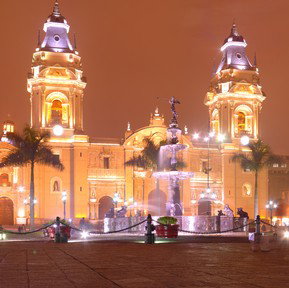
Many of the buildings in Lima's historic centre, designated as a UNESCO World Heritage Site in 1988, were erected in the years that followed the city's foundation. However, they had to be rebuilt several times because of the violent earthquakes that struck the city between 1586 and 1687. The cover photo shows the Metropolitan Cathedral at night.
6. Second-largest national capital located in a desert

Answer: Lima

One of the largest cities in South America, with a population of over 10 million, Lima lies in the arid coastal zone of central Peru, covering an area of about 800 km˛ (310 sq mi) of mostly flat terrain. The metropolitan area is much larger. Several rivers run through the city, the most significant of which is the Rimac. Despite its location within the tropical zone, Lima has a mild climate, characterized by two distinct seasons and very low rainfall. Peru's coastal desert, known as Chala, stretches for over 2,000 km (1,243 mi), bounded by the Pacific Ocean to the west and the Andes to the east.

Home to over 30% of Peru's population, Lima is the most populous South American capital and one of the world's most populous national capitals. However, the metropolitan area of Cairo - the capital of Egypt, which lies on the eastern edge of the Sahara Desert - has a population of over 22 million, making it the largest city located in a desert.
7. Home to the oldest university in the Americas

Answer: Lima

Lima's National University of San Marcos is the oldest continuously operating university in the Americas and the first officially established in the New World. This prestigious institution started in the late 1540s as a course of general studies offered at the Dominican convent of the Rosario (now Basilica and Convent of Santo Domingo), but was officially established in 1551 by decree of Emperor Charles V. In 1571 it was also granted the Pontifical title by Pope Pius V. Saint Mark the Evangelist was chosen as the patron saint of the university in 1574.

The current institution (UNMSM for short) is a public research university with 20 faculties grouped into five main academic areas. Throughout its history the university has changed its location five times; its main campus, known as Ciudad Universitaria (University City), also includes the Central Library, a sports stadium and an archaeological complex. The second-oldest university in the Americas, also founded by the Dominican Order, is in Bogotá, Colombia.
8. Known as the Gastronomical Capital of the Americas

Answer: Lima

Lima's cosmopolitan atmosphere, developed through the centuries, is reflected in its unique food culture, which has gained international recognition in the 21st century. A major centre of immigration already in colonial times, Lima has welcomed culinary traditions from all over the world and blended them seamlessly with Peru's own local heritage. Peru's national dish, ceviche - raw fish marinated in citrus juice, found in a myriad different versions in Lima's restaurants - is believed to have originated from the contact between the cuisines of the Andean peoples and those brought by Europeans. Another eminent example of fusion cuisine is "chifa", a unique blend of Chinese (mainly Cantonese) and traditional Peruvian ingredients and techniques.

In recent years the vibrant Lima restaurant scene has earned various prestigious accolades - such as the inclusion of several of the city's restaurants in the list of The World's Best 50 Restaurants, produced since 2002 by a UK media company. Two Lima restaurants, Central and Maido, earned the coveted top spot in 2023 and 2025: the former specializes in creative "contemporary Peruvian" cuisine, while the latter offers a creative fusion of Japanese and Peruvian cuisines. In addition, the Peruvian Society for Gastronomy was created in 2007 to promote Peruvian food as an essential component of the country's national identity.
9. Located in a valley in the centre of the country

Answer: Santiago

The Central Valley of Chile lies between two mountain ranges - the Andes to the east and the Chilean Coastal Range to the west. This long depression stretches from the border with Peru to the port city of Puerto Montt in southern Chile. Santiago is located in the central part of this valley, in the bowl-shaped Santiago Basin, a broad expanse of fertile lands surrounded by mountains. The city's territory is hilly, with varying elevations; the river Mapocho flows through it. As Santiago's boundaries have expanded considerably in recent years, some of the newer developments have reached the Precordillera, the foothills of the Andes.

Home to nearly 6.5 million people, Santiago is the fifth-largest city in South America and Chile's undisputed economic, financial and industrial hub as well as the seat of political power. While it enjoys a cool, quasi-Mediterranean climate, because of its location in an enclosed valley the city has a serious problem of air pollution, especially during the winter. Like the rest of Chile, it is also quite prone to earthquakes.
10. Founded by Pedro de Valdivia in 1541

Answer: Santiago

The site where Santiago is now located has been inhabited for thousands of years. At the time of the Spanish invasion of the Americas the villages along the river Mapocho inhabited by the native Picunche people were part of the Inca Empire. Conquistador Pedro de Valdivia arrived there from Cusco in 1540 and made plans to establish a city in the Mapocho valley. Named Santiago for the Apostle James the Great, Spain's patron saint, the city was founded on 12 February 1541. Unfortunately, when Valdivia left to fight in the south of Chile a few months later, the local people revolted and destroyed the city, which was then gradually rebuilt.

The beginnings of Santiago's existence were difficult due to natural disasters as well as the natives' hostility. Despite these headwinds, the city grew steadily and eventually began to thrive - becoming the capital of the newly formed Republic of Chile in 1810.
11. Home to the tallest building in South America

Answer: Santiago

Most of Santiago's historic monuments are more recent than those in Quito and Lima, as most of the original colonial-era buildings were destroyed by earthquakes and rebuilt between the mid-18th century and the 19th century in the Neoclassical style. In fact, the oldest surviving colonial-era structure is the Church of San Francisco, dating from 1622. With the city's expansion in the past few decades several business districts studded with skyscrapers have emerged, and high-rise buildings can be found next to historic monuments.

The most famous of these skyscrapers is the Gran Torre Costanera that looms over the upscale financial district of Sanhattan. Designed by a team that included Chilean, Argentine and Canadian architects, the 62-floor tower is 300 m (980 ft) tall. Construction began in 2006 and was completed in 2013. Part of the larger Costanera Center complex (which includes one of the largest shopping malls in Latin America), the Gran Torre Costanera officially became South America's tallest building in February 2012.
12. Gateway to the famous Maipo Valley wine region

Answer: Santiago

The common grape vine (Vitis vinifera) was introduced to present-day Chile by Spanish conquistadors and missionaries in the 16th century. Production of wine started almost immediately afterwards, though on a small scale with some restrictions. A true wine industry in the modern sense, however, did not develop until the 19th century, when French wine varieties (such as Cabernet Sauvignon and Merlot) were introduced. Now Chile is one of the world's top ten largest wine producers and exporters.

With a climate that has been described like a cross between California and France, Chile has no less than five major wine regions distributed over a 1287-km (800 m) stretch of its long, narrow territory. The birthplace of the Chilean wine industry, the Maipo Valley is one of the main wine-producing areas in the Santiago Metropolitan Region, part of the Central Valley wine region. From the capital it extends both eastwards to the foothills of the Andes and westwards to the Pacific coast. More than half of the Maipo Valley's vineyards produce Cabernet Sauvignon grapes; white grape varieties such as Sauvignon Blanc are grown in the Pacific Maipo subregion.
Source: Author LadyNym

This quiz was reviewed by FunTrivia editor agony before going online.
Any errors found in FunTrivia content are routinely corrected through our feedback system.
7/3/2026, Copyright 2026 FunTrivia, Inc. - Report an Error / Contact Us