FREE! Click here to Join FunTrivia. Thousands of games, quizzes, and lots more!
Quiz about Whaddaya At

Whaddaya At? Trivia Quiz

Some Geography of Newfoundland and Labrador

Welcome to Newfoundland and Labrador! Hope you brought your parka and toque. Let's take a look at the land of silly phrases, small towns, rich history, mixed cultures, historic sites... and of course, cliffs, wind, and subarctic cold. Enjoy!

A photo quiz by JJHorner. Estimated time: 3 mins.
  1. Home
  2. »
  3. Quizzes
  4. »
  5. Geography Trivia
  6. »
  7. Canada
  8. »
  9. Newfoundland

Author
JJHorner
Time
3 mins
Type
Photo Quiz
Quiz #
423,926
Updated
Apr 24 26
# Qns
10
Difficulty
New Game
Avg Score
9 / 10
Plays
14
Last 3 plays: Guest 174 (10/10), james1947 (10/10), Guest 5 (5/10).
-
Question 1 of 10
1. What narrow body of water separates the cliff-strewn island of Newfoundland from its mainland counterpart, Labrador? Hint


Question 2 of 10
2. Which Labrador community is a major population center and includes a large military air base? Hint


Question 3 of 10
3. What UNESCO World Heritage Site boasts the oldest known evidence of complex life forms on Earth? Hint


Question 4 of 10
4. It's the easternmost point in North America and is a popular historic and scenic landmark. What is it? Hint


Question 5 of 10
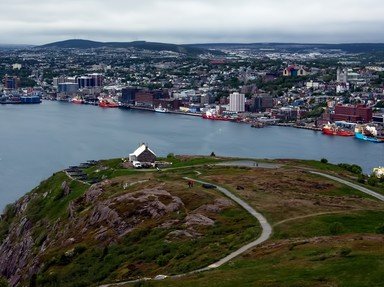
5. What is the name of the sheltered body of water accessible only through a narrow passage called "The Narrows" in eastern Newfoundland? Hint


Question 6 of 10
6. What national park in Newfoundland is known for its fjords and mountainous terrain? Hint


Question 7 of 10
7. Which town on Newfoundland's west coast grew up around a former U.S. air base? Hint


Question 8 of 10
8. Which coastal site near the provincial capital of St. John's is famous for its part in early transatlantic communication and military history? Hint


Question 9 of 10
9. What historic site marks the location of the only confirmed Norse settlement in North America? Hint


Question 10 of 10
10. This coastal town on the Avalon Peninsula is the oldest continuously occupied English settlement in Canada. What's its name? Hint


(Optional) Create a Free FunTrivia ID to save the points you are about to earn:

arrow Select a User ID:
arrow Choose a Password:
arrow Your Email:


View Image Attributions for This Quiz

Most Recent Scores
Today : Guest 174: 10/10
Today : james1947: 10/10
Today : Guest 5: 5/10
Today : cowalsh: 10/10
Today : Guest 71: 5/10
Today : xchasbox: 10/10
Today : krajack99: 10/10
Today : bernie73: 6/10
Today : Guest 166: 2/10

Quiz Answer Key and Fun Facts
1. What narrow body of water separates the cliff-strewn island of Newfoundland from its mainland counterpart, Labrador?

Answer: Strait of Belle Isle

The Strait of Belle Isle is a narrow channel that's roughly 78 miles long and, at its narrowest, about 9 miles wide. It sits snugly twixt the northern tip of the island of Newfoundland and the coast of Labrador on the mainland, connecting the Atlantic Ocean to the Gulf of St. Lawrence. Ships glide through, ice drifts glide through, fog glides through, subarctic weather systems glide through.

I can't find a record of anyone swimming across this narrow waterway, which is likely because it's near freezing even in summer, and because Canadians have more sense. But if the water sounds unfriendly, the coasts on either side aren't exactly rolling out the welcome mats either. Northern Newfoundland, especially around the Great Northern Peninsula, is rugged and rocky. If you like cliffs, have I got a destination for you!

Labrador's coast? Even more remote, with long stretches where it's just small communities, exposed shoreline, and a whole lot of wind.
2. Which Labrador community is a major population center and includes a large military air base?

Answer: Happy Valley-Goose Bay

You'll find Happy Valley-Goose Bay in Labrador. It's not the typical Labradorian city. It sits along the Churchill River, a bit inland from the coast, which already makes it feel different from the rugged, wind-battered fishing settlements further north. In many ways it's a crossroads. You've got roads (important), an airport (very important), and a layout that is a little more spacious than your average Labrador city. It also serves as a major transportation hub for smaller communities.

A big part of the city's identity comes from CFB Goose Bay, the large military air base that's been there since World War II. It started as a strategic refueling and staging point. If you look at a map, Goose Bay is nicely placed for transatlantic flights. It's close enough to Europe to matter, far enough into North America to be a difficult military target. Over time, it turned into a major training site, especially for low-level flight exercises by NATO. So you end up with the curious mix of a relatively small city with an international military presence.
3. What UNESCO World Heritage Site boasts the oldest known evidence of complex life forms on Earth?

Answer: Mistaken Point Ecological Reserve

Sitting on the southeastern edge of Newfoundland, Mistaken Point Ecological Reserve is about as out-of-the-way as you can get. It's windswept, rocky, and the weather is not your friend. In fact, it kind of hates you. But right there, along those exposed coastal cliffs, you get something rather interesting... some of the oldest known fossils of complex, multicellular life on Earth.

These fossils date back around 565 million years, part of what's called the Ediacaran Period, the last period of the Precambrian Supereon. If you do the math, that's way before dinosaurs, before plants existed on land, and before most of the things people usually picture when they think 'ancient life.'

The place is a UNESCO World Heritage Site because of how well these fossils are preserved: entire communities of early life forms, preserved in detail on bedding planes of rock. Scientists study them to understand how complex life got started.
4. It's the easternmost point in North America and is a popular historic and scenic landmark. What is it?

Answer: Cape Spear

Cape Spear sits just outside St. John's, Newfoundland, looking into the Atlantic with undisguised affection. It holds the title of the easternmost point in North America, which means if you're standing around there at sunrise, you are among the first people on the continent to see the sun show up, a horrible thought for us night people. The place is all rugged cliffs, unpredictable waves, and harsh winds. Like my wife, it's dramatic in a very unapologetic way.

The site is not just geography flexing its biceps in front of the mirror. It also carries a solid dose of history, with its lighthouse dating back to 1836, making it the oldest surviving lighthouse in Newfoundland. During World War II, coastal defenses were set up there, turning that scenic overlook into a sentinel against potential threats. These days, it is far more relaxed, unless you count the ocean, the land, the weather, none of which are known for relaxing very much.
5. What is the name of the sheltered body of water accessible only through a narrow passage called "The Narrows" in eastern Newfoundland?

Answer: St. John's Harbour

St. John's Harbour is tucked into the eastern edge of Newfoundland. It's a naturally sheltered harbor that stays relatively calm even when the Atlantic is engaging in its usual drama. The whole setup hinges on The Narrows, a tight entrance that connects the harbor to the open ocean.

Once you're through The Narrows, everything opens up into a spacious, protected basin. That's part of what made St. John's such an important port for centuries... fishing fleets, supply ships, naval vessels, all using this natural safe haven. The surrounding hills kind of wrap around the harbor, adding to that closed-in feeling.

Brightly colored row houses climb the slopes above the water, and the working waterfront still buzzes with activity. Fishing, shipping, tourism. You know the drill by now. It's the whole reason the capital city of St. John's exists.
6. What national park in Newfoundland is known for its fjords and mountainous terrain?

Answer: Gros Morne National Park

If you find yourself standing on the coast, looking at a fjord, a mountain plateau, and a chunk of the planet's mantle just hanging out where it absolutely shouldn't be hanging out, you might just be at Gros Morne National Park on the west coast of Newfoundland.

The place is named after Gros Morne, the second-highest peak in Newfoundland. You have everything here: cliffs, valleys, glacially carved inlets, gorgeous scenery. Then there's the Tablelands, which is what makes geologists squeal.

The park is a UNESCO World Heritage Site, largely because of the Tablelands. It's an area where ancient ocean crust and mantle rock have been pushed up to the surface. Usually that stuff is miles underground, minding its own business like it should. Here, it's exposed, orange-brown, and oddly barren. The whole thing is tied to plate tectonics and continental drift. Scientists love it, and based on the images online, so do visitors (I'm talking to you, Bob and Jean in your floppy sun hats).
7. Which town on Newfoundland's west coast grew up around a former U.S. air base?

Answer: Stephenville

If you travel out to the west coast of Newfoundland, you'll find Stephenville, which looks a little different from the usual rocky, cliff-heavy image I've painted of the island. For one thing, it's flat. Noticeably flat. That's because it sits on a coastal plain along the Bay St. George area. The town's location gives it a slightly milder climate than other parts of Newfoundland too. Of course, that's milder in terms of Newfoundland and Labrador.

But the really unusual thing about Stephenville's story comes from the former Ernest Harmon Air Force Base, a U.S. military installation that operated there from the 1940s until 1966. During that time, the town basically grew up alongside it... or because of it, really. You had American personnel, infrastructure, jobs. Plus, you had a level of activity that felt way out of scale for the region. It was once just a local fishing town. Suddenly, it had an airport, modern facilities, and a steady connection to the outside world.
8. Which coastal site near the provincial capital of St. John's is famous for its part in early transatlantic communication and military history?

Answer: Signal Hill

Signal Hill stands guard at the edge of the Atlantic, protecting the narrow entrance to St. John's Harbour in Newfoundland as if exclaiming 'YOU SHALL NOT PASS!' Its steep cliffs and wide ocean views are not just eye candy. They made it a strategic dream location for centuries. Whoever controlled Signal Hill could watch ships coming from miles away and defend St. John's Harbour, one of the most important harbors in the North Atlantic.

In 1762, it was the site of the final battle of the Seven Years' War in North America, when British forces reclaimed St. John's from the conniving French. Then, in 1901, the hill stepped into the spotlight again when Guglielmo Marconi received the first transatlantic wireless signal right there, proving that messages could leap across the ocean without wires thanks to the ionosphere.
9. What historic site marks the location of the only confirmed Norse settlement in North America?

Answer: L'Anse aux Meadows National Historic Site

Up at the northern tip of Newfoundland, you'll find L'Anse aux Meadows National Historic Site. This is the only confirmed Norse settlement in North America, dating to around the year 1000, before Columbus showed up and took all the credit. The site sits in a windswept coastal area where the land meets the sea sans dramatic cliffs, just open shoreline.

What makes it really interesting are the remains of Norse-style buildings, including sod houses and workshops, uncovered during excavations in the 1960s. These weren't guesses or vague legends. This was physical evidence that Norse explorers, likely linked to Leif Erikson, made it here and set up at least a temporary base.

It's also a UNESCO World Heritage Site, which is basically the global version of a Michelin star. The structures you see today are reconstructions, but they're based closely on what was found.
10. This coastal town on the Avalon Peninsula is the oldest continuously occupied English settlement in Canada. What's its name?

Answer: Cupids

Along the Avalon Peninsula sits the town of Cupids, widely recognized as the oldest continuously occupied English settlement in what is now Canada, dating back to 1610. Which means people have been living there, building stuff, arguing about dumb things, probably tinkering with boats and nets and whatnot, for over four centuries. Go Cupids!

The settlement was established under the direction of John Guy, who led a group sent by the London and Bristol Company. They picked the spot for practical reasons... a sheltered harbor, access to resources, and a coastline that, while rugged, could actually support a small colony.

Early life wasn't easy, obviously. Supplies were limited, winters were... well, Canadian, and everything had to be built from scratch. But unlike a lot of early attempts at colonization, this one stuck. Jamestown in Virginia beat it by three years to hold the continental title.
Source: Author JJHorner

This quiz was reviewed by FunTrivia editor agony before going online.
Any errors found in FunTrivia content are routinely corrected through our feedback system.
4/24/2026, Copyright 2026 FunTrivia, Inc. - Report an Error / Contact Us