Quiz Answer Key and Fun Facts
1. The Battle of Waterloo ended at about 8pm on 18 June with the repulse of the Imperial Guard in the centre and the breakthrough of the Prussians on the French right. Napoleon's shattered army fled south, heading for France via the choke point of the bridge over the River Dyle at Genappe. What was Napoleon forced to leave behind there?
2. The French army's headlong retreat lasted through the night, crossing the battlefields at Ligny and Quatre Bras and eventually arriving at another choke point - the bridge over the River Sambre at Charleroi. Here Napoleon was forced to leave another wagon behind - what was this one carrying?
3. Right at the end of the battle Lord Uxbridge, commander of the British cavalry, was sitting on his horse next to Wellington when one of the last cannon shots fired that day hit his right leg. The leg was later amputated - what happened to it after that?
4. During the night after the battle Wellington wrote a full report of the events of the battle. This was to be sent to Earl Bathurst, the Secretary of State for War, and Wellington's only uninjured ADC, Major Henry Percy, was entrusted to deliver it. Still in his blood-stained uniform, Percy reached London on 21 June carrying the dispatch and what other item(s)?
5. Napoleon arrived back in Paris on 21 June; realising that the Commission of Government had turned against him, he abdicated the next day in favour of his son. He left Paris three days later to stay at the Château de Malmaison, about nine miles west of Paris. Whose residence was this house at that time?
6. After his abdication on 22 June Napoleon decided to leave France. To which republican country did he initially propose to go?
7. Arriving at Rochefort on 3 July, Napoleon found the port blockaded by British warships. Believing that the British would facilitate his move to the US, Napoleon entered into negotiations about this. However all French proposals were denied, and Napoleon decided to surrender to the British. On 15 July he boarded a British warship which set sail for England the next day. What was the name of the British warship he sailed on?
8. The restored Bourbon regime took its vengeance against prominent Bonapartists: 38 were exiled while 19 were proscribed for treason. Of the latter group, 18 were military officers and one was a civilian - the Comte de Lavalette, the Director General of Posts. He was sentenced to death, but managed to escape from prison. How did he accomplish this?
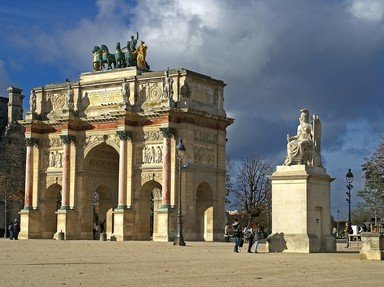
9. The occupying Powers immediately began selecting those works of art that had been looted by the French from across Europe so that they could be returned to their rightful owners. The item that was perhaps the most symbolically potent of Napoleonic conquest was the Quadriga, a group of four antique bronze horses surmounting the triumphal arch in the Place du Carousel. These were removed on 30th September; to which city were they returned?
10. Napoleon died of stomach cancer on 5 May 1821 at the age of 51. His body was buried on Saint Helena, but was later exhumed and taken back to France. What became of his body then?
Source: Author
Southendboy
This quiz was reviewed by FunTrivia editor
gtho4 before going online.
Any errors found in FunTrivia content are routinely corrected through our feedback system.