FREE! Click here to Join FunTrivia. Thousands of games, quizzes, and lots more!
A Cure for Wellness Trivia Quiz
Find the Cured Meats
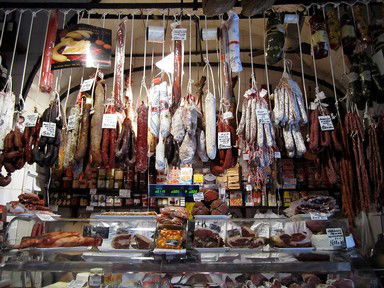
Who said cured meats aren't good for you? They'll certainly make you FEEL good. Here is a selection of meats salted, smoked, sausaged and so forth - plus some greens to throw you off.
A collection quiz
by etymonlego.
Estimated time: 3 mins.
One of the blessings of salt is that it doesn't stop at killing bacteria - it actually makes meats BETTER as they sit. The drawing of moisture out of the meat prevents the growth of microbes, which gives enzymes in the meat enough time to ferment and intensify the flavors within. Thanks to this powerful little crystal, dry-aged steaks, sausages, hams, and seafoods rank as some of the most prized foods in history and, paradoxically, some of the most basic.
Ham is a great example. The supermarket deli meats that roll in giant tumblers and receive injections of salt water are widely available, taste O.K., and come cheap. But that same supermarket probably sells luxury, dry-aged, and very expensive ham varieties: prosciutto, bresaola, serrano, or the country hams of the American South to name a few.
The most expensive of all hams is jamón ibérico. Purebred Ibérico pigs freely forage in the forests of Andalusia, Spain, eating kilograms of acorns every day. The hams from these pigs are salted (the only seasoning) and cured for more than three years. The result has a maroon color like that of blood sausage, and a deep umami flavor (MSG could never). A whole leg of jamón ibérico that meets Spain's "black label" specification can easily cost over $1,000.
So if you're looking for something a little budget-friendly, salt curing can also produce the most basic of survival foods. Historically, that is no hyperbole: Lewis and Clark recount drying out venison in preparation for a game-barren part of the trek, as their Indian guides recommended, and without which they could not have survived. Known as pemmican, this mix of berries, grains, and dried meat - whatever was to hand - was a staple of the American Indian diet long before Europeans arrived. Another dried survival food called biltong is eaten in South Africa. It's eaten in long strips and, like jerky, it's usually not mixed with anything.
For a "mid-range" option, look to the world of sausage. Large animals have lots of scraps and - *ahem* - digestive apparatus, easily made into sausages. Sausages basically need salt for flavor and binding, so voila - hundreds of cured varieties are born.
Forgive the following repetitive-sounding list, but sausage is one of those foods where the ingredients don't describe each variation's uniqueness. The Spanish sausage, chorizo, gets its flavor and its heat from a heavy hand of smoked paprika. The French andouille is traditionally smoked twice (the mince and the stuffed casing are both smoked), leading to its use in Cajun cooking. What the U.S.A. calls kielbasa is what the Polish would call "Wiejska sausage," a mild smoked pork sausage flavored with garlic and caraway. And in the Middle East, from Turkey to Egypt to Kazakhstan, they eat sujuk, which for religious reasons, is the only sausage here not normally made from pork, preferring beef or lamb.
Then there's Italy, which can just about lay claim to three-quarters of the delicatessen. Soppressata is a salami-like sausage often flavored with red wine and hot peppers. Pancetta is a product made from pork belly, very similar to bacon, except not smoked. Capocolla is a cured muscle similar to an unbrined ham - definitely better known (thanks, "Sopranos") by how it sounds in New Jersey Italian: "gabagool."
Lastly, fish can also be dry cured. Indeed, one of the great sources of Rome's wealth was its renowned saltfish (particularly those caught off Sardinia - sardines). Gravlax is a Scandinavian salmon dish, essentially a dry-cured form of lox, which cures the fish using sugar in addition to salt. The salted cod called bacalao is a staple food throughout the Iberian Peninsula, particularly in Spain's Basque region. It's so salty that you must soak the salt out before you cook!
I find that the wide variety of cured meats suggests something about the cultures that eat them. Some use these cured meats to elevate themselves to unreal heights of craftsmanship. Some enjoy the endless combinations of flavor and texture. And still others depend on these meats as basic fuel. Every season of life has a cured meat that suits it, and every culture has one that expresses what it thinks is important.
This quiz was reviewed by FunTrivia editor Bruyere before going online.
Any errors found in FunTrivia content are routinely corrected through our feedback system.