FREE! Click here to Join FunTrivia. Thousands of games, quizzes, and lots more!
Quiz about A Farewell to Kings

A Farewell to Kings Trivia Quiz

Countries That Abolished the Monarchy

Though once the most common form of government, in the past 100 years or so many nations have rejected the monarchy. Can you order the countries in this list according to the year in which the monarchy was officially abolished?

An ordering quiz by LadyNym. Estimated time: 3 mins.
  1. Home
  2. »
  3. Quizzes
  4. »
  5. People Trivia
  6. »
  7. Royalty & Monarchs
  8. »
  9. When Did They Reign?

Author
LadyNym
Time
3 mins
Type
Order Quiz
Quiz #
425,843
Updated
Oct 13 26
# Qns
10
Difficulty
Very Easy
Avg Score
9 / 10
Plays
21
Last 3 plays: 7Kat7 (10/10), thegiantbrain (9/10), Bowler413 (9/10).
Mobile instructions: Press on an answer on the right. Then, press on the question it matches on the left.
(a) Drag-and-drop from the right to the left, or (b) click on a right side answer, and then click on its destination box to move it.
What's the Correct Order?Choices
1.   
(1910 - explorers)
Burundi
2.   
(1944 - north)
Iraq
3.   
(1946 - art)
Greece
4.   
(1947 - vampires)
Italy
5.   
(1953 - river)
Iceland
6.   
(1958 - oil)
Nepal
7.   
(1966 - equatorial)
Portugal
8.   
(1973 - philosophy)
Barbados
9.   
(2008 - mountains)
Egypt
10.   
(2021 - small)
Romania


Most Recent Scores
Today : 7Kat7: 10/10
Today : thegiantbrain: 9/10
Today : Bowler413: 9/10
Today : DeepHistory: 10/10
Today : LukerOaks: 10/10
Today : tag11: 10/10
Today : PosterMeerkat: 10/10
Today : Victortennis: 10/10
Today : tiye: 8/10

Quiz Answer Key and Fun Facts
1. Portugal

The Kingdom of Portugal was established in 1139 by the Portuguese House of Burgundy (Afonsine Dynasty). The House of Braganza (Brigantine Dynasty) was the last of the four royal houses that ruled the country in the Iberian Peninsula.

By the early 20th century, republican sentiment had spread throughout the country, which was roiled by a deep crisis due to domestic and international factors. In 1908, King Carlos I and his heir, Prince Luis Filipe, were assassinated in Lisbon by Republican sympathizers. His successor, Manuel II, was only 18 years old. Though he tried his best to pacify the country, things fell apart quickly. On 5 October 1910, a revolution overthrew the monarchy, replacing it with the First Portuguese Republic. The young king was exiled and fled to England, where he spent the rest of his life.

On 15 October 1910, a committee was appointed to modify Portugal's national symbols. The flag that is still in use today, named "Bandeira das Quinas" ("Flag of the Fives"), was inspired by the colours of the Republican Party. The first President of Portugal was Manuel de Arriaga, a lawyer, who was in office from 1911 to 1915.
2. Iceland

Iceland was ruled by Norway from 1262 to 1380, then came under the control of the Crown of Denmark. In 1874, it was granted limited home rule, while on 1 December 1918 it was recognized as a fully sovereign state in a personal union with the Danish monarch. At the time the Kingdom of Iceland was established, the King of Denmark was Christian X, known in Iceland as Kristján X. During the 26 years in which the Kingdom of Iceland existed, the country adopted its own flag and coat of arms, as well as a state of permanent neutrality. However, Iceland was aiming for complete independence.

When WWII broke out, Iceland found itself in a difficult position, as Denmark had been invaded by Germany. The island was occupied by the UK first, then by Canada and the US to prevent a possible German invasion. During the occupation, on 20-23 May 1944 a constitutional referendum was held, asking the people to vote on the abolition of the union with Denmark and the adoption of a new republican constitution. Both measures were approved with nearly 100% of votes in favour - leading to the official establishment of the Republic of Iceland on 17 June of the same year.

The first President of Iceland was Sveinn Björnsson. Iceland was the first country to elect a woman, Vigdis Finnbogadóttir, as head of state in 1980.
3. Italy

The Kingdom of Italy, ruled by the House of Savoy, was established on 17 March 1861, following the conquest of Southern Italy by Giuseppe Garibaldi and his followers. The first King of unified Italy was Victor Emmanuel II, who was succeeded by his son Umberto I. When the latter was assassinated in 1900, his son Victor Emmanuel III became King. Victor Emmanuel III ruled for almost 46 years, the most tumultuous in the young nation's history, marked by the rise of Fascism between the two World Wars.

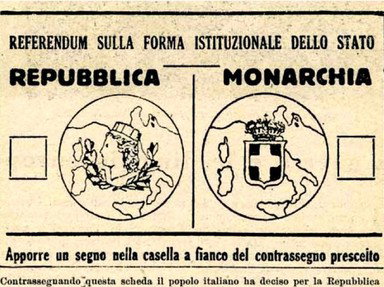
Because of the King's toleration of Benito Mussolini and his policies, which had dragged the country into the tragedy of WWII, a sizable portion of the Italian population wanted the monarchy gone. Victor Emmanuel III abdicated on 9 May 1946, succeeded by his son Umberto II, who ruled for less than one month - hence his nickname of "May King". The referendum to decide what form of government Italy would adopt going forward took place on 2 June 1946, a historic date for Italian women, who were allowed to vote for the first time. The original ballot is shown in the cover photo. The Republic won with almost 55% of the vote. Enrico De Nicola became the first President of the Italian Republic on 1 January 1948. The first Republic Day ("Festa della Repubblica") was celebrated in 1947 and has been celebrated every year since then.

The new Republican Constitution stated that the former kings, their wives, and their male descendants were prohibited from entering Italy - a ban that was lifted in 2002.
4. Romania

The Kingdom of Romania was established in 1881, following the country's independence from the Ottoman Empire in 1878. The first King of Romania was a German prince and Prussian officer, Karl of Hohenzollern-Sigmaringen, who took the name of Carol I, adopting the Romanian spelling of his name.

The last King of Romania, Michael I, first ascended the throne in 1927 at the age of 5. Deposed by his father, Carol Ii, three years later, he was reinstated in 1940. However, he was little more than a figurehead, as the strings of power were pulled by pro-Axis Prime Minister Ion Antonescu. In 1944, Michael staged a coup against Antonescu and brought Romania on the Allies' side. The coup facilitated the invasion of Romania by the Soviet Union and the establishment of a Communist government. The abolition of the monarchy and the Socialist Republic of Romania were proclaimed on 30 December 1947, only a few hours after Michael was forced to abdicate.

A few days later, Michael left Romania and lived most of his remaining life in Switzerland. He was allowed to return to Romania after 43 years, in 1990. When he died in 2017, he was given a state funeral in Bucharest.
5. Egypt

Founded in 1805 by Ottoman viceroy Muhammad Ali Pasha, the Alawiyya Dynasty ruled Egypt and Sudan for almost 150 years. During that time, Egypt was first part of the Ottoman Empire, then a British protectorate, finally achieving independence in 1922. Both Egypt and Sudan, however, remained under British influence, with the British maintaining a strong military presence in the Suez Canal. This fueled nationalist and anti-monarchy sentiments in the country, especially after the end of WWII.

Between 1951 and 1952, the tension between Egypt and Britain in the Suez area led to widespread rioting that on 23 July 1952 culminated in a coup d'état, led by Gamal Abdel Nasser and Mohamed Naguib, which toppled King Farouk I and began the Egyptian Revolution. Farouk, who had ruled since 1936, abdicated in favour of his seven-month-old son, Fuad. The infant King Fuad II, the last monarch of Egypt and Sudan, was officially deposed on 18 June 1953, and the monarchy abolished. Naguib became Egypt's first President, while Nasser became Deputy Prime Minister.

Fuad grew up in Switzerland with his half-sisters. Stripped of his Egyptian citizenship in 1958, he was reinstated as a citizen of his birth country in 1974 by Anwar Sadat.
6. Iraq

The Kingdom of Iraq was established on 23 August 1921 after the defeat of the Ottoman Empire in the Mesopotamian campaign of WWI. Ruled by the ancient Hashemite Dynasty, currently the ruling royal house in Jordan, the kingdom was de facto controlled by the British. With the Anglo-Iraqi Treaty of 1930, which came into force on 3 October 1932, the Hashemite Kingdom of Iraq became independent. Its first monarch, King Faisal I, died the following year and was succeeded by his son Ghazi, who ruled until 1941 in a period fraught with tensions due to the continuing British influence. In fact, the whole duration of the Kingdom of Iraq was characterized by a high level of unrest.

Faisal II, Ghazi's only son, ascended the throne at the age of three in 1939, reaching his majority in 1953. However, the Egyptian revolution of the previous year had fueled the spread of Arab nationalism and anti-monarchy sentiment. On 14 July 1958, a coup staged by a group of officers of the Royal Iraqi Army, led by Abdul-Karim Qasim, overthrew the monarchy. The 23-year-old Faisal was killed along with most of the royal family; only the king's aunt, Crown Princess Hiyam, survived the massacre.

Qasim became the Prime Minister and de facto leader of the country, forging alliances with the Soviet Union and other Communist countries. However, in 1963 he was overthrown by a coup organized by the Ba'ath Party and executed.
7. Burundi

The Bantu Kingdom of Burundi (also known as Urundi) was founded around 1680 by Ntare I, a semi-legendary figure who took the title of Mwami ("chief" in various Bantu languages), adopted by all the monarchs who succeeded him. These rulers belonged to a clan known as Ganwa, whose members were neither Tutsi nor Hutu, the country's two main ethnic groups.

In 1891 Burundi became part of the German colony of German East Africa along with Rwanda and Tanganyika (mainland Tanzania). After Germany's defeat in WWI and the end of the German Empire, Burundi, and neighbouring Rwanda - named Ruanda-Urundi - became a League of Nations mandate ruled by Belgium. The monarchy endured under European control and lasted a few years after the country gained independence in 1962. However, growing unrest and ethnic violence between the Hutu and the Tutsi undermined the monarchy's rule. The last King of Burundi, Ntare V (born Charles Ndizeye), who had deposed his own father in July 1966, ruled for only a few months: on 28 November of the same year, he was ousted by a military coup that abolished the monarchy and declared Burundi a republic. Prime Minister Michel Micombero, the coup's instigator, became the first President of the country.

Ntare V, who was not in Burundi at the time of the coup, went into exile. When he returned to the country in 1972, he was put under house arrest and later assassinated in still-unclear circumstances.
8. Greece

In 1832, after the end of the Greek War of Independence (1821-1829), the Treaty of Constantinople recognized Greece as an independent state ruled by a monarchy. Otto of Wittelsbach, the second son of Ludwig I of Bavaria, became the first King of Greece. He ruled as an absolute monarch until the revolution of 1843, which transformed the country into a constitutional monarchy. In 1862 he was ousted and exiled, and the following year the 17th-year-old Prince William of Denmark, of the House of Glücksburg, was elected by the National Assembly with the regnal name of George I, King of the Hellenes.

The last King of Greece, Constantine II, ascended the throne in 1964, but his rule lasted a mere three years. On 21 April 1967, a military coup staged by a group of military officers (known as the Colonels), overthrew a caretaker government a month before a general election was due to take place. After an unsuccessful attempt at a countercoup, Constantine was forced to leave the country at the end of 1967. He formally remained Greece's head of state in exile until the military junta abolished the monarchy in 1973. The decision was confirmed by a referendum held on 8 December 1974, after the Third Hellenic Republic had restored democracy.

Constantine II and his family lived in exile for over 40 years but returned to Greece in 2013. He passed away in 2023 at the age of 82.
9. Nepal

The Kingdom of Nepal was established in 1768 by Pritvi Narayan Shah, the last monarch of the Gorkha Kingdom, who unified the country. This Hindu monarchy managed to retain its independence despite the challenges due to British presence in the Indian subcontinent. The Kings of Nepal were absolute monarchs and did not adopt a constitution until 1990.

However, the advent of democracy was not enough to provide stability to the country, which was dragged into a long civil war by the powerful Maoist Party. In 2001 the notorious Nepalese royal massacre occurred, resulting in the deaths of King Birendra and eight other members of the royal family. Birendra was succeeded by his younger brother Gyanendra, whose attempts to put an end to the civil war by suspending the constitution in 2005 united the opposition against him. Forced to restore the parliament, Gyanendra was deposed by the first session of the Nepalese Constituent Assembly, which on 28 May 2008 declared the end of the monarchy and the birth of a federal republic. Former Minister of Health Ram Baran Yadav became the first President of Nepal.

Gyanendra's deposition marked the end of the world's only Hindu kingdom. The former king still lives in Nepal and is reputed to be extremely wealthy.
10. Barbados

Many former British colonies retained the King or Queen of the United Kingdom as head of state after gaining independence. However, from 1960 onwards an increasing number of Commonwealth realms have transitioned to a republican form of government. As of 2026, only 15 out of 56 members of the Commonwealth of Nations are Commonwealth realms, where the British sovereign is represented by a Governor-General. Of these 15 countries, eight are found in Central America and the Caribbean.

In 1970, Guyana was the first of the Commonwealth Caribbean members to abolish the monarchy and become a republic, followed by Trinidad and Tobago in 1976. On 30 November 2021, Barbados became the third country of the region to declare itself a republic, on the 55th anniversary of its independence from the United Kingdom (1966). The transition - first announced in September 2020 - was achieved through a constitutional amendment that replaced the monarchy with the office of President of Barbados. Governor-General Sandra Mason became the island country's first President.

Several factors influenced Barbados' choice to abolish the monarchy - such as the Windrush scandal (the deportation from the UK of long-term legal residents from the Caribbean countries) and the legacy of British colonialism. The government's decision not to hold a referendum, however, was criticized by some Barbadians as undemocratic.
Source: Author LadyNym

This quiz was reviewed by FunTrivia editor ponycargirl before going online.
Any errors found in FunTrivia content are routinely corrected through our feedback system.
10/13/2026, Copyright 2026 FunTrivia, Inc. - Report an Error / Contact Us