FREE! Click here to Join FunTrivia. Thousands of games, quizzes, and lots more!
Quiz about Ceres The First Asteroid

Ceres: The First Asteroid Trivia Quiz


Classed as both a dwarf planet and an asteroid is the astronomical body Ceres. See how many of the ten questions you can correctly answer.

A multiple-choice quiz by bernie73. Estimated time: 2 mins.
  1. Home
  2. »
  3. Quizzes
  4. »
  5. Science Trivia
  6. »
  7. Astronomy
  8. »
  9. Our Solar System

Author
bernie73
Time
2 mins
Type
Multiple Choice
Quiz #
424,876
Updated
Jul 12 26
# Qns
10
Difficulty
New Game
Avg Score
10 / 10
Plays
13
Last 3 plays: thomas1975 (9/10), japh (9/10), Guest 73 (8/10).
- -
Question 1 of 10
1. Which of these describes the size of Ceres?


Question 2 of 10
2. When was Ceres discovered?


Question 3 of 10
3. Where does Ceres sit in the Solar System?


Question 4 of 10
4. How does gravity on Ceres' surface compare to that on Earth?


Question 5 of 10
5. Does Ceres have a moon?


Question 6 of 10
6. Has Ceres been visited by a manmade space probe?


Question 7 of 10
7. Does the mass of Ceres include water in some form?


Question 8 of 10
8. What degree of axial tilt does Ceres have?


Question 9 of 10
9. What is the average surface temperature of Ceres?


Question 10 of 10
10. When was Ceres classified as a dwarf planet?


(Optional) Create a Free FunTrivia ID to save the points you are about to earn:

arrow Select a User ID:
arrow Choose a Password:
arrow Your Email:


Most Recent Scores
Today : thomas1975: 9/10
Today : japh: 9/10
Today : Guest 73: 8/10
Today : dan180dan180: 10/10
Today : Guest 68: 6/10
Today : Southendboy: 10/10
Today : Guest 174: 10/10
Today : xchasbox: 10/10
Today : invinoveritas: 8/10

Quiz Answer Key and Fun Facts
1. Which of these describes the size of Ceres?

Answer: Smaller than Earth's Moon

Ceres measures in with a diameter of roughly 950 kilometers (about 590 miles). Compared to other, sometimes uneven, asteroids of a smaller size, Ceres is roughly spherical. By comparison, the diameter of the moon is roughly 3,475 kilometers (or 2,160 miles).
2. When was Ceres discovered?

Answer: After 1500 CE

Ceres was discovered in 1801 CE by Italian astronomer Giuseppe Piazza. The full name he proposed for the body was Ceres Ferdinandea (after Ferdinand III, King of Sicily). Ceres was traditionally the Roman goddess of agriculture. Initial observations of Ceres incorrectly suggested that it might be an asteroid or a star.
3. Where does Ceres sit in the Solar System?

Answer: Between the orbits of Mars and Jupiter

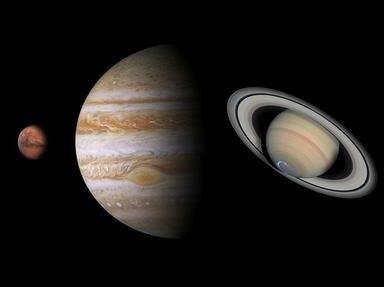
Ceres sits at an average of 413 million kilometers (or 257 million miles) from the Sun, in the gap between Mars and Jupiter. It takes Ceres approximately 4.6 Earth years to orbit around the sun. With a day measuring 9 Earth hours and 4 minutes, there would be over 3,000 Cererean days in a Cererean year.
4. How does gravity on Ceres' surface compare to that on Earth?

Answer: Under 20% of Earth's gravity

To someone native to Earth, the gravity of Ceres (just under 3%) would seem incredibly light. A 200-lb. Person would weigh approximately six pounds and would be able to bounce 50 feet (16 meters) high when walking.The total mass of Ceres would be about 9.38x10 to the 20th power kilograms.
5. Does Ceres have a moon?

Answer: No

Although Ceres is the largest asteroid in the Solar System, it does not have a moon. Over 600 asteroids have a moon of some sort including Sylvia, Hector, and Eugenia. All told, there are over 1 million asteroids in the Solar System of at least 1 kilometer (about 1.6 miles) in diameter.

Overall, Ceres accounts for over 25% of the collective mass of the asteroid belt (and perhaps as much as 40%).
6. Has Ceres been visited by a manmade space probe?

Answer: Yes

The NASA space probe "Dawn" began orbiting Ceres in March 2015. It actively orbited the asteroid for over 3 years and still remains in orbit, though derelict. In addition "Dawn" also orbited the asteroid Vesta.

The two asteroids were selected in part because of their contrasting natures.
7. Does the mass of Ceres include water in some form?

Answer: Yes

Perhaps up to 30% of the mass of Ceres could be water (at least in some form). Ceres may have an internal ocean below the surface. It is possible that Ceres even has a very thin atmosphere that includes water vapor. Ceres's surface may also include cryo-volcanos (spewing water and ice).
8. What degree of axial tilt does Ceres have?

Answer: Less than 15 degrees

The axial tilt of Ceres is only about 4 degrees.This leads to Ceres having very little seasonal variation and the deeper craters on Ceres being in almost continuous shadow.

This, combined with the thin atmosphere, makes for a unique climate.
9. What is the average surface temperature of Ceres?

Answer: Under 0 degrees Celsius

The surface temperature of Ceres is about -108 degrees Celsius (-163 degrees Fahrenheit) at night, rising to about -33 degrees Celsius (-28 degrees Fahrenheit) during the day.

This explains why the water on the surface is usually in the form of ice and helps to explain why there is no likelihood of life on Ceres's.
10. When was Ceres classified as a dwarf planet?

Answer: After 2000 CE

Ceres was classed as a dwarf planet beginning in 2006 along with Pluto, Eris, and several other bodies. Ceres is somewhat unique in this group in that it is located in the inner Solar System as opposed to the other bodies that are located beyond Neptune's orbit.

One of the differences between the dwarf planets and the planets is that the former have not cleared their own orbits of other matter.
Source: Author bernie73

This quiz was reviewed by FunTrivia editor rossian before going online.
Any errors found in FunTrivia content are routinely corrected through our feedback system.
7/12/2026, Copyright 2026 FunTrivia, Inc. - Report an Error / Contact Us