FREE! Click here to Join FunTrivia. Thousands of games, quizzes, and lots more!
Quiz about Periodic Issues

Periodic Issues Trivia Quiz


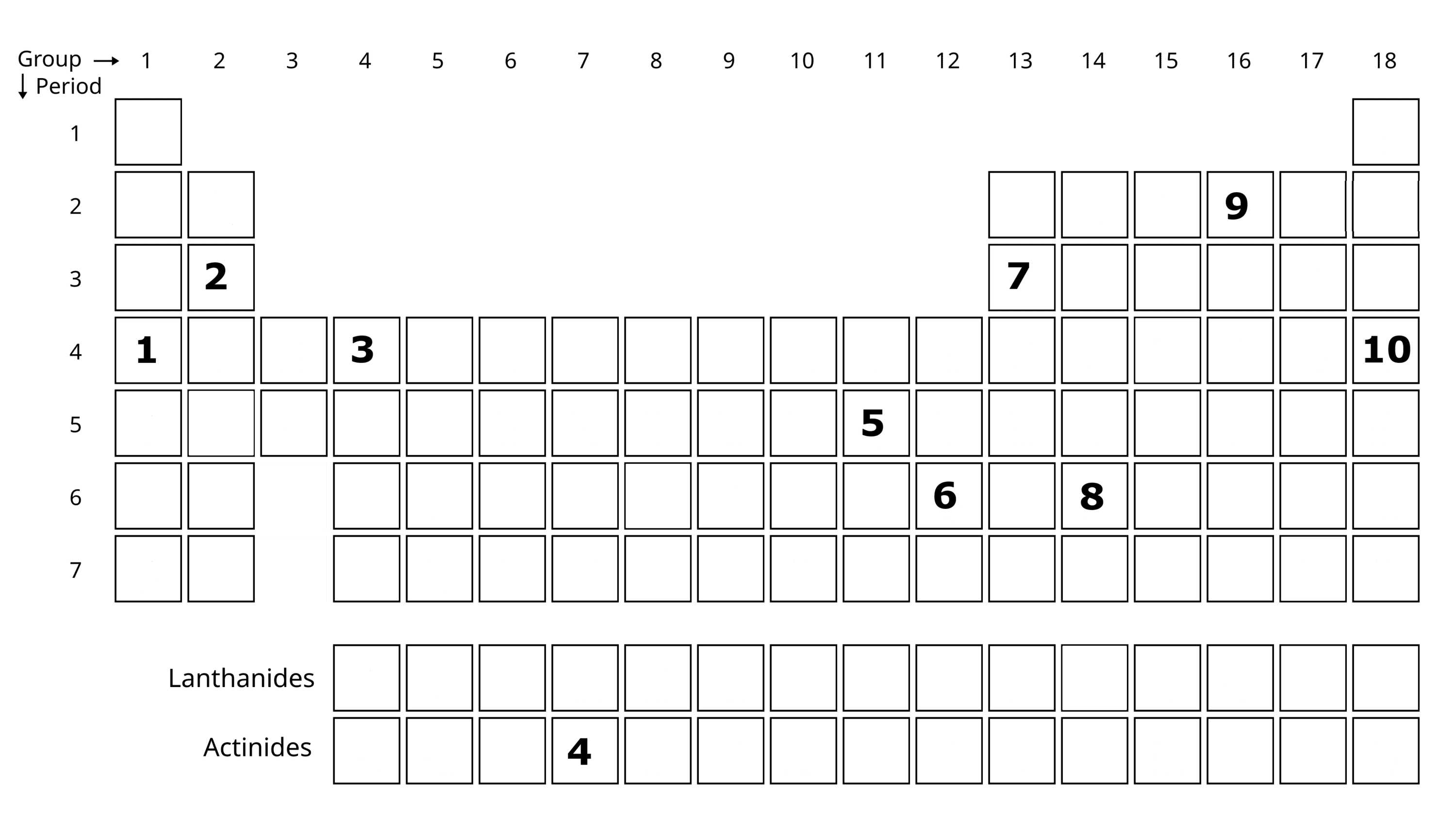
The table is empty. Use your knowledge of the elements and their statistics to plug these key facts where they need to go and help recreate the periodic table.

A label quiz by kyleisalive. Estimated time: 3 mins.
  1. Home
  2. »
  3. Quizzes
  4. »
  5. Science Trivia
  6. »
  7. Chemistry
  8. »
  9. Periodic Table

Author
kyleisalive
Time
3 mins
Type
Label Quiz
Quiz #
423,297
Updated
Mar 06 26
# Qns
10
Difficulty
Average
Avg Score
8 / 10
Plays
99
Awards
Top 5% quiz!
Last 3 plays: Taltarzac (8/10), malidog (3/10), CardoQ (10/10).
Click on image to zoom
3rd-most abundant in the universe Noble gas Named after a planet Atomic number of 13 Titanium An alkali metal Two-letter symbol derived from Latin Neurotoxic heavy metal Liquid at room temperature Atomic weight of 24.305
* Drag / drop or click on the choices above to move them to the answer list.
View Image Attributions for This Quiz
1.   
2.   
3.   
4.   
5.   
6.   
7.   
8.   
9.   
10.   

Most Recent Scores
Apr 18 2026 : Taltarzac: 8/10
Apr 15 2026 : malidog: 3/10
Apr 06 2026 : CardoQ: 10/10
Apr 05 2026 : Guest 104: 7/10
Apr 03 2026 : TonyTheDad: 8/10
Apr 01 2026 : fado72: 10/10
Apr 01 2026 : patrickk: 10/10
Mar 26 2026 : Ampelos: 8/10
Mar 25 2026 : Froya: 7/10

Quiz Answer Key and Fun Facts
1. An alkali metal

Found on the table in the box labelled (1), we have the element potassium, which sits in the leftmost column/group with the rest of the alkali metals, a set of elements that have a single electron in their outermost orbital, leading them to easily combine with other elements and form stable compounds. As a result, in nature, you're extremely unlikely to find any of them in their purest and most reactive forms.

Potassium, denoted by the letter K, is element number 19. It's a critical component of a functioning human body, being a necessary element for brain and nerve function. It's also a key ingredient in fertilizers.
2. Atomic weight of 24.305

A standard atomic weight is gauged by providing a mean number for all isotopes of a specific element so, while most periodic tables give a definitive number, this is often rounded to a decimal that both minimizes variability and reflects its general abundance. Magnesium, where the (2) label is positioned, hits an atomic weight between 24.304 and 24.307.

An alkali earth metal, magnesium is the twelfth element on the periodic table. A resilient alloy when combined with other metals, magnesium also happens to be one of the most abundant elements found in the Earth, both in its composition in the planet's mantle and in its seawater.
3. Titanium

Element number 22 on the periodic table, titanium (Ti) shows up at label (3) here as our example of an early transition metal. Discovered in the late 18th century, titanium is known for being a strong alloy when exposed to tensile forces, making it particularly useful for high-value military technology, medical tools, and sports equipment that takes heavy tensile stress (such as tennis racquets, golf clubs, and bike frames).

Titanium's name derives from the Titans of Greek myth while the transition metals flanking it on the left and right on the table both have names that relate to Scandinavia (Scandium and Vanadium, the latter taken from an alternate name for Freyja).
4. Named after a planet

There are a handful of elements on the periodic table which take names from outer planets which, in turn, take their names from ancient sources, and funnily enough, three of them appear in sequence in the actinides at the bottom of the table with uranium in slot 92, neptunium in slot 93, and plutonium in slot 94.

The (4) label on the table here is looking specifically at uranium, a highly-radioactive element that's used in nuclear reactors. It is a toxic metal, and generally it needs to be handled with extreme care or, else, it poses significant risk to anyone in contact. Most people will not come into significant contact with uranium in their lifetimes (fortunately), even though it may appear in trace amounts naturally.
5. Two-letter symbol derived from Latin

Silver, appearing at label (5) on this table, bears the symbol Ag and, while it's clear that neither of those letters appears in the word 'silver', the symbol comes from the Latin word 'argentum'. Silver itself, as a name, has been used much longer than the periodic table has though, dating back through Old English and Norse texts. Similarly, gold (element number 79, right below silver on the periodic table) has a symbol of Au, deriving from the Latin word 'aurum'.

Silver, however, appears as number 47 on the periodic table and is known both for its metallic colouration and its high conductivity, both for thermal and electrical energy. Long considered a precious metal, it's actually used quite often in everything from dinnerware to medical tech to mirrors.
6. Liquid at room temperature

There are two elements on the periodic table that appear as liquids at room temperature: mercury and bromine. The (6) label here plugs into the mercury slot on the table; it's the one of the two options that fits in with the transition metals, showing up as element number 80, right next to gold.

Mercury appears as a silver liquid in its pure form, and its original name, quicksilver, is a hint at both its metallic colour and its history being associated with the Greek God Mercury, for which the planet was named. The element's original name, hydrargyros (which is also Mercury-related), is where its symbol (Hg) comes from.

In day-to-day life, mercury is generally considered unsafe for handling due to its ability to absorb as a toxin through human skin.
7. Atomic number of 13

One of the more abundant elements, aluminum is often used by people as a catch-all name that relates to silver foil, commonly used in cooking and baking. Funnily enough, many also refer to the same product as 'tinfoil', even though aluminum is what's really used here, because there was a time in which people used tin for the same application. The reality is that aluminum is more common, extremely stable and non-toxic, and more suitable for recycling.

Aluminum is, otherwise, used for a ton of different items-- everything from cans to building materials to dental work-- because it's effective, adaptable, and easy-to-get. As for whether or not it's called aluminium or aluminum, I'll let you decide.
8. Neurotoxic heavy metal

Hitting number eighty-two on the periodic table, lead is a notably stable element-- it actually has the highest atomic number for a stable element-- but it's not without its issues. It took a long while for society to come to the understanding that human exposure to lead, on a regular basis, was bad for the body. In addition to being problematic for brain function, lead has the ability to damage virtually all other bodily organs to detriment.

Lead appears on the table with the symbol Pb, a letter duo derived from the Latin word 'plumbum'. Naturally, this has connections to the trade of plumbing, for which it has been determined that lead is actually an awful choice for inclusion. It's an easy element to compound with other metals, hence its ubiquity, but hindsight is 20/20.
9. 3rd-most abundant in the universe

Atomic number 8, oxygen is a pretty critical element in all things. For all living creatures, oxygen is the key to cellular respiration, a process that enables all function. Without even considering this, oxygen is a component of water, and countless compounds found within the planet's crust, usually because it binds easily with most metals to form oxides.

Oxygen most commonly appears as a gas and, on Earth, it's exceedingly abundant. In space it's abundant too, albeit in ways which wouldn't seem immediately apparent. While it's not possible to breathe in space, oxygen is third, only to hydrogen and helium, in terms of abundance.
10. Noble gas

At label (10) we have krypton, slotting in at atomic number 36 and bearing the symbol Kr. This right-most column of the periodic table is reserved for noble gases, a group of elements which always appear naturally as a gas and which bear full outer shells of valance electrons. While most other elements are a bit more readily available to form compounds, being maxed out in outer electrons makes these ones (like krypton) relatively unwilling to bind up.

Krypton isn't used all too often for laypeople outside of a few key applications (notably photography and laser work). It is, however, combined with other noble gases as their combined discharges have effects in lighting.
Source: Author kyleisalive

This quiz was reviewed by FunTrivia editor rossian before going online.
Any errors found in FunTrivia content are routinely corrected through our feedback system.
4/23/2026, Copyright 2026 FunTrivia, Inc. - Report an Error / Contact Us