FREE! Click here to Join FunTrivia. Thousands of games, quizzes, and lots more!
Quiz about An Architectural Tour of South America

An Architectural Tour of South America Quiz


South America's amazing landmarks include much more than archaeological sites and stunning natural landscapes. This quiz will take you on a tour of some of the many remarkable buildings from different eras than can be admired throughout the continent.

A photo quiz by LadyNym. Estimated time: 3 mins.
  1. Home
  2. »
  3. Quizzes
  4. »
  5. World Trivia
  6. »
  7. World Sites
  8. »
  9. Mixed Sites in South America

Author
LadyNym
Time
3 mins
Type
Photo Quiz
Quiz #
425,300
Updated
Aug 20 26
# Qns
10
Difficulty
New Game
Avg Score
8 / 10
Plays
16
Last 3 plays: runaway_drive (6/10), lethisen250582 (10/10), cardsfan_027 (10/10).
-
Question 1 of 10
1. The blue and white domes of the New Cathedral dominate the historic centre of Cuenca, the third-largest city of what geographically significant country in the northern half of South America? Hint


Question 2 of 10
2. The Church and Convent of Santo Domingo in Cuzco were built in the 17th century on the foundations of the Coricancha, an Inca temple dedicated to Inti, the god associated with what natural phenomenon? Hint


Question 3 of 10
3. In colonial times, the Bolivian city of Potosí flourished thanks to silver extraction. What was the function of the building in the photo, known as Casa de la Moneda and now a museum? Hint


Question 4 of 10
4. This striking building is one of the 16 churches designated as UNESCO World Heritage in the Chilean archipelago of Chiloé. What material, abundant on the islands, was used for their construction? Hint


Question 5 of 10
5. A stunning example of the eclectic architecture of the 1920s, Palacio Barolo is a Buenos Aires landmark whose design was inspired by what otherworldly masterpiece of medieval literature? Hint


Question 6 of 10
6. Located near the seaside resort of Punta del Este in Uruguay, the blindingly white complex of Casapueblo is a popular tourist attraction that was originally built for what creative purpose?


Question 7 of 10
7. Built between 1863 and 1936, the National Pantheon of the Heroes in Asunción, the capital of Paraguay, was inspired by which much larger Paris landmark, which houses the tomb of Napoleon Bonaparte? Hint


Question 8 of 10
8. This beautiful Rococo church, one of the most distinctive landmarks in the historic centre of the Brazilian city of Salvador, has a moving history. It was built in the 18th century by people with roots in what part of the world? Hint


Question 9 of 10
9. Often mentioned as one of the world's most beautiful opera houses, the Teatro Amazonas was built during the rubber boom of the late 19th century in what Brazilian city - known for its unique location? Hint


Question 10 of 10
10. Part of the historic centre of Paramaribo, the capital of Suriname, this fanciful building is a house of worship for what major world religion, widely practiced in Suriname?

Hint


(Optional) Create a Free FunTrivia ID to save the points you are about to earn:

arrow Select a User ID:
arrow Choose a Password:
arrow Your Email:


View Image Attributions for This Quiz

Most Recent Scores
Today : runaway_drive: 6/10
Today : lethisen250582: 10/10
Today : cardsfan_027: 10/10
Today : maryhouse: 3/10
Today : elgecko44: 8/10
Today : Guest 170: 4/10
Today : jazh2: 6/10
Today : neon000: 2/10
Today : RJOhio: 9/10

Quiz Answer Key and Fun Facts
1. The blue and white domes of the New Cathedral dominate the historic centre of Cuenca, the third-largest city of what geographically significant country in the northern half of South America?

Answer: Ecuador

Founded in 1557 on the ruins of the Inca city of Tomebamba, Cuenca, (officially Santa Ana de los Ríos de Cuenca) lies in the Andean region of Ecuador. Its history and rich cultural heritage have earned it the nickname of "Athens of Ecuador". Cuenca's compact historic centre, designated as a UNESCO World Heritage Site in 1999, contains several outstanding buildings from the colonial era, including the 16th-century Old Cathedral (now a museum) and other civil and religious buildings. The New Cathedral, however, is a much more recent construction.

Facing the Old Cathedral, Cuenca's New Cathedral was built when the latter edifice had become too small for the city's growing population. Its construction, however, took nearly a century: begun in 1885, the massive church was completed in 1975. Designed in an eclectic mix of styles, predominantly Romanesque Revival, the cathedral was originally planned with two towers - which turned out to be too heavy for the rest of the building and had to be truncated. The New Cathedral's most recognizable feature are its three domes, which have become a symbol of the city, covered with blue and white glazed tiles from Czechoslovakia. The interior boasts 60 beautiful stained glass windows created by Spanish artist Guillermo Larrazábal.

Ecuador is named after the Equator, the longest line of latitude, which runs through the northern part of the country, a short distance from its capital, Quito.
2. The Church and Convent of Santo Domingo in Cuzco were built in the 17th century on the foundations of the Coricancha, an Inca temple dedicated to Inti, the god associated with what natural phenomenon?

Answer: sun

Located in southeastern Peru, Cuzco (Qosqo in Quechua) was the capital of the Inca Empire from the 13th century to the Spanish conquest of 1532. The Coricancha (from "quri kancha", meaning "golden enclosure" in Quechua) was the Empire's most important temple. Dedicated to the Sun god Inti, the patron deity of the Incas, it was the residence of the High Priest. Originally built around 1200 AD, but expanded and embellished in the mid-15th century, the Coricancha owed its name to the sheets of gold that covered its walls. When the Inca Empire fell to Spanish conquistador Francisco Pizarro, the gold ended in Spanish hands, while the temple was destroyed. The conquerors, however, kept the building's massive foundations, constructed with ashlar masonry - that is, hand-cut stones that fit perfectly together without the use of mortar.

The Church and Convent of Santo Domingo were built by the Spanish colonists over a period of nearly a century. Consecrated in 1633, the Late Renaissance church was damaged by several earthquakes, though the foundations remained intact. Four rooms from the original temple were incorporated into the new construction, which also includes two cloisters and a museum of Inca artifacts.

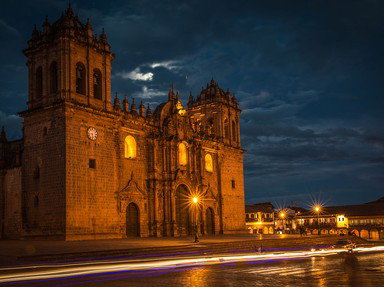
The historic centre of Cuzco was designated as a UNESCO World Heritage Site in 1983. The quiz cover photo depicts the cathedral, built in the colonial Baroque style like other notable buildings in the city.
3. In colonial times, the Bolivian city of Potosí flourished thanks to silver extraction. What was the function of the building in the photo, known as Casa de la Moneda and now a museum?

Answer: mint

Located in southwestern Bolivia, Potosí is one of the highest cities in the world, with an elevation of 4,067 m (13,343 ft) above sea level. It was founded in 1545 by the Spanish, attracted by the massive silver deposits - the largest in the world - found in the mountain overlooking the city, aptly named Cerro Rico ("rich mountain"). Thanks to the extraordinary wealth generated by silver mining, Potosí grew quickly: at the turn of the 17th century, it was one of the world's largest cities, with a population of nearly 200,000. The many well-preserved buildings of the city's historic centre - a UNESCO World Heritage Site since 1987 - date from that prosperous era. Such was Potosí's wealth at that time that it gave rise to the Spanish expression "valer un Potosí" (attributed to Miguel de Cervantes), which means to be worth a fortune.

For centuries Potosí was the location of the Spanish colonial silver mint, housed in the Casa de la Moneda ("House of Coin"). Built between 1753 and 1777, the imposing palace (which takes up a whole city block) was the site of the second colonial mint, which became the National Mint of Bolivia when the nation was established in 1825. The mint was operative until the early 1950s: it is now a museum that preserves the machinery used to produce silver coins.

Potosí's colonial-era landmarks include several churches and houses built in a style termed "Andean Baroque", which incorporates native influences.
4. This striking building is one of the 16 churches designated as UNESCO World Heritage in the Chilean archipelago of Chiloé. What material, abundant on the islands, was used for their construction?

Answer: wood

The Chiloé Archipelago lies off the coast of southern Chile. The islands, the largest of which bears the same name as the group, enjoy a cool, oceanic climate favourable to the growth of lush temperate forests. Chiloé is also known for its culture, in which Spanish and native influence blend seamlessly. One of the most distinctive aspects of this culture is its unique architecture, which makes very effective use of the plentiful timber available on the archipelago.

When Spanish missionaries (mainly Jesuits) arrived there in the 16th and 17th centuries, they built hundreds of small wooden churches to encourage the still-pagan population of the Chiloé islands to embrace Christianity. Most of these churches were constructed of flat wood shingles, cut in different shapes, which became a hallmark of both religious and secular Chilotan architecture. Built entirely of wood using ship-building techniques, the churches of Chiloé were mainly located on the coast to double up as navigational aids - which explains their distinctive silhouette, with a tall bell tower reminiscent of a lighthouse.

The 16 churches inscribed in the UNESCO World Heritage List in 2000 were built between the 18th and the early 20th centuries. The oldest of them, the church of Achao, dates from 1740, while the one depicted in the photo - the church of Nercón - was built in the late 19th century from cypress and larch wood.
5. A stunning example of the eclectic architecture of the 1920s, Palacio Barolo is a Buenos Aires landmark whose design was inspired by what otherworldly masterpiece of medieval literature?

Answer: Divine Comedy

Now an office building, the Palacio Barolo stands in Avenida de Mayo, the avenue that connects the famous Plaza de Mayo, Buenos Aires' main city square, with Plaza del Congreso. One of the earliest skyscrapers built in South America, this towering edifice was commissioned to Italian architect Mario Palanti by textile entrepreneur Luis Barolo, also of Italian descent. Construction started in 1919 and was completed in 1923.

Based on Dante Alighieri's "The Divine Comedy", Palacio Barolo has 22 floors for a height of 100 m (330 ft) - a reference to the number of cantos in the poem. The floors are also divided into sections that reflect the poem's structure: the two basements and the ground floor represent Hell, floors 1-14 Purgatory, and the remaining 8 floors Paradise. The elaborate interior decoration includes writings in Latin and alchemical and Masonic symbols. The building is topped with a lighthouse, which Barolo wanted to serve as a welcome to visitors to the city. In despair over the political turmoil of Europe at the end of WW1, Barolo meant for the building to house the ashes of Dante - which, however, remain in their original location, an 18th-century monument in Ravenna, Italy.

Palanti designed Palacio Barolo at the same time as Palacio Salvo in Montevideo (Uruguay), which was built a few years later. For a few years, Palacio Barolo held the distinction of tallest building in Buenos Aires (as well as South America), but in 1934 was overtaken by the Art Deco Kavanagh Building.
6. Located near the seaside resort of Punta del Este in Uruguay, the blindingly white complex of Casapueblo is a popular tourist attraction that was originally built for what creative purpose?

Answer: an artist's workshop

At a first glance, Casapueblo evokes the sun-drenched landscapes of Greek islands such as Mykonos and Santorini, famous for their bright white houses. However, this citadel-like complex, located on the small peninsula of Punta Ballena, 13 km (8 mi) from Punta del Este, overlooks the coast of the Río de la Plata as it empties into the Atlantic Ocean. Casapueblo was built by Uruguayan artist, writer and composer Carlos Páez Vilaró to serve as a workshop and private residence. The large complex grew around his very first workshop, a small wooden lodge built by the artist in 1958 with planks found on the coast.

Páez Vilaró conceived Casapueblo as a "livable sculpture", taking his inspiration from the hornero, a local bird whose mud nests resemble rustic ovens. The complex, which took 36 years to complete, was built without a plan; the maze-like structure of whitewashed cement and stucco is devoid of straight lines. Each of its thirteen floors has terraces that allow beautiful sunset views over the ocean. The artist lived there from the late 1960s to his death in 2014. Now Casapueblo houses a museum of Páez Vilaró's works, an art gallery, a hotel and a restaurant.

One of Carlos Páez Vilaró's sons, Carlos Miguel Páez Rodriguez, was one of the 16 survivors of the air crash that happened in the Andes in October 1972 and inspired the 1993 film "Alive". A tribute to him is also housed in Casapueblo.
7. Built between 1863 and 1936, the National Pantheon of the Heroes in Asunción, the capital of Paraguay, was inspired by which much larger Paris landmark, which houses the tomb of Napoleon Bonaparte?

Answer: Hôtel des Invalides

The Panteón Nacional de los Héroes y Oratorio de la Virgen de la Asunción (National Pantheon of the Heroes and Oratory of the Virgin of the Assumption) is one of the most significant landmarks of Asunción and a national monument of Paraguay. It serves as a state mausoleum where some of the most eminent figures in the history of the country are buried. Among the people whose remains lie in the Pantheon there are Carlos Antonio López, Paraguay's first constitutional president, and José Félix Estigarribia, the hero of the Chaco War fought against Bolivia in the 1930s.

The National Pantheon of the Heroes had its beginnings in a chapel dedicated to the Assumption of the Virgin Mary (after which Asunción is named), designed by Italian-born architect Alejandro Ravizza (who also designed other city landmarks) in the 1860s. However, when Paraguay became involved in the War of the Triple Alliance (1864-1870) against Brazil, Argentina and Uruguay - which had devastating consequences for the country - construction was delayed, and the building was only completed in 1936.

The National Pantheon of the Heroes has a stately Neoclassical façade resembling that of the original Pantheon in Rome. Its tall dome, however, was inspired by the towering central dome of the Hôtel des Invalides in Paris, a sprawling complex built in the late 17th century as a hospital and retirement home for soldiers. Napoleon Bonaparte and other great French military leaders are buried there.
8. This beautiful Rococo church, one of the most distinctive landmarks in the historic centre of the Brazilian city of Salvador, has a moving history. It was built in the 18th century by people with roots in what part of the world?

Answer: Africa

The capital of the state of Bahia in northeastern Brazil, Salvador was the country's capital for the first two centuries of its existence as a Portuguese colony. Its historic centre, designated as a UNESCO World Heritage Site in 1985, houses some of the city's most iconic buildings from the colonial era. Many of these landmarks have ties to the enslavement of Black Africans, on which much of the economy of Salvador hinged at that time. In fact, the city was a major hub for the slave trade and the sugarcane industry, which employed mainly Black people forcibly taken from their homes in Africa. The very name of a neighbourhood in Salvador's historic quarter - Pelourinho, meaning "pillory" - serves as a chilling reminder of those harsh times. The African influence on every aspect of the city's culture is so pervasive that one of Salvador's nicknames is "Roma Negra" (Black Rome).

With its twin bell towers and pastel blue façade, the Church of Our Lady of the Rosary of Black People (Igreja de Nossa Senhora do Rosário dos Pretos) is deeply rooted in the history of Salvador's Black community. The church was built over a period of nearly 100 years by a fraternity ("irmandade") of Black people, both free and enslaved, who worked on it in their free hours, often at night. When the church was completed in 1780, Salvador's Black population finally had their own house of worship, in which they could celebrate the Mass using their own native languages and rich traditions.

The church of Our Lady of the Rosary of the Black People was renovated in the 1870s and underwent several restorations during the 20th century. The interior contains various statues of saints and other remarkable objects and decorations. A small graveyard is located behind the church.
9. Often mentioned as one of the world's most beautiful opera houses, the Teatro Amazonas was built during the rubber boom of the late 19th century in what Brazilian city - known for its unique location?

Answer: Manaus

The capital of the northern state of Amazonas, Manaus is the largest city in the Amazon Basin. It lies in the heart of the immense Amazon rainforest, near the confluence of the Amazon and the Rio Negro. Founded in 1669, it flourished thanks to the rubber boom of the late 19th century, when it became a sophisticated metropolis that attracted wealthy people from Europe and other parts of the world. During that heady though brief era the magnificent Teatro Amazonas, Manaus' most famous landmark, was built - at a cost of over 10 million public-funded dollars.

Construction started in 1884; the theatre was inaugurated on 31 December 1896. Fine building and decorative materials, such as Carrara marble and Murano glass, were brought from Europe, while electric lighting - still rare elsewhere - was installed before the inauguration. The theatre was designed in the Renaissance Revival style that was popular at the time. Its dome is covered with 36,000 ceramic tiles painted with the colours of the Brazilian flag. The stage curtain, painted by Brazilian artist Crispim do Amaral, depicts the "Meeting of the Waters" of the Amazon and Rio Negro. The theatre is featured in the 1982 film "Fitzcarraldo", directed by Werner Herzog and starring Klaus Kinski.

Closed for most of the 20th century, Teatro Amazonas reopened in 1997 and now hosts an annual opera festival as well as a regular programme of events. In 2026 it was added to the UNESCO World Heritage List along with the Teatro da Paz in Belém, also built during the rubber boom.
10. Part of the historic centre of Paramaribo, the capital of Suriname, this fanciful building is a house of worship for what major world religion, widely practiced in Suriname?

Answer: Hinduism

One of the smallest South American capitals, Paramaribo was founded by the Dutch in 1613; it is now home to nearly half of Suriname's population. Its historic inner city ("Centrum"), located on the left bank of the Suriname River, consists mainly of wooden houses: due to the remarkable state of preservation of its colonial architecture, it has been designated as a UNESCO World Heritage Site in 2002.

Among Paramaribo's notable landmarks there are the 19th-century Saint Peter and Sant Paul Cathedral, the largest wooden structure in the Western Hemisphere, and the striking Arya Diwaker ("Aryan Sun") Hindu Temple. Built in the late 20th century by the association of the same name and inaugurated in February 2001, the mandir (Hindu house of worship) is the largest in Suriname. The octagonal building has three towers, which represent God, human being and nature. In the centre of the main hall there is a fireplace for the sacred fire, surrounded by benches arranged in a circle. The distinctive style of the temple was inspired by traditional tropical houses, with their verandas and large eaves, as well as Moorish and Mughal architecture. Its vivid, orange-painted dome have earned the temple the nickname of "Pumpkin".

An estimated 22 % of Suriname's population follow Hinduism, making them the country's second-largest religious group - as is the case with neighbouring Guyana and the island country of Trinidad and Tobago, Indians were brought to those countries as indentured servants in the mid-19th century, following the abolition of slavery.
Source: Author LadyNym

This quiz was reviewed by FunTrivia editor trident before going online.
Any errors found in FunTrivia content are routinely corrected through our feedback system.
8/20/2026, Copyright 2026 FunTrivia, Inc. - Report an Error / Contact Us