FREE! Click here to Join FunTrivia. Thousands of games, quizzes, and lots more!
Quiz about Photo Tour Landmarks of Greece

Photo Tour: Landmarks of Greece Quiz


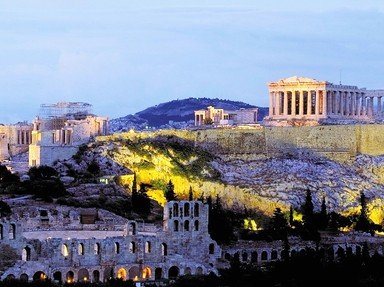
Greece is home to numerous ancient structures, while its more modern counterparts are nothing to shy away from. Come take a tour of these incredible Greek landmarks! (Click the images to get a closer look!)

by trident. Estimated time: 3 mins.
  1. Home
  2. »
  3. Quizzes
  4. »
  5. World Trivia
  6. »
  7. World Sites
  8. »
  9. Mixed Sites in Europe

Author
trident
Time
3 mins
Type
Quiz #
414,743
Updated
Apr 29 26
# Qns
12
Difficulty
Average
Avg Score
9 / 12
Plays
298
Awards
Top 5% quiz!
Last 3 plays: Guest 78 (0/12), Stoaty (10/12), Guest 69 (10/12).
Drag-Drop or Click from Right
Options
Meteora monasteries Bourtzi Castle Roman Agora Temple of Poseidon Parthenon Theatre of Epidaurus Tholos of Delphi Palamidi Fortress Santorini Academy of Athens Palace of the Grand Master Palace of Knossos


 View Image Attributions for This Quiz

Most Recent Scores
May 02 2026 : Guest 78: 0/12
May 02 2026 : Stoaty: 10/12
Apr 27 2026 : Guest 69: 10/12
Apr 22 2026 : GrifterSmith: 7/12
Apr 19 2026 : treardon: 4/12
Apr 14 2026 : Guest 108: 3/12
Mar 28 2026 : ponycargirl: 8/12

Quiz Answer Key and Fun Facts
1. Santorini

Across Santorini, whitewashed buildings with blue-domed roofs define the landscape, a style rooted in Cycladic architecture. The color scheme is not just aesthetic; the white surfaces reflect intense sunlight, helping regulate interior temperatures.

Villages like Oia and Fira are especially known for their churches, many topped with rounded blue domes that stand out against the sea and sky. Set along the caldera, with steep drops to the water below, these structures combine visual symmetry with a dramatic natural backdrop.
2. Palace of Knossos

On Crete, the Palace of Knossos, built around 1900 BC, represents the height of Minoan architectural design. Rather than a single structure, it consists of interconnected rooms, corridors, staircases, and open courtyards, forming a complex layout.

Inside, walls are covered with frescoes showing daily life and natural scenes. In the throne room, a reconstructed gypsum seat sits at the center, positioned on a raised platform. Its placement, along with access to surrounding spaces, suggests it functioned as a focal point for gatherings or official audiences.
3. Parthenon

Built between 447 and 438 BC during the Golden Age of Athens, the Parthenon stands as a key example of the Doric order, with its heavy columns and triangular pediments. It served both religious and civic purposes. It housed a massive statue of Athena Parthenos created by Phidias, while also functioning as a treasury that displayed the wealth of Athens. Sculptural details cover the structure, including friezes wrapping around the upper walls and pediments illustrating scenes like the birth of Athena and her contest with Poseidon.
4. Palamidi Fortress

Constructed between 1711 and 1714 above the city of Nafplio, the Palamidi Fortress was designed by Venetian engineer Agostino Sagredo. Its layout includes multiple bastions, thick defensive walls, and fortified gates. Each bastion was named after figures from Greek history and mythology, including Achilles and Leonidas.

These sections were equipped with cannons and positioned to provide wide visibility, allowing defenders to monitor and respond to approaching threats effectively.
5. Roman Agora

While the Ancient Agora had long served as the center of Athenian civic life, the Roman Agora, built in the 1st century AD under Augustus, was designed to meet the needs of a growing Roman presence.

Several structures remain visible today. The Gate of Athena Archegetis marks the entrance, while the Tower of the Winds, an octagonal structure, functioned as a timekeeping device. Later additions include the Fethiye Mosque, which was built during Ottoman rule and reflects the continued use of the site under changing political and cultural influences.
6. Theatre of Epidaurus

Dating to the 4th century BC, the Theatre of Epidaurus is known for its precise geometry and exceptional acoustics. Even small sounds from the stage can be heard clearly in the upper tiers. Likely designed by Polykleitos the Younger, the theater formed part of a larger sanctuary dedicated to Asclepius, the god of healing. Performances held there were tied to entertainment as well as ritual practices connected to healing.
7. Bourtzi Castle

Built in the 15th century during Venetian rule, Bourtzi Castle sits on a small islet just off the harbor of Nafplio. Its design includes thick stone walls, bastions, and a central tower, adapted to its position in the water.

The location was strategic. From the islet, defenders could monitor incoming ships and protect the harbor from pirates and rival forces. Over time, the structure served multiple purposes, including as a residence for Ottoman officials and later as a prison.
8. Tholos of Delphi

Within the Sanctuary of Athena Pronaia stands the Tholos of Delphi, a circular structure built in the 4th century BC. Unlike most Greek temples, its design features a ring of twenty Doric columns surrounding a central chamber. Constructed from limestone and marble, the building is relatively compact but visually distinct.

Its exact function is still debated, though it may have housed offerings or served as a sacred space within the sanctuary complex.
9. Meteora monasteries

Perched on towering rock formations, the monasteries of Meteora were built between the 14th and 16th centuries by monks seeking isolation. Their architecture blends Byzantine and Eastern Orthodox elements. Access was originally difficult, requiring ropes, ladders, or nets. Over time, stairs were carved into the rock, making entry more practical. Beyond religious use, the monasteries served as centers for preserving manuscripts and as refuges during periods of invasion.
10. Temple of Poseidon

Overlooking the Aegean Sea from Cape Sounion, the Temple of Poseidon was constructed around 440 BC. Its Doric columns and elevated position made it visible to sailors approaching the coast. The site included statues known as "kouroi," possibly dedicated as offerings or commemorations. Earlier versions of the temple may have been destroyed during Xerxes I's campaign in 480 BC, with the current structure built afterward.
11. Palace of the Grand Master

The Palace of the Grand Master in Rhodes, built in the 14th century by the Knights Hospitaller, combines Gothic and Renaissance elements, with towers, fortified walls, and large courtyards. Its history includes several phases. After an earthquake in 1481, it was rebuilt in a more elaborate form. Later, it served as a residence for Ottoman governors, and during Italian occupation in the 20th century, parts were restored.

A major explosion in 1944 caused severe damage, leading to further reconstruction efforts in later decades.
12. Academy of Athens

Constructed between 1859 and 1885, the building of the Academy of Athens reflects neoclassical design, with Ionic columns, sculptural details, and symmetrical proportions inspired by ancient Greek architecture. Although the institution itself was formally established in 1926, its name references Plato's Academy. Today, it functions as a research center, housing libraries and lecture halls while supporting work in science, philosophy, and the humanities.
Source: Author trident

This quiz was reviewed by FunTrivia editor stedman before going online.
Any errors found in FunTrivia content are routinely corrected through our feedback system.
Related Quizzes
This quiz is part of series Photo Tour:

Take an incredible tour around these countries with these fascinating photo match quizzes.

  1. Photo Tour: Landmarks of France Easier
  2. Photo Tour: Landmarks of Italy Easier
  3. Photo Tour: Landmarks of Germany Easier
  4. Photo Tour: Landmarks of the U.K. Easier
  5. Photo Tour: Landmarks of Greece Average

5/5/2026, Copyright 2026 FunTrivia, Inc. - Report an Error / Contact Us