FREE! Click here to Join FunTrivia. Thousands of games, quizzes, and lots more!
State Flags of Germany Trivia Quiz
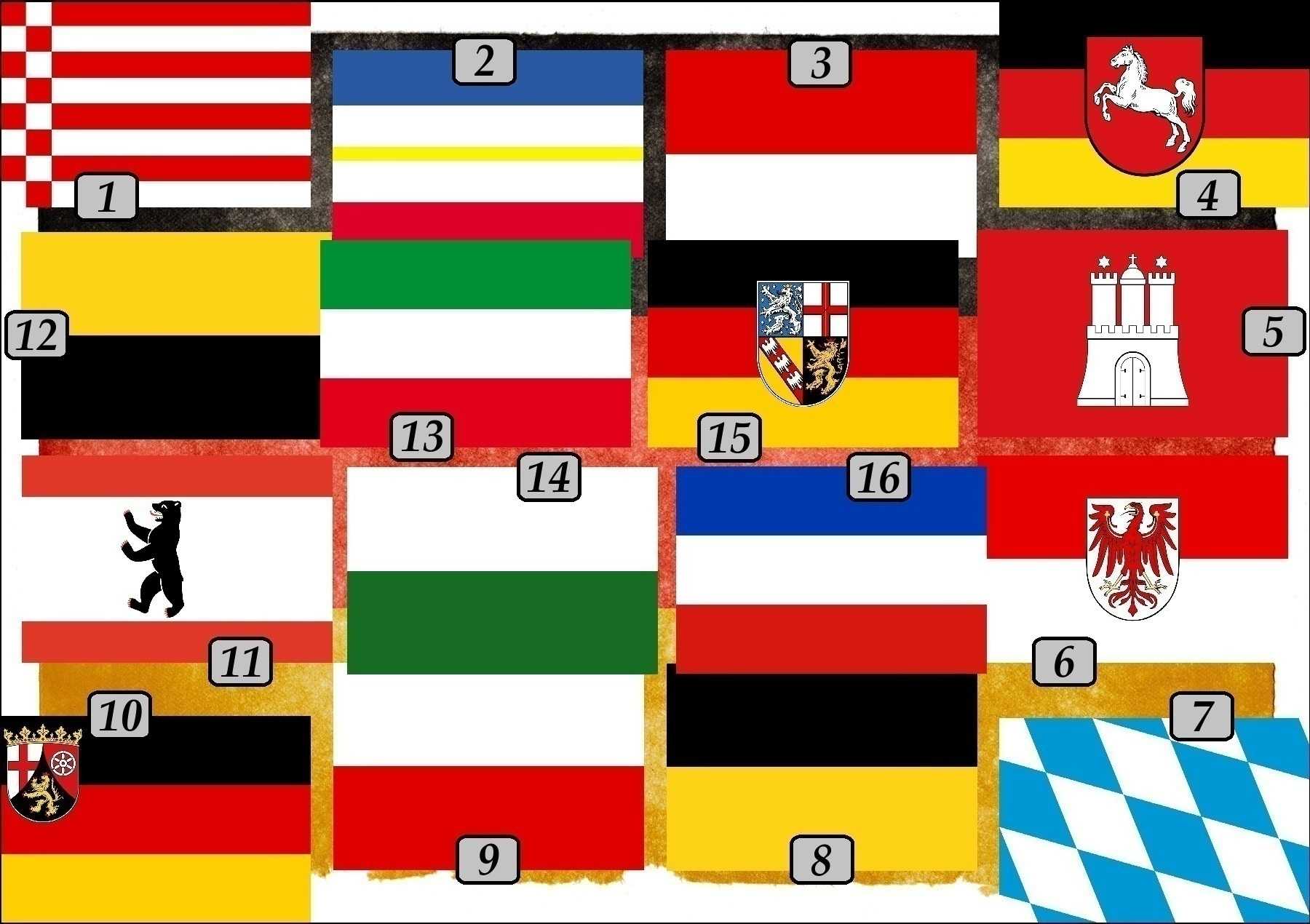
Germany is made up of 16 federal states, each with its own flag and history. Some designs date back centuries, while others emerged after reunification. Can you identify them all? (The flags are not arranged geographically or alphabetically.)
ThuringiaRhineland-PalatinateBaden-WürttembergBremenLower SaxonyHamburgMecklenburg-VorpommernBavariaSchleswig-HolsteinSaxony-AnhaltSaxonySaarlandBrandenburgNorth Rhine-WestphaliaHesseBerlin* Drag / drop or click on the choices above to move them to the answer list. View Image Attributions for This Quiz
Bremen's distinctive flag is nicknamed the Speckflagge ("bacon flag") because of its many alternating red and white stripes. The modern state flag was officially adopted in 1952 and reflects Bremen's long history as a Free Hanseatic City.
The red and white colours have been associated with Bremen since the Middle Ages. In official versions of the flag, the state's coat of arms appears in the centre, featuring the Silver Key of Saint Peter, the patron saint of Bremen. This key is one of Germany's most recognizable heraldic symbols.
2. Mecklenburg-Vorpommern
The flag of Mecklenburg-Vorpommern was adopted following German reunification in 1991. Its five horizontal stripes of blue, white, yellow, white, and red combine the traditional colours of the state's historic regions.
The blue and white are associated with the former region of Western Pomerania (Vorpommern), while the blue, yellow, and red derive from Mecklenburg. Together, the colours symbolize the reunification of the two historic regions into a single federal state. Mecklenburg-Vorpommern is Germany's least densely populated state and is known for its extensive Baltic Sea coastline and hundreds of lakes.
3. Hesse
Hesse's flag consists of two horizontal stripes of red and white and was adopted in 1949. The colours have deep historical roots dating back to the medieval Landgraviate of Hesse and have been associated with the region for centuries.
The state occupies a central position in Germany and is home to Frankfurt am Main, one of Europe's most important financial centres. Red and white have appeared on Hessian banners and military standards since the Middle Ages, making this one of Germany's most traditional state flag designs.
4. Lower Saxony
Lower Saxony adopted its flag in 1951. It uses Germany's national colours of black, red, and gold, reflecting the state's place within the Federal Republic.
The state coat of arms features a white horse, known as the Saxon Steed. This symbol has been associated with Saxon peoples for centuries and remains one of the best-known regional emblems in Germany.
5. Hamburg
The flag of Hamburg is one of Germany's oldest state flags, having existed in its present form since the nineteenth century and retaining its modern status after 1952. It consists of a white castle on a red field.
The castle reflects Hamburg's long history as a Free and Hanseatic City. The three towers symbolize the city's strength and independence, while the closed gate is traditionally interpreted as a sign of security rather than exclusion.
6. Brandenburg
Brandenburg adopted its modern flag in 1991 following the re-establishment of the state after German reunification. It consists of two horizontal stripes, red above white.
At the centre of the official state flag is the red eagle of Brandenburg, a symbol that dates back centuries. The eagle has long represented the rulers of Brandenburg and remains one of the most recognizable symbols of eastern Germany.
7. Bavaria
Bavaria's flag is among the most famous regional flags in the world. Officially adopted in 1949, it features the distinctive white and blue diamond pattern associated with the Wittelsbach dynasty, which ruled Bavaria for centuries.
The blue and white lozenges have become synonymous with Bavarian identity and can be seen throughout the state, particularly during Oktoberfest celebrations. Bavaria is Germany's largest state by area and was once an independent kingdom before becoming part of a unified Germany in the nineteenth century.
8. Baden-Württemberg
The state of Baden-Württemberg was created in 1952 through the merger of several post-war states, and its flag was adopted shortly afterward. It consists of two horizontal stripes of black and gold.
The colours have long historical associations with parts of southwestern Germany. Today, Baden-Württemberg is one of Germany's most prosperous states and is widely associated with engineering and manufacturing. Stuttgart, the state capital, is home to both Mercedes-Benz and Porsche.
9. Thuringia
Thuringia adopted its current flag in 1991 after German reunification. The flag consists of two horizontal stripes of white and red, colours that have been associated with the region since medieval times.
Often referred to as the "Green Heart of Germany," Thuringia lies near the geographical centre of Germany and is known for its forests and mountains. The state is also associated with several important figures in German history, including Johann Sebastian Bach and Johann Wolfgang von Goethe.
10. Rhineland-Palatinate
Rhineland-Palatinate adopted its flag in 1948. It combines Germany's national colours of black, red, and gold with the state's coat of arms in the upper corner.
The coat of arms combines symbols from three historic territories: the lion of the Palatinate, the cross of Trier, and the wheel of Mainz. Together they reflect the state's diverse historical foundations.
11. Berlin
Berlin's flag was adopted in 1954 and consists of a broad white band between two red stripes. At its centre is the city's famous black bear.
The bear has been associated with Berlin for centuries and is the city's best-known symbol. While the exact origin of the bear is debated, it has become inseparable from Berlin's identity and appears throughout the city.
12. Saxony-Anhalt
Following German reunification, Saxony-Anhalt adopted its modern flag in 1991. It features two horizontal bands of yellow and black, colours historically associated with Saxony.
The state's unusual name reflects its origins as a union of territories associated with both Saxony and Anhalt. Saxony-Anhalt contains several UNESCO World Heritage Sites and played an important role in the Protestant Reformation. The city of Wittenberg, where Martin Luther began the movement in 1517, is located here.
13. North Rhine-Westphalia
North Rhine-Westphalia adopted its flag in 1953. It consists of three vertical stripes of green, white, and red, reflecting the colours of the territories that were merged to create the state following the Second World War.
Despite being one of Germany's youngest states, it is also its most populous. The green represents the Rhineland, while the white and red derive from Westphalia. Today, North Rhine-Westphalia contains several of Germany's largest cities, including Cologne, Düsseldorf, and Dortmund.
14. Saxony
Saxony reintroduced its state flag in 1991 after German reunification. The flag features horizontal white and green stripes, colours that have long been associated with Saxony.
The exact origins of the green-and-white colour scheme are somewhat uncertain, although they have been used since the nineteenth century and became firmly established as Saxon colours. The state includes the historic cities of Dresden and Leipzig, both of which played important roles in German cultural and political history.
15. Saarland
The flag of Saarland was adopted in 1957 when the territory joined the Federal Republic of Germany. It uses the national German colours of black, red, and gold.
The coat of arms reflects Saarland's position along Germany's western frontier and its long history of French and German influence. Its four quarters represent the historical territories of Nassau-Saarbrücken, Trier, the Duchy of Lorraine, and the Palatinate-Zweibrücken.
16. Schleswig-Holstein
Schleswig-Holstein adopted its current flag in 1948. It consists of three horizontal stripes of blue, white, and red, combining the colours of the historic duchies of Schleswig and Holstein.
Germany's northernmost state is bordered by both the North Sea and the Baltic Sea. The flag's colours were first used during the nineteenth-century movement that sought to unite Schleswig and Holstein, and they remain a strong symbol of regional identity today.
This quiz was reviewed by FunTrivia editor stedman before going online.
Any errors found in FunTrivia content are routinely corrected through our feedback system.