Renowned is the name Taj Mahal of Agra, India! Since 1983 it has been a UNESCO World Heritage Site--a masterpiece of beauty, Mughal architecture and East Indian heritage, as well as a profound homage to love.
The Taj Mahal was built in 1631 at the behest of the 5th Mughal emperor, Shah Jahan the Magnificent (1592-1666). He commissioned it in stunning white marble on the bank of the Yamuna River as a mausoleum in memory of his wife and political partner Mumtaz Mahal (1612-1631).
Agra is a large metropolis in Uttar Pradesh, India, southeast of Delhi. It was the grand capital of the Mughal Empire, an advanced cultural, religious and business center. Today it is a major tourist city, famous for its cuisine.
2. Angkor Wat
Answer: Siem Reap, Cambodia
Renowned is the name Angkor Wat in Siem Reap, Cambodia. This Hindu-Buddhist temple is said to be the largest religious monument in the world, and is a UNESCO World Heritage site. It was built in the 12th century as a capital dedicated to the Hindu god Vishnu, but it was later sacked, restored and then converted to a Buddhist temple in the late 12th century. Angkor Wat is a modern name meaning "Temple City".
The Khmer Empire declined due to severe droughts and heavy flooding, internal power struggles, and increased trade at the coasts, so the temple was much neglected and the capital moved to the coast. In the 16th century, the city was re-discovered hidden in the forest, described as extraordinary and grand. In 1992 after much preservation and restoration progress, Angkor was removed from the World Heritage in Danger list. The best visiting season is November to February, in modest dress. Shorts are not allowed. A favorite activity is to watch the sun rise over the towers, said to be captivating and magical, if crowded. Total visitors for 2025 was estimated at four million.
3. Machu Picchu
Answer: Peruvian Andes
Renowned is the name Machu Picchu, the "old peak" in the Peruvian Andes! This ancient city is among the New Seven Wonders of the World, as well as a UNESCO World Heritage Site. Located high on the slopes, this stone ruin is an Inca wonder built for the Emperor Pachacuti.
It is much admired for its precision engineering and stonework, sophisticated agriculture and advanced water management. Its exact purpose, and the reasons it was abandoned just 80 years later, are a mystery. Many visitors say they are spiritually transformed after a visit.
As this is a sacred site, there are no "obscene acts" allowed, such as lying down, undressing or running. One cannot use a selfie stick, or wear a kilt or any other cultural dress.
4. Mount Rushmore
Answer: Black Hills, South Dakota
Renowned is the name Mount Rushmore in the Black Hills of South Dakota! Near Keystone, South Dakota, stands the Mount Rushmore National Memorial "Shrine of Democracy". Sculptor Gutzon Borglum, his wife and his son Lincoln carved four sculpted heads 60 foot tall (18 m) into the granite of the mountain. George Washington represents the birth and foundation of the nation; Thomas Jefferson growth; Theodore Roosevelt development and Abraham Lincoln preservation of these United States. The monument is on the National Register of Historic Places.
Unfortunately these sculptures are on land taken from the Sioux Native Americans in the 1870s, related to the Black Hills Gold Rush, the Great Sioux War of 1876 and the breaking of The Treaty of Fort Laramie (1868) that granted the Sioux rights to their Black Hills "forever". A 1980 U.S. Supreme Court ordered $102 million compensation be given to the Sioux, but they declined the money, so it remains an ongoing heartbreak and dispute. American Indian activists occupied the monument in 1971. Borglum had connections to the Ku Klux Klan. In 2025 a bill introduced to the House sought to add President Trump's head to the monument, although there is no space for additions. There is a time capsule hall near Lincoln's head, and increased concerns over high levels of chemicals released by annual fireworks displays. Altogether this is a unique, fascinating, controversial, beautiful and thus very American place, like no other.
5. The Acropolis
Answer: Athens, Greece
Renowned is the Acropolis of Athens, Greece! The Acropolis is a citadel, from the Italian "cittadella", meaning small city, often a castle or stronghold. In this case it is a rocky spot high above Athens, formed by several ancient and architecturally wondrous buildings.
Dedicated to the city's ancient goddess Athena, visitors tour the famous Parthenon, a stunning temple built upon the original temple erected about 580 BCE, and an additional temple which Xerxes destroyed in 480 BCE. Pericles had the shrine rebuilt in 447 BCE, possibly with misappropriated funds. Romans used the site, Christians worshipped there, and the Ottoman Empire occupied it as headquarters and a mosque. After 1832 it became an architectural site, and in 1987 a UNESCO World Heritage site. A limit of 20,000 people per day can visit and marvel, so as to safeguard its structural integrity. The Parthenon is just one acclaimed structure. There's also the Erechtheion, the Propylaea, and the Temple of Athena Nike, each constructed in the 5th century BC, less known, yet the stuff of legend.
6. Neuschwanstein Castle
Answer: Schwangau, Germany
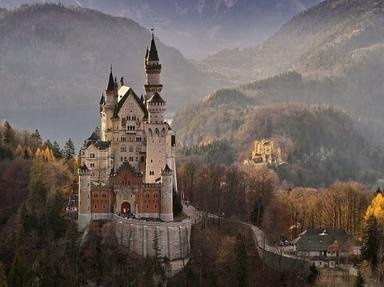
Renowned is the name Neuschwanstein Castle of Schwangau, Germany! In 1864 Ludwig II, the young King of Bavaria (1845-1886), "Our Cherished King", determined to rebuild a castle ruin into a magnificent beauty, and then live in it. When he was deposed and committed suicide, or was murdered, the castle became a public destination.
Today, despite harsh weather and a steep rocky climb, about 6,000 people come to the Alps to walk through Neuschwanstein Castle every day. It is a " fairy-tale" castle, dramatic and breathtaking, with chapel, courtyards, galleries, frescoes, stained glass and much representation of Ludwig's friend and opera composer Richard Wagner. Ludwig II wrote to Wagner that he envisioned the castle as "holy and unapproachable".
A 2025 tourist website warns visitors to leave behind bulky items such as prams and backpacks, weapons of any kind, all animals, and no drones may be launched, flown over or landed at the castle. Nor is it allowed to take photographs inside. You must park at or take a train or bus to the village of Hohenschwangau, then walk a steep path to the castle. Cars and bicycles are not allowed on this path. There is a horse-drawn carriage which takes tourists within a short, uphill walking distance. All to say, this is a site unapproachable, but well worth the planning and experience.
7. Leaning Tower
Answer: Pisa, Italy
Renowned is the name Leaning Tower of Pisa! Completed in 1372 the tower was originally called "Torre di Pisa", the Tower of Pisa's Cathedral, located in Pisa, Italy. During the 12th century, after the second floor was created in 1178, the tower began to lean due to soft ground and excessive weight. Because of ongoing battles all progress stopped, which happily gave the tower time to settle. When construction resumed in 1264 they made one side taller than the other, creating a curve. The Leaning Tower was stabilized by 2001, so it may retain but not increase its tilt of 3.97 degrees. The original architect is unknown.
The Leaning Tower has nearly 300 steps, which I climbed, like some 5 million other visitors each year, up a memorably narrow stairwell. Galileo, a Pisa resident, climbed the Leaning Tower to do an experiment. During WWII the tower was saved by a U.S. Army sergeant impressed with its beauty. In August of 2023 the Leaning Tower of Pisa had its 850th birthday.
8. Blue Mosque
Answer: Istanbul, Turkey
Renowned is the name Blue Mosque! Located in Istanbul, Turkey, the inside of this mosque is decorated with thousands of intricately designed blue Iznik tiles and 260 windows, while outside is a massive dome, eight smaller domes, and six minarets. Sultan Ahmed I was just 19 when he had this sacred site built in 1609-1617, upon the remains of the Great Palace of Constantinople. Ahmed wanted to display Ottoman power, and surpass the nearby Hagia Sophia. Tourists must dress modestly, remove shoes, and women cover their heads.
The mosque is a functioning place of worship, thus five times each day it is open only to Muslims in prayer. It once contained a hospital, school, market and tomb as well as a soup kitchen. This architectural splendor is a UNESCO World Heritage site.
9. Petra
Answer: Wadi Musa, Jordan
Renowned is the name Petra! Located in Wadi Musa, Jordan, Petra covers 264 square miles. The "Rose City" is carved right into the mountains, with temples, tombs, a theatre, a dam and much more. This ancient city was a prosperous crossroads for commercial and cultural trade, and the home of the nomadic Arab tribe Nabataeans.
The Biblical Moses traveled through Petra (called Sela) during his Exodus. Jealous of their wealth, Greek general Antigonus launched a failed attacked on Petra in 312 B.C. In 2024 a 2,000-year-old sealed tomb was discovered beneath Petra, another historical intrigue. It is said it takes two to three days to explore this massive and astounding place.
10. Terracotta Army
Answer: Near Xi'an, China
Renowned is The Terracotta Army! Near Xi'an, China more than 130 chariots, 520 horses and eight thousand warriors made of yellow clay were discovered in 1974 by local farmers. These figures were decreed by and then buried with the Chinese emperor Qin Shi Huang in 210-29 BCE, to guard him in the afterlife.
It is estimated it required 700,000 workers to mold these amazing warriors, who bear unique hairstyles, hats, shoes, facial hair, hands and ears. They are armed with real bronze weapons. Each is about six feet (1.8 meters) tall, and some scholars believe each represents a person who lived at the time.
This quiz was reviewed by FunTrivia editor trident before going online.
Any errors found in FunTrivia content are routinely corrected through our feedback system.