FREE! Click here to Join FunTrivia. Thousands of games, quizzes, and lots more!
Spicy Colours Trivia Quiz
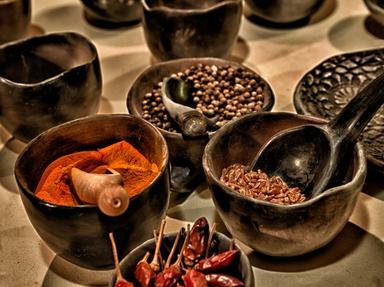
Step into a vibrant world of flavour! Can you identify these global staples by sight alone? Herbs and spices can be from fiery crimsons to obsidian dark, so put your culinary intuition to the ultimate sensory challenge.
A classification quiz
by LeoDaVinci.
Estimated time: 3 mins.
Paprika is a versatile powder produced by grinding the dried pods of various peppers within the 'capsicum annuum' species, in normal speak, dried peppers. Depending on the variety used, its flavour can range from delicate and sweet to intensely smoky or pungent.
Historically associated with Hungarian and Spanish cuisines, it is prized for its ability to provide a deep, brick-red base to stews and dry rubs. Because it contains high levels of natural sugars, it can scorch easily if exposed to high direct heat, so it is often stirred into warm oil or liquid to release its colour and earthy aroma safely.
2. Sumac
Answer: The Red Hots
Sumac comes from the dried and ground berries of the wild sumac flower, a shrub that thrives throughout the Mediterranean and parts of the Middle East. It is easily identified by its coarse texture and dark burgundy hue. Unlike its pepper-based neighbours, sumac offers a sharp, acidic profile that is remarkably similar to fresh lemon juice, though this in powdered form.
This makes it an essential finishing touch for fatty meats, salads, and rice dishes where a pop of brightness is needed without adding liquid.
It is a key component in the za'atar herb blend (a wild oregano mixed with other spices, amongst them our aforementioned sumac), providing both visual contrast and tartness.
3. Annatto
Answer: The Red Hots
Annatto is derived from the seeds of the achiote tree. This is one that is native to tropical regions of the Americas. Often looked down upon as "the poor man's saffron", these small, triangular seeds are an intense shade of rust-red. While they have a mild, peppery, and slightly floral flavour, they are primarily used as a powerful natural dye.
In commercial food production, annatto is the secret behind the orange tint of cheddar cheese and certain butters. To use it at home, the seeds are typically infused into warm oil or lard.
This results in a vibrant liquid that adds character to the entire dish.
4. Saffron
Answer: The Red Hots
Saffron consists of the hand-harvested stigmas of the saffron crocus, making it the most expensive spice by weight in the entire world. In fact, kilo per kilo, saffron is actually more expensive than gold (even with increases to gold prices steadily). Each flower produces only three tiny crimson threads, of which each must be plucked with *extreme* care. Saffron offers a complex, hay-like fragrance with a subtle metallic sweetness that defines dishes like paella and risotto. It is cherished not just for its luxury, but for its unique chemical compounds that provide a sensory experience unlike any other spice. Even a tiny pinch is enough to transform a simple pot of rice into a fragrant, gourmet centerpiece.
The rich red colour of saffron threads comes from its high concentration of carotenoids, specifically crocin. Now, once these threads hit water or fat, the crocin dissolves and releases a brilliant, sunny yellow pigment into the surrounding food. Thus the difference in colour between raw and cooked saffron.
5. Oregano
Answer: The Fresh Greens
Often called the "joy of the mountains," oregano is a hardy perennial herb that has been a staple of Mediterranean life for millennia. Unlike many herbs that lose their character when processed, oregano is unique because its flavor actually gets more intense when it's dried, as the essential oils become more concentrated. It offers a bold, peppery profile with a slight bitterness and a cooling undertone that cuts through rich, savoury fats.
While it is the undisputed backbone of Neapolitan pizza and tomato-based pasta sauces, its versatility extends far beyond the Italian typical cuisine. It is equally vital in Mexican dishes, where a slightly different citrus-forward variety defines slow-roasted meats and earthy chili rubs.
6. Parsley
Answer: The Fresh Greens
Often considered the world's most popular herb, parsley is much more than a simple garnish. It is a member of the carrot family and is generally found in two main varieties: the robust, peppery flat-leaf (Italian) and the mild, decorative curly-leaf. While its flavour is clean and slightly grassy, it acts as a powerful flavour enhancer, much like salt, brightening the other ingredients in a dish and providing a fresh lift to heavy sauces and stocks.
Beyond its culinary uses, parsley is a nutritional additive, packed with high concentrations of vitamin K, vitamin C, and antioxidants. Historically, it was used by ancient Greeks and Romans not just for food, but as a symbol of rebirth and as a natural palate cleanser (especially if you ate garlic and are just about to go on a date).
7. Sage
Answer: The Fresh Greens
Sage consists of the fuzzy, grey-green leaves of a woody perennial shrub, known more simply as a hardy evergreen from the mint family. It is easily recognized by its soft, velvety texture and a potent, aromatic profile that carries notes of pine and eucalyptus. Unlike delicate herbs, sage is remarkably sturdy; its flavour actually improves when fried in butter or oil, which mellows its slight bitterness and releases a warm, savoury depth.
This makes it an essential pairing for heavy ingredients like squash, pork, and poultry, where it provides an earthy backbone that can withstand long roasting times without losing its character.
8. Thyme
Answer: The Fresh Greens
Thyme consists of the tiny, tear-shaped leaves of a low-growing woody shrub, which is actually a member of the mint family. It is easily identified by its grey-green hue and its incredibly thin, wiry stems. Unlike many herbs that are best used fresh, thyme is highly resilient and maintains its sharp, earthy profile with hints of lemon and pine even after being dried or subjected to long cooking times.
Since its essential oils, specifically the aptly-named thymol, are released slowly, it is a staple for slow-cooked stews, stocks, and roasted meats where it provides a subtle, savoury base without overpowering other ingredients. It is a fundamental component of a 'bouquet garni' (along with bay leaves and parsley), providing a steady, herbaceous depth that bridges the gap between different flavours in a pot.
9. Peppercorn
Answer: The Midnight Blacks
Black peppercorns are the dried berries of a tropical climber vine with a kick of flavour. They are characterized by their dark, wrinkled exterior and a biting, pungent heat that stems from the chemical compound called piperine. Unlike the searing burn of a chili pepper, black pepper offers a complex, woody aroma with sharp citrus undertones that enhance the natural flavours of almost any savoury food. Because the volatile oils begin to dissipate as soon as the spice is ground, it is most prized when cracked fresh, providing a crisp, spicy bang that acts as the universal counterpoint to salt.
It is, therefore, the cornerstone of the world's spice trade, universally known and accepted, and, thus, essential.
10. Nigella
Answer: The Midnight Blacks
Nigella consists of the small, matte-black seeds of an annual herb belonging to the buttercup family. They are easily identified by their triangular shape and a charcoal-like appearance that looks similar to black sesame. Unlike most seeds, nigella offers a strange, slightly medicinal flavour that bridges the gap between toasted onion, black pepper, and oregano. Because the seeds are encased in a sturdy husk, they are often dry-roasted or tempered in hot oil to release their nutty aroma and crunchy texture.
It is a staple finishing touch for Middle Eastern and South Asian flatbreads like naan, providing a striking visual contrast and a savoury, aromatic pop that defines the crust.
11. Urfa Biber
Answer: The Midnight Blacks
Urfa biber consists of the sun-dried flakes of a Turkish isot pepper, which undergoes a unique "sweating" process where the peppers are wrapped in plastic at night to preserve their natural oils. It is easily identified by its deep, near-black colour. It has a moist and slightly oily texture that sets it apart from standard crushed red pepper.
Unlike the sharp, direct heat of many chilies, urfa biber offers a slow-building warmth with a complex profile reminiscent of raisins, chocolate, and coffee. Since it is cured with a touch of salt and oil during the drying process, it provides a rich, smoky depth and a salty-sweet finish.
12. Vanilla bean
Answer: The Midnight Blacks
Vanilla beans are the long, slender seed pods of a specific orchid - the only orchid in the world that produces an edible fruit. It's actually native to Central and South America, but is produced today primarily in Madagascar. They are easily identified by their dark, waxy exterior and a supple texture that indicates the presence of thousands of microscopic black seeds inside. Unlike most spices, vanilla requires an incredibly labour-intensive process: each flower must be hand-pollinated within a few hours of opening to produce a pod.
Vanilla offers a deep, creamy aroma with complex notes of oak, smoke, and cherry that provide the aromatic backbone for nearly every single confectionery. The intense flavour is concentrated in both the dark seeds and the oily pod. When opening, the pod split open to infuse liquids, releasing a signature floral sweetness that transforms a simple dish to an elevated masterpiece.
This quiz was reviewed by FunTrivia editor Bruyere before going online.
Any errors found in FunTrivia content are routinely corrected through our feedback system.