
FREE! Click here to Join FunTrivia. Thousands of games, quizzes, and lots more!
Quiz about Illuminate And Label Me

Illuminate (And Label) Me! Trivia Quiz


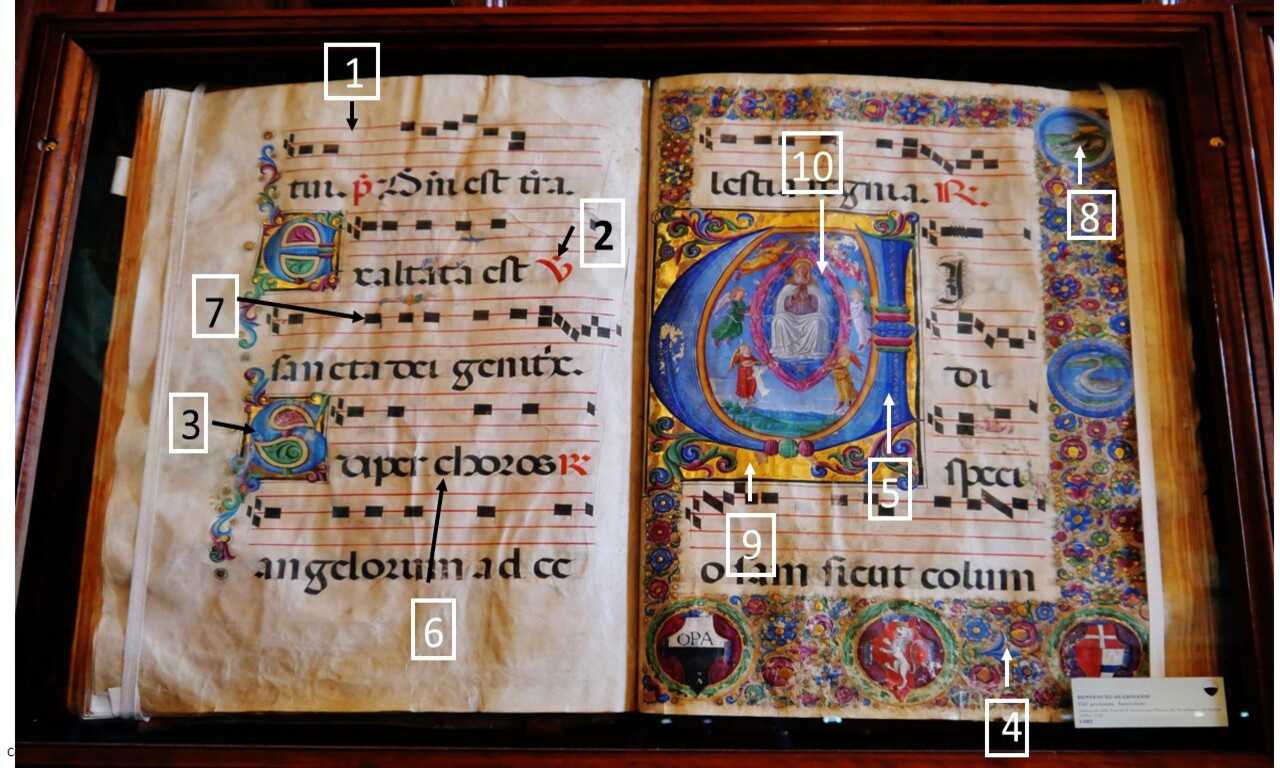
Illuminated manuscripts were the 'scrapbooks' of ancient times. They are handwritten books where the text is supplemented by various decorations. Label the various parts of this illuminated manuscript example.

A label quiz by stephgm67. Estimated time: 3 mins.
  1. Home
  2. »
  3. Quizzes
  4. »
  5. Humanities Trivia
  6. »
  7. Design Applied Art

Author
stephgm67
Time
3 mins
Type
Label Quiz
Quiz #
422,513
Updated
Jan 03 26
# Qns
10
Difficulty
Tough
Avg Score
6 / 10
Plays
51
Last 3 plays: Strike121 (0/10), Emma-Jane (10/10), lethisen250582 (10/10).
Click on image to zoom
Historiated initial Miniature Parchment Marginalia Border Script Neumes Rubric Gold leaf Decorated initial
* Drag / drop or click on the choices above to move them to the answer list.
View Image Attributions for This Quiz
1.   
2.   
3.   
4.   
5.   
6.   
7.   
8.   
9.   
10.   

Most Recent Scores
Today : Strike121: 0/10
Today : Emma-Jane: 10/10
Jan 04 2026 : lethisen250582: 10/10
Jan 04 2026 : toonces21: 6/10
Jan 04 2026 : car101: 4/10
Jan 04 2026 : Guest 71: 10/10
Jan 04 2026 : Morrigan716: 5/10
Jan 04 2026 : morel5555: 3/10
Jan 04 2026 : Cymruambyth: 6/10

Quiz Answer Key and Fun Facts
1. Parchment

Parchment was the primary writing surface for illuminated manuscripts. It was made from prepared animal skins, usually sheep, goats, or calves, and provided a high-quality, long-lasting product for scribes and artists before the widespread availability of paper.

Animal hides were first soaked in water and then in a lime bath before the hair was scraped off with a knife. Then it was stretched onto a frame until it reached the desired thinness for the manuscript. Finally, after it was dry it was rubbed with chalk to give it a smooth finish for the paint and ink that was to come.
2. Rubric

In an illuminated manuscript, a rubric is text, often a heading, title, or instruction, that is written or highlighted in red ink to set it apart from the main body of the text. It can also be a single letter or initial. The word rubric comes from the Latin word "rubrica", meaning "red earth".

Rubrics acted as navigational aids, allowing a reader flipping through a manuscript to quickly locate specific sections, chapters, or major divisions of a text. The bright red color drew immediate attention to important information. Adding these was a separate, later stage in the manuscript production process when a specialized craftsperson called a rubricator would fill in spaces with red ink.
3. Decorated initial

An illuminated initial is an enlarged and highly decorated capital letter that begins a new section of text in a manuscript. It's both beautiful and provides essential navigational and organizational structure for the reader.

These initials are significantly larger than the main body text, often spanning several lines of writing. They were created using expensive mineral pigments (such as lapis lazuli for blue) and applied by a skilled artist called an illuminator. A decorated initial featured elaborate patterns or pen-work, but did not usually include figures.
4. Border

A border is a decorative frame that surrounds the main text block in an illuminated manuscript. It enhances the page's appearance, lends coherence to the layout, and sometimes includes additional visual aspects within it.

The main purpose of the border was to create a clear and aesthetically pleasing page structure. They also added richness and value to the book. If there was gold or silver leaf in the border, it highlighted the status of the book's owner. In later medieval manuscripts, borders often included figures, animals, and complex motifs (such as swirling leaves or vines) that often related to the text.
5. Historiated initial

A historiated initial is a very elaborate, enlarged capital letter at the beginning of a section of text in an illuminated manuscript. It contains an identifiable narrative scene or figures directly related to the content of the text it introduces.

The image inside the letter functions as a miniature illustration, summarizing or depicting the events, people, or concepts described in the text that follows. It is also a powerful visual bookmark, allowing readers in the Middle Ages to quickly find major divisions, chapters, or specific psalms within the manuscript. The imagery within the initial helped to explain or conceptualize the text's meaning for those people who were illiterate or semi-literate.
6. Script

The script, or handwriting, in an illuminated manuscript was a central element of its creation, carefully executed by a professional scribe using specific tools. The scribe would use a quill pen, usually made from the feathers of a goose or swan. The scribe would then cure the feather and cut the tip with a pen knife to create a nib suitable for writing.

The main body of the text was typically written in a brown-black ink made from oak galls (which are wart-like growths on an oak tree), iron sulfate, and a binder. There were multiple script types that evolved over the centuries ranging from rounded, capital letters to dense, angular black letters. The specific style of an individual's handwriting was referred to as their "hand".
7. Neumes

Neumes are an early form of musical notation found in illuminated manuscripts that were used to represent pitches and melodic contours of song or chant. The earliest neumes (9th-10th centuries AD) were "staffless". They were written freely above the text, indicating general direction and the number of notes.

In the later Middle Ages (by the 13th century AD), neumes evolved into the standardized square notation still used for Gregorian chant today, featuring square and diamond shapes. In illuminated manuscripts, neumes were often written in black ink, while surrounding elements might be decorated with vibrant pigments or gold leaf, turning the page into both a musical guide and a work of art!
8. Marginalia

Marginalia are notes, diagrams, or illustrations made in the blank spaces surrounding the main text block of a manuscript page or within the border itself around the text. They could be part of the original, planned decoration or later additions by readers and artists. They can be doodles or depictions of animals, coat of arms, monsters, pastoral scenes, and much more.

There are many theories as to why marginalia are included in illuminated manuscripts. Some experts feel it adds a "break" from the monotony of text or musical notes. Some say it is a social commentary on the subject matter. Other scholars believe scribes and artists simply disliked empty space and filled it with decoration.
9. Gold leaf

In an illuminated manuscript, gold leaf is an extremely thin sheet of genuine gold, hammered to a delicate form, that was applied to pages to create a radiant, shimmering effect. This artistic work is what gave the manuscripts their name of "illuminated". Gold leaf was applied to important elements such as initial capital letters and borders.

The application of gold leaf, known as gilding, was a painstaking process performed by a skilled artist called an illuminator after the scribe had completed the main text. A glue-like type of adhesive was applied in multiple layers to give a 3-D like appearance. Then the gold leaf was lifted with a soft brush and quickly placed onto the moistened adhesive. Finally, it was polished to a high shine.
10. Miniature

A miniature is a small, detailed illustration or painting within an illuminated manuscript. The word miniature does not refer to the small scale of the image, but rather comes from the Latin verb "miniare", meaning "to color with minium". They depicted specific religious scenes, historical events, myths, legends, or daily life, directly illustrating the stories and information presented in the accompanying text.

They could be full-page miniatures or dotted within the text lines themselves. They could also be embedded within the shape of a historiated initial. Artists, or "illuminators" and "miniaturists," worked with fine brushes and rich pigments to create these works of art in the manuscript.
Source: Author stephgm67

This quiz was reviewed by FunTrivia editor looney_tunes before going online.
Any errors found in FunTrivia content are routinely corrected through our feedback system.
1/5/2026, Copyright 2026 FunTrivia, Inc. - Report an Error / Contact Us