FREE! Click here to Join FunTrivia. Thousands of games, quizzes, and lots more!
A Pirate's Take On Jekyll Island's Geography Quiz
I adopted this quiz because I grew up in Georgia and visited Jekyll Island often. At the time I was fascinated with the pirate history there. So this quiz is about the unique geography at the site (and how it may help a pirate). This is a renovated/adopted version of an old quiz by author theanvil
A collection quiz
by stephgm67.
Estimated time: 3 mins.
Last 3 plays: Dizart (0/10), Guest 104 (3/10), JanIQ (8/10).
From the selection, choose the ten geographic features that pertain to Jekyll Island in the state of Georgia. Leave out the ones that would NOT be found there.
There are 10 correct entries. Get 3 incorrect and the game ends.
Freshwater aquifers Deep water harbor Salt marshes Coral reefs High dunes Gulf stream proximity Barrier island Sloping beaches Maritime forests Shifting sandbars Cloud forestsVolcanic basalt cliffs Tidal creeksShallow inlets Limestone karst caves
Left click to select the correct answers. Right click if using a keyboard to cross out things you know are incorrect to help you narrow things down.
Most Recent Scores
Today
:
Dizart: 0/10 Today
:
Guest 104: 3/10 Today
:
JanIQ: 8/10
May 08 2026
:
lancer1972: 9/10
May 08 2026
:
Guest 76: 10/10
May 08 2026
:
Guest 70: 8/10
May 08 2026
:
feuematt1: 9/10
May 08 2026
:
Guest 75: 9/10
May 08 2026
:
Guest 75: 10/10
Quiz Answer Key and Fun Facts
Answer:
Shallow inlets: Jekyll is flanked by St. Simons Sound to the north and Jekyll Sound to the south. These areas are always reshaped by the Atlantic Ocean tides and river silt. The waters around can be as shallow as 2 feet (.6 m). This would aid a pirate as they utilize light and fast ships that can handle the low depths.
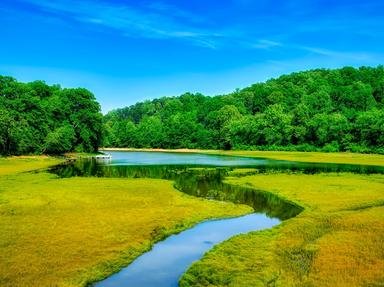
Salt marshes: The famous salt marshes of Glynn cover the western part of Jekyll. These areas are filled with thick cordgrass. When the tide goes out, it's a field of deep, sticky mud; when the tide comes in, it becomes a network of thousands of tiny, hidden streams. This would help a pirate because it could act as a natural fortress.
Maritime forests: The center of Jekyll Island is packed with live oak trees and palm trees. The oaks are famous for their massive, horizontal branches that grow wide instead of just tall, often draped in gray Spanish moss. Below the trees, there is a dense wall of saw palmettos (sharp, fan-like plants) that makes it very hard to walk through. Pirates could use the oak for wood and the area itself as camouflage for their camp.
Barrier island: Jekyll is part of a chain of islands. It sits just a few miles off the Georgia coast. Because it is physically separated from the mainland by rivers and marshes, it's like its own little world. Pirates could use the barrier island to watch for ships on the ocean side while keeping an eye out for civil authorities on the mainland side.
High dunes: Jekyll has many ridges of older secondary dunes that run along the length of the island. Some of these sand hills are significantly higher than the beach itself and can reach upwards of 20 feet (6 m) tall. A pirate standing on top of these dunes has a significant viewpoint to watch for potential targets to rob.
Tidal creeks: Jekyll is separated from the mainland by the Jekyll River, but branching off that river are dozens of smaller creeks like Jointer Creek. These creeks are extremely twisty and are hidden by tall marsh grass. For a pirate, these quiet, calm creeks were perfect places to keep a boat for a few days to clean the hull or fix a sail.
Freshwater aquifers: Jekyll sits right on top of a massive supply of fresh water. Because the water table is so high there are many places on the island where natural ponds form, or where water naturally bubbles up. Pirates were masters of the barrel well where they would dig a hole and drop in a wooden barrel with the bottom knocked out, and wait for fresh water to seep in. This gave them a clean, endless supply of water.
Gulf Stream proximity: Jekyll sites right near the Gulf Stream. That is a fast current of warm water that flows from the Gulf of Mexico, up past Florida, and along the Georgia coast toward Europe. Pirates knew that any ship carrying gold from Mexico or sugar from the Caribbean had to use the Gulf Stream to get home and would pass right by them.
Sloping beaches: Jekyll is famous for its wide, flat Atlantic beaches. Because the Georgia coast has very high tides (dropping and rising 6-9 feet or 1.8-2.7 m twice a day), a huge amount of beach is uncovered every few hours, leaving a perfectly smooth, firm surface. As the tide went out, a pirate ship would lean over on its side on the firm sand. Pirates could then walk right up to the bottom of the boat to scrape it clean, patch holes, or paint it with protective tar.
Shifting sandbars: The waters around Jekyll, especially where the sounds meet the Atlantic Ocean, are filled with shoals. Because the Georgia coast has such a high tidal range, a massive amount of water pushes sand around every six hours. This creates a constantly changing maze of sandbars. Pirates spent enough time in these waters to learn the "current" paths through the sandbars. They knew exactly which way to turn to stay in deep water, while an outsider would be guessing.
Jekyll has no volcanic history and therefore no dark, jagged basaltic rock formations or towering cliffs.
Coral reefs require clear, shallow, tropical water to grow, which the Georgia coast does not provide.
Jekyll is surrounded by shallow sounds and shifting sandbars and does not have a natural deep-water harbor.
Jekyll lacks the elevation and high altitude moisture required to form a cloud forest or any kind of mountainous terrain.
The island is mostly on sand and clay and does not have the thick limestone bedrock necessary to create karst caves.
This quiz was reviewed by FunTrivia editor agony before going online.
Any errors found in FunTrivia content are routinely corrected through our feedback system.