FREE! Click here to Join FunTrivia. Thousands of games, quizzes, and lots more!
Quiz about Africas Fiery Side

Africa's Fiery Side Trivia Quiz

Volcanoes of Africa and Nearby Islands

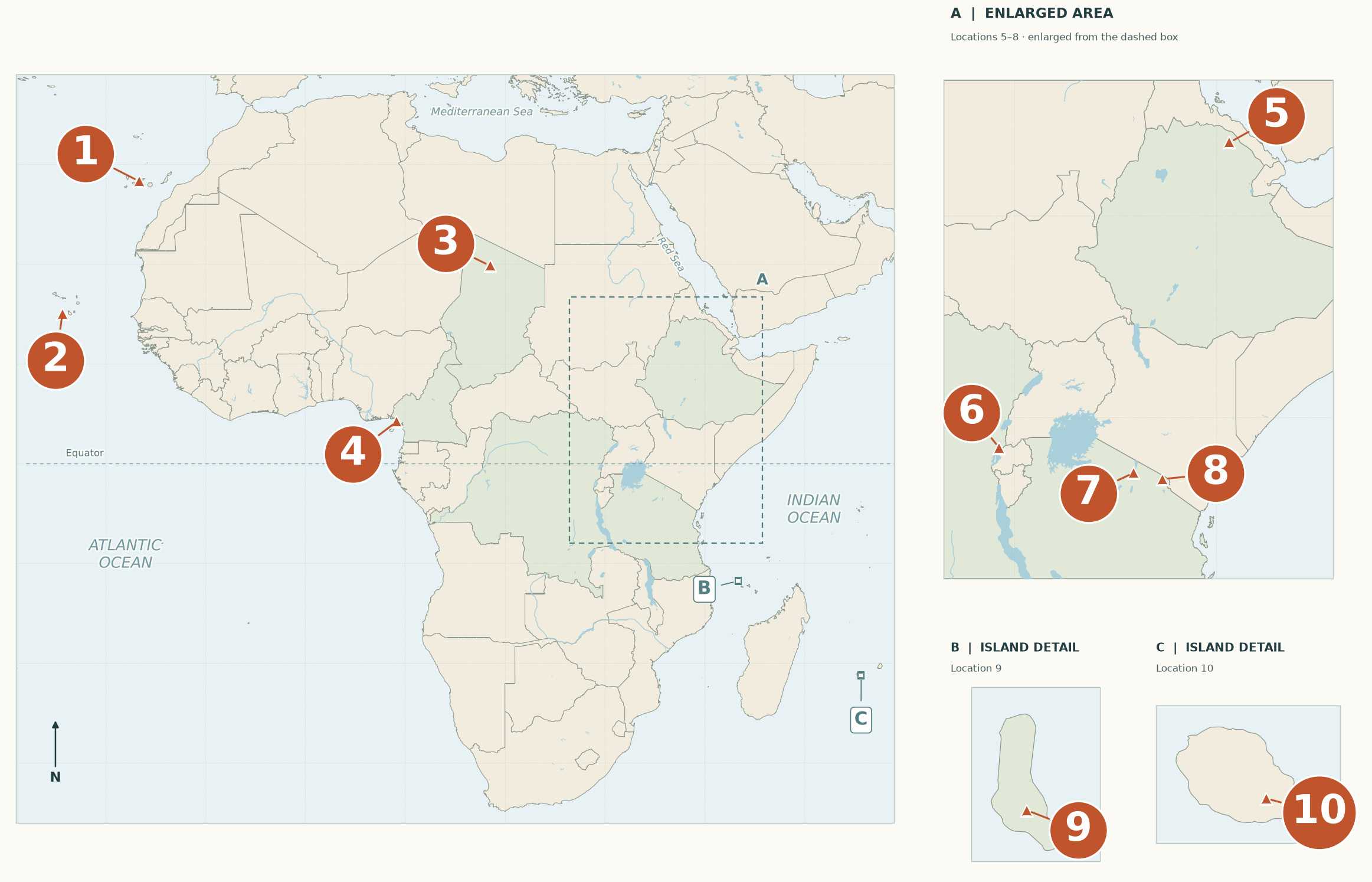
Africa's volcanoes come in many shapes. Match ten volcanic landmarks on the mainland and nearby Atlantic and Indian Ocean islands to their numbered map locations.

A label quiz by SCIENCEKING_00. Estimated time: 3 mins.
  1. Home
  2. »
  3. Quizzes
  4. »
  5. Geography Trivia
  6. »
  7. Africa

Time
3 mins
Type
Label Quiz
Quiz #
426,434
Updated
Nov 12 26
# Qns
10
Difficulty
New Game
Avg Score
7 / 10
Plays
10
Last 3 plays: bernie73 (3/10), masfon (10/10), miner8265 (6/10).
Match each volcano to an orange number. Locations 1-4 are on the main map; 5-8 are in panel A, 9 in B and 10 in C. Letters mark enlarged areas, not answers. Each name is used once. Click the map to enlarge it.
Click on image to zoom
Teide Ol Doinyo Lengai Emi Koussi Mount Cameroon Karthala Fogo Piton de la Fournaise Erta Ale Nyiragongo Kilimanjaro
* Drag / drop or click on the choices above to move them to the answer list.
View Image Attributions for This Quiz
1. Spain's highest peak rises on Tenerife, off northwestern Africa.  
2. This volcano forms much of an island in Cabo Verde, west of Senegal.  
3. This broad volcano in Chad is the highest point in the Sahara.  
4. This volcano overlooks the Gulf of Guinea near Douala.  
5. This Ethiopian shield volcano is famous for lava lakes in its summit pits.  
6. This volcano's 2002 lava flows crossed Goma and reached Lake Kivu.  
7. This Tanzanian volcano south of Lake Natron is known for unusual carbonate-rich lava.  
8. Africa's highest mountain has three main volcanic peaks: Shira, Mawenzi and Kibo.  
9. This shield volcano dominates southern Grande Comore in the Comoros.  
10. This shield volcano occupies southeastern Réunion, east of Madagascar.  

Most Recent Scores
Today : bernie73: 3/10
Today : masfon: 10/10
Today : miner8265: 6/10
Today : xchasbox: 1/10
Today : Guest 128: 6/10
Today : shahbhavik: 10/10
Today : mazza47: 10/10
Today : Guest 195: 1/10
Today : kstyle53: 10/10

Quiz Answer Key and Fun Facts
1. Teide

Teide rises on Tenerife in the Canary Islands, a Spanish island group off northwestern Africa. It is a stratovolcano, a steep-sided volcano built from repeated deposits of lava and other erupted material, and stands within the much larger volcanic landscape of Las Cañadas. Teide National Park became a UNESCO World Heritage Site in 2007, recognising the landforms that reveal how volcanic ocean islands grow and change.
2. Fogo

Fogo island in Cabo Verde is largely one enormous stratovolcano, with the steep Pico cone rising from the broad, bowl-shaped Chã caldera. An ancient collapse removed the eastern side of the older volcanic mountain, leaving the dramatic opening in its rim. During the eruption of 2014-2015, lava from a fissure (a long crack in the ground) spread across the depression and destroyed the villages of Portela and Bangaeira, showing how new eruptions can reshape an inhabited landscape.
3. Emi Koussi

Emi Koussi rises in the Tibesti Mountains of northern Chad and forms the highest point in the Sahara. It is a pyroclastic shield volcano: a broad volcano built largely from fragmented material expelled during explosive eruptions. Two large calderas (basin-like volcanic depressions) sit one inside the other at the summit, while smaller craters, lava domes and flows record later stages of its volcanic history.
4. Mount Cameroon

Mount Cameroon rises close to the Gulf of Guinea on Africa's Atlantic coast. It is a steep-sided stratovolcano surrounded by many smaller cinder cones, hills formed when fragments of erupted lava accumulate around a vent (an opening where volcanic material escapes).

In 1922, lava travelled down its southwestern side and reached the Atlantic coast, a striking example of how closely this mountain's volcanic history is linked to the sea.
5. Erta Ale

Erta Ale lies in northeastern Ethiopia's Danakil Depression, in the Afar region. It is a shield volcano: repeated flows of fluid lava spread out to build broad, gently sloping sides rather than a sharply pointed cone. Reports from 1967 onward document long-lived lava lakes in its summit pits, and later observations show how their surfaces and levels have changed, providing a view of molten rock within an active volcanic system.
6. Nyiragongo

Nyiragongo stands in the Virunga volcanic region of the Democratic Republic of the Congo, just north of Lake Kivu. Although it is a steep-sided stratovolcano, it has produced exceptionally fluid lava and has repeatedly hosted a lava lake in its summit crater.

In January 2002, lava escaped through cracks down its southern side, crossed parts of Goma and entered Lake Kivu, demonstrating that an eruption's effects can extend well beyond the summit crater.
7. Ol Doinyo Lengai

Ol Doinyo Lengai rises south of Lake Natron in northern Tanzania; its Maasai name is usually translated as "Mountain of God". It is a stratovolcano known for carbonatite lava, which is rich in carbonate minerals, the family that includes calcite in limestone. Fresh lava is dark, but its minerals react with moisture and turn pale; observations in 1988 recorded this change within two days.
8. Kilimanjaro

Kilimanjaro rises from the plains of northern Tanzania close to the Kenyan border and is Africa's highest mountain. Rather than being a single simple cone, it is a volcanic complex made up of Shira, Mawenzi and Kibo, with Uhuru Peak on Kibo forming its highest point. Mountain forest on the lower slopes gives way to increasingly sparse vegetation higher up, so a climb crosses several different environments as well as revealing the scale of this enormous volcanic mountain.
9. Karthala

Karthala occupies much of the southern part of Grande Comore, also called Ngazidja, in the Comoros. It is a broad shield volcano with overlapping summit calderas, depressions created as parts of the summit collapsed. Its eruptions can produce ash as well as lava: in 2005, ash spread across much of the island and contaminated water-storage tanks, showing how volcanic effects can reach far beyond the route taken by a lava flow.
10. Piton de la Fournaise

Piton de la Fournaise stands in southeastern Réunion, a French island east of Madagascar in the Indian Ocean. It is a shield volcano built mainly by fluid lava flows, with much of its activity occurring inside the Enclos Fouqué, a large depression open towards the sea. During its April 2007 eruption, lava reached the ocean while the floor of the Dolomieu summit crater collapsed, illustrating how volcanoes can build new coastal land while also losing parts of their summits.
Source: Author SCIENCEKING_00

This quiz was reviewed by FunTrivia editor agony before going online.
Any errors found in FunTrivia content are routinely corrected through our feedback system.
11/12/2026, Copyright 2026 FunTrivia, Inc. - Report an Error / Contact Us