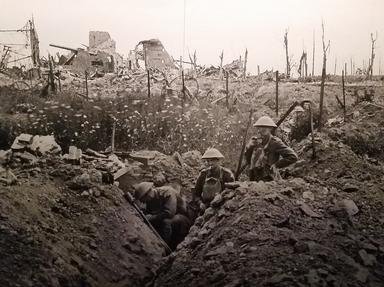
The immediate cause of World War I came from the assassination of Archduke Franz Ferdinand by a Serbian national. In response to this, Austria-Hungary set a number of conditions higher than Serbia would meet. Due to a number of pre-existing alliances between nations, by August 1914, a number of nations were at war including Austria-Hungary on the side of the Central Powers (so named because of their relatively central position on the European continent).
2. Bulgaria
Answer: Central Powers
Bulgaria entered World War I later than many other nations. It joined the war on the side of the Central Powers in October 1915. For Bulgaria, the World War was really a continuation of the Balkan Wars of a few years previous. Bulgaria signed an armistice and left active involvement in September 1918.
3. France
Answer: Allied Powers
Before World War I, France was in the Triple Entente with Russia and the United Kingdom. France found itself drawn in the war after Germany had declared war on Russia. During the war, France was one of the Allied powers. Much of the western front of the war took place in Northeastern France.
4. Germany
Answer: Central Powers
Germany was on the side of the Central Powers during the war. Looking at a map of Europe would make the reason for the alliance clear. The Central Powers lay towards the middle of Europe with the United Kingdom and France to their west and Russia to their east.
In the weeks before August 1914 the Kaiser of Germany and the Tsar of Russia engaged in a bit of personal diplomacy through the so-called "Willy-Nicky telegrams" where they communicated with each other in a last minute attempt to stop the coming war.
5. Italy
Answer: Allied Powers
Italy had actualliy been allied with Austria-Hungary and Germany in the Triple Alliance before the war. Once World War I began, Italy remained neutral initially before switching sides to the Allied Powers in 1915. Though it was on the winning side at the end of the war, Italy felt somewhat locked out from being one of the "Big Three".
6. Netherlands
Answer: Neutral
The official policy of the Netherlands during World War I was that of neutrality. It did allow a number of Belgium refugees to enter during the war. The border was fortified, however, to keep the fighting out of the neutral Netherlands. After the war, they allowed the Kaiser of Germany, now abdicated, to enter the Netherlands, where he remained for the rest of his life.
7. Ottoman Empire
Answer: Central Powers
The Ottoman Empire entered World War I on the side of the Central Powers a few months after the war began in the fall of 1914. They fought in the war on several fronts. Late in the war, the troubled empire collapsed and exited the war. The Ottoman Empire itself would collapse a few years after the end of the war.
8. Russia
Answer: Allied Powers
Russia fought in World War I on the side of the Allied Powers. Even before the war it had been part of the Triple Entente with France and the United Kingdom. Later in the war, the Tsarist government of Russia lost control. Russia signed a separate peace treaty and exited the war in early 1918.
9. Spain
Answer: Neutral
Spain remained neutral during World War I. The country gained some money by selling supplies to both sides during the war. Since Spain was Neutral, its press did not have the wartime restrictions faced in some other countries. This led to the Influenza Epidemic of 1918 being named after the country of Spain.
10. Sweden
Answer: Neutral
Sweden also officially declared itself a neutral nation during World War I. The nation found limitations in trading with either side during the war. This, despite strong pro-German feeling among the Swedish nobility and government. Sweden was not an originally signing nation of the Treaty of Versailles, but did do so in 1920.
11. Switzerland
Answer: Neutral
Like Sweden, Switzerland was neutral during World War I. The neutrality was an armed one, however. Unlike Sweden which had mostly sea boundaries with the combatant nations, Switzerland shared land boundaries with several of the nations. Support for the war in Switzerland was largely divided on the basis of language.
12. United Kingdom
Answer: Allied Powers
The United Kingdom was one of the Allied Powers during World War I. Before the outbreak of the war, the United Kingdom had been allied with France and Russia in the Triple Entente. After the war, the United Kingdom had worked with the other Allies to create the Treaty of Versailles.
This quiz was reviewed by FunTrivia editor gtho4 before going online.
Any errors found in FunTrivia content are routinely corrected through our feedback system.