FREE! Click here to Join FunTrivia. Thousands of games, quizzes, and lots more!
Quiz about No Money Down

No, Money Down! Trivia Quiz


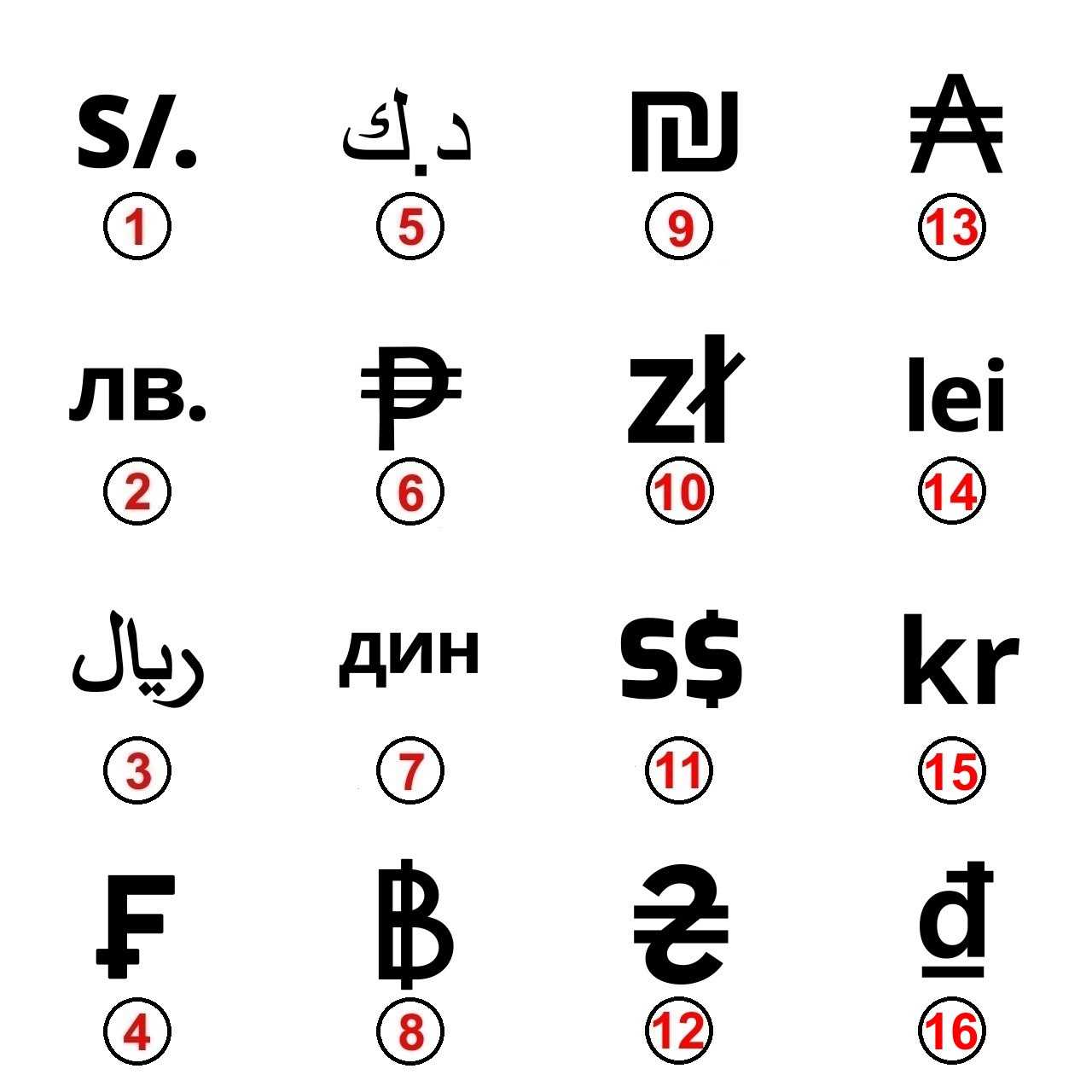
$, £, ¥... those are easy. But what about the rest? Match each currency name in the image to its correct symbol and prove your global money knowledge.

A label quiz by reedy. Estimated time: 3 mins.
  1. Home
  2. »
  3. Quizzes
  4. »
  5. World Trivia
  6. »
  7. Currencies

Author
reedy
Time
3 mins
Type
Label Quiz
Quiz #
426,020
Updated
Oct 30 26
# Qns
16
Difficulty
Easy
Avg Score
13 / 16
Plays
21
Last 3 plays: Guest 151 (11/16), Guest 185 (16/16), Baby_Bebe (12/16).
Click on image to zoom
Ukrainian Hryvnia Polish Złoty Israeli New Shekel Saudi Riyal Swiss Franc Swedish Krona Bulgarian Lev Romanian Leu Serbian Dinar Thai Baht Singapore Dollar Kuwaiti Dinar Argentine Peso Vietnamese Đồng Philippine Peso Peruvian Sol
* Drag / drop or click on the choices above to move them to the answer list.
View Image Attributions for This Quiz
1.   
2.   
3.   
4.   
5.   
6.   
7.   
8.   
9.   
10.   
11.   
12.   
13.   
14.   
15.   
16.   

Most Recent Scores
Today : Guest 151: 11/16
Today : Guest 185: 16/16
Today : Baby_Bebe: 12/16
Today : GoodVibe: 12/16
Today : DizWiz: 16/16
Today : Steelflower75: 16/16
Today : psnz: 16/16
Today : Reamar42: 16/16
Today : spanishliz: 12/16

Quiz Answer Key and Fun Facts
1. Peruvian Sol

Peru adopted the nuevo sol in 1991 after a decade marked by hyperinflation and economic instability. Introduced as part of President Alberto Fujimori's economic reforms, it replaced the badly devalued inti and helped restore confidence in the country's monetary system. The currency's name was later shortened to simply sol (ISO Code PEN).
2. Bulgarian Lev

The lev (ISO Code BGN) entered circulation in 1881, only a few years after Bulgaria emerged from nearly five centuries of Ottoman rule. Its introduction reflected the country's efforts to establish the institutions of a modern, self-governing state.
3. Saudi Riyal

Long before Saudi Arabia became a major oil producer, the riyal (ISO Code SAR) was helping to unify the kingdom economically. It was introduced in 1925 under Ibn Saud and became the official currency of the newly established Kingdom of Saudi Arabia when the country was formally unified in 1932.
4. Swiss Franc

When Switzerland adopted a federal constitution in 1848, one challenge was the confusing patchwork of currencies issued by individual cantons. The Swiss franc (ISO Code CHF), introduced in 1850, solved that problem by creating a single national currency for the federation.
5. Kuwaiti Dinar

The Kuwaiti dinar (ISO Code KWD) debuted in 1961, the same year Kuwait gained independence from Britain. Replacing the Gulf Rupee, it quickly became a symbol of the country's newfound sovereignty.
6. Philippine Peso

The Philippine peso (ISO Code PHP) has roots stretching back to the Spanish colonial period, but its modern form emerged after independence. Following the creation of the Central Bank of the Philippines in 1949, the country began issuing its own national currency as a fully independent republic.
7. Serbian Dinar

Serbia first issued the dinar (ISO Code RSD) in 1868 as it moved toward full independence from the Ottoman Empire. Although the currency disappeared during various Yugoslav periods, it ultimately survived as the monetary unit of modern Serbia.
8. Thai Baht

Few currencies can claim a history as long as the baht (ISO Code THB). While it has existed in one form or another for centuries, its modern decimal structure was introduced in 1897 during the sweeping modernization reforms of King Chulalongkorn, one of Thailand's most influential monarchs.
9. Israeli New Shekel

By the mid-1980s, runaway inflation had become a serious problem in Israel. The government responded in 1985 by introducing the new shekel (ISO Code ILS), replacing the previous currency at a rate of 1,000 to 1 as part of a broader economic stabilization program.
10. Polish Złoty

Today's złoty (ISO Code PLN) dates from 1995, when Poland redenominated its currency by removing four zeros from old banknotes. The move reflected the country's economic transformation following the collapse of communist rule and its shift toward a market economy.
11. Singapore Dollar

Independence brought more than political change to Singapore. In 1967, the young nation introduced the Singapore dollar (ISO Code SGD), establishing full control over its monetary policy just two years after separating from Malaysia.
12. Ukrainian Hryvnia

Five years after gaining independence from the Soviet Union, Ukraine introduced the hryvnia (ISO Code UAH) in 1996. The currency replaced the temporary karbovanets and became an important symbol of the country's statehood and economic independence.
13. Argentine Peso

Argentina's current peso (ISO Code ARS) was born out of an effort to end chronic inflation. Introduced in 1992, it replaced the austral and formed part of the Convertibility Plan, which temporarily linked the peso's value directly to the U.S. dollar.
14. Romanian Leu

The leu (ISO Code RON) first appeared in 1867, during a period when Romania was consolidating its national institutions after the union of its principalities. Establishing a common currency was a significant step in the country's development as a modern state.
15. Swedish Krona

Sweden adopted the krona (ISO Code SEK) in 1873 when it joined Denmark in forming the Scandinavian Monetary Union. The new currency replaced the riksdaler and reflected a growing interest in economic cooperation across the Nordic region.
16. Vietnamese Đồng

The first đồng (ISO Code VND) was issued in 1946 by the Democratic Republic of Vietnam during its struggle for independence from France. The version used today dates to 1978, when North and South Vietnam's separate currencies were merged following national reunification after the Vietnam War.
Source: Author reedy

This quiz was reviewed by FunTrivia editor stedman before going online.
Any errors found in FunTrivia content are routinely corrected through our feedback system.
10/30/2026, Copyright 2026 FunTrivia, Inc. - Report an Error / Contact Us