FREE! Click here to Join FunTrivia. Thousands of games, quizzes, and lots more!
Quiz about The Rise and Fall of Leon Trotsky

The Rise and Fall of Leon Trotsky Quiz


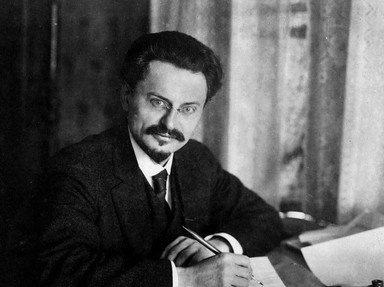
Whether you believe he was a shining intellect and political mastermind or an overly naďve revolutionary whose luck eventually ran out, Leon Trotsky was easily one of the most influential people of the early USSR. How much do you know of him? Have fun!
This is a renovated/adopted version of an old quiz by author arsalanrizvi

A multiple-choice quiz by NeuralSpicy. Estimated time: 3 mins.
  1. Home
  2. »
  3. Quizzes
  4. »
  5. World Trivia
  6. »
  7. Government
  8. »
  9. Soviet and Russian Government

Author
NeuralSpicy
Time
3 mins
Type
Multiple Choice
Quiz #
86,595
Updated
Aug 05 26
# Qns
10
Difficulty
New Game
Avg Score
9 / 10
Plays
16
Last 3 plays: spiroschris25 (10/10), Reamar42 (10/10), Flukey (3/10).
- -
Question 1 of 10
1. Leon Trotsky was born on 7 November 1879 in which region of imperial Russia? Hint


Question 2 of 10
2. In 1897, Leon Trotsky helped form what organization? Hint


Question 3 of 10
3. In 1917, what party did Leon Trotsky join? Hint


Question 4 of 10
4. After the October Revolution of 1917, Vladimir Lenin appointed Leon Trotsky as the first head of which government department (commissariat)? Hint


Question 5 of 10
5. As the People's Commissar for War, Leon Trotsky's led his forces to victory in which 1921 conflict? Hint


Question 6 of 10
6. When was the Union of Soviet Socialist Republics (USSR) formally proclaimed? Hint


Question 7 of 10
7. In 1923, Leon Trotsky became a founding member of an opposition coalition against Joseph Stalin called what? Hint


Question 8 of 10
8. After his exile seven years earlier, Leon Trotsky finally took up permanent residence in which country in 1937? Hint


Question 9 of 10
9. What was the title of the book Leon Trotsky published in 1936? Hint


Question 10 of 10
10. On 20 August 1940, Ramón Mercader assassinated Leon Trotsky with which of the following weapons? Hint


(Optional) Create a Free FunTrivia ID to save the points you are about to earn:

arrow Select a User ID:
arrow Choose a Password:
arrow Your Email:


Most Recent Scores
Today : spiroschris25: 10/10
Today : Reamar42: 10/10
Today : Flukey: 3/10
Today : Guest 99: 6/10
Today : xchasbox: 10/10
Today : Guest 76: 4/10
Today : Guest 90: 6/10
Today : bernie73: 8/10
Today : Alcoholic63: 4/10

Quiz Answer Key and Fun Facts
1. Leon Trotsky was born on 7 November 1879 in which region of imperial Russia?

Answer: Ukraine

Leon Trotsky entered the world as Lev Davidovich Bronstein on 7 November 1879. That's 25 October if you're still using the old Russian calendar. He was born at Yanovka, a farming settlement in what was called the Kherson Governorate of the Russian Empire. That area is now in modern Ukraine. The distinction matters because Ukraine was not an independent country at the time. It was just another of the many regions that made up the massive Russian Empire, and Trotsky's childhood unfolded along its multilingual, multicultural southern frontier.

His revolutionary career took him almost everywhere except anywhere comfortable. Arrests, exile in Siberia, daring escapes, years in London, Paris, Vienna, New York, and eventually Petrograd all would end up on his lengthy résumé.
2. In 1897, Leon Trotsky helped form what organization?

Answer: South Russian Workers' Union

While still in his teens, Leon Trotsky got involved with underground revolutionary politics in Nikolayev (now Mykolaiv, Ukraine). In 1897, he helped organize the South Russian Workers' Union. It was a small but passionate socialist group that sought to spread Marxist ideas among industrial workers. It didn't last long. The Tsar's secret police cracked down on the organization within a year. That led to Trotsky being arrested in 1898. He spent more than two years in prison before being exiled to Siberia. While there, he continued studying Marxism, and Lev Davidovich Bronstein adopted the pseudonym "Trotsky".

In 1907, Trotsky escaped. It was planned in advance and occurred during his transit to a different remote frozen penal settlement. Trotsky feigned illness to delay his transport, giving him time to coordinate with a local guide. After escaping, he made his way toward the Ural region, where he bought fake documentation and a train ticket. Just another traveler.
3. In 1917, what party did Leon Trotsky join?

Answer: Bolshevik

After escaping exile, Trotsky spent the next decade touring Vienna, Paris, Switzerland, Spain, and the United States while writing, organizing, and generally arguing for revolutionary socialism. He tried to bring the Bolsheviks and Mensheviks together, refusing to commit fully to either version of socialism.

The events of 1917 changed everything. Trotsky returned to Russia after the February Revolution and quickly found that his positions had moved much closer to Lenin's than to any other socialist faction. Trotsky joined the Bolsheviks, and his own organization, the Mezhraiontsy (Inter-District Group), merged with the party in August 1917.

After just a couple months, he had become one of the party's leading figures, serving as chairman of the Petrograd Soviet and playing a major role in planning and directing the October Revolution. Revolutionary politics, as it turns out, can be tricky. Trotsky has spent almost as much time criticizing Lenin over the years as agreeing with him.
4. After the October Revolution of 1917, Vladimir Lenin appointed Leon Trotsky as the first head of which government department (commissariat)?

Answer: Foreign Affairs

Lenin was quick to fill the top posts in the new Soviet government after the October Revolution, and Trotsky became the People's Commissar for Foreign Affairs. It suited him. He was a talented writer and speaker. The catch was that the position meant having to negotiate peace with Germany. All the while the Russians were fighting each other, they were still combatants in the First World War. Trotsky led the Soviet delegation at the peace talks in Brest-Litovsk and tried to delay the whole thing with his curious policy of "neither war nor peace". This was his way of saying that Russia would unilaterally stop fighting without signing a treaty.

Since things don't actually work that way in real life, Germany simply resumed its offensive, forcing the Bolsheviks to accept even harsher terms. In protest of the treaty, Trotsky resigned and was made commissar and chairman of the Supreme Military Council of Russia.
5. As the People's Commissar for War, Leon Trotsky's led his forces to victory in which 1921 conflict?

Answer: Russian Civil War

Trotsky became People's Commissar for Military and Naval Affairs in 1918. At the time. the "army" barely qualified for such a lofty name. By the end of the Russian Civil War, he had transformed it completely. The Red Army became a disciplined force numbering in the millions.

The dates of the conflict vary depending on which source you're looking at. A good rule of thumb is 1918-1922, although the main fighting against the principal White armies had ended for the most part by late 1920, with the last major anti-Bolshevik forces defeated in 1921.

Trotsky's methods were curious but effective. He recruited thousands of former Imperial Army officers for their military expertise. Then he assigned political commissars to monitor their loyalty. His famous armored train became a wheeled command center, complete with telegraph equipment, a printing press, and even a library. It carried him more than 60,000 miles across the fronts during the civil war, allowing him to appear wherever things were going badly.
6. When was the Union of Soviet Socialist Republics (USSR) formally proclaimed?

Answer: December 1922

The Soviet Union officially came into the world on December 30, 1922. That's when delegates from the Russian, Ukrainian, Byelorussian, and Transcaucasian Soviet republics approved the Treaty on the Creation of the USSR and the accompanying Declaration. The goal was to unite the communist republics under a single federal government on the heels of years of revolution and civil war. Although the USSR was proclaimed in December 1922, its first constitution was not adopted until January 1924.

By this time, Lenin's health was failing after a series of strokes, and the struggle for power was already beginning, with those such as Joseph Stalin, Leon Trotsky, Grigory Zinoviev, and Lev Kamenev all maneuvering for influence.
7. In 1923, Leon Trotsky became a founding member of an opposition coalition against Joseph Stalin called what?

Answer: Left Opposition

The Left Opposition was created in 1923 as Trotsky and a group of Communist Party members grew increasingly unhappy with the concentration of power within the party leadership and the growing bureaucracy. Trotsky argued that the ideals of the Russian Revolution were being compromised by administrative control and a lack of internal party democracy. In addition, he pushed for faster industrialization and believed the Soviet Union's survival depended on the spread of socialist revolutions abroad.

Stalin was always one step ahead. Trotsky lost his position as Commissar for War in 1925, a year after Lenin's death. In 1926 the Left Opposition joined with the supporters of Grigory Zinoviev and Lev Kamenev to form the United Opposition. That alliance didn't last. By the end of 1927, Trotsky was expelled from the Communist Party and later exiled to Kazakhstan. In 1929 he was forced out of the Soviet Union altogether.
8. After his exile seven years earlier, Leon Trotsky finally took up permanent residence in which country in 1937?

Answer: Mexico

Expelled from the Soviet Union in 1929, Trotsky first found a home in Turkey. There he lived on the island of Büyükada near Istanbul for over four years. From there he moved to France in 1933. Pressure from Stalin and concerns from French authorities made that stay brief. In 1935 he gave Norway a try, only to find himself placed under strict restrictions after protests by the Soviet Union. So finally, in January 1937, he arrived in Mexico at the invitation of artists Diego Rivera and Frida Kahlo, with the approval of President Lazaro Cardenas. Mexico became his final home.

He lived in Mexico City, Mexico with his family, where he continued to advocate world revolution.
9. What was the title of the book Leon Trotsky published in 1936?

Answer: The Revolution Betrayed

"The Revolution Betrayed" was one of Leon Trotsky's more influential works and is crucial to understanding his political thought. It was published in 1936 while he was living in exile in Norway. The book argued that the Soviet Union had drifted too far from the ideals of the 1917 Revolution. Trotsky insisted that socialism had not failed, but that a growing bureaucratic elite under Joseph Stalin had ended effective control of the country.

Stalin's Great Purge was just beginning at the time it was published, and many of Trotsky's former comrades were about to disappear into prisons or worse. Trotsky watched these events from exile, believing that the Soviet bureaucracy posed as great a danger to the revolution as any external enemy.
10. On 20 August 1940, Ramón Mercader assassinated Leon Trotsky with which of the following weapons?

Answer: Ice axe

Ramón Mercader gained access to Trotsky's heavily guarded home in Coyoacan, Mexico by posing as a trusted associate. With a mountaineer's ice axe. On 20 August 1940, while Trotsky was reading a document Mercader had brought for comment, the latter struck him in the head with the ice axe. Trotsky did not die immediately.

Instead, he fought back, shouted for help, and ordered his guards not to kill his attacker in order that he could be questioned. Trotsky was taken to the hospital but died from his injuries the following day, on 21 August 1940, at the age of 60.
Source: Author NeuralSpicy

This quiz was reviewed by FunTrivia editor stedman before going online.
Any errors found in FunTrivia content are routinely corrected through our feedback system.
8/5/2026, Copyright 2026 FunTrivia, Inc. - Report an Error / Contact Us