FREE! Click here to Join FunTrivia. Thousands of games, quizzes, and lots more!
Quiz about Weapons of Flag Creation

Weapons of Flag Creation Trivia Quiz


Though not as common as stars or animals, weapons appear on a number of national flags. Can you match each of these somewhat belligerent flags with the brief description of the country they belong to?

by LadyNym. Estimated time: 3 mins.
  1. Home
  2. »
  3. Quizzes
  4. »
  5. World Trivia
  6. »
  7. Flags and Symbols
  8. »
  9. World Flags

Author
LadyNym
Time
3 mins
Type
Quiz #
425,371
Updated
Aug 29 26
# Qns
10
Difficulty
Easy
Avg Score
8 / 10
Plays
28
Last 3 plays: Guest 75 (3/10), pire8 (5/10), Guest 65 (8/10).
Drag-Drop or Click from Right
Options
Island country in the Caribbean Landlocked country in South America Formerly known as Swaziland Popular safari destination in East Africa Island country in the Indian Ocean Former Portuguese colony (southwest Africa) Oil-rich country in West Asia Former Portuguese colony (southeast Africa) Central American country famous for Maya sites Islamic Republic once known as Persia


 View Image Attributions for This Quiz

Most Recent Scores
Today : Guest 75: 3/10
Today : pire8: 5/10
Today : Guest 65: 8/10
Today : daver852: 10/10
Today : rainbowriver: 10/10
Today : Guest 71: 6/10
Today : spanishliz: 9/10
Today : Baldfroggie: 5/10
Today : cardsfan_027: 10/10

Quiz Answer Key and Fun Facts
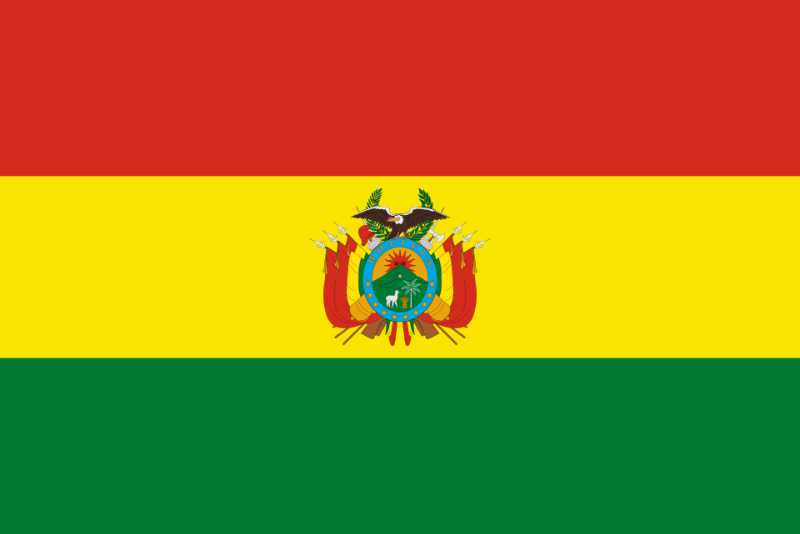
1. Landlocked country in South America

Bolivia uses two different versions of its national flag. The civil flag is a plain horizontal tricolour of red, yellow and green, while the state flag bears the nation's coat of arms in the centre of the yellow band. The red represents the blood shed for the country, the yellow its wealth and resources, and the green its natural areas. The flag was designed by President Manuel Isidoro Belzu and adopted under his presidency in 1851.

The coat of arms that appears on Bolivia's state flag, whose current design was adopted in 2004, is quite an elaborate affair. A central oval with various national symbols (including a llama) surrounded by a blue frame bearing the country's name and ten stars (nine current departments plus the lost Littoral) is flanked at each side by three national flags, a cannon and two rifles. There is also an axe on the right-hand side, while the left-hand side bears a liberty cap. The oval is surmounted by an Andean condor about to take flight. The flag of Bolivia is one of four national flags to feature firearms.
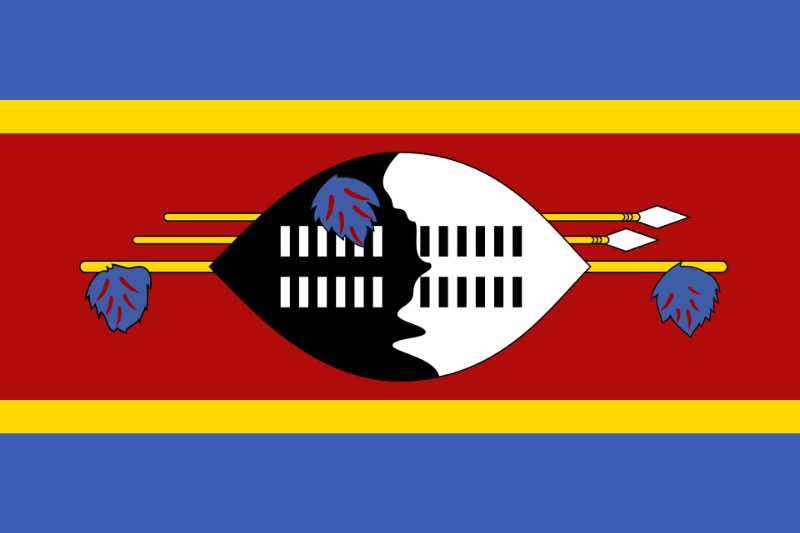
2. Formerly known as Swaziland

The flag of Eswatini was adopted on 6 October 1968, a month after the small, landlocked country in southern Africa (then known as Swaziland) became independent from the UK. It was designed by King Sobhuza II, who - having ruled the country for nearly 83 years - holds the record for longest reign in recorded history. The design is based on the military flag of the Swazi Pioneer Corps. It features two horizontal blue bands and a wider, central red band edged in yellow. The red represents the blood shed in battle, the blue peace and stability, and the yellow Eswatini's mineral resources. A black and white shield with a staff and two spears is laid horizontally in the centre of the red band.

The shield, which is the focal point of the flag, is known as a Nguni shield: it is made of cowhide stretched over a wooden frame in a pointed-oval shape. Both the shield and the staff are decorated with tassels made with the feathers of two local birds, the lourie and the widowbird, which only the king has the right to use. The two spears are assegais, the traditional African throwing spears. The Nguni shield was held in one hand while throwing the assegai with the other. Shield, staff and spears symbolize the protection of the nation against enemies.
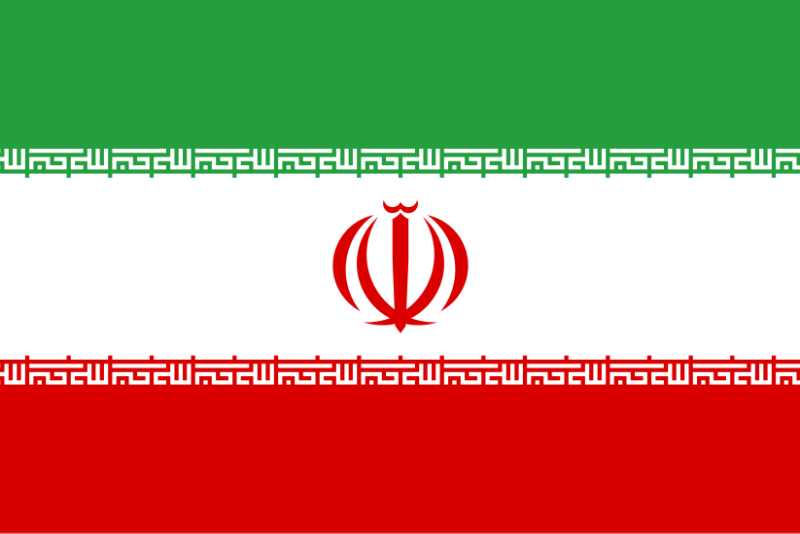
3. Islamic Republic once known as Persia

The current flag of Iran was adopted in July 1980, following the Islamic Revolution that in 1979 overthrew Shah Mohammed Reza Pahlavi. Its original version, adopted in 1905 during the Iranian Constitutional Revolution, was similar in design - three horizontal bands of green, white and red charged with the Lion and Sun ("Shir-o-Korshid" in Persian) emblem, whose origins go back to ancient Mesopotamia. The Lion and Sun flag was replaced by the government of the Islamic Republic because of its association with the previous regime. For this reason, though banned from public use, it continues to be used by Iranian opposition groups.

Instead of the ancient emblem, the flag of Iran is charged with a red Nisham Rasmi, the formal emblem of the Islamic Republic, consisting of four crescents and a downward-pointing sword, surmounted by a "shaddah", an Arabic diacritic mark that represents the name of Allah. Along the edges of the green and red band the Arabic phrase "Allah Akbar" (known as "takbir") in Kufic script is repeated 11 times on each side. The number 22 is a reference to 22 Bahman (11 February), the date in which the Revolution took place. Green, white and red are associated with pan-Iranian identity. A symbol of power, sovereignty and defense against enemies, the sword also appears in the Lion and Sun emblem, though it is a traditional Iranian curved sword ("shamshir") rather than a straight sword as in he present emblem.
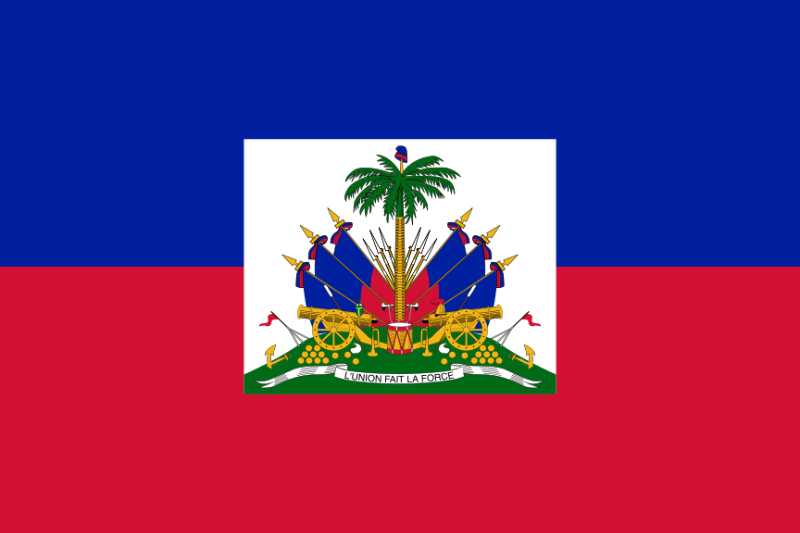
4. Island country in the Caribbean

Adopted on 26 February 1986, the national flag of Haiti consists of two horizontal bands of blue and red, with a white rectangular panel in the centre that bears the country's coat of arms. This emblem reflects the unique story of the Caribbean island country - heroic and tragic at the same time. The present design was originally adopted in 1806 by the first Republic of Haiti, two years after the former French colony declared its independence. The official description of the flag is laid out in the Constitution of Haiti that came into effect in June 2012.

Haiti's coat of arms, introduced in 1807, depicts what is known as a trophy of arms - that is, an artistically arranged display of weapons and other military items. The weapons in question are two cannons (with cannonballs), six rifles with bayonets and two battle axes, while the other objects include six civil flags, a drum, two bugles, two powder bags and two ship's anchors. In the centre stands a palm tree topped by a liberty cap. This elaborate design symbolizes Haiti's long struggle for independence, which began in 1791 with the revolution led by former slave Toussaint Louverture.
5. Former Portuguese colony (southwest Africa)

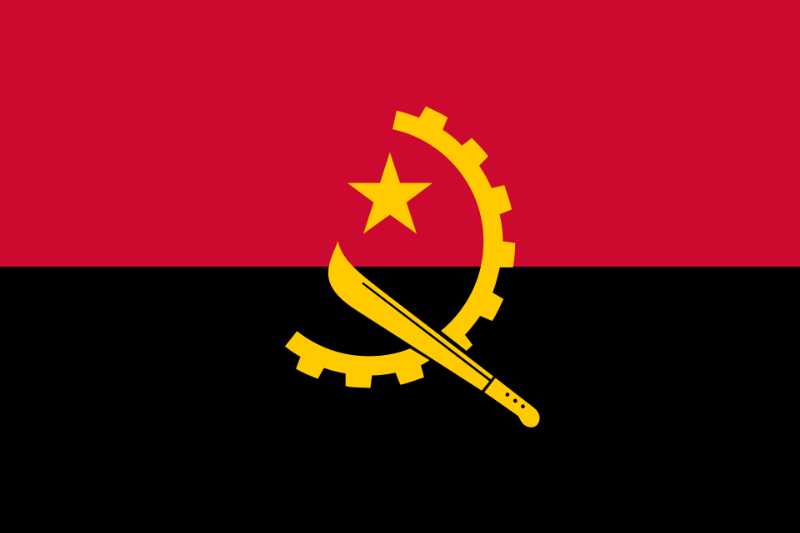
The flag of Angola was adopted on 11 November 1975, when the southern African country was granted independence from Portugal after 13 years of war. The flag's design and its significance are laid out in the country's constitution. Based on the flag of the MPLA (People's Movement for the Liberation of Angola), the country's ruling party, the flag was designed by Henrique de Carvalho Santos, who served as Minister of Industry after independence. It consists of two horizontal bands, red and black, with a yellow emblem in the centre depicting a half-cogwheel crossed by a machete and crowned with a five-pointed star. Black represents Africa, while red (as it is frequently the case) stands for the blood shed by Angolans during their troubled history, and yellow for the wealth of the country.

Though in the early 1990s MPLA turned into a more moderate, social democratic party, its militant Marxist-Leninist past is reflected in the flag's design, reminiscent of the Soviet hammer and sickle. However, in the Angolan flag it is the half-cogwheel that represents workers and industry, whereas the machete - a fearsome long-bladed knife used both as an agricultural implement and a combat weapon - represents peasants and agriculture, as well as the country's armed struggle against colonialism. The star is a symbol of progress and international solidarity.
6. Island country in the Indian Ocean

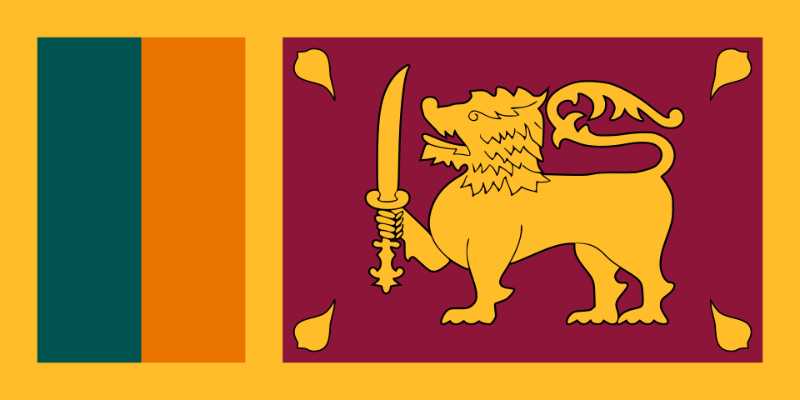
With its unusual design and colour scheme, Sri Lanka's flag is one of the world's most striking national flags. Adopted on 22 May 1972, when the South Asian island country ceased to be a dominion and became a republic, the flag displays an elaborate symbolism rooted in Sri Lanka's centuries-long history. It is known as the Singha (Lion) Flag because of its most noticeable feature - a golden lion holding a sword. This image is based on an ancient mural found in the Dambulla Cave Monastery (1st century BC), a UNESCO World Heritage Site. Various versions of the Lion Flag were used in Sri Lanka until 1815, when the island came under British colonial rule.

The Sri Lanka flag is also remarkable for its unusually elongated shape. Every element of its design - the colours and the images - symbolizes an aspect of the country and its culture. The Lion and its maroon background stand for the nation and the dominant Sinhala ethnicity, while the orange and teal green stripes represent the Tamils and the Sri Lankan Moors (Muslims), and the golden yellow border all the other minority communities living on the island. The four bodhi tree leaves in the corners of the maroon rectangles represent the four Buddhist virtues. The sword held by the Lion in its right forepaw is known as "kastane", a short, single-edged ceremonial sword noted for its richly decorated hilt, often depicting mythical creatures.
7. Central American country famous for Maya sites

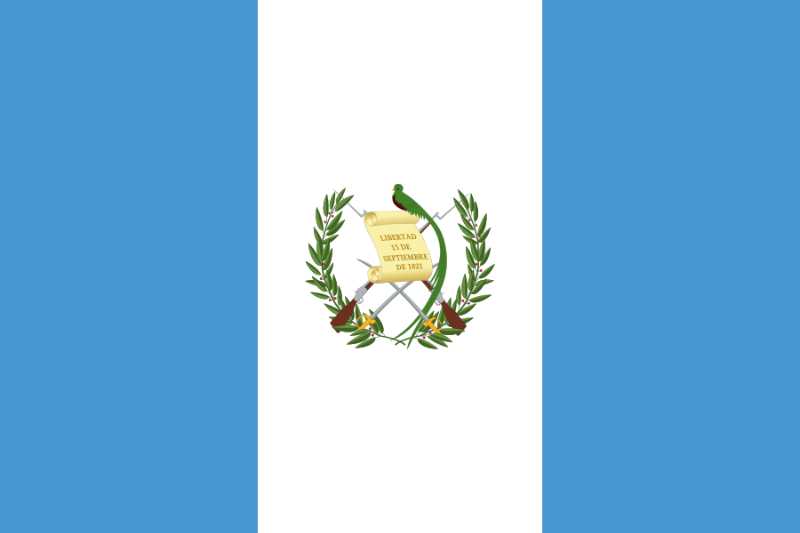
The current flag of Guatemala was adopted on 17 August 1871. It consists of two sky-blue vertical stripes with a white one in the middle - hence its nickname of "Azul y Blanco" (blue and white). The central white band is charged with the country's coat of arms. The blue stripes represent strength, justice, truth and loyalty, while the white stripe stands for purity, integrity, firmness and light. Other Central American countries (namely Honduras, Nicaragua and El Salvador) also use the same colours, which originally appeared on the flag of the Federal Republic of Central America (1823-1841). This shade of blue is also known as Maya blue, a bright azure blue pigment used by the peoples of pre-Columbian Mesoamerica - a homage to the country's native heritage.

The Guatemalan coat of arms includes a laurel wreath (a symbol of victory), a parchment scroll bearing the date of Central America's independence from Spain, a resplendent quetzal (Guatemala's national bird), two crossed swords and two crossed Remington Rolling Block rifles. The latter are breech-loading rifles that were produced between the mid-1860s and the early 20th century and were used in Guatemala during the Liberal Revolution of 1871. Guatemala is one of only two countries whose national flag features a specific brand of firearm (the other being Mozambique). While the swords represent justice and honour, the rifles represent the willingness to defend the country.
8. Popular safari destination in East Africa

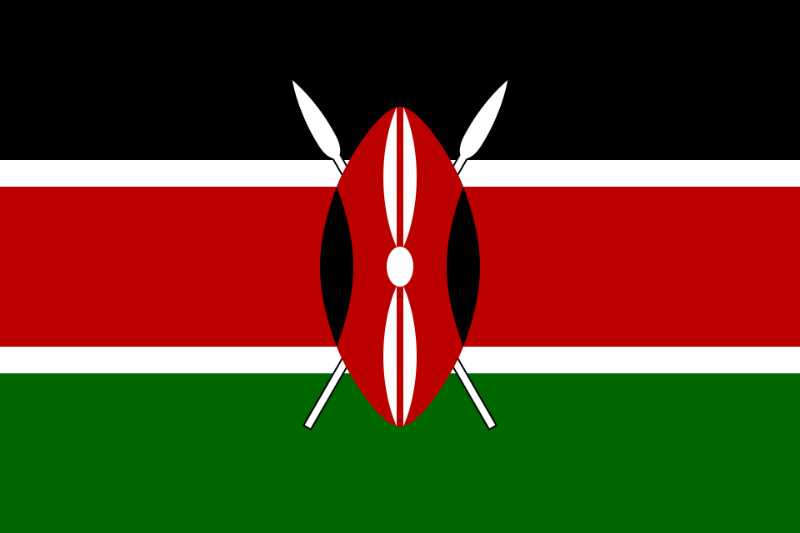
Adopted on 12 December 1963, the date of the country's independence from the UK, the flag of Kenya pays homage to the East African nation's history and culture. It was based on the flag of KANU (Kenya African National Union), the country's ruling party for 40 years, and designed by Thomas Mboya, one of the founding fathers of the Republic of Kenya. The flag is a horizontal tricolour of black, red and green, with the central red band edged in white. It is charged with a red, white and black Maasai shield and two crossed white spears. Black represents the Kenyan people, while red stands for the blood shed during the fight for independence and green for the country's fertile land; white, on the other hand, signifies peace and unity.

As is usually the case with weapons featured on flags and national emblems, the Maasai shield and spears symbolize Kenya's will to defend its freedom. The Maasai, an Eastern Nilotic ethnic group of the African Great Lakes region, are cattle herders known as fearsome warriors, skilled in the use of spears and throwing clubs. Their shields, made of cowhide stretched over a wooden frame, are a powerful symbol of cultural identity, used in warfare and hunting, as well as for ceremonial purposes. They were traditionally decorated with symbolic motifs (known as "sirata") that identified the owner's status.
9. Oil-rich country in West Asia

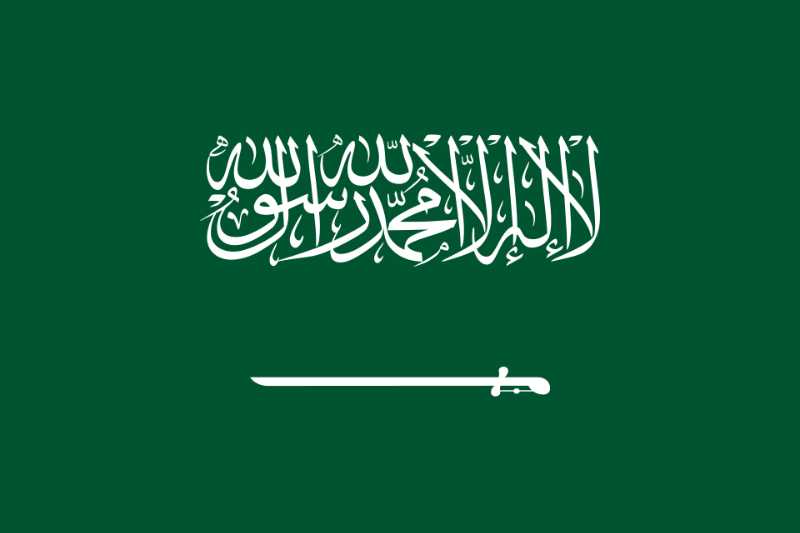
The current flag of Saudi Arabia was adopted on 15 March 1973. Designed by the Shura Council (the formal advisory body of the Saudi government), it is based on the flag of Nejd, one of the two states (the other being Hejaz) that united in 1932 to become the Kingdom of Saudi Arabia. Also known as the Fluttering Green, the flag has a green background with the "shahada" (the Islamic creed) written in white above a horizontal sword, also white. Both the inscription and the sword were drawn by hand by Saudi calligrapher Saud al-Mansouf, who used the beautiful Thuluth script rather than the more angular Kufic.

The Saudi flag's green background represents Islam, while the sword symbolizes safety and justice. This traditional Arabian sword with a straight blade, whose origins go back to the pre-Islamic era, is known as "saif". On earlier versions of the flag, the sword was a curved scimitar ("shamshir"), of Persian origin. However, two crossed swords with curved blades appear on the emblem of Saudi Arabia, representing the kingdoms of Nejd and Hejaz. As the Saudi flag cannot be hoisted vertically because of the sacred nature of the shahada, special vertical hanging flags are also manufactured.
10. Former Portuguese colony (southeast Africa)

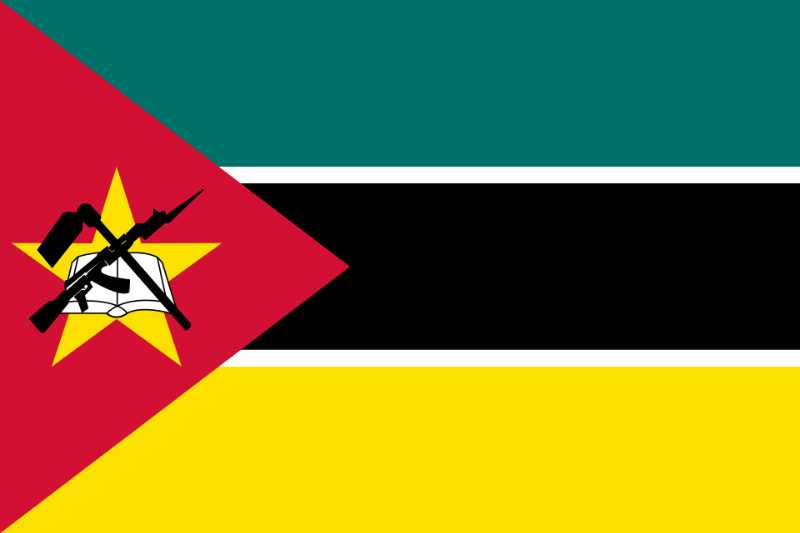
The flag of Mozambique may be the best known of the four national flags that feature firearms because of the kind of weapon that appears on it. Adopted on 1 May 1983, almost eight years after the country in southeast Africa gained independence from Portugal, it is based on the first flag of FRELIMO (Mozambique Liberation Front), the country's ruling party since 1975. It consists of a horizontal tricolour of green, black and gold, with the central black band edged in white; a red isosceles triangle at the hoist is charged with a five-pointed gold star bearing an AK-47 assault rifle crossed with a hoe superimposed on an open book.

The flag's design and the regulations concerning its use are laid out in the Constitution of Mozambique, where the symbolism of images and colours is also explained. Red represents anti-colonial resistance, while green and yellow represent the country's land and its mineral resources, black stands for Africa and white for peace and justice. The star, the book, the hoe and the rifle are symbols respectively of international solidarity, education, production and defense. Like Angola's MPLA, the FRELIMO was originally a Marxist-Leninist party with ties to Russia and China but has since renounced that ideology and embraced democratic socialism. After the end of the civil war that racked the country for 15 years, there have been calls to change the flag and remove the aggressive presence of the AK-47 - which gives the Mozambican flag the dubious distinction of being the only national flag featuring a modern firearm.
Source: Author LadyNym

This quiz was reviewed by FunTrivia editor trident before going online.
Any errors found in FunTrivia content are routinely corrected through our feedback system.
8/29/2026, Copyright 2026 FunTrivia, Inc. - Report an Error / Contact Us