FREE! Click here to Join FunTrivia. Thousands of games, quizzes, and lots more!
Quiz about A Timeline of Canadian National Railway

A Timeline of Canadian National Railway Quiz


A recent quiz challenge was about the CN Tower in Toronto, Canada. I decided to dig deeper into the Canadian National Railway (CN) itself and its fascinating history.

A label quiz by stephgm67. Estimated time: 3 mins.
  1. Home
  2. »
  3. Quizzes
  4. »
  5. World Trivia
  6. »
  7. Trains
  8. »
  9. Canadian Railways

Author
stephgm67
Time
3 mins
Type
Label Quiz
Quiz #
425,963
Updated
Oct 22 26
# Qns
10
Difficulty
New Game
Avg Score
4 / 10
Plays
12
Last 3 plays: Guest 68 (2/10), pennie1478 (0/10), Alcoholic63 (1/10).
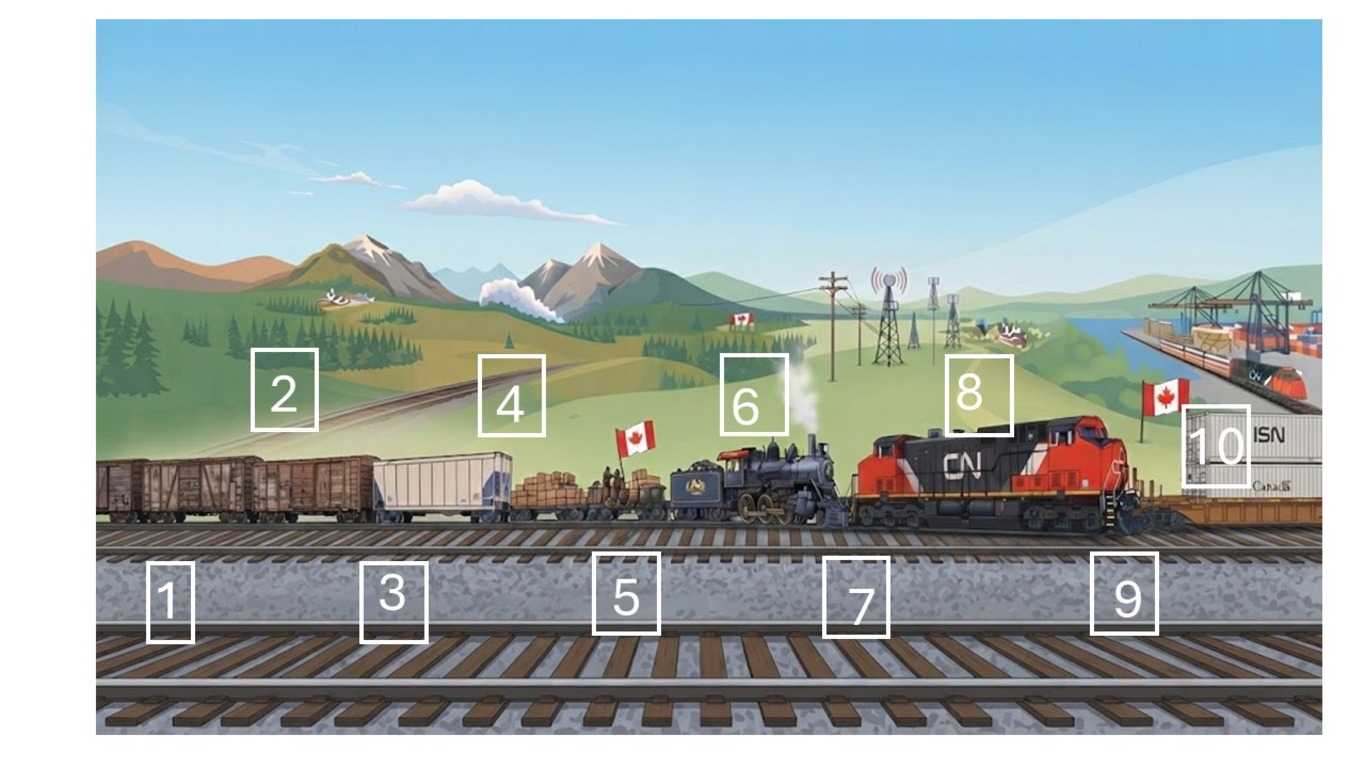
There are ten key events in the history of CN. Put them in chronological order from left to right (oldest to latest). For your help, I have put the years in as hints.
Click on image to zoom
Passenger train Panorama launched Takeover of Grand Trunk Railway CN Tower opened to public Diesel Car No. 15820 set records Cabooseless train usage began Prince Edward opened Union Station Introduced continuous welded rail Company "worm" logo introduced CN privatized Installed first electronic hot box detectors
* Drag / drop or click on the choices above to move them to the answer list.
View Image Attributions for This Quiz
1. 1923  
2. 1925  
3. 1927  
4. 1954  
5. 1960  
6. 1961  
7. 1964  
8. 1976  
9. 1990  
10. 1995  

Most Recent Scores
Today : Guest 68: 2/10
Today : pennie1478: 0/10
Today : Alcoholic63: 1/10
Today : Radain: 3/10
Today : Dizart: 10/10
Today : MargW: 5/10
Today : nnamarie: 6/10
Today : Jdoerr: 2/10
Today : bernie73: 2/10

Quiz Answer Key and Fun Facts
1. Takeover of Grand Trunk Railway

In the late 19th century, the Grand Trunk Railway (GTR) was a major railroad in Canada and connected Toronto to Montreal. By the 1880s it had grown to more than 700 locomotives with 18,000 freight cars and covered a vast area. Shortly thereafter, GTR began to struggle financially and had suffered several accidents including an incident in 1885 when the famous circus elephant, Jumbo, was killed.

One of its subsidiaries, Grand Trunk Pacific, created a route to the Pacific. Completed in 1914, the new railway was a financial disaster and was largely responsible for GTR's ultimate bankruptcy in 1919. The federal government took over GTR in October of that year and placed it under the management of the Canadian National Railways in January of 1923. CN was then able to eliminate duplicate routes, standardize equipment, and rationalize operations across eastern Canada and the border regions, turning a network of distressed lines into a unified public utility.
2. Diesel Car No. 15820 set records

Canadian National Railways was among the earliest users of diesel rail cars (rather than steam locomotives) in North America and set a number of records. One of these was set by CN car No. 15820 which was a single-unit railcar measuring 60 feet (18.2 m) long.

On Sunday, November 1, 1925 the car set off from Bonaventure station in Montreal for its historic run to Vancouver. It covered 2,937 miles (4,726 km) in just 67 hours. Three world records were broken on this trip for endurance, economy and sustained speed over such a distance. The durability of the Beardmore diesel was proven to all and helped pave the way for the diesel era of railroading.
3. Prince Edward opened Union Station

In downtown Toronto on Aug. 6, 1927, Edward VIII (then the Prince of Wales) was presented with a gold key that unlocked the new Union Station. He also used a pair of gold scissors to cut a ceremonial ribbon, officially opening the station building for service. He was accompanied by his brother, Prince George, British Prime Minister Stanley Baldwin, Canadian Prime Minister William Lyon Mackenzie King, and Ontario Lieutenant Governor William Donald Ross.

He walked through the concourse as a 60-voice choir sang. When he reached the ticket booths, he visited the Canadian National (CN) and Canadian Pacific (CP) ticket counters, where he received ceremonial leather-bound and commemorative tickets. This included a ticket from Canadian National "valid for all time" and "between all stations".
4. Introduced continuous welded rail

In 1954, Canadian National became the first company to introduce Continuous Welded Rail (CWR) to Canada, marking a big leap forward in track technology and engineering. Traditionally, standard railroad tracks were laid in short sections bolted together at joints, which made a nice "clackety clack" sound but created structural weaknesses. CWR welded long individual steel rails together into continuous ribbons.

By removing the vast majority of track joints, CWR drastically cut down on track wear and tear, loose bolts, and battered rail ends. This created a much smoother surface for heavy modern freight trains and high-speed operations, reducing mechanical stress on both the rolling stock and the locomotive wheels.
5. Company "worm" logo introduced

Designed by Canadian graphic designer Allan Fleming, the iconic continuous "worm" logo was officially unveiled in 1960 as part of a corporate rebranding. CN believed they needed a fresh, new trademark that people would associate with being customer-friendly and technologically savvy. Sketched initially on a cocktail napkin during a flight, the design ingeniously links the letters 'C' and 'N' into a single flowing line to symbolize continuous motion, fluid logistics, and a railroad rushing toward the future.

Fleming's creation was considered a global masterclass in corporate branding and mid-century modern design. Widely praised and emulated by international rail designers, the logo represented CN's rolling stock and became its corporate identity across North America.
6. Installed first electronic hot box detectors

In 1961, Canadian National pioneered a major safety leap by installing Canada's very first electronic hot box detector. Historically, a "hot box" occurred when friction caused a railcar's journal bearing to overheat due to a lack of proper lubrication, frequently resulting in axle seizures or severe derailments if not caught in time.

These new automated trackside detectors utilized advanced infrared scanners to measure the heat radiating from passing trains. When an overheated bearing was flagged, the system immediately alerted crews and dispatchers, shifting reliance away from manual visual inspections and drastically improving the safety and reliability of high-speed freight transport.
7. Passenger train Panorama launched

On May 24, 1964, Canadian National officially launched the Panorama, a new deluxe transcontinental passenger train designed to serve as a companion and secondary service to CN's flagship train, the Super Continental. The train was introduced to completely upgrade the route previously run by the older Continental, modernizing travel across the country by offering fully updated equipment and comfortable passenger service from Montreal and Toronto all the way to Vancouver.

A major selling point of the Panorama was its carefully planned schedule, which allowed passengers traveling westward through the Canadian Rockies to experience the mountain scenery during daylight hours. CN heavily promoted the train as a true twin to the Super Continental, highlighting its modern sleepers, dining cars, and coaches.
8. CN Tower opened to public

The increase of high-rise construction in 1960s Toronto created major telecommunication challenges, as new skyscrapers bounced radio and television signals away from their intended audiences. To solve this, Canadian National utilized its own railway lands in the city. More than 1,500 workers spent 40 months on the project. By February 1974, it had already become the tallest structure in Canada, and by August of that year, work began on the main sphere designed to house the observation decks and a revolving restaurant.

Utilizing a massive hydraulic slipform and a giant Sikorsky helicopter named "Olga" to hoist the final antenna sections into place, construction was finished on April 2, 1975. The tower was opened to the public on June 26, 1976. At 553 metres (1,815 feet), it would remain the tallest freestanding structure in the world until surpassed by Dubai's Burj Khalifa in 2009. Decades later in 1995, Canadian National sold the tower to the Canada Lands Company.
9. Cabooseless train usage began

Cabooseless trains began operating on the CNR effective February 1, 1990. For over a century, the caboose served as the iconic office and living quarters for the train crew at the rear of every freight train, but advancing technology and labor agreements brought this era to a close.

This shift was made possible by the introduction of electronic End-of-Train Devices (ETDs), which were mounted on the final coupler of the last car to monitor brake-pipe pressure and transmit data to the locomotive engineer via radio. Eliminating the caboose allowed CN to dramatically cut operational costs by reducing train crews down to two members in the locomotive cab, while new safety rules were established to ensure passing trains were properly inspected from the ground.
10. CN privatized

On November 17, 1995, the Government of Canada officially privatized the Canadian National Railway through an initial public offering (IPO). To prepare the carrier for the open market, the federal government restructured its finances and absorbed its non-railroad holdings, setting the stage for what was then the largest and most successful IPO in Canadian history.

The public share offering raised over $2 billion for the federal treasury and successfully transitioned CN into a streamlined, profit-driven private enterprise. To protect national interests, specific stipulations were put in place, requiring the company to maintain its headquarters in Montreal while restricting any single investor from owning more than 15 percent of the stock. This historic privatization freed CN from political constraints, allowing it to modernize operations, shed unprofitable lines, and expand aggressively into the United States.
Source: Author stephgm67

This quiz was reviewed by FunTrivia editor stedman before going online.
Any errors found in FunTrivia content are routinely corrected through our feedback system.
10/22/2026, Copyright 2026 FunTrivia, Inc. - Report an Error / Contact Us