FREE! Click here to Join FunTrivia. Thousands of games, quizzes, and lots more!
Quiz about Above Us Only Sky

Above Us Only Sky Trivia Quiz

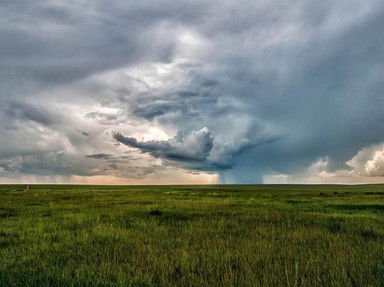
A Journey Through the Eurasian Steppe

Join me on a trip through the boundless expanses of the storied Eurasian Steppe, which stretches for thousands of miles through two continents, and learn some fascinating facts along the way!

A photo quiz by LadyNym. Estimated time: 3 mins.
  1. Home
  2. »
  3. Quizzes
  4. »
  5. Geography Trivia
  6. »
  7. Geography - Miscellany
  8. »
  9. Mixed Geography Photo Quizzes

Author
LadyNym
Time
3 mins
Type
Photo Quiz
Quiz #
423,026
Updated
Feb 20 26
# Qns
10
Difficulty
Easy
Avg Score
8 / 10
Plays
46
Last 3 plays: RonBelgium (7/10), Matthew_07 (10/10), Kota06 (6/10).
-
Question 1 of 10
1. Looking at the map in the photo, what kind of climate - characterized by temperature extremes - would you expect to find in the areas touched by the Eurasian Steppe? Hint


Question 2 of 10
2. The Pannonian Steppe is the westernmost part of the Eurasian Steppe. It touches Hungary, Romania and what other Central European country, known for a "velvet divorce"? Hint


Question 3 of 10
3. The main part of the European end of the Eurasian Steppe is known as Pontic-Caspian Steppe. What body of water does the name Pontic refer to? Hint


Question 4 of 10
4. In ancient times, the Pontic-Caspian Steppe was inhabited by various nomadic peoples, highly skilled in horse riding and archery. What are the names of two of the most prominent of them?


Question 5 of 10
5. The most significant part of the Eurasian Steppe in Central Asia bears the name of what Turkic-speaking people, who inhabit the world's largest landlocked country? Hint


Question 6 of 10
6. Along with drought-resistant grasses, the Eurasian Steppe is home to shrubs and herbaceous plants such as numerous species of Artemisia, a genus rich in powerful chemicals that is known by what common name? Hint


Question 7 of 10
7. The Dzungarian Gate is a mountain pass that connects the steppes of Central Asia with those of East Asia. In ancient times, it was believed to be the origin of what violent winter wind, whose name is reminiscent of the Greek god of the North Wind (as well as the Northern Lights)? Hint


Question 8 of 10
8. The Ukok Plateau, in the Altai Republic of southern Siberia, is one of the last remnants of a huge steppe that once covered a substantial portion of the Northern Hemisphere - associated with what rather sizable prehistoric animal? Hint


Question 9 of 10
9. The Eurasian Steppe is home to many unique animal species. One of them is the takhi, Mongolia's national animal. By what name is it known in English?


Question 10 of 10
10. The Mongolian-Manchurian Steppe forms the easternmost end of the Eurasian Steppe. Which of these facts about this vast expanse of grassland is *false*? Hint


(Optional) Create a Free FunTrivia ID to save the points you are about to earn:

arrow Select a User ID:
arrow Choose a Password:
arrow Your Email:


View Image Attributions for This Quiz

Most Recent Scores
Today : RonBelgium: 7/10
Today : Matthew_07: 10/10
Today : Kota06: 6/10
Today : KingDaddyL: 5/10
Today : Guest 73: 6/10
Today : Wildcat393: 5/10
Today : kingmama: 6/10
Today : misstified: 10/10
Today : RedHook13: 9/10

Quiz Answer Key and Fun Facts
1. Looking at the map in the photo, what kind of climate - characterized by temperature extremes - would you expect to find in the areas touched by the Eurasian Steppe?

Answer: continental

As their name implies, continental climates mainly occur in interior areas of large landmasses, located far from the moderating influence of oceans - such as the central parts of Eurasia and North America. According to the Köppen climate classification, the distinguishing feature of continental climates is the significant annual variation in temperature. While summers can get quite hot, winters tend to be cold, often severely so. The amount of precipitation received annually by these areas depends on the type of continental climate, which in the Köppen classification is indicated by the letter D.

The large swath of Europe and Asia occupied by the Eurasian Steppe falls into the hot-summer or warm-summer humid continental climate zones, which sustain vast expanses of grassland such as those found in central and southeastern Europe. In Central Asia and the interior of East Asia, however, the climate tends to be drier, transitioning into a cold semi-arid (steppe) climate, which is not favourable to the growith of trees. In those regions, summer temperatures can easily exceed 30 ºC (86 ºF), though winters can be bitterly cold, with temperatures averaging -20 ºC (-4 ºF) in January and February.
2. The Pannonian Steppe is the westernmost part of the Eurasian Steppe. It touches Hungary, Romania and what other Central European country, known for a "velvet divorce"?

Answer: Slovakia

Named after a province of the Roman Empire that encompassed the lands south and west of the Danube River, the Pannonian Steppe covers much of present-day Hungary, extending into Romania west of the Carpathian Mountains. A smaller portion of the Steppe lies in southern Slovakia, north of the Danube that marks the border with Hungary. The Čenkovská forest steppe, located in the southwest of the country, has been a protected nature reserve since 1965: it includes habitats where various plant species grow in sandy, semi-arid conditions.

The photo shows a detail of Hortobágy National Park in eastern Hungary, designated as a UNESCO World Heritage Site in 1999. The park preserves an area of the Pannonian Steppe that has not been altered by agriculture, Europe's largest semi-natural grassland, known as the puszta ("deserted" in Hungarian). This region is home to a large number of animal species, in particular birds; much of its flora consists of plants more typical of a seashore environment, which thrive in the alkaline soil. The well sweep in the photo, a symbol of the puszta, is one of the many that dot the landscape.

The nickname Velvet Divorce refers to the peaceful dissolution of Czechoslovakia in 1992, and the creation of two independent countries, Slovakia and the Czech Republic (Czechia).
3. The main part of the European end of the Eurasian Steppe is known as Pontic-Caspian Steppe. What body of water does the name Pontic refer to?

Answer: Black Sea

The adjective Pontic is derived from the Ancient Greek name for the Black Sea, "Pontos Euxinos" (Pontus Euxinus in Latin), meaning "hospitable sea". This name, however, was a euphemism, as the sea's original name, Pontos Axeinos (from an Iranian word meaning "dark-coloured" - hence the "black" used today), was rendered in Greek as "inhospitable sea", which was regarded as bad luck.

The Pontic-Caspian Steppe stretches from the mouth of the Danube along the northern shores of the Black Sea, reaching southeast through the Caucasus region, and northeast towards the Urals. It touches northeastern Bulgaria, southeastern Romania, Moldova, eastern and southern Ukraine (including most of the Crimean Peninsula), and southern Russia. Covering an area of 994,000 km² (384,000 sq mi), this vast region is bounded to the north by the East European forest-steppe, a transitional ecoregion that, however, has been encroached into by agricultural lands. South of the Steppe, on the northern shores of the Caspian Sea - where the Volga and Ural rivers flow into the world's largest inland body of water - lies an arid ecoregion known as the Caspian lowland desert.

The photo shows a detail of the landscape of the Tarhankut Peninsula, the westernmost point of the Crimea, with the steppe vegetation in the foreground and the Black Sea in the background.
4. In ancient times, the Pontic-Caspian Steppe was inhabited by various nomadic peoples, highly skilled in horse riding and archery. What are the names of two of the most prominent of them?

Answer: Scythians and Sarmatians

It would not be exaggerated to say that, in ancient times, the Pontic-Caspian Steppe was a major cradle of civilization. According to a broadly accepted theory, known as the Kurgan hypothesis, the region was the original homeland of the speakers of the Proto-Indo-European language, the ancestor of most European languages - as well as many of those spoken in the Indian subcontinent and parts of Western Asia. Very little is known of this people, who are believed to have inhabited the area during the Late Neolithic (6400 to 3500 BC).

Among the many peoples who made their home in the vast grasslands of the Pontic-Caucasian Steppe, two stand out - the Scythians and the Sarmatians, both of them part of the Iranian ethnolinguistic group. The Scythians migrated to the Pontic Steppe from Central Asia between the 9th and 8th centuries BC, quickly becoming the dominant power in the area. By the 4th century BC their power started to decline, and in the 3rd century BC they were conquered by the Sarmatians, who also came from Central Asia. Both peoples were renowned (as well as feared) for their skill in mounted warfare, which involved the use of composite bows - as shown in the Greek vase painting in the photo. The Sarmatians also used swords and spears; their mounted warriors, known as cataphracts, frequently wore full scale armour - as depicted in the reliefs of the Trajan Column in Rome.

In the 3rd century AD, the Sarmatians were overwhelmed by other nomadic peoples, in particular the Huns and the Ostrogoths. The Vandals and Visigoths, however, came from regions north of the Pontic Steppe, where present-day Poland is located.
5. The most significant part of the Eurasian Steppe in Central Asia bears the name of what Turkic-speaking people, who inhabit the world's largest landlocked country?

Answer: Kazakh

The Eurasian Steppe narrows considerably around the southern end of the Urals and northeast of the Caspian Sea. The Uralo-Caspian Narrowing, located on the border between Russia and Kazakhstan, connects the Pontic-Caspian Steppe with the Kazakh Steppe, a huge expanse of grassland that extends for over 2,200 km (1,400 mi) from the Urals to another mighty range, the Altai Mountains. This vast region, the largest dry steppe on Earth, covers an area of about 804,450 km² (310,600 sq mi) - which includes much of the territory of Kazakhstan, the world's ninth-largest country by area.

Unlike the more humid parts of the Eurasian Steppe located in Europe, the Kazakh Steppe is for the most part a semi-desert (as can be seen from the photo), with the exception of its northern part, a narrow strip of forest-steppe that borders the Siberian taiga. In the south, the Kazakh Steppe becomes increasingly more arid, in particular on the southwest, near the border with Uzbekistan. This region is very sparsely populated and receives little rainfall. The world's oldest space launch facility, the Baikonur Cosmodrome, operated by Russia, is located within the Kazakh Steppe.

Like the Kazakhs, the Uzbeks and the Turkmens are Turkic-speaking peoples who inhabit countries named after them - the "stans" of Central Asia. The Afghans, even if their country is also a "stan", are for the most part speakers of Indo-European languages.
6. Along with drought-resistant grasses, the Eurasian Steppe is home to shrubs and herbaceous plants such as numerous species of Artemisia, a genus rich in powerful chemicals that is known by what common name?

Answer: wormwood

Most of the vegetation that covers the Eurasian Steppe consists of various species of grasses - notably those of the genus Stipa (feathergrass) and Festuca (fescue), which can thrive even in nutrient-poor soils. As odd as it may sound, the words Stipa and steppe are not etymologically related, as the name of the grass genus comes from Greek, while the word steppe comes from Russian.

Among other herbaceous plants and shrubs, those of the genus Artemisia are particularly common, due to their affinity for sandy, semi-arid habitats. The genus comprises nearly 500 species, known by the common names of wormwood, mugwort and sagebrush, mostly found in the Northern Hemisphere. The plant depicted in the photo, Artemisia absinthium, or common wormwood, is widely cultivated as an ornamental plant or for its aromatic and medicinal properties.

It is estimated that about 80 species of Artemisia grow wild in the Eurasian Steppe, in particular in Central and East Asia. Widely used in the traditional medicine of the nomadic herders of those regions, these plants play a major role in those challenging ecosystems.
7. The Dzungarian Gate is a mountain pass that connects the steppes of Central Asia with those of East Asia. In ancient times, it was believed to be the origin of what violent winter wind, whose name is reminiscent of the Greek god of the North Wind (as well as the Northern Lights)?

Answer: buran

Also known as Altai Gap, the Dzungarian Gate is a narrow, straight valley located on the border between Kazakhstan and China's Xinjiang Autonomous Region, providing the only passage through the lofty mountain wall that separates Central Asia from China. For centuries it was used by the nomadic populations of Central and East Asia in their migrations. Today it is an important railway corridor between China and the West; the Central Asia-China gas pipeline (shown in the photo) also runs through the pass.

The Dzungarian Narrowing marks a clear separation between the Central Asian and the East Asian sections of the Eurasian Steppe. Named for a group of Mongol Oirat tribes, Dzungaria is the northern part of Xinjiang, with a relatively more humid climate than the Tarim Basin in the south, which is largely covered by the Taklamakan Desert. The region was known since antiquity, and is mentioned in Herodotus' "Histories" as the home of the legendary griffins - a likely reference to the dinosaur fossils found in the area.

According to a local legend recorded by various travellers throughout the ages, the mountains of the Dzungarian Alatau were also the home of the "buran", a violent winter wind that blows through Central Asia, sometimes reaching Europe. This legend (based in reality, as the Dzungarian Gate is known for its fierce winds) recalls the one about Boreas, the Greek god of the North Wind, who like the buran was said to issue from a cave in a mountain. However, although the names Boreas and buran sound very similar, they are unlikely to be etymologically related.

The chinook is a warm wind of western North America, while the mistral is a cold northerly wind of southern France, and the harmattan a dry, dusty wind of West Africa.
8. The Ukok Plateau, in the Altai Republic of southern Siberia, is one of the last remnants of a huge steppe that once covered a substantial portion of the Northern Hemisphere - associated with what rather sizable prehistoric animal?

Answer: woolly mammoth

In the later Pleistocene, the Earth's most recent period in which glaciations occurred repeatedly, a vast biome known as mammoth steppe, or steppe-tundra, stretched across much of the Northern Hemisphere - from Spain to northwest Canada, and from the Arctic to southern Europe and Central Asia. Although with some variation due to the sheer extent of the biome, the mammoth steppe resembled much of the territory of the Eurasian Steppe - a flat, mostly treeless plain dominated by grasses and a variety of other plants that provided abundant fodder for large herbivores such as woolly mammoths, as well as woolly rhinos, giant deer, steppe bison and others.

This huge grassland, which lasted for about 100,000 years, began to shrink about 12,000 years ago, Now its only remnants are found in the Altai-Sayan region of Central Asia, at the meeting point of Russia, Kazakhstan, China and Mongolia. Most of this region belongs to Russia: the Ukok Plateau (part of the Golden Mountains of Altai UNESCO World Heritage Site, inscribed in 1998) is a rugged, mountainous plateau located close to the border with China and Mongolia. The Plateau is an important habitat for a number of endangered animal species, in particular the snow leopard and the argali mountain sheep.
9. The Eurasian Steppe is home to many unique animal species. One of them is the takhi, Mongolia's national animal. By what name is it known in English?

Answer: Przewalski's horse

Many ungulates roam the vast grasslands of the Eurasian Steppe. Among them there are two notable members of the horse family (Equidae), the Asiatic wild ass, or onager (Equus hemionus) and the Przewalski's horse (Equus ferus przewalskii), regarded by many experts as a subspecies of the domesticated horse rather than a true wild horse. Another free-ranging horse population of the Eurasian Steppe, the tarpan (Equus ferus ferus), went extinct in 1909.

Named for an 19th-century Russian naturalist, the Przewalski's horse was also believed to be extinct in the wild since the 1960s: however, in 1985 a number of individuals bred in captivity were successfully reintroduced in the Chinese Autonomous Region of Xinjiang. Now various wild populations can be found in protected areas of China, Mongolia and other parts of Central Asia and Eastern Europe.

As can be seen in the photo, the Przewalski's horse is smaller and shorter than most domestic horses; here it is pictured with its thick, shaggy winter coat, which protects the animal from the harsh winters of the steppe. The horse's Mongolian name, takhi, means "spirit" or "holy", as in Mongolian folklore these animals were believed to be the mounts of the gods.

Scott's horse (Equus scotti) was a species of horse native to North America that went extinct around 12,000 years ago.
10. The Mongolian-Manchurian Steppe forms the easternmost end of the Eurasian Steppe. Which of these facts about this vast expanse of grassland is *false*?

Answer: it has a relatively mild climate

The Mongolian-Manchurian Steppe covers an area of 887,300 km² (342,600 sq mi) in central and eastern Mongolia, the eastern part of the Chinese Autonomous Region of Inner Mongolia,and eastern and central Manchuria - a historical region that comprises all of Northern China and parts of the Russian Far East. This crescent-shaped area surrounds the Gobi Desert to the west and southwest, while on its other sides it is bounded by various types of forests.

Covered by tall grasses, the Mongolian-Manchurian Steppe is for the most part hilly, open land with very few trees. Its climate is characterized by extremely harsh winters, cold and dry, and warm, more humid summers. High summer temperatures are not uncommon in some parts of the Steppe, in particular those closer to the Gobi Desert. Because of these challenging conditions, the region is very sparsely populated - Mongolia being the least densely populated of all independent countries. Most of the people that make their home in the Mongolian-Manchurian Steppe are nomadic herders who live in the traditional portable tents known as gers or yurts, a group of which can be seen in the photo.

Though not as threatened by the expansion of agriculture as other parts of the Eurasian Steppe, the Mongolian-Manchurian Steppe faces other threats, such as desertification (a particularly urgent concern in Mongolia) and wildfires. Very cold winters or dry summers may bring about a natural disaster called "zud", which results in livestock being unable to graze and thus dying of starvation. This phenomenon, which causes severe economic hardship to those who engage in pastoral farming, has been worsened by climate change.
Source: Author LadyNym

This quiz was reviewed by FunTrivia editor agony before going online.
Any errors found in FunTrivia content are routinely corrected through our feedback system.
2/20/2026, Copyright 2026 FunTrivia, Inc. - Report an Error / Contact Us