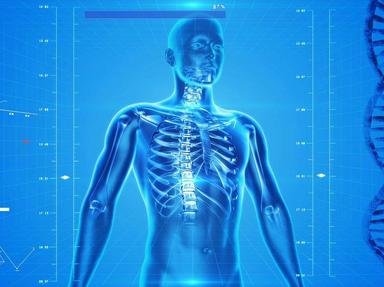
Ancient Greek and Roman physicians had a tendency to name medical phenomena (i.e. diseases and body parts, particularly bones) after things they observed in nature and the world around them, such as shapes, animals, tools and household items. The thyroid was named for its shape as it resembles a soldier's shield, complete with a notch at the top for the chin.
It is derived from the Greek "thyreos" (shield) and "eidos" (form, shape), i.e. shaped like a shield.
2. Muscle
Answer: Little mouse
The word muscle is derived from the Latin "musculus", meaning 'little mouse', because the shape and the rippling of flexing muscles under the skin was thought to resemble the scurrying of little mice.
3. Sigmoid colon
Answer: Like the letter S
There are a number of body parts whose names end in the suffix -oid, which is derived from the Greek "eidos" meaning 'form, shape'. The portion of the large intestine known as the sigmoid colon is so-called because it is S-shaped; that is, it resembles the Greek letter S or sigma.
In the same way, the deltoid muscle resembles the Greek letter delta, which is triangular. The hyoid bone in the neck comes from the Greek word "hyoeides", which means 'shaped like the letter upsilon' or U-shaped.
4. Rectum
Answer: Straight, right
The last section of the large intestine is called the rectum because this is where the colon straightens out and descends vertically. In Latin, "rectum" means 'straight or right'. The rectum holds faeces prior to expulsion from the digestive tract. It is about 15 cm (6 inches) in length.
It is related to some words you may be familiar with - such as erect (standing up straight or upright), rectify (to straighten out an error), rectangle (has straight sides at right angles) and direct (to set straight).
5. Testicle
Answer: Little witness
The word testicle literally translates as 'little witness' from the Latin "testiculus". There are two schools of thought on the reason for this. One is that the presence of the testicles bears witness to the fact that the person is a male. The other is that, in ancient times, one's testimony was validated by the witness swearing on their testicles to tell the truth or may the gods strike them impotent.
An interesting example of this is found in Genesis 24:9 which states "So the servant put his hand under the thigh of his master Abraham and swore an oath to him concerning this matter" - 'under the thigh' being a euphemism for the genitals. (Apparently it wasn't necessarily one's own testicles that were sworn by). Those who did not have testicles (i.e. women and eunuchs) were not allowed to give evidence in court. The words testament, testimony, testify and testicle are all related to the male organ.
6. Pancreas
Answer: Entirely meat, all flesh
The word pancreas comes from Greek "pan" (all) and "kreas" (flesh), essentially translating to 'all flesh' or 'entirely meat'. The term was coined by an Ancient Greek physician, Herophilus, who has been called the "Father of Anatomy", to describe the fleshy or meaty structure of the pancreas.
The pancreas produces enzymes that aid in digestion as well as hormones, such as insulin and glucagon, which control blood sugar. Sweetbread is the culinary term given to the pancreas (and thymus gland) of animals such as lambs and calves, which some people like to eat.
7. Anus
Answer: Ring
The anus is the opening at the end of the digestive tract through which the waste products of digestion pass. The action of the anus is regulated by a ring of two muscles that controls the expelling of waste material and gas. The anus is often colloquially referred to as one's 'ring', which is, in fact, precisely what the word means in Latin.
8. Prostate
Answer: Leader, one standing in front
The prostate gland is a small doughnut-shaped gland located underneath the urinary bladder and encircling the urethra (the tube that carries urine from the bladder, through the penis, to the outside of the body). Its main function is to produce a fluid that mixes with sperm to produce semen.
The Greek physician Herophilus, named the gland "prostates" meaning 'one who stands before/in front'. (The prefix pro- means forward, before). In ancient Greece, this term was used in a non-medical sense, often referring to a leader or guardian. It was applied to the prostate gland because it 'guards' the entrance to the bladder.
9. Iris
Answer: Rainbow, coloured circle
The iris is the coloured part of your eye. It controls the amount of light that enters the pupil (the black hole in the centre of the eye). The Greeks observed that eye colour varied among people and named that body part "iris", meaning 'rainbow, or coloured circle'. To the Ancient Greeks, a rainbow was a sign from the gods, personified in their messenger goddess, Iris.
Much later, that name was also given to a genus of flowering plants.
10. Hippocampus
Answer: Horse, sea-monster
The brain has two temporal lobes, a left and a right, located near the temples. The hippocampus is a part of the brain located deep within the temporal lobe, so the brain has two hippocampi. Their main functions are to assist memory and learning processes and to process recognition of odours.
In Greek mythology the hippocampus was a sea monster with the head of a horse and the tail of a fish. Hippocampi were used to pull the chariot of Poseidon, the god of the sea, across the waves. The name was also applied to the fish known as the seahorse because of its similar appearance.
The name comes from the Greek "hippos" (horse) and "kampos" (sea monster). The body part is shaped exactly like a seahorse.
This quiz was reviewed by FunTrivia editor rossian before going online.
Any errors found in FunTrivia content are routinely corrected through our feedback system.